

Imagine turning the key after 12 months of silence and hearing nothing but the hollow click of a dead battery and the faint scent of nesting rodents in your hand-stitched leather. For the owner of a high-performance machine, this isn’t just a nuisance; it’s a heartbreak. Mastering how to store a car long term is the only way to ensure your investment doesn’t become a cautionary tale of dry-rotted seals and degraded fuel. You’ve poured your soul into every meticulous detail of your build. You deserve to have it fire up with that signature roar the moment you return to the driver’s seat.
We understand that a vintage aesthetic paired with modern power requires a specific level of care that a standard garage often fails to provide. You want a turn-key experience and zero environmental depreciation, not a mechanical nightmare. Industry data shows that untreated fuel can begin to degrade in as little as 90 days; a timeline that can ruin a high-performance fuel system. Our 2026 preservation guide promises to help you protect every bespoke component from the LS3 crate engine to the flawless finish. We’ll walk you through a systematic checklist covering fluid stabilization and climate control to maintain your car’s mechanical integrity through any length of dormancy.
Key Takeaways
- Understand the “Dormancy Decay” threshold and why any period exceeding 30 days requires a professional-grade preservation strategy to protect internal seals.
- Master the definitive checklist for how to store a car long term, ensuring modern fuel systems and engine components remain free of corrosion and ready for a turn-key start.
- Shield your vehicle’s bespoke finish by applying sacrificial barriers that prevent road salt and environmental debris from becoming permanent imperfections.
- Eliminate the risk of flat-spotting and electrical failure with advanced chassis stabilization techniques and strategic tire management.
- Discover the critical difference between heated and climate-controlled environments, including how vapor barriers defend your investment against rising concrete moisture.
The Risks of Automotive Dormancy: Why Preparation is Mandatory
Stagnant fluids are a primary catalyst for mechanical failure. Engine oil that has undergone even 500 miles of combustion contains trace amounts of sulfur and nitrogen. When left to sit, these elements react with moisture to form sulfuric and nitric acids that etch into soft-metal engine bearings. Brake fluid presents a different challenge; it is hygroscopic, meaning it actively pulls moisture from the atmosphere. Within 12 months of storage in a humid environment, the water content can rise enough to cause internal rust within the master cylinder and calipers. Fuel oxidation is a chemical reaction where hydrocarbons react with oxygen to create a gummy varnish that obstructs the precision orifices of modern high-flow fuel injectors.
Environmental Threats to Vintage Aesthetics
- UV Degradation: Even in indoor settings, UV rays filtered through garage windows can reach 300 nanometers, causing hand-stitched leather to lose its natural oils and fade.
- Humidity Fluctuations: Relative humidity levels swinging above 60% lead to “leather shrink” and cause delicate wood trim to expand and crack.
- Concrete Sweating: Unsealed concrete floors release moisture through capillary action, creating a humid microclimate that oxidizes the raw metal components of the undercarriage.
Mastering how to store a car long term is the only way to ensure that when you finally turn the key, the engine delivers that familiar, visceral roar. Anything less than a meticulous preparation strategy is a gamble with a masterpiece. Precision matters. Your build deserves it.
Mechanical Stabilization: The Engine and Fuel System Checklist
Old oil is a silent engine killer. Before your vehicle enters its slumber, perform a final oil change using a high-quality synthetic. Used oil contains combustion byproducts and acids that corrode internal bearings over several months of stagnation. Change the filter, run the engine for five minutes to circulate the fresh lubricant, and then shut it down for the season. Learning how to store a car long term requires this level of obsession with internal cleanliness. Precision matters.
The debate between a full or empty fuel tank is settled by modern chemistry. For 2026 fuel systems, a full tank is essential. Ethanol-blended fuels like E10 are hygroscopic, meaning they actively pull moisture from the air. A full tank minimizes the “breathing” space where condensation forms, preventing phase separation and tank corrosion. Always add a high-quality fuel stabilizer before the final fill-up. For those seeking additional seasonal car storage tips, industry experts agree that fluid stabilization is the most critical hurdle for EFI systems. Finally, use fogging oil in the spark plug holes of older engines to coat the cylinder walls. This creates a protective barrier against oxidation. Classic style. Modern protection.
Modern Crate Engine Considerations
Transmission and Differential Care
Driveline health is often overlooked. Ensure your rear end has fresh gear oil, especially in high-performance limited-slip differentials where friction modifiers can settle over time. For manual transmissions, leave the car in first gear rather than neutral. This provides a mechanical failsafe should wheel chocks fail, and it keeps the internal gears submerged in their lubricant bath. Ensure all seals remain hydrated by checking for leaks before the car is tucked away. Our team at Elite Restomods ensures every build is engineered for both the open road and the off-season. This meticulous approach preserves the soul of your machine. Understanding how to store a car long term is the difference between a turn-key start and a costly repair bill.
Preserving the Bespoke: Exterior and Interior Protection
A masterfully restored muscle car is a testament to engineering excellence. Leaving it to sit without preparation is a disservice to the craft. When learning how to store a car long term, your first commandment is the “Clean-First” rule. Corrosive elements like road salt or bird droppings don’t just sit on the surface; they undergo chemical reactions. Bird droppings contain uric acid with pH levels as low as 3.0, which can etch through a flawless clear coat in under 48 hours. If left for a six-month storage cycle, these contaminants become permanent scars on your investment.
Meticulous detailing is your primary defense. Apply a clay bar treatment to pull microscopic industrial fallout from the paint pores. Follow this with a high-grade carnauba wax or a ceramic topper. This creates a sacrificial barrier. It’s the difference between dust resting on your paint and dust bonding to it. Inside the cabin, cleanliness is equally vital. Vacuum every crevice. A single stray crumb of organic matter is a beacon for pests. To manage the invisible threat of humidity, place 500-gram silica desiccant bags on the floorboards. These professional-grade canisters pull moisture from the air, preventing the 60% humidity threshold where mold begins to colonize hand-stitched leather and vintage upholstery.
Rodent Mitigation Strategies
Mice view a dormant engine bay as a five-star hotel. To stop them, stuff Grade 0000 steel wool into exhaust tips and intake tracts. Rodents cannot chew through the metallic fibers. While ultrasonic deterrents claim to work, 2023 industry testing shows they often fail in large garages. Instead, saturate cotton balls with 100% pure peppermint oil. The intense scent overwhelms their sensory receptors. Seal your airbox with heavy-duty tape to ensure no nesting material ends up in your cylinders when you finally turn the key and hear that engine roar.
Car Cover Selection: Breathability vs. Protection
Choosing the wrong cover is worse than using none at all. Cheap plastic covers trap moisture against the body, creating a greenhouse effect that bubbles paint and corrodes chrome. For a bespoke finish, only a multi-layer, flannel-lined breathable cover will do. This soft inner lining protects the depth of a custom paint job while allowing vapors to escape. Even in a climate controlled car storage facility, a high-quality cover is mandatory. It shields the vehicle from UV degradation and the abrasive “garage dust” that accumulates over a 180-day storage period. Understanding how to store a car long term means protecting the finish from both the elements and the storage environment itself. The same philosophy applies when moving your vehicle between locations; choosing enclosed vehicle transport ensures your bespoke paintwork receives the same level of shielded protection during transit as it does in a professional storage facility.
Chassis and Electrical: Tires, Brakes, and Batteries
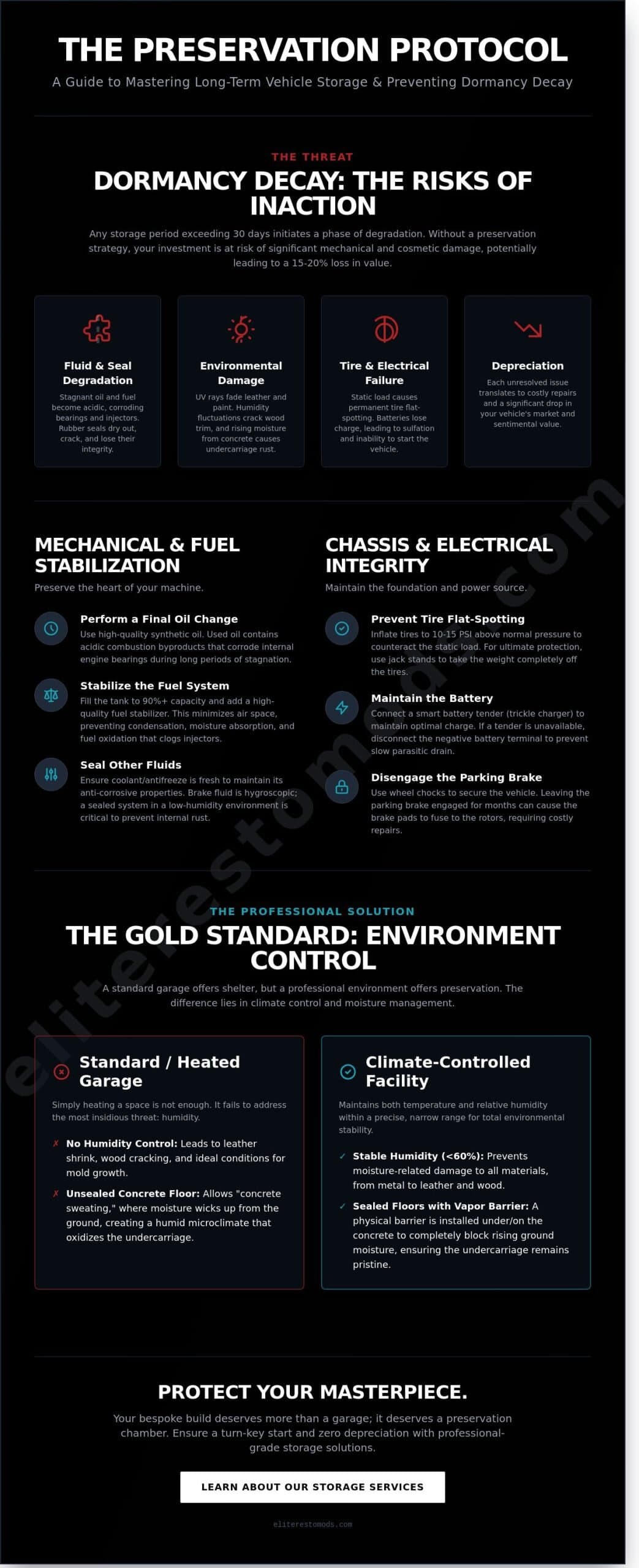
Preserving the stance of a high-performance machine requires more than a locked garage door. When you’re learning how to store a car long term, your tires are often the first point of failure. Rubber has a memory. If left stationary under 3,500 pounds of American iron, tires develop flat spots that cause permanent, rhythmic vibration. For a brief hiatus of 90 to 180 days, the over-inflation technique is effective. Increasing your tire pressure to 45 or 50 PSI helps maintain the carcass shape against the concrete. Longer stints demand radius-matching tire cradles to distribute weight, or heavy-duty jack stands to completely unload the suspension components.
Brake rotors are equally vulnerable to the elements. Moisture creates a molecular bond between the pad material and the iron rotor through galvanic corrosion. You should never engage the parking brake during storage. Use high-quality wheel chocks instead. This simple step prevents the pads from seizing to the rotors, which is the primary cause of the “brake pulse” felt during your first drive back on the asphalt.
The Science of Battery Tending
Modern power meets vintage soul in every restomod, but that sophisticated electronics suite needs a constant heartbeat. A standard trickle charger is a blunt instrument. It delivers a constant current that can eventually boil the battery’s electrolyte. You need a microprocessor-controlled battery tender. These units are designed to monitor voltage levels and cycle through specific bulk, absorption, and float stages. Whether you’re running a traditional Lead-Acid cell or a high-output AGM battery, the tender adjusts its output to match the chemistry and internal resistance.
Proper grounding is vital for vehicles equipped with aftermarket ECUs and digital dash clusters. A completely drained battery can result in the permanent loss of volatile ECU memory data, requiring a professional re-flash of your performance mapping. Keeping the electrical system energized ensures your custom tunes and fuel maps remain intact for the next time you turn the key.
Suspension and Braking Systems
Rubber and polyurethane bushings are the silent heroes of your car’s handling. During dormancy, apply a silicone-based lubricant to these components to prevent dry rot and environmental cracking. This keeps the suspension supple, ensuring that the “turn-key reliability” we promise remains a reality. If you’re looking for a vehicle engineered to withstand the test of time, explore our classic car restomods for sale to see how we integrate modern durability into iconic silhouettes. Every joint and pivot point should be inspected for moisture before the cover goes on.
The Professional Solution: Climate Control and Vapor Barriers
Storing a high-performance machine requires more than a locked door and a roof. Many enthusiasts confuse heated storage with true climate control. Heating simply prevents fluids from freezing. Climate control, however, manages the entire atmospheric profile of the room. Understanding how to store a car long term means recognizing that moisture is the primary enemy of vintage steel and bespoke interiors. Meeting the proper collector car storage requirements for temperature, humidity, and environmental control is what separates a facility that truly preserves your investment from one that simply keeps it out of the rain.
Concrete floors are deceptive. They look solid, yet they are porous sponges that constantly pull moisture from the earth. Without a vapor barrier, this ground dampness rises and settles on your vehicle’s undercarriage, triggering oxidation in places you cannot see. Professional facilities utilize specialized vapor barriers or epoxy sealants to break this cycle. For the ultimate level of protection, inflatable storage bubbles like the Car Capsule create a pressurized, filtered environment. This isolated micro-climate ensures that no dust, pests, or stagnant air ever touch your paintwork. Learn more about the technical science behind climate controlled car storage and how professional humidity regulation protects investment-grade vehicles from invisible decay.
Why 55% Humidity is the “Magic Number”
The Elite Storage Concierge Experience
True vehicle curation goes beyond the environment. It involves active maintenance. At Elite Restomods, we treat every vehicle as a piece of functional art. Our concierge service eliminates the risks of stagnation through a meticulous regimen of care. We perform monthly tire rotations to prevent flat-spotting on high-performance rubber. We monitor fluid levels and battery health to ensure the mechanical vitals remain peak. This is the “Turn-Key” promise. When you are ready to drive, your car is ready to perform. No troubleshooting. No surprises. Just the roar of the engine and the open road. Contact Elite Restomods to secure your vehicle’s future and experience the peace of mind that comes with professional preservation.
Protecting the Legacy of Your High-Performance Machine
A vintage restomod is a bespoke masterpiece that demands more than a simple garage corner. Mastering how to store a car long term requires a meticulous approach to mechanical stabilization and environmental control. By prioritizing fuel system preservation and utilizing professional-grade vapor barriers, you prevent the gradual decay that sidelines so many iconic builds. Whether your vehicle houses a high-revving Coyote engine or a custom LS3 crate, the goal remains the same: turn-key reliability the moment you return to the driver’s seat.
Leaving your investment to chance is a risk no collector should take. Elite Restomods provides a 24/7 monitored facility designed specifically for the preservation of high-value machinery. Our professional team handles the heavy lifting, providing 100% climate-controlled environments and monthly maintenance protocols. Every vehicle in our care benefits from dedicated battery tending and routine inspections to ensure the seals, fluids, and electrical systems remain in peak condition. Secure Your Investment with Elite Climate-Controlled Storage today. Your car’s story is far from over; we’re here to ensure the next chapter begins with a roar.
Frequently Asked Questions
Is it better to store a car with a full or empty tank of gas?
You should store your vehicle with a tank that is 95% full. A nearly full tank minimizes the air gap where moisture can condense and cause internal rust. Fill the tank with premium fuel and add a stabilizer to prevent the gasoline from degrading into varnish over a 12 month period. This ensures your fuel system remains pristine and ready for action.
How often should I start my car if it is in long-term storage?
Don’t start your car unless you can drive it for at least 20 minutes to reach a full operating temperature of 190 degrees. Short idle sessions are counterproductive. They create moisture in the oil and exhaust that never gets hot enough to evaporate. If you can’t take it for a proper run, it’s better to let the machine sleep undisturbed.
Can I store my car on jack stands to prevent flat spots?
Yes, using jack stands is a professional way to preserve tire integrity. High-performance tires can develop permanent flat spots in as little as 30 days when left on cold concrete. Place the stands under the suspension components rather than the frame. This keeps the bushings loaded while relieving the 3,500 pound weight of the vehicle from the tire carcasses.
Will my car insurance cover my vehicle while it is in storage?
Your standard policy usually covers the car, but you should switch to comprehensive-only coverage to save money. This “storage” or “laid-up” status protects against fire, theft, and falling objects while removing the cost of collision and liability. Many providers offer a 40% reduction in premiums for vehicles that aren’t being driven. Always confirm the specific terms with your agent before the car enters the garage.
What is the best way to keep mice out of my stored car?
Use a combination of physical barriers and scent-based deterrents like 100% pure peppermint oil. Rodents can cause $2,000 in wiring damage in a single week if they nest in your engine bay. Stuff stainless steel wool into exhaust tips and air intakes to block entry. Place peppermint-soaked cotton balls around the perimeter to create a sensory shield that protects your hand-stitched interior.
Do I need to change the oil after taking a car out of storage?
You should change the oil immediately before storage and again if the car sits for more than 12 months. Fresh oil has a neutral pH that protects metal internals from the acidic byproducts found in used lubricants. When you’re learning how to store a car long term, remember that clean oil is the cheapest insurance for your engine’s longevity. It keeps the heart of your beast healthy.
What temperature is best for storing a classic car long term?
Maintain a consistent temperature between 50 and 70 degrees Fahrenheit for optimal preservation. Extreme fluctuations cause metal to sweat and seals to shrink or crack. Aim for a relative humidity level of 50% to prevent rust and keep leather components from drying out. This controlled environment protects the bespoke finishes of a high-end restoration. For a comprehensive breakdown of the environmental and mechanical standards that define professional preservation, review the full collector car storage requirements that distinguish a truly investment-grade facility from basic heated storage.
Should I disconnect the battery if I don’t have a battery tender?
Disconnect the negative battery terminal to prevent the battery from draining completely. Lead-acid batteries lose about 1% of their charge every day due to natural discharge and parasitic draws from clocks or computers. This simple step ensures the voltage doesn’t drop below 12.4 volts. Maintaining this charge level is a vital part of how to store a car long term without damaging the battery’s internal chemistry.