

Your bank just said no. Not because your credit score is lacking or your finances are in question, but because the 1969 Camaro restomod you’ve spent years dreaming about doesn’t fit neatly into their decade-old lending criteria. It’s a frustrating reality that stops serious collectors cold, and it raises the question that brings most buyers to this article: how do classic car loans work when the vehicle you want defies every assumption a traditional lender makes?
You already know this isn’t a standard transaction. A fully sorted restomod with modern mechanicals, a fuel-injected LS powerplant, and a hand-stitched interior isn’t a depreciating asset, and treating it like one is exactly the mistake conventional lenders make. The good news is that specialized collector vehicle financing exists precisely to bridge that gap, valuing these machines the way they deserve to be valued.
This article breaks down the mechanics of classic car lending from the ground up. You’ll learn how modified vehicles are appraised for loan value, what documentation lenders actually require, and how extended loan terms can make monthly payments on an investment-grade restomod far more manageable than you might expect.
Key Takeaways
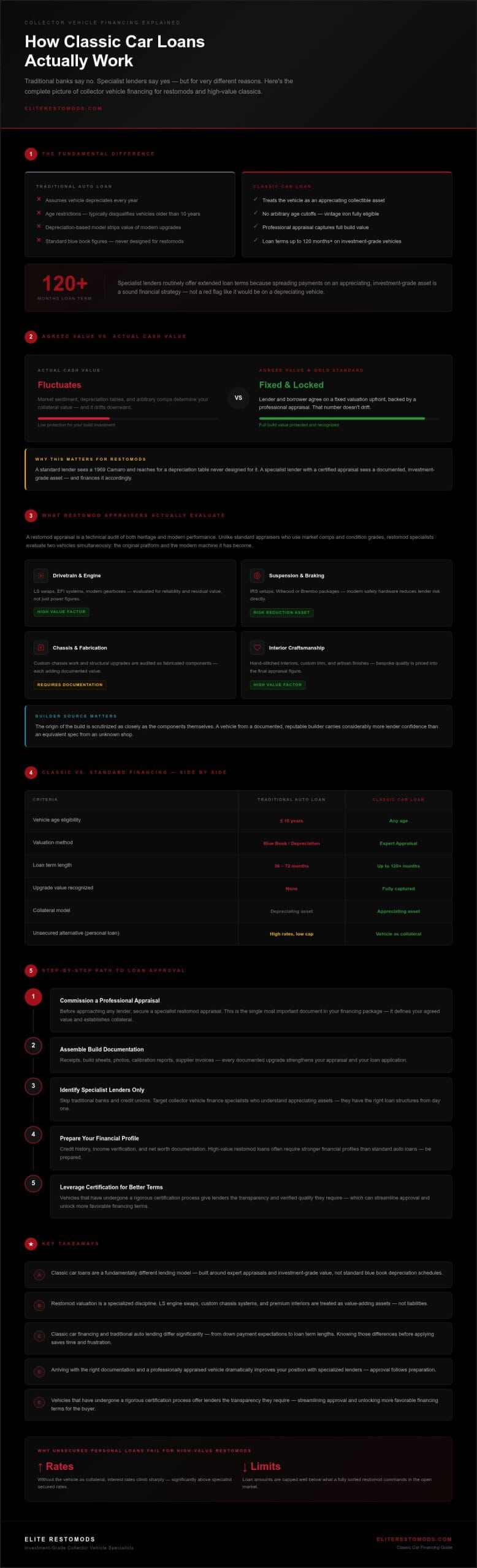
- Understanding how do classic car loans work reveals a fundamentally different lending model — one built around expert appraisals and investment-grade value rather than standard blue book depreciation schedules.
- Restomod valuation is a specialized discipline, and lenders financing these vehicles scrutinize mechanical upgrades like LS engine swaps and custom chassis systems as value-adding assets, not liabilities.
- Classic car financing and traditional auto lending differ significantly in structure, from down payment expectations to loan term lengths, and knowing those differences before you apply can save you time and frustration.
- The path to loan approval for a high-value restomod follows a specific sequence, and arriving with the right documentation and a professionally appraised vehicle dramatically improves your position with specialized lenders.
- Vehicles that have undergone a rigorous certification process offer lenders the transparency and verifiable quality they require, which can streamline approval and unlock more favorable financing terms for the buyer.
Defining the Classic Car Loan and Its Core Mechanism
At its core, a classic car loan is a specialized financial product engineered for a fundamentally different kind of asset. Where a conventional auto loan assumes the vehicle sitting in your driveway will be worth less every year, a classic car loan operates on the opposite premise: that the right vehicle, properly built and documented, holds or grows its value over time. That single distinction changes everything about how the loan is structured, underwritten, and serviced.
Understanding how do classic car loans work begins with recognizing that these lenders aren’t financing transportation. They’re financing a collectible. The vehicle is treated as an appreciating asset, much like fine art or investment-grade real estate, and the entire lending framework reflects that reality. Extended loan terms, sometimes reaching 120 months or beyond, are common precisely because lenders recognize that spreading payments on a high-value, appreciating asset is a sound financial strategy, not a red flag.
The Concept of Agreed Value vs. Actual Cash Value
Agreed value is the gold standard in collector vehicle financing, and for good reason. Rather than assigning a fluctuating market value to the vehicle at any given moment, the lender and borrower establish a fixed valuation upfront, backed by a professional appraisal. That number doesn’t drift with market sentiment or depreciation schedules. It holds.
For a bespoke restomod with a hand-built drivetrain, custom chassis fabrication, and an artisan interior, this matters enormously. A standard lender looking at a 1969 Camaro sees a 55-year-old vehicle and reaches for a depreciation table that was never designed with it in mind. A specialized lender reviewing the same car with a certified appraisal in hand sees a documented, investment-grade asset. The agreed value model protects both parties: the lender’s collateral is clearly defined, and the borrower isn’t penalized for owning something extraordinary.
Why Traditional Auto Loans Fail for Classics
The structural mismatch is immediate. Most traditional banks and credit unions apply age restrictions that automatically disqualify any vehicle older than ten years. Those that don’t will still run the vehicle through a depreciation-based valuation model that strips away every dollar invested in modern mechanical upgrades, premium fabrication, and bespoke finishes.
Some buyers attempt to bridge the gap with an unsecured personal loan. The problem is exposure. Without the vehicle as collateral, interest rates climb sharply and loan amounts are capped well below what a fully sorted restomod commands. Understanding how do classic car loans work makes clear that asset-backed specialist financing isn’t just more elegant; for high-value builds, it’s the only structure that actually fits.
The Mechanics of Restomod Valuation and Appraisal
A restomod appraisal is, at its core, a technical audit of both heritage and modern performance, one that demands an appraiser capable of reading a classic body line and a fuel injection calibration report with equal fluency. This is where the financing process gets genuinely interesting, and where understanding how do classic car loans work separates buyers who get approved from those who don’t.
Traditional appraisers lean on market comps and condition grades. Restomod appraisers go deeper. They’re evaluating two vehicles simultaneously: the original platform and the modern machine it’s become. Every upgrade, every fabricated component, every calibrated system contributes to a final valuation that a standard blue book figure couldn’t begin to capture. The complexity is the point, and specialized lenders know it.
Evaluating Modern Performance Upgrades
Lenders financing high-value restomods aren’t just looking at horsepower figures. They’re assessing reliability and residual value. A professionally installed electronic fuel injection system, a fully engineered independent rear suspension, and a Wilwood or Brembo braking package aren’t cosmetic additions. They’re risk-reduction hardware. Modern drivetrains eliminate the mechanical unpredictability that makes lenders nervous about vintage iron, and that confidence translates directly into lender willingness to extend favorable terms.
The source of the build matters just as much as the components themselves. A restomod completed by a professional builder with documented processes, calibrated systems, and verified parts sourcing carries substantially more weight than an equivalent home build, regardless of the quality of individual components. Lenders are financing an asset they may need to liquidate. Provenance and professional execution make that asset defensible.
Specific hardware that consistently strengthens appraisal value includes:
- LS or LT engine swaps with documented dyno results and professional installation records
- Custom chassis fabrication or subframe connector systems from recognized builders
- Late-model independent suspension conversions with alignment documentation
- Modern EFI systems with calibrated tune files and supporting fuel delivery upgrades
- Six-piston or larger brake packages with heat-rated rotors and stainless lines
The Role of Professional Documentation
Documentation isn’t administrative housekeeping. It’s the financial architecture of your loan application. A comprehensive build sheet that traces every major component from purchase order to installation, supported by high-resolution photography at each stage of construction, gives a lender the transparency they need to defend the valuation internally. Without it, even an exceptional build is difficult to finance at its true value.
Receipts for premium components serve as market-rate proof. A documented invoice for a hand-fabricated roll cage, a premium audio system, or an artisan interior doesn’t just show what was spent; it anchors the appraiser’s valuation to verifiable market data. That paper trail is what converts a lender’s uncertainty into confidence.
This is precisely why the Elite Restomods build process is structured the way it is. Detailed documentation at every phase of a build isn’t just a quality assurance measure; it’s the foundation that makes financing these vehicles straightforward rather than speculative. When a lender can trace a build from bare metal to finished product, the conversation about how do classic car loans work becomes far less complicated for everyone involved.
Comparing Classic Loans to Standard Auto Financing
Standard auto lending is an industrial process. Volume is the priority, and the entire system is calibrated for the average transaction: a late-model vehicle, a predictable depreciation curve, and a borrower who’ll replace it in five years. Classic car financing operates on an entirely different philosophy. Every loan is underwritten as an individual case, because every vehicle is an individual asset. That distinction shapes everything from the down payment conversation to the final payment schedule.
Down payment expectations reflect this difference immediately. Specialized lenders financing investment-grade restomods typically require a meaningful equity position upfront, often in the range of ten to twenty percent, because they’re protecting a collateral position on an asset that requires expert valuation to liquidate. That’s not a penalty; it’s the cost of entry into a lending category that treats your vehicle as the appreciating asset it actually is. Standard lenders, by contrast, routinely finance new vehicles with minimal down payment precisely because the depreciation schedule works in their favor from day one.
Interest rates in the collector vehicle space are competitive, but they reflect the specialized nature of the risk. Lenders financing a hand-built restomod are extending credit against an asset that requires an expert appraisal to value, a niche buyer pool to sell, and a level of mechanical complexity that a standard repo auction can’t accommodate. That specificity is priced into the rate, and buyers who understand how do classic car loans work recognize that the rate differential is justified by the structure they’re receiving in return.
Loan Terms and Monthly Payment Structures
Extended loan terms are where collector financing genuinely changes the financial calculus. A six-figure restomod financed over 144 months carries a fundamentally different monthly obligation than the same vehicle compressed into a 60-month term. Spreading payments across ten to twelve years doesn’t just lower the monthly number; it preserves capital that a serious collector can deploy elsewhere, whether that’s the next acquisition, a storage facility, or a separate investment portfolio. Many specialized lenders in this space also offer no prepayment penalties, which means buyers retain the flexibility to accelerate payoff whenever it makes sense without being penalized for doing so. That combination of low monthly obligation and structural flexibility is something standard auto financing simply doesn’t offer.
Credit Requirements and Debt-to-Income Ratios
Specialized lenders expect a stronger credit profile than a typical auto lender requires. They’re underwriting a complex, illiquid asset, and the borrower’s financial narrative needs to support that level of commitment. A clean, long-standing credit history carries significant weight. So does your existing relationship with the collector vehicle market. Lenders who understand how do classic car loans work will often view a documented history of buying and selling appreciating collector vehicles as a positive signal, evidence that you understand the asset class and manage it responsibly. What underwriters are ultimately looking for is stability: consistent income, a manageable debt-to-income ratio, and a financial picture that tells a coherent story rather than a complicated one.
Step-by-Step Path to Loan Approval for a Classic Asset
Knowing how do classic car loans work in theory is one thing. Walking the actual approval path is another. The process isn’t complicated, but it is sequential, and skipping steps or arriving unprepared is the fastest way to stall an otherwise strong application. What follows is the logical order that gives serious buyers the best possible position with a specialist lender.
Start with the vehicle itself. Lenders financing investment-grade restomods want assets that meet a clear quality threshold: professionally executed builds, documented mechanical upgrades, and a platform with genuine collector market demand. A vehicle that’s been through a rigorous certification process, like those in the Elite Restomods inventory, arrives with the transparency and verified quality that lenders require to move quickly and confidently. That foundation shapes every step that follows.
Once the vehicle is confirmed, secure a professional appraisal or work with a certified dealer whose valuation process is already structured for lender review. That appraisal isn’t just a number; it’s the document that anchors your entire loan structure. From there, the sequence tightens:
- Gather two to three years of tax returns to establish verifiable income history
- Compile bank and investment statements that demonstrate liquid asset depth
- Collect any prior automotive purchase records that show experience in the collector vehicle market
- Assemble the vehicle’s complete build documentation, including receipts, installation records, and photography
- Finalize a collector insurance policy that meets the lender’s agreed value requirements before closing
That last point catches buyers off guard. Standard auto insurance won’t satisfy a specialist lender. Agreed value coverage from a collector-focused insurer is non-negotiable, and arranging it in advance keeps the closing timeline clean.
For a detailed breakdown of what specialist lenders expect at each stage, the classic car loan requirements resource covers the specifics of approval criteria that general guides consistently overlook.
Preparing Your Financial Portfolio
Liquidity often carries more weight than a credit score alone when the loan amount reflects a six-figure asset. Lenders want evidence that you can absorb the down payment and still maintain meaningful reserves. Organize your financial statement to surface both income stability and asset depth clearly. If you’ve bought or sold collector vehicles previously, document that history. Lenders who understand this asset class treat prior automotive investment experience as a signal of sophistication, not a complication.
Selecting the Right Specialist Lender
A general bank sees a 55-year-old car. A boutique automotive lender sees a certified, appreciating asset with a documented build history. The difference in how they underwrite is significant. Ask any prospective lender directly how many high-value restomod loans they’ve closed, what their appraisal review process looks like, and whether they maintain preferred relationships with collector insurance providers. Working through a dealer with established lender partnerships compresses that discovery process considerably, connecting you immediately with underwriters who already speak the language of investment-grade collector vehicles.
Ready to explore financing on a certified restomod? Connect with the Elite Restomods team to learn how the certification process translates directly into a stronger lending position.
Leveraging Elite Certified Restomods for Seamless Financing
There’s a reason the certification question comes up so early in any serious financing conversation. Lenders underwriting six-figure collector vehicles aren’t just evaluating the borrower’s balance sheet; they’re evaluating the asset itself. A vehicle with a verifiable, rigorous quality assurance process behind it tells an entirely different story to an underwriter than one that arrives with ambiguous provenance and incomplete documentation. That distinction is where Elite Certified Restomods change the financing equation in a way that no general guide on how do classic car loans work fully captures.
The Value of a Fully Sorted Vehicle
Fully sorted means exactly what it sounds like: nothing left to question, nothing left to finish, nothing that requires a lender to hedge their collateral position against an unknown. Every system is calibrated, every upgrade is documented, and the vehicle is ready for immediate, reliable enjoyment the moment it leaves the transport carrier. That operational readiness isn’t just a buyer’s luxury; it’s a lender’s requirement.
When a vehicle meets a defined quality standard before it reaches the market, appraisers have a reliable baseline to work from. The guesswork disappears. Valuations become defensible, and lenders can structure loans with confidence rather than caution. Explore the current Elite Restomods inventory to see what investment-grade, fully sorted builds actually look like at this level of execution.
Streamlining the Transaction with Professional Expertise
Classic car transactions carry logistical complexity that standard dealership purchases simply don’t. Title histories on vintage platforms can be layered, registration requirements vary across state lines, and transporting a hand-built restomod demands more than a standard carrier. Elite Restomods handles national enclosed transport as a core part of the ownership experience, protecting the vehicle’s condition and finish from the moment it leaves the facility to the moment it arrives in your garage.
The lender relationship piece matters just as much. Understanding how do classic car loans work in practice means having access to underwriters who already speak the language of a professionally built restomod, not ones who need to be educated on why an LS-swapped first-gen Camaro is worth more than its donor year suggests. Elite Restomods’ referral network connects buyers directly with specialist lenders who recognize the value embedded in a certified build, compressing the approval timeline and removing the friction that derails transactions elsewhere.
The result is a process that honors both the vehicle and the buyer. Not a transaction. A transfer of something genuinely extraordinary. Explore the full range of Elite Restomods services to understand how every element of the ownership journey, from sourcing through financing through delivery, is engineered to match the quality of the machines themselves.
Your Next Investment Is Ready When You Are
Understanding how do classic car loans work is the difference between watching extraordinary vehicles sell to someone else and actually owning one. The financing model is built around asset quality, professional documentation, and lenders who recognize what a certified restomod genuinely represents. Get those fundamentals right, and the path from interest to ownership is far more direct than most buyers expect.
Three things matter most: start with a vehicle that’s fully sorted and investment-ready, arrive at your lender with complete documentation, and work with specialists who understand the asset class from the ground up. Elite Certified Restomods are built to satisfy exactly those requirements, backed by rigorous quality assurance, specialized financing partnerships, and national enclosed transport that protects your investment from facility to garage.
The machine you’ve been waiting for exists. The financing structure to acquire it exists. The only remaining step is yours. Explore our investment-grade inventory and discover your dream restomod and see what’s available right now.
Frequently Asked Questions About Classic Car Loans
How long are the terms for a classic car loan?
Classic car loan terms are significantly longer than standard auto financing, commonly ranging from 84 to 144 months depending on the lender and vehicle value. Some specialist lenders extend terms beyond that threshold for high-value, investment-grade builds. The logic is straightforward: spreading payments on an appreciating asset over a longer horizon preserves your capital flexibility without penalizing you for owning something extraordinary.
Do I need a professional appraisal before applying for a classic car loan?
Yes, and it’s non-negotiable with any serious specialist lender. A professional appraisal establishes the agreed value that anchors your entire loan structure, replacing the depreciation-based blue book figures that standard lenders rely on. For a restomod with modern mechanical upgrades and premium fabrication, that appraisal is what converts a lender’s uncertainty into a defensible collateral position. Arriving without one significantly weakens your application before it’s even reviewed.
Can I get a classic car loan for a vehicle I am building myself?
It’s possible, but considerably more difficult. Specialist lenders financing high-value builds want verifiable provenance, documented professional execution, and a completed, fully sorted vehicle they can appraise with confidence. A self-build in progress introduces collateral uncertainty that most lenders aren’t structured to accommodate. Buyers who want financing aligned with how classic car loans work at the investment-grade level are typically better positioned acquiring a professionally certified vehicle than financing an incomplete project.
What is the typical down payment required for a restomod loan?
Specialist lenders generally expect a down payment in the range of ten to twenty percent for investment-grade restomods, though requirements vary by lender, vehicle value, and borrower financial profile. That equity position protects the lender’s collateral stake on an asset that requires expert appraisal and a niche buyer pool to liquidate. It’s not a penalty for owning something exceptional; it’s the entry point into a lending category that values your vehicle correctly.
Are interest rates higher for classic car loans than for new cars?
Rates in the collector vehicle space are competitive but typically reflect the specialized nature of the asset. Lenders are underwriting a hand-built machine with a niche resale market, not a mass-produced vehicle with a predictable depreciation curve. That specificity carries a modest rate premium over new car financing. Buyers who understand how classic car loans work recognize that rate differential is justified by the agreed value structure, extended terms, and lender expertise they receive in return.
Can I finance a classic car through my local credit union?
Most credit unions apply age restrictions that automatically disqualify vehicles older than ten years, and those that don’t will still run the vehicle through a depreciation model that ignores every dollar invested in modern upgrades. A handful of larger credit unions have collector vehicle programs, but they’re the exception. For a high-value restomod, specialist lenders who understand the asset class from the ground up will consistently offer better terms, higher loan amounts, and a faster path to approval than a general financial institution.
What happens if the car’s value increases during the loan term?
The agreed value established at origination holds for the life of the loan, so appreciation during the term doesn’t automatically adjust your loan balance. What it does create is meaningful equity. As the vehicle’s market value climbs above the agreed value and your principal decreases, you build a stronger ownership position over time. Some buyers choose to refinance against updated appraisals when appreciation is significant, though the mechanics of that process depend entirely on the lender’s policies.
Is there a mileage limit on vehicles financed through classic car loans?
Specialist lenders don’t apply the mileage restrictions that define standard auto lending. A 1969 platform with 80,000 original miles and a fully rebuilt drivetrain isn’t evaluated the same way a high-mileage late-model commuter would be. What matters is the vehicle’s documented condition, the quality of its mechanical upgrades, and the professional execution of the build. Mileage on the original odometer is one data point among many, not a disqualifying threshold.