
The lowest commission rate on paper often yields the smallest return in your bank account. Consignment negotiations succeed when you protect your net return and asset integrity, not merely when you slash a baseline commission. Yet, when negotiating classic car consignment terms, most owners fixate on that single headline percentage while leaving back-end administrative charges, unapproved price drops, and bailment liabilities completely unguarded.
You’ve poured capital, time, and mechanical devotion into your machine. It’s only natural to worry about handing over possession to an unfamiliar showroom where surprise storage fees and predatory markups threaten your bottom line. You deserve absolute clarity before relinquishing the keys. In this strategic guide, you will master the essential clauses, commission structures, and negotiation tactics required to protect your vehicle and maximize your net proceeds. We’ll examine the core contractual levers, establish clear marketing commitments, and reveal how to secure an ethical partnership built on vehicle preservation and shared success.
Key Takeaways
- Establish enforceable bailment protections that safeguard your asset and ensure legal title remains in your hands until funds fully clear.
- Compare percentage splits against net-to-seller structures to expose hidden markups and eliminate incentives for premature price drops.
- Master a proven framework for negotiating classic car consignment terms to eliminate unexpected administrative fees and lock in transparent marketing commitments.
- Leverage comprehensive build documentation, historical provenance, and verified mechanical condition as negotiation assets to secure premier representation.
- Distinguish high-volume turnover lots from curated specialty showrooms where dedicated technical experts understand how to communicate bespoke engineering.
Understanding the Core Components of a Classic Car Consignment Agreement
A consignment agreement is not a standard retail contract. It is a specialized bailment contract. Under this legal framework, you grant temporary physical custody of your vehicle to a consignee dealership while retaining complete property ownership. Understanding these consignment agreement basics ensures you never confuse physical possession with a transfer of rights. Standard retail forms fail to protect vintage builds or custom restomods. They overlook the bespoke mechanics, irreplaceable coachwork, and extensive build records that define high-caliber collector cars.
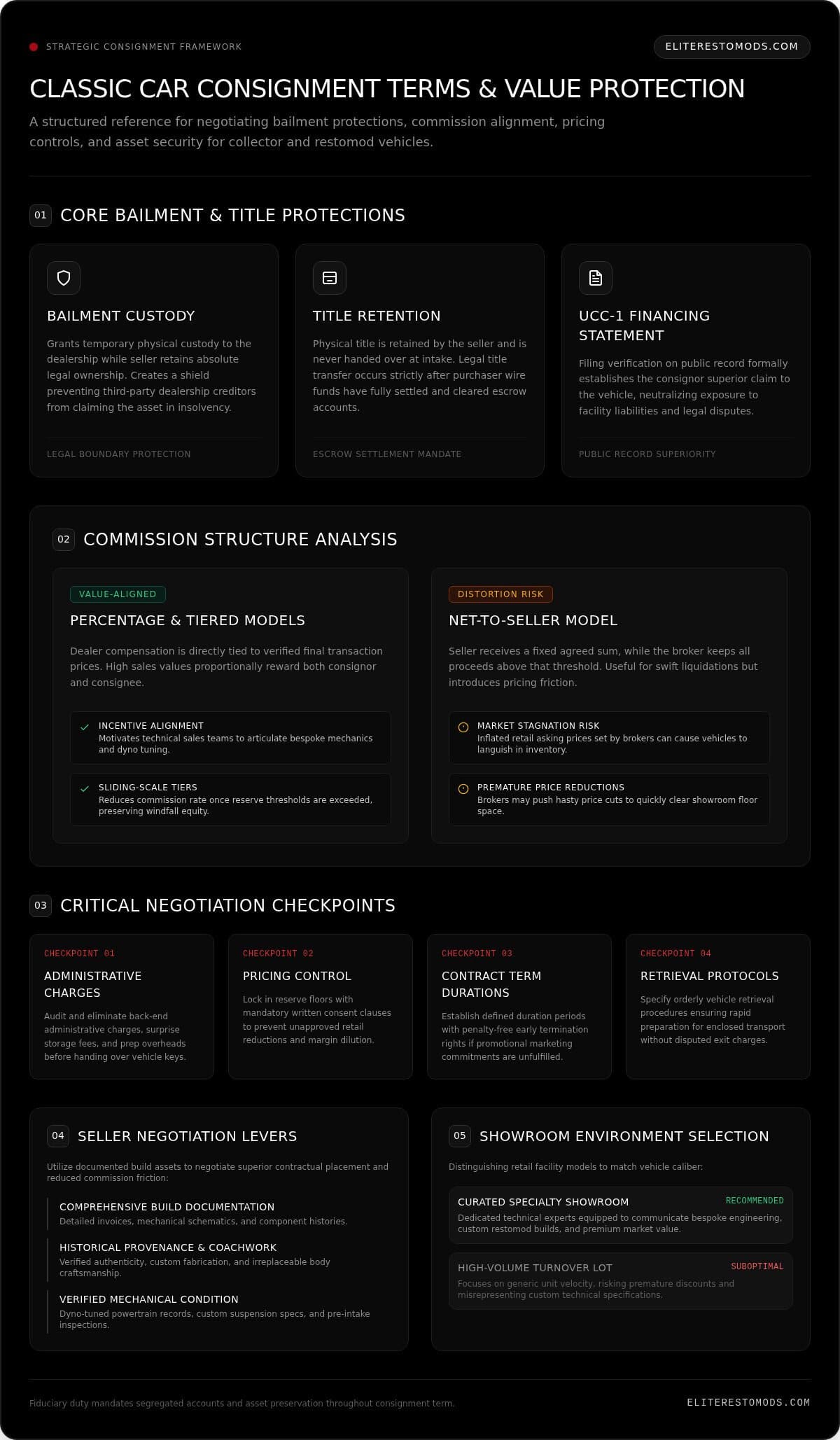
Nationwide, the consignee dealership operates as your fiduciary agent. They are legally bound to protect the asset and execute transactions through segregated accounts. The foundational rule of every legitimate agreement states: “Ownership title remains vested in the seller until purchaser funds have fully cleared escrow.” Establishing this protection forms the foundation of negotiating classic car consignment terms.
To see how professional consignment representation works in practice and how to prepare your vehicle, review this operational breakdown:
Bailment and Legal Title Retention
Bailment creates an essential legal boundary. It shields your vehicle from dealer liabilities. If a facility encounters insolvency or legal disputes, properly documented bailment prevents third-party creditors from claiming your asset. Never hand over an assigned title at intake. You retain the physical title until wire funds settle in your account. For added security, verify that the contract permits filing a UCC-1 financing statement, formally establishing your superior claim to the asset on public record.
Consignment Term Durations and Termination Provisions
Marketing an investment-grade classic takes time. Even so, open-ended contracts trap your vehicle in inventory purgatory if the dealer loses momentum. When negotiating classic car consignment terms, establish realistic contract durations with clear early termination rights. If an agency fails to execute promised promotional efforts, you need the contractual right to terminate without punitive fees. The agreement must also specify an orderly retrieval process, ensuring the vehicle is promptly prepped for safe, enclosed transport without disputed overhead charges.
Comparing Commission Structures: Percentage Fees Versus Net-to-Seller Agreements
Commission structures dictate dealer behavior. The right compensation model aligns the consignee’s financial incentives with your asset value. An improper framework creates friction, often prompting a broker to push hasty price reductions simply to rotate showroom floor space. For collectors seeking total transparency across high-caliber builds, exploring our specialized consignment program demonstrates how structured incentives preserve equity.
The Mechanics of Percentage-Based Commissions
Straight percentage models tie consignee compensation directly to the final verified transaction price. When your vehicle commands a higher figure, the dealer earns more. This structure inherently motivates technical sales teams to articulate the precise value of bespoke suspension work, custom coachwork, and dyno-tuned powertrains. Sliding-scale tiers push this incentive further. By reducing the commission rate once sales surpass designated reserve thresholds, tiered agreements reward the dealer for achieving milestone valuations while preserving your share of the windfall.
Evaluating the Net-to-Seller Pricing Model
A net-to-seller agreement guarantees a fixed yield to the consignor, with the dealer keeping any revenue achieved above that figure. This approach offers predictable returns during estate liquidations or swift portfolio restructuring. However, it introduces significant market distortion. If a broker sets an inflated retail price to maximize their own margin, your car can languish indefinitely, losing freshness and credibility among serious buyers. Consulting established state consignment regulations highlights why statutory standards often mandate clear transactional disclosures, protecting sellers from unchecked spread markups.
Uncovering Deductions and Hidden Ancillary Surcharges
A competitive headline commission quickly evaporates if an agreement harbors predatory secondary fees. High-volume clearinghouses routinely pad revenues with separate line items for administrative processing, studio photography, ongoing storage, and pre-sale mechanical sorting. When negotiating classic car consignment terms, you can’t afford to overlook back-end deductions. Mandate written caps on routine preparation, eliminate recurring administrative surcharges, and confirm that all buyer-side processing fees remain entirely separate from your net proceeds.
Essential Clauses to Protect Asset Value, Pricing Control, and Liability
Handing over the keys to a custom restomod or rare classic demands strict operational guardrails. Vague promises won’t protect an irreplaceable build if an unexpected incident occurs on the showroom floor. True risk mitigation requires definitive contract language. Reviewing the mechanical verification standards on our process page illustrates how disciplined technical oversight preserves asset value. When negotiating classic car consignment terms, your agreement must govern custody and physical care just as rigorously as sale proceeds.
Enforcing Reserve Price Controls and Negotiation Authority
Never leave pricing authority ambiguous. Your agreement must state an unbreakable reserve figure, explicitly prohibiting unilateral price reductions or dealer discounts without your prior written consent. Require the broker to log all incoming bids and present counteroffers through formal digital channels. Crucially, specify that no bill of sale or physical vehicle handover may proceed until purchase funds clear escrow in full.
Mitigating Physical Risk: Storage, Maintenance, and Test Drives
Bespoke engineering requires specialized care. Mandate that your vehicle resides strictly within a secure, climate-controlled facility to protect sensitive fuel systems, artisanal leather, and modern electrical wiring. To prevent unnecessary wear, your contract should enforce rigid operational rules:
- Prohibit open public test drives, restricting driving privileges exclusively to pre-qualified buyers accompanied by dealership management.
- Establish a strict mileage ceiling for promotional handling, mechanical checks, and buyer validation.
- Require continuous battery maintenance, professional fluid management, and periodic cosmetic detailing while on display.
Insurance Coverage and Garage Keepers Liability Alignment
Never assume standard commercial coverage protects your build. Your personal agreed-value policy protects your capital, but the consignment dealership must carry primary garage-keepers liability insurance that covers comprehensive physical loss, collision, fire, and theft while the asset is in their custody. When negotiating classic car consignment terms, demand an updated certificate of insurance confirming complete physical damage protection before scheduling transport. Clarify liability allocations across every phase of representation, from studio photography staging to enclosed carrier handoffs.
How to Negotiate Consignment Terms: A Tactical 5-Step Protocol
Walking into representation discussions unprepared surrenders your financial leverage immediately. When negotiating classic car consignment terms, methodical preparation transforms an emotional sale into a professional transaction. Highlighting extensive documentation and flawless mechanical integrity gives you the upper hand when securing representation. To see how premier vehicles are positioned and staged, evaluate our curated inventory of high-caliber builds.
Step 1 & 2: Documentation Audit and Realistic Valuation Benchmarking
Begin by compiling a complete mechanical and provenance dossier. Gather dyno tuning sheets, wiring schematics, crate engine certifications, and step-by-step restoration records. When you present an impeccably sorted asset with documented componentry, the consignee faces minimal sales friction, giving you valid justification to push for reduced commission splits. Next, benchmark your baseline valuation against verified private sales and auction results, separating sentimental attachment from defensible market data.
Step 3: Auditing the Dealership Marketing Commitment
Don’t settle for vague promises of broad exposure. Demand clear marketing deliverables written directly into the representation schedule. Secure firm contractual obligations for professional studio photography, paint depth mapping, undercarriage lift documentation, and targeted distribution across high-intent enthusiast platforms. Establish a hard launch date following vehicle delivery so your car doesn’t sit idle while other inventory takes priority.
Step 4 & 5: Redlining Clauses and Executing the Final Covenant
Review the agreement line by line. Redline any clause that allows price modifications without your prior written consent or grants open-ended discretion for dealer service charges. Attach formal addendums specifying indoor staging and transport requirements. Once every protection is in place, execute the finalized covenant alongside dealership leadership. If you’re ready to partner with a team that values bespoke engineering and transparent agreements, submit your build to our nationwide consignment program.
Partnering With a Premier Specialist: The Value of Curation Over Volume
High-volume consignment warehouses treat collector builds as interchangeable inventory. Hundreds of cars pack tightly into cavernous buildings, creating an overwhelming sea of metal where distinct assets surrender their individuality. For a high-performance machine blending vintage character with contemporary mechanical precision, volume-driven representation actively diminishes perceived value. True market distinction requires an environment that honors automotive craft.
The Pitfalls of Mass-Market Consignment Clearinghouses
Clearinghouses thrive on rapid churn and surface-level engagement. Their floor staff rarely possess the technical literacy needed to articulate the engineering behind a bespoke multilink rear suspension, custom dyno calibration, or aircraft-grade wiring architecture. Bespoke machinery sits exposed to heavy foot traffic, collecting micro-scratches and cabin wear while languishing in static rows. A discount commission split means very little if an unqualified sales team cannot justify your reserve to serious buyers.
The Elite Restomods Advantage: Curation, Sorting, and Transparency
True representation requires uncompromising curation. At Elite Restomods, we eliminate showroom clutter by admitting only fully sorted, investment-grade builds into our secure, climate-controlled spaces. Our specialists understand high-output drivetrains, modern chassis geometry, and concours-level finishing. When negotiating classic car consignment terms with a focused specialist, you align with consultants who know how to communicate your vehicle’s mechanical pedigree to collectors who actively seek turnkey performance.
Streamlined Buyer Facilitation That Maximizes Final Value
Closing high-value sales requires an integrated operational ecosystem. Access to specialized classic car financing empowers qualified buyers to complete acquisitions smoothly without reallocating private capital. Concurrently, white-glove enclosed vehicle transport eliminates distance barriers, delivering vehicles securely from door to door. Addressing these transaction pillars while negotiating classic car consignment terms ensures your vehicle benefits from comprehensive buyer support, safeguarding both your personal privacy and your net proceeds. Review our complete services portfolio to see how our white-glove infrastructure elevates the consignment experience.
Secure the Return and Preservation Your Build Deserves
Consigning a high-caliber classic shouldn’t feel like a leap into the unknown. True transactional success hinges on retaining legal title until funding clears, eliminating hidden administrative charges, and aligning dealer incentives with your net proceeds. When negotiating classic car consignment terms, demanding contractual transparency ensures your investment is preserved rather than compromised by high-turnover sales lots.
Your vehicle represents countless hours of precision engineering, artisanal craftsmanship, and capital investment. Protecting that dedication requires a partner who operates with identical standards. Through rigorous quality assurance protocols, secure climate-controlled environments, and direct access to specialized classic car financing, we connect your machine with an appreciative national collector network. Take control of your asset’s sale and partner with a team dedicated to vehicle preservation and seller equity. Explore Consignment With Elite Restomods today to command the valuation your build has earned.
Frequently Asked Questions
Can I legally negotiate the commission rate in a classic car consignment contract?
Yes, consignment contracts are entirely negotiable commercial agreements rather than fixed statutory forms. Dealerships often propose standard commission schedules, but owners of high-caliber builds possess considerable leverage. When negotiating classic car consignment terms, you can propose sliding scales or capped fees based on documented restoration value, vehicle rarity, and verified condition. A dealer eager for premium inventory will readily adjust rates to secure an investment-grade machine.
What happens if my classic car does not sell within the agreed consignment period?
When an agreement expires without a sale, you have the contractual right to retrieve your vehicle or negotiate a term extension. A well-drafted contract guarantees that repossession incurs zero punitive exit penalties or unexpected showroom charges. Prior to collection, inspect the odometer, review maintenance logs, and arrange secure enclosed transport. If you choose to extend, re-evaluate market demand and marketing strategies alongside your specialist to determine whether pricing requires adjustment.
Who is responsible for vehicle insurance while the car is on the consignment showroom floor?
The dealership’s primary garage-keepers liability insurance should cover physical damage, theft, and fire while the car remains in their custody. However, your personal agreed-value policy acts as vital secondary protection. Before handing over possession, request an active certificate of insurance directly from the facility’s underwriter confirming sufficient limits for high-dollar assets. Never rely on verbal assurances. Ensure the written agreement explicitly details who bears financial responsibility during detailing, staging, and buyer evaluations.
How does a net-to-seller agreement differ from a percentage commission agreement?
A net-to-seller agreement establishes a fixed payout figure for the seller, allowing the dealership to retain any excess funds generated above that threshold. In contrast, a percentage commission aligns dealer compensation directly with the final gross sale price. While net agreements offer clear certainty for estate liquidations, they can incentivize dealers to mark prices up artificially high, which often stalls sales. Percentage models ensure that both parties remain focused on securing true market value.
Can a consignment dealership lower my asking price without my explicit permission?
No, a dealership cannot legally reduce your asking or reserve price unless your written agreement explicitly grants them unilateral pricing discretion. When negotiating classic car consignment terms, always redline clauses that allow flexible dealer discounting. Require written or verified digital authorization before any counteroffer or price reduction takes effect. If a dealer attempts to lower pricing without consent, they breach their fiduciary bailment duties, rendering the transaction voidable under standard commercial contract principles.
What should I do if a consignment dealership asks for upfront marketing or detailing fees?
Request a detailed breakdown of the proposed expenses and negotiate to have those costs deducted from final sale proceeds rather than paid out of pocket. Premier consignment programs often absorb intake photography and detailing as standard overhead or cap sorting costs under clear contractual limits. If an agency demands non-refundable upfront cash without guaranteed promotional deliverables, treat it as a warning sign. Insist that all preparation fees tie directly to successful vehicle liquidation.
Is my consigned vehicle protected if the dealership experiences bankruptcy or financial distress?
Yes, provided the contract correctly structures the relationship as a true legal bailment and you retain the vehicle title. Under bailment principles, your classic never becomes an asset of the dealership. Because title remains registered in your name until purchaser funds clear escrow, commercial creditors cannot seize your property to satisfy dealership debts. Filing a UCC-1 financing statement provides additional public notice, cementing your senior ownership claim against third-party claims during insolvency proceedings.