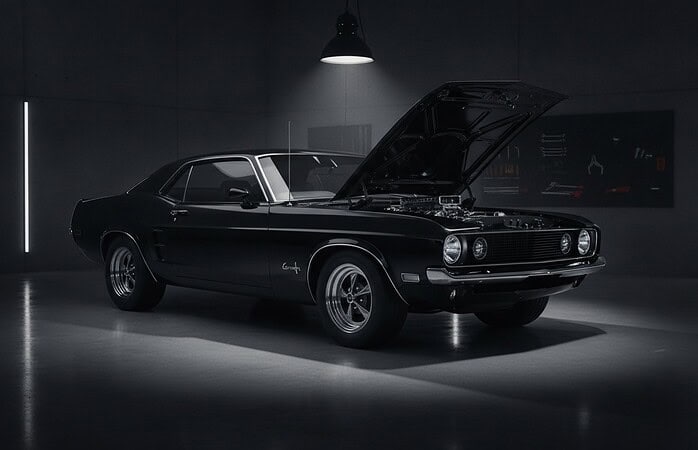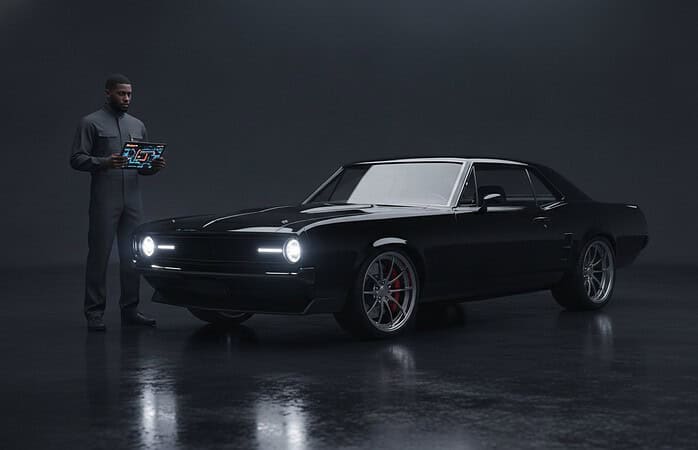

Your childhood dream of piloting a 1960s muscle car shouldn’t end with a tow truck or a white-knuckle struggle against manual drum brakes. While the allure of a factory-original machine is undeniable, the reality of vintage mechanical failure often clashes with the expectations of a modern driver. Choosing between a restomod vs restoration is no longer just about aesthetics; it’s a decision about how you intend to interact with automotive history. Classic style. Modern power. It’s the ultimate crossroads for the elite collector.
You want a vehicle that offers the soul of the past without the compromises of the mid-twentieth century. We understand the pride of ownership that comes from a concours-level restoration, yet we also recognize the thrill of a bespoke masterpiece that pairs a classic silhouette with turn-key reliability. This article provides a definitive breakdown of the investment value, engineering differences, and driving experiences of both paths. You’ll discover why high-end builds now command over $400,000 and how shifting regulations, like California’s pending SB 1392 rolling exemption for 1981 models, are reshaping the landscape in 2026. Whether you seek a museum-grade investment or a high-performance beast, the right choice starts here.
Key Takeaways
- Decipher the core philosophies of the restomod vs restoration debate to determine if you desire a museum-grade time capsule or a bespoke, high-performance masterpiece.
- Analyze the engineering shift from temperamental vintage components to the raw, visceral power of modern LS3 crates and precision-engineered chassis.
- Compare the ownership realities of constant mechanical upkeep versus the safety, comfort, and turn-key reliability of a modern performance build.
- Review current 2026 market trends to see why high-quality, “fully sorted” builds are increasingly dominating the investment landscape at elite auctions.
Defining the Philosophies: Preservation vs. Evolution
Choosing between a restomod vs restoration is a decision between two distinct legacies. One honors the exact moment a vehicle rolled off the assembly line; the other honors the spirit of the machine by giving it a second life. In 2026, the collector market has pivoted. While purists still cherish the “numbers-matching” dream, many enthusiasts now demand more than just a visual replica. They want performance that matches the aggressive lines of a ’69 Camaro or a ’67 Mustang. This shift has turned the restomod from a niche hobby into a dominant force in a $337 billion automotive aftermarket industry.
To better understand how these philosophies impact market value and driving dynamics, watch this helpful comparison:
The Time Capsule: What Defines a True Restoration
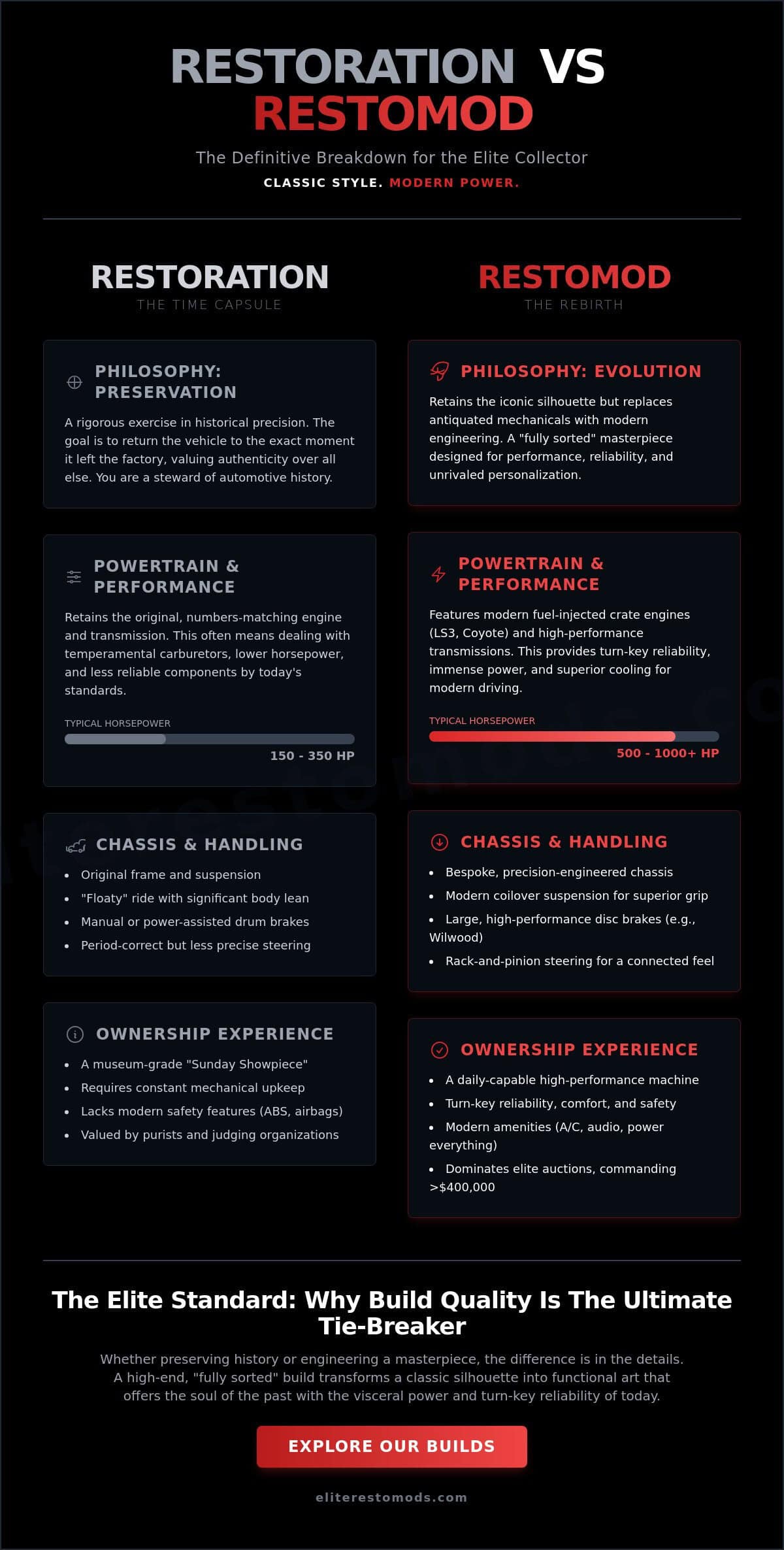
A traditional restoration is an exercise in historical precision. It follows the rigorous guidelines of organizations like the NCRS or MCA. Every bolt, marking, and factory-applied finish must be period-correct to achieve top-tier judging scores. In 2026, finding “New Old Stock” (NOS) parts has become a masterclass in detective work. This path focuses on the conservation and restoration of road vehicles in their most authentic form. You aren’t just a car owner; you’re a steward of history. It’s a commitment to preservation that values original engineering over modern convenience, even if it means dealing with temperamental carburetors and manual steering.
The Rebirth: The Philosophy Behind a Bespoke Restomod
A bespoke restomod flips the script. It retains the iconic silhouette but replaces antiquated mechanicals with modern beasts. Classic style. Modern power. This philosophy centers on the “fully sorted” experience. It means your 1970 Chevelle starts on the first turn every time because it’s powered by a modern LS3 crate engine. Unlike factory restorations, this path allows for unrivaled personalization. You can choose hand-stitched leather interiors and Wilwood brakes that stop with modern precision. It’s a transformative journey that turns a temperamental relic into a daily-capable masterpiece. Explore our meticulous build process to see how we bridge these two eras to create functional art.
Engineering the Difference: Under the Hood and Beneath the Chassis
The mechanical soul of a vehicle defines its character on the asphalt. In the high-stakes choice between a restomod vs restoration, the most profound differences lie hidden beneath the iconic sheet metal. A traditional restoration preserves the original, often temperamental, engineering of the mid-20th century. While a numbers-matching engine is a historical treasure, it frequently lacks the reliability and cooling capacity required for modern traffic. Conversely, a high-end restomod replaces these aging components with a sophisticated symphony of 21st-century performance parts. Classic style. Modern power. It’s the ultimate mechanical upgrade.
Modern Powertrains: The Heart of the Performance
The shift toward fuel-injected reliability has established 500+ horsepower as the new baseline for elite builds. Modern LS3 crates or Ford Coyote engines eliminate the finicky morning rituals of pumping gas pedals and adjusting chokes. These powerplants offer turn-key reliability, allowing you to focus on the roar of the exhaust rather than the fear of a stall. Thermal management is equally critical for 2026 driving conditions. High-capacity aluminum radiators paired with twin electric fans ensure these beasts stay cool during sweltering July heat. Shifting gears has also evolved. We replace the vague, 3-speed “slushbox” automatics with high-performance 6-speed manuals or lightning-fast 10-speed automatics. This transformation provides a visceral connection to the road that original hardware simply cannot replicate.
Chassis and Footwork: Taming the Beast
Vintage frames were never designed for modern cornering forces. A traditional restoration leaves you with a “floaty” ride and significant body lean. To truly transform the driving experience, we utilize bespoke chassis from industry leaders like Roadster Shop or Art Morrison. These platforms provide a rigid foundation that supports Pro-Touring suspension geometry. The result is precision handling that rivals modern sports cars. Vague steering boxes are swapped for power rack-and-pinion systems, offering immediate feedback and unrivaled control. Stopping power is the final, safety-critical piece of the puzzle. The leap from four-wheel drum brakes to Wilwood or Brembo multi-piston disc systems is life-changing. It’s the difference between a terrifying emergency stop and confident, repeatable deceleration.
Integrating these upgrades requires a meticulous eye for detail. We install modern HVAC systems and bespoke sound systems that remain hidden, preserving the vintage dash aesthetic while providing modern climate control. As noted in Restomod vs. Restoration: Here’s What You Need To Know, the choice often comes down to how you plan to use the vehicle. If you’re ready to experience the marriage of brute force and refined comfort, you can browse our current inventory of fully sorted machines to find your perfect match.
The Ownership Experience: Daily Driver vs. Sunday Showpiece
The ownership journey is where the theoretical debate of restomod vs restoration meets the practical reality of the open road. Owning a traditional restoration is often a labor of love that requires a weekend dedicated to constant tinkering. You are adjusting carburetors, chasing minor oil leaks, and monitoring vintage gauges with a wary eye. It is a Sunday showpiece. Conversely, a high-end restomod offers turn-key reliability. It is the difference between a vehicle that demands your constant attention and a machine that serves your lifestyle. Vintage aesthetics. Turn-key reliability.
Modern expectations for safety have evolved significantly since the golden age of muscle. Original restorations, while beautiful, lack the structural integrity of modern crumple zones and the visibility provided by high-intensity LED lighting. We bridge this gap by integrating modern three-point seatbelts and advanced braking systems without compromising the car’s silhouette. While a modern engine’s roar is precise and powerful, it never eclipses the vintage soul; it simply amplifies it with the confidence of modern performance. You gain the visceral thrill of the past with the peace of mind of the present.
Reliability and Road Trips
Restomod owners aren’t tethered to a 20-mile radius from their home garage. These vehicles are engineered for the cross-country haul, capable of sustaining 80 mph on the interstate without breaking a sweat. The peace of mind comes from modern OBD-II diagnostics and parts that are readily available at any local auto store. You don’t need a specialist to source a belt or a spark plug in the middle of a road trip. Check our current inventory for road-ready icons that are built to be driven, not just displayed.
Comfort and Interior Craftsmanship
The interior is where luxury craftsmanship meets high-performance machinery. We utilize layers of high-tech sound deadening to eliminate the tinny rattles and road noise common in vintage shells. This creates a serene, luxury cabin feel. Ergonomic upgrades are also essential. Modern seating provides the lateral support needed during high-speed maneuvers, ensuring you stay planted when the suspension bites into a corner. We preserve the iconic interior DNA of the build story while seamlessly integrating Apple CarPlay and hand-stitched leather. It is a bespoke environment where nostalgia meets 21st-century comfort. Every touchpoint is refined. Every drive is an event.
Investment Value: Analyzing the 2026 Market Trends
The collector market in 2026 has witnessed a tectonic shift in how value is calculated. While rare, numbers-matching icons still command a premium at museum-grade auctions, high-quality restomods are now frequently outpacing traditional restorations on digital platforms like Bring a Trailer and Mecum. This isn’t a fluke. It’s a reflection of a buyer pool that prioritizes liquidity and usability. Investors today view vehicles as functional art meant for the road, not just static assets in a temperature-controlled vault. The $337 billion automotive aftermarket industry proves that the demand for modernized performance has never been higher.
Resale Value and Market Desirability
The buyer pool for a 1969 Camaro restoration is specific and often shrinking. Conversely, a pro-touring restomod appeals to a broader, younger demographic that values performance benchmarks as much as factory paint codes. In 2026, “investment-grade” is defined by a meticulous “build book” and proven engineering. A “Frankenstein” build, cobbled together without professional oversight, carries significant risk. Professional builds that utilize certified classic cars as a foundation provide the security and provenance that elite collectors demand. The numbers don’t lie. High-end builds now regularly range from $189,000 to over $400,000 depending on the level of bespoke craftsmanship involved.
The Cost of Ownership and ROI
Traditional restorations carry high hidden costs that many first-time buyers overlook. Maintaining a vehicle in “Concours” condition requires constant attention to period-correct finishes that degrade with even minimal use. With high-end labor rates reaching $135 per hour in 2026, a 4,000-hour frame-off restoration represents a massive, often unrecoverable, financial commitment. When analyzing the restomod vs restoration financial path, the restomod often emerges as the more “usable asset.” It doesn’t lose $10,000 in value the moment you drive it to a Saturday morning car meet. It’s built to be enjoyed.
Choosing a vehicle that matches your lifestyle and financial goals is a critical step in the restomod vs restoration journey. For those ready to enter this market, exploring classic car financing can help secure a high-performance masterpiece that balances visceral thrill with long-term ROI. If you’re looking to acquire a vehicle that balances historical soul with modern market demand, you can view our investment-grade inventory to see the standard of excellence we maintain.
The Elite Standard: Why Build Quality is the Ultimate Tie-Breaker
The final decision between a restomod vs restoration often rests on a single factor: build quality. A classic car is more than a machine; it is a bespoke piece of functional art. However, the market in 2026 is flooded with “driver-quality” builds that lack the precision of modern engineering. At Elite Restomods, we provide a “Fully Sorted” guarantee. We reject 90% of the vehicles we inspect to ensure our clients only receive the finest donor shells. This perfectionism ensures that the marriage of brute force and refined comfort is seamless. Every detail matters.
The Elite Certification Process
Our rigorous 150-point inspection separates a standard driver from a true investment-grade asset. We examine every weld, wire, and finish. This meticulous QA process is why our builds offer unrivaled peace of mind. We bridge the gap between vintage soul and modern performance by verifying that every component, from the LS3 crate to the hand-stitched leather, works in perfect harmony. We don’t just build cars. We curate experiences. Our final 500-mile shake-down ensures that your vehicle is ready for the open road the moment it leaves our facility.
For some, the answer lies in a hybrid approach known as the “Sympathetic Restomod.” This path retains a higher percentage of original components while upgrading only the safety and reliability essentials. It’s a nuanced way to navigate the restomod vs restoration debate. You keep the period-correct feel but gain the confidence of Wilwood brakes and modern thermal management. It’s about fulfilling your specific expectations as a driver. You get the nostalgia of the past with the reliability of the future.
Commissioning Your Dream Build
Designing a bespoke vehicle is a collaborative journey. It’s a transformative process where your personal style meets our master craftsmanship. We guide you through every choice, from engine displacement to the exact shade of flawless paint. Before you begin, review our ultimate 2026 buyer’s checklist to ensure you’re making an informed investment. Whether you seek a factory-original time capsule or a modern high-performance beast, we ensure the final product is unrivaled. Choosing the right partner is the most important step. When you’re ready to start your journey, consult with a custom restomod builder who understands that no detail is too small to be overlooked in the pursuit of automotive excellence.
Igniting Your Next Automotive Chapter
The journey through the restomod vs restoration landscape reveals a fundamental truth: the best vehicle is the one that matches your pulse. Whether you choose to preserve a numbers-matching time capsule or embrace the roar of a modern LS3 crate engine, your decision shapes how you’ll experience the golden age of American muscle in 2026. A restoration offers a direct link to history. A restomod offers a bespoke bridge to the future. Both paths deserve the meticulous attention to detail that only master builders can provide.
You don’t have to settle for anything less than perfection. Every machine we offer undergoes a rigorous 150-Point Elite Quality Assurance Process to ensure it meets our investment-grade standards. We handle the logistics with nationwide enclosed transport, delivering functional art directly to your door. Your childhood dream is waiting. It’s time to stop dreaming and start driving. Explore Our Curated Inventory of Elite Certified Restomods and find the high-performance masterpiece that speaks to your soul.
Frequently Asked Questions
Which is more expensive: a restoration or a restomod?
A professional restomod is generally more expensive than a traditional restoration because it requires the purchase of high-end modern components. While a driver-quality restoration starts around $20,000, a bespoke restomod build in 2026 frequently ranges from $189,000 to over $400,000. These costs reflect the integration of new chassis, crate engines, and luxury electronics that are not part of a factory-correct build.
Do restomods lose value over time compared to original classics?
High-quality restomods often hold or increase their value more effectively than standard restorations because they appeal to a larger pool of 21st-century buyers. In the current market, usability and performance are primary drivers of desirability. While a rare, museum-grade original remains a blue-chip investment, a “fully sorted” modern build provides a more liquid asset that collectors can actually drive and enjoy.
Can any classic car be turned into a restomod?
Virtually any vintage vehicle can be modernized, though muscle cars from the 1960s and 1970s offer the most robust aftermarket support. The success of the project depends on the availability of components like LS3 crates or Roadster Shop chassis. For rarer models, custom fabrication becomes essential, which can increase the build complexity and timeline significantly compared to a standard restomod vs restoration project.
Is a restomod harder to insure than a traditional restoration?
Insuring a restomod is straightforward if you utilize a specialty collector car policy with an “agreed value” clause. Standard insurance companies often struggle to value a modified vehicle, but providers like Hagerty or Grundy specialize in these high-end builds. Annual premiums in 2026 typically range from $200 to $1,000, depending on the vehicle’s appraised value and your chosen mileage limitations.
What are the most popular engines for a restomod build in 2026?
The Chevrolet LS3 crate and the Ford Coyote 5.0L remain the dominant choices for their unrivaled balance of power and reliability. We also see a significant trend toward Gen V LT engines and high-performance electric vehicle conversion kits. These modern powerplants provide the turn-key reliability that eliminates the temperamental nature of vintage carburetors, offering 500+ horsepower as a standard baseline for elite builds.
Are restomods considered reliable enough for daily driving?
Modern restomods are specifically engineered for daily reliability and can comfortably handle heavy traffic or long-distance road trips. By replacing points-style ignitions with electronic fuel injection and modern thermal management, these cars eliminate the common failure points of vintage machinery. They offer the consistent performance of a new production vehicle while maintaining the iconic silhouette and soul of a classic muscle car.
How do I know if a restomod build is high quality or a ‘Frankenstein’ car?
High-quality builds are distinguished by a comprehensive “build book” and the use of name-brand components from reputable manufacturers. You should look for clean, organized wiring and a unified suspension design rather than a collection of mismatched parts. A professional, “fully sorted” machine will have undergone a rigorous testing phase, such as our 150-point inspection, to ensure every mechanical system works in harmony.
What happens to the original numbers-matching parts during a restomod build?
Most owners choose to crate and store their original numbers-matching engines and transmissions to preserve the vehicle’s historical provenance. This strategy allows you to enjoy the visceral thrill of a restomod vs restoration today while keeping the option to return the car to factory specifications later. It is a smart way to hedge your investment while enjoying the benefits of modern performance and safety.