
What if the twenty thousand dollars you save in a private driveway actually costs you a hundred thousand in mechanical surgery and legal disputes? It’s a chilling thought for any enthusiast seeking the perfect blend of heritage and horsepower. You crave the raw, visceral experience of a classic muscle car but demand the uncompromising reliability of modern engineering. We know the temptation of a private sale is real. Yet, you also know that a high-end build is a bespoke engineering project, not a mass-produced asset. Choosing between buying a restomod from a dealer vs private seller is ultimately a choice between verified excellence and expensive uncertainty.
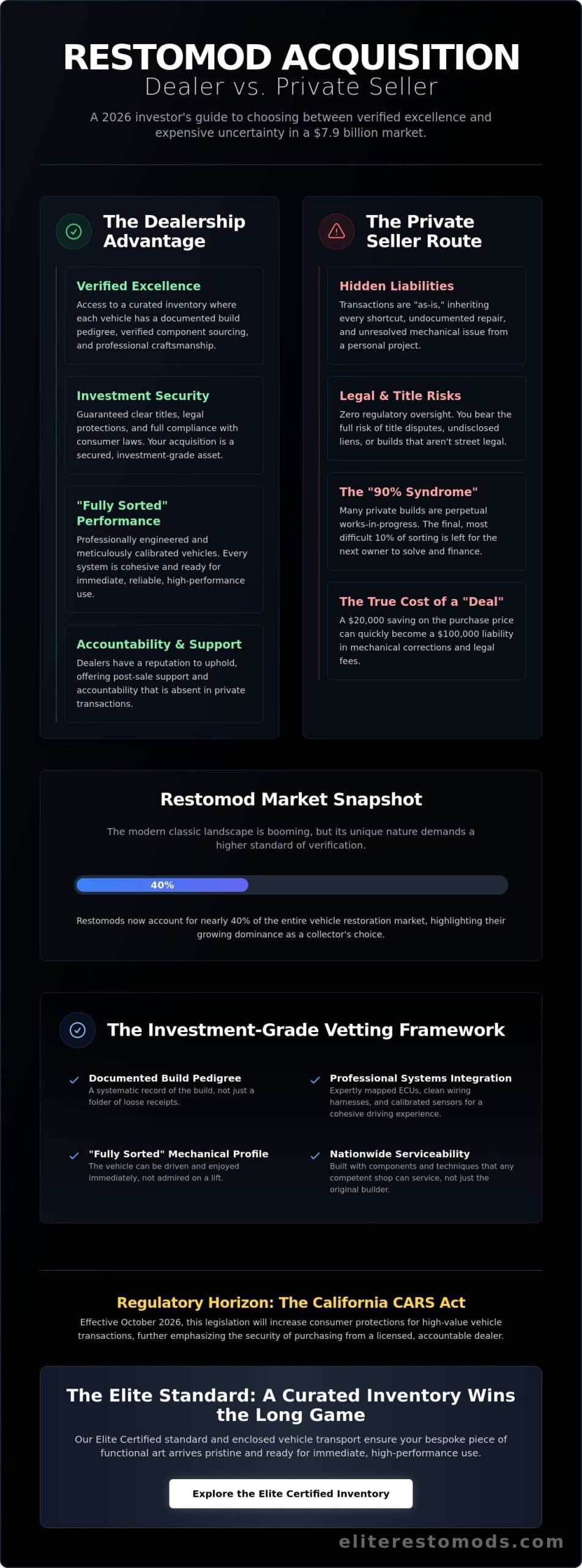
This 2026 investor guide clarifies the risks and rewards of the current landscape where restomods now account for nearly 40 percent of the restoration market. We’ll demonstrate why a professional dealership offers the security of documented craftsmanship and clear titles that private transactions often lack. You’ll gain the technical insight to evaluate engine swaps and understand how the latest consumer protections, like the California CARS Act effective October 2026, impact your purchase. We’ll show you how to ensure your next acquisition is a reliable, high-performance vehicle ready for daily enjoyment.
Key Takeaways
- Understand why a truly “fully sorted” mechanical profile is the most valuable asset in a market where no two builds are identical.
- Evaluate the critical trade-offs between buying a restomod from a dealer vs private seller, focusing on the legal protections and documented provenance that secure your investment.
- Apply a master builder’s vetting framework to uncover hidden liabilities in build descriptions before you ever commit to a physical inspection.
- Explore how the Elite Certified standard and enclosed vehicle transport ensure your bespoke piece of functional art arrives ready for immediate, high-performance use.
The Restomod Marketplace: Why the Seller Source Dictates Your Risk
Every restomod is a universe of one. Unlike a factory-fresh supercar, these machines represent a specific vision executed with varying degrees of precision. Wikipedia defines a ‘restomod’ as a vehicle that combines vintage aesthetics with modern performance, but this definition barely scratches the surface of the engineering depth involved. You aren’t just buying a car; you’re buying the technical decisions of the person who built it. This is the fundamental challenge when buying a restomod from a dealer vs private seller. One offers a curated legacy. The other offers a personal project.
A “fully sorted” vehicle is the holy grail of this 7.9 billion dollar industry. It means every rattle is silenced, every sensor is calibrated, and the cooling system can handle a summer afternoon as easily as a mountain pass. Most private builds never reach this state. They remain perpetual works in progress, plagued by ninety-percent syndrome where the final, most difficult details are left for the next owner to solve. The value of a modern classic lies in its ability to be driven, not just admired on a lift.
To better understand how different seller sources impact your purchase experience, watch this helpful comparison:
The Complexity of Modern Engineering in Vintage Steel
Marrying a modern Coyote or LS engine to a fifty-year-old chassis is a feat of sophisticated integration. It isn’t just about motor mounts. It’s about the invisible architecture: the wiring harnesses, the ECU mapping, and the fuel delivery systems. Amateur builds often fail here. A hobbyist might get the engine to turn over, but a professional shop ensures the throttle response is linear and the telemetry is accurate. There’s a visceral difference in how these cars feel. A professionally engineered masterpiece feels cohesive; a garage build often feels like a collection of parts fighting for dominance.
Defining the Investment-Grade Restomod
To be a true financial asset, a restomod must possess a documented pedigree. This goes beyond a folder of receipts. It involves a systematic record of component sourcing and build phases. Investors in 2026 look for vehicles that can be serviced anywhere, not just in the builder’s own garage. This transparency is why the source of the sale heavily impacts market value. A vehicle sourced through a specialized curated inventory carries an implicit seal of approval. It’s the difference between a simple ownership history and a verified build pedigree that justifies a premium valuation.
The Private Seller Route: High Rewards vs. Hidden Liabilities
The hunt for a private seller often starts with the dream of a bargain. You envision a “diamond in the rough” tucked away in a suburban garage. It’s a romantic notion. A passionate owner selling a labor of love. However, the reality of buying a restomod from a dealer vs private seller is often defined by what you cannot see. Private transactions are almost universally “as-is.” There is no regulatory oversight. When the transaction happens on a driveway, you inherit every shortcut, every oversight, and every emotional bias the seller possesses. Their attachment to the vehicle often clouds the transparency you need to protect your capital.
Verifying a build’s integrity requires more than a flashlight and a test drive. Without a professional hoist and diagnostic scanners, you’re guessing at the quality of the welds and the health of the engine management system. This is why a comprehensive pre-purchase inspection is non-negotiable in the private market. Even then, an inspector can’t always see the “lipstick on a pig” hidden beneath fresh undercoating or behind a custom dashboard. You’re betting on the seller’s honesty in a market where mistakes are expensive to hide and even more expensive to fix.
The “Project Car” Trap
The phrase “90 percent finished” is the most expensive lie in the automotive world. Those final details, the interior trim, the window seals, and the ECU fine-tuning, often require specialized labor that exceeds the cost of a completed car. Correcting a poorly executed modern suspension swap often requires a complete tear-down and re-engineering of the geometry, costing significantly more in labor than a fresh install. You aren’t just finishing a build; you’re often paying to undo someone else’s amateur engineering. It’s an exhausting process that drains both your wallet and your passion for the drive.
Navigating the Paperwork Minefield
Paperwork is where the dream often dies. Private sellers frequently struggle with “title jumping,” where the title was never properly transferred to their name. This creates a legal nightmare during registration. VIN assignments for modified vehicles can be equally complex, especially when engines and frames come from different donors. Securing classic car financing for a private sale is notoriously difficult. While lenders like Star One Credit Union offer rates as low as 4.75 percent, they often require rigorous documentation that a private seller simply cannot provide. Without a professional intermediary, the risk of an undisclosed lien or an out-of-state transfer rejection remains a constant threat to your investment. If you prefer a more secure path, browsing a curated inventory can eliminate these administrative hurdles before they begin.
The Dealership Advantage: Verification, Accountability, and Curation
A specialist showroom is more than a display case. It’s a laboratory where automotive history is refined through the lens of modern engineering. When you’re buying a restomod from a dealer vs private seller, you’re transitioning from a game of chance to a partnership in excellence. A professional dealer acts as a rigorous gatekeeper. They filter out the “lipstick on a pig” builds, ensuring that every vehicle in their inventory meets a baseline of structural and mechanical integrity that a private enthusiast simply cannot guarantee. This curation process is the foundation of long-term investment security.
Accountability is the invisible passenger in every dealer transaction. While a private seller’s phone number might go dead the moment the trailer leaves their driveway, a reputable dealership stakes its entire brand on the performance of its vehicles. They provide a buffer of professional reputation. This means the car has been scrutinized under professional lighting and on high-capacity lifts, revealing the truths that remain hidden in a dimly lit home garage. Dealers also navigate the complex regulatory environment, ensuring that the FTC’s Buyer’s Guide is present and that all title disclosures are transparent and accurate.
The Value of a Fully Sorted Inventory
A “turn-key” restomod should be capable of a 500-mile journey the day you take delivery. Achieving this requires a obsessive focus on NVH, or noise, vibration, and harshness. Professional test drivers spend hours identifying the harmonic imbalances and electrical gremlins that plague amateur builds. They ensure the LS3 idles perfectly and the Wilwood brakes bite with consistent pressure. This meticulous Elite Restomods process transforms a collection of high-end parts into a cohesive, high-performance machine. You’re paying for the peace of mind that comes from thousands of miles of simulated road wear and professional calibration.
Dealer vs. Private Seller Comparison
The sticker price of a restomod is only the beginning of the financial narrative. To understand the true cost of ownership, consider the following comparison of the purchase experience:
| Feature | Specialized Dealer | Private Seller |
|---|---|---|
| Technical Vetting | Multi-point mechanical and electrical audit | Visual inspection and subjective “feel” |
| Financing Options | Access to specialized classic car financing | Typically cash-only or personal loans |
| Legal Protection | State and Federal consumer disclosures | Caveat Emptor (Buyer Beware) / “As-Is” |
| Logistics | Professional enclosed vehicle transport | Buyer-coordinated shipping and risk |
Beyond the initial purchase, a dealership provides a path for your evolving collection. Through a professional Consignment Program, you have a ready-made platform to sell your vehicle when you’re ready to upgrade to your next bespoke project. This ecosystem of support ensures that your investment remains liquid and your passion for the drive remains uninterrupted by the logistical headaches of the open market.
Critical Evaluation: How to Vet a Seller Before the Transaction
Due diligence is the armor of the collector. The process of buying a restomod from a dealer vs private seller demands a shift in mindset from enthusiast to investigator. While a dealer often presents a curated narrative backed by a professional reputation, a private seller presents a personal history that requires deep verification. You must look past the gleaming paint and focus on the mechanical architecture. Red flags often hide in plain sight. A vague description or a refusal to provide high-resolution undercarriage photography usually signals hidden rust or compromised fabrication. If a seller cannot produce a detailed component list featuring industry standards like Wilwood brakes or Holley EFI systems, the build’s long-term reliability is a gamble you shouldn’t take.
The logistical divide between these two paths is most apparent during the closing phases. Private sellers rarely have the infrastructure to coordinate Enclosed Vehicle Transport, leaving you to manage the risk of shipping a six-figure asset on an open trailer or vetting third-party carriers yourself. Dealerships eliminate this anxiety by providing end-to-end logistics. They also bridge the gap in capital acquisition. While a private seller requires a liquid transaction, a specialized dealer facilitates Classic Car Financing through lenders like Woodside Credit or LightStream. As of May 2026, rates for these high-value assets typically range from 6.49 percent to over 9 percent, depending on the term. A dealer handles the documentation these lenders require, which a private party often lacks.
Questions Every Buyer Must Ask
An elite build is defined by its lineage. You must demand transparency regarding the labor behind the machine. Start with these essential inquiries:
- Who performed the engine swap and wiring integration? A reputable shop name adds immediate value.
- Is there a full build book with receipts and wiring diagrams? Without a map, future electrical repairs become an expensive guessing game.
- How many miles have been driven since the completion of the build? A car with only fifty “test miles” is not yet sorted; it is a prototype.
Evaluating the Seller’s Professionalism
Reputation is a tangible asset in the restomod world. When dealing with a dealership, scrutinize their online reviews and presence at major industry events. Their willingness to allow a third-party pre-purchase inspection (PPI) is the ultimate litmus test of their confidence. In a private sale, the burden of this inspection falls entirely on you. You must verify the integrity of modern suspension swaps and the precision of the ECU tuning. For a deeper dive into the technical nuances of these machines, consult this A Buyer’s Checklist for a Restomod Car. If the search for the perfect build feels overwhelming, utilizing professional vehicle sourcing can ensure you only evaluate cars that have already passed an expert’s scrutiny.
The Elite Standard: Why a Curated Inventory Wins the Long Game
The decision of buying a restomod from a dealer vs private seller is ultimately a decision about the future of your collection. In a market projected to reach 14.4 billion dollars by 2036, the distinction between a hobbyist build and an investment-grade asset becomes the difference between a depreciating liability and a legacy piece. Elite Certified Restomods represent the pinnacle of this evolution. They are not merely cars for sale. They are engineering benchmarks. By choosing a curated inventory, you bypass the volatility of the open market and step into a world of verified performance and aesthetic perfection.
A professional dealership serves as a permanent anchor in your automotive journey. While private transactions are fleeting and often fraught with post-sale silence, a dedicated curator offers a suite of ongoing support. This includes specialized Vehicle Sourcing to find specific year and model combinations that meet your exacting standards. Once acquired, your investment is protected by Enclosed Vehicle Transport. This ensures that the pristine finish and mechanical calibration remain undisturbed from our showroom to your door, regardless of the distance.
Simplifying the Ownership Experience
The true luxury of a high-end restomod is the absence of anxiety. We handle the heavy lifting of mechanical verification, subjecting every build to a level of scrutiny that would be impossible for an individual buyer to replicate. Our process ensures that the marriage of vintage steel and modern power is harmonious and reliable. For those who prioritize the long-term preservation of their assets, we provide Climate-Controlled Storage. This service shields your functional art from the elements, maintaining the integrity of the artisanal interiors and high-performance components. It’s a comprehensive approach that treats the car as a living piece of history, ready to be enjoyed at a moment’s notice.
Your Journey to the Perfect Drive
The hunt for excellence shouldn’t be a burden. It should be an invitation to rediscover the thrill of the open road. By prioritizing curation over mere transaction, you ensure that your garage is filled with icons that are as reliable as they are breathtaking. We invite you to witness the results of our perfectionism firsthand. Explore our curated inventory of Elite Certified Restomods and find the machine that speaks to your soul. The best restomod isn’t just a collection of parts; it’s the one you can drive with total confidence.
Secure Your Automotive Legacy
The choice of buying a restomod from a dealer vs private seller determines whether your acquisition is a source of visceral joy or mechanical frustration. While the private market offers the initial thrill of the hunt, it often hides liabilities that compromise both safety and long-term investment value. A specialized dealer provides the necessary engineering oversight to ensure every component, from the ECU tuning to the chassis reinforcement, functions as a cohesive masterpiece. You aren’t just purchasing a car; you’re investing in a verified standard of excellence that preserves the soul of the original design.
Our Elite Certified quality assurance process eliminates the guesswork that plagues unverified builds. Through specialized classic car financing partnerships and national enclosed vehicle transport, we provide a seamless transition from our curated showroom to your private collection. Every detail is meticulously managed so you can focus on the visceral experience of the drive rather than the anxiety of the unknown. Browse our investment-grade restomod inventory today. Your journey toward the perfect modern classic begins with a partner who values perfection as much as you do.
Frequently Asked Questions
Is it cheaper to buy a restomod from a private seller?
The initial purchase price in a private sale is often lower, but the total cost of ownership frequently exceeds that of a dealer-sourced vehicle. Private sales lack the rigorous mechanical sorting that defines a professional build. You often pay for those initial savings later through expensive repairs to wiring or suspension geometry that weren’t properly integrated during the hobbyist build process.
Do restomod dealers offer warranties on classic cars?
Most restomod dealers sell vehicles as-is but provide a higher level of accountability and post-sale support than private parties. While a traditional factory warranty is rare in the classic world, reputable dealers must comply with the FTC’s Used Car Rule and display a Buyer’s Guide. This transparency ensures that known mechanical issues are disclosed before the transaction is finalized.
Can I get financing for a restomod bought from a private party?
Securing financing for a private party restomod is significantly more difficult than through a dealership. Lenders like Star One Credit Union and LightStream offer rates ranging from 4.75 percent to over 15 percent APR as of May 2026, but they often require professional appraisals. Dealers simplify this by maintaining established partnerships with specialized classic car financing providers who understand these bespoke assets.
How do I verify the quality of a restomod build from a dealer?
Verification comes through a combination of documented build history and physical inspection. You should request a full build book that details the component sourcing, such as the specific engine variant and wiring harness used. A professional dealership will welcome a third-party inspection and provide detailed photography of the chassis and electrical integration to prove the build’s long-term integrity.
What are the most common red flags when buying from a private seller?
The most significant red flags include a lack of documentation, title jumping, and a refusal to provide undercarriage photos. Be wary of sellers who describe a car as nearly finished. This usually indicates that the most complex engineering hurdles, like ECU tuning or final interior fitment, remain unresolved and will soon become your financial burden.
Why do restomod dealers charge more than the private market value?
The premium reflects the cost of professional curation, mechanical sorting, and legal security. When buying a restomod from a dealer vs private seller, you’re paying for a vehicle that has already undergone hundreds of hours of testing and refinement. This investment acts as an insurance policy against the catastrophic mechanical failures common in amateur, unverified builds found on the open market.
Is a PPI (Pre-Purchase Inspection) necessary if I buy from a reputable dealer?
A PPI is always a wise investment for a high-value asset, though it’s less critical when buying from a dealer with a transparent quality assurance process. Reputable dealers often perform their own multi-point audits before a vehicle enters their inventory. However, a third-party inspection provides an additional layer of confidence and ensures the vehicle meets your specific performance and aesthetic expectations.
How does enclosed transport work when buying a car from a dealer across the country?
Enclosed transport provides a secure environment that protects your vehicle from road debris and weather during transit. Most specialized dealers coordinate Enclosed Vehicle Transport as part of their white-glove service. The carrier picks up the vehicle directly from the showroom and delivers it to your specified location, maintaining the pristine condition of the artisanal finishes and high-performance mechanical components.