
Authenticity isn’t just a badge on a grille. It’s a forensic narrative written in stamped steel and faded ink, requiring a meticulous eye to distinguish between a factory-original icon and a well-executed tribute. You’ve likely felt that sharp pang of anxiety when staring at a non-standardized pre-1981 serial number, wondering if the metal truly matches the soul of the machine. It’s a high-stakes game where the difference between a blue-chip investment and a costly clone often hides in the smallest casting marks. Learning how to verify classic car authenticity is the only way to safeguard your legacy, especially in a selective buyer’s market where precision is the ultimate currency.
We understand that your pursuit of automotive excellence demands absolute certainty before you sign the title. This guide will teach you to master the art of verification to protect your capital and ensure your vehicle’s long-term investment potential. We’ll provide a clear roadmap for tracing provenance, spotting counterfeit tags, and evaluating the integrity of hidden mechanical modifications. You’ll move from the initial spark of recognition to a systematic, logical breakdown of the vehicle’s history, gaining the confidence of a world-class curator and protecting your vision of high-performance reality.
Key Takeaways
- Navigate the labyrinth of pre-1981 serial numbers to separate genuine automotive heritage from high-priced imitations.
- Master the forensic audit of historical documentation, learning how to verify classic car authenticity through a verified chain of ownership and original build sheets.
- Verify mechanical DNA by cross-referencing engine casting numbers and transmission date codes against the vehicle’s original chassis.
- Assess the integrity of modern performance upgrades to ensure bespoke craftsmanship aligns with elite investment-grade standards.
- Understand the meticulous vetting process required to source and certify high-performance assets for a world-class collection.
The Foundation of Classic Car Authenticity and the VIN Challenge
Authenticity is a narrative written in steel. In the high-stakes world of vintage assets, it’s more than a feeling; it’s a verifiable lineage. For organizations like the Classic Car Club of America (CCCA), the definition of a true classic often hinges on historical significance and mechanical purity. When you’re looking at how to verify classic car authenticity, you aren’t just looking for a clean title. You’re hunting for the soul of the machine as it left the factory.
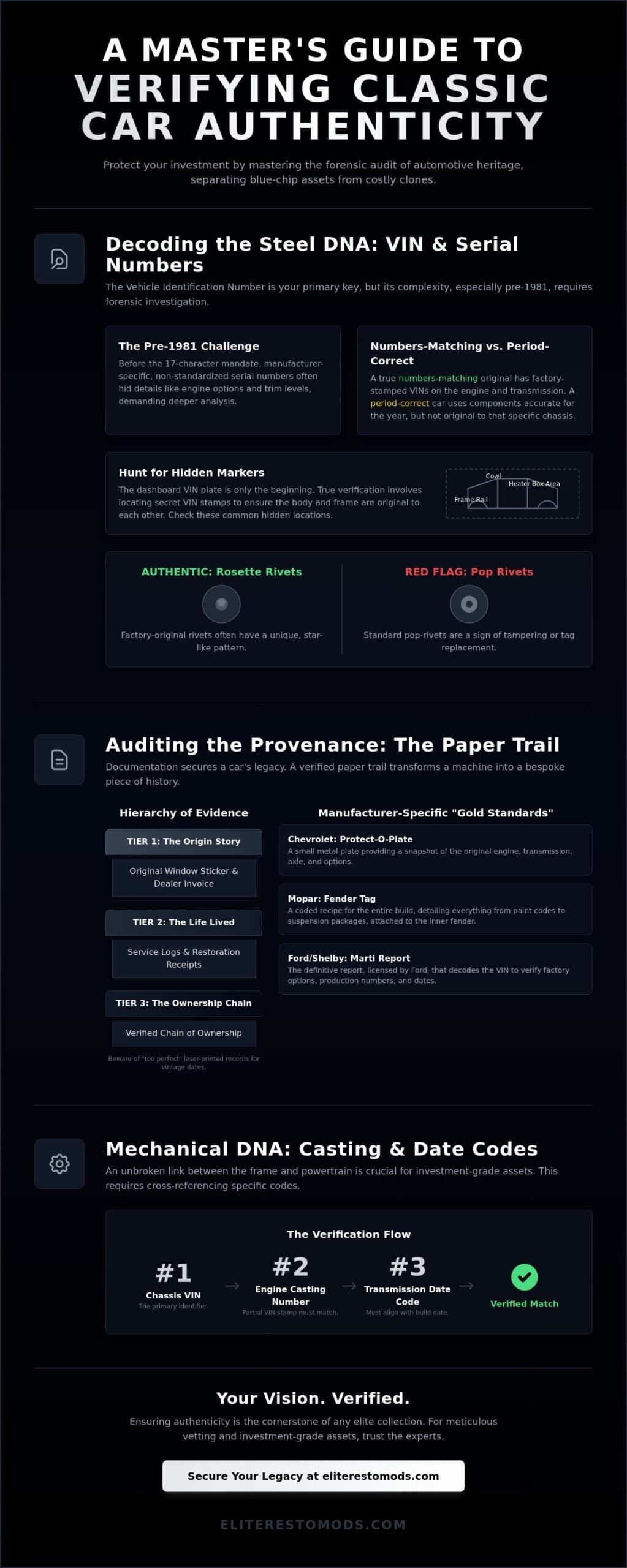
The Vehicle Identification Number (VIN) is your primary key. It’s a complex one. Before the federal 17-character mandate in 1981, manufacturers were the masters of their own proprietary coding systems. This lack of standardization created a landscape where a serial number might only reveal the assembly plant and the production sequence. It often left the engine options and trim levels shrouded in mystery, making forensic investigation a necessity for any serious collector.
To better understand the nuances of these identification systems, watch this breakdown of vintage verification:
A VIN is a starting point. It’s not a destination. To truly master how to verify classic car authenticity, one must look beyond the dashboard. A true numbers-matching original means the engine, transmission, and rear axle carry the specific partial VIN stamped at the factory. In contrast, a period-correct restoration uses components that are technically accurate for the year but didn’t actually begin life in that specific chassis. While both have value, the investment-grade asset relies on that singular, unbroken connection between the frame and the powertrain.
Locating Hidden Identification Markers
Master builders know that the obvious VIN plate on the dash is only half the story. To truly verify a vehicle, you must dive deeper into secret VIN locations. These are often stamped into the top of the frame rails, hidden under the cowl, or tucked behind the heater box. We look for these hidden markers to ensure the body hasn’t been swapped onto a different frame. Look closely at the rivets on the VIN tag. Rosette-style rivets are standard for certain eras; any sign of a standard pop-rivet is an immediate red flag for tampering or reproduction plates.
Understanding Manufacturer-Specific Coding
Every brand left its own unique paper and metal trail. Chevrolet enthusiasts hunt for the Protect-O-Plate, which provides a detailed snapshot of the car’s original mechanical specs. Mopar collectors rely on Fender Tags. These act as a coded recipe for the entire build, detailing everything from paint codes to suspension packages. For Ford and Shelby owners, the Marti Report is the gold standard for verifying factory options. Identifying factory-original spot welds and the specific texture of firewall paint can also reveal if a car has been rebodied. Our meticulous vetting process ensures every detail aligns with historical standards.
Verifying Provenance Through Historical Documentation
Steel and rubber tell the story of a car’s life, but paper secures its legacy. Documentation is the silent guardian of value. When you look at how to verify classic car authenticity, you aren’t just inspecting the chassis; you’re auditing a paper trail that spans decades. A stack of receipts isn’t just a record of maintenance. It’s a map of the car’s soul. Provenance transforms a mere machine into a bespoke piece of history, ensuring that its pedigree is as legitimate as its performance.
Collectors must establish a hierarchy of evidence. At the summit sits the original window sticker and the dealer invoice. These documents prove exactly how the car was configured when it rolled off the showroom floor. Below these are service logs and restoration receipts. Beware of “too perfect” records. If a 1969 muscle car comes with a stack of laser-printed invoices from 1974, you’re looking at a fabrication. Authentic vintage receipts often feature carbon-copy residue, typewriter indentations, or hand-written notes in period-correct ink. It’s vital that you thoroughly research any models before committing to a purchase. Gaps in service history often hide the trauma of major collisions or long periods of neglect.
The Holy Grail: Original Build Sheets
The build sheet is the ultimate proof of identity. Factory workers often tucked these into hidden crevices during assembly. You might find them behind the rear seat springs, under the carpeting, or even taped to the top of the fuel tank. These sheets contain specific factory codes for every option, from heavy-duty suspension packages to rare interior trim colors. Cross-referencing these codes with the physical vehicle is the most reliable way to ensure you aren’t buying a clone. Check the paper’s texture. Genuine build sheets from the 1960s and 70s are often brittle, yellowed, and carry the faint scent of old oil and industrial dust. This is where the art of how to verify classic car authenticity becomes a tactile experience.
Tracing the Chain of Ownership
A clear chain of title is non-negotiable for investment-grade assets. Tracing ownership through state DMV records can reveal the car’s geographical history. A car that spent thirty years in the dry Arizona desert has a different structural narrative than one from the salt-heavy roads of the Northeast. Reach out to previous owners if possible. Long-term club registries often hold the keys to a vehicle’s past. If you find a ten-year gap where the car seemingly vanished, it may have been undergoing a significant rebody or total restoration. For those seeking absolute transparency, our curated inventory includes vehicles with vetted histories to remove the guesswork from your acquisition.
Mechanical DNA: Casting Numbers and Date Codes
The heartbeat of a vintage asset isn’t found in a logbook. It’s cast in iron and aluminum. While a modern Vehicle Identification Number (VIN) provides a digital fingerprint for post-1981 machines, vintage blocks tell their story through granular mechanical DNA. Understanding how to verify classic car authenticity requires a deep dive into the foundry marks that define a vehicle’s mechanical integrity. This is where brute force meets forensic science. Every major component, from the intake manifold to the rear-end housing, carries a coded history that must align perfectly with the chassis build date.
Logic dictates the timeline. In the meticulously sequenced world of automotive assembly, every part was manufactured before the car was completed. If a vehicle’s build date is the third week of October, an authentic engine block must carry a casting date from weeks or months prior. A block cast in November found in an October car is a replacement, regardless of how well the stampings appear to match. This chronological consistency is the hallmark of an investment-grade machine. We verify these sequences to ensure the soul of the car remains as the factory intended.
Forensic Engine Inspection
The engine pad is the primary canvas for verification. We look for factory broach marks, the fine, parallel lines left by the massive machining tools at the plant. These marks are nearly impossible to replicate perfectly once a block has been decked during a rebuild. If the pad is smooth or shows circular sanding marks, the numbers have likely been restamped. Genuine stampings should show slight variations in depth and alignment, reflecting the hand-held nature of the original assembly process. Identifying the specific casting dates on the block and cylinder heads ensures the powertrain is a cohesive unit, not a collection of period-correct parts salvaged from different donors.
Transmission and Drivetrain Verification
Drivetrain integrity extends far beyond the engine bay. High-performance muscle cars often featured partial VINs stamped into the transmission case, usually near the top or on a side flange. Matching these to the frame is critical for establishing a true numbers-matching pedigree. Differential housings and axle tubes also carry identification codes that reveal the original gear ratios and manufacturing dates. Verifying these components ensures the vehicle’s mechanical capability matches its historical specifications. For collectors who demand excellence, our vehicle sourcing experts utilize this forensic approach to identify assets that possess both raw power and unquestionable provenance.
The Restomod Paradox: Verifying Modern Excellence
Authenticity is an evolving narrative. While preservationists chase the elusive numbers-matching block, the restomod collector seeks a different kind of truth. In this space, the question of how to verify classic car authenticity shifts from factory purity to the pedigree of modern engineering. It’s about ensuring that the marriage of brute force and refined comfort is built on a legitimate foundation. A true restomod isn’t a Frankenstein of parts; it’s a bespoke piece of functional art where every modern upgrade has a verifiable lineage. With the global restoration and restomod market estimated at 7.9 billion dollars in 2026, the stakes for verifying these high-performance assets have never been higher.
Verification in the restomod world requires a dual-track audit. You must first confirm the historical identity of the donor vehicle, then pivot to a forensic review of the modern components. A high-end build should come with a comprehensive binder detailing the provenance of every major system. From the serial numbers of the crate engine to the specific gear ratios in the aftermarket transmission, transparency is the ultimate hallmark of quality. Without this ink-and-paper trail, a vehicle is just a collection of parts rather than a curated investment.
Verifying the Quality of Modern Upgrades
Modern performance hardware must be as elite as the chassis it inhabits. When inspecting an LS or Coyote engine swap, look beyond the horsepower ratings. We examine the integration of the wiring harness and the layout of the electronic fuel injection system. Professional-grade builds utilize industry-standard hardware and clean, modular looms that mirror factory reliability. High-end suspension systems from recognized manufacturers should be accompanied by documentation that confirms their specific tuning and geometry. If the braking system features six-piston calipers and oversized rotors, verify they are authentic components and not unbranded imitations. Quality is visible in the details of the fabrication, from the precision of the welds to the finish on the artisanal interiors.
The Integrity of the Donor Chassis
Modern power is useless if the foundation is compromised. Even the most radical build must begin with a genuine classic chassis to maintain its soul and its value. Confirming the original VIN of the donor vehicle is the first step in how to verify classic car authenticity, ensuring the car isn’t a modern reproduction masquerading as a vintage icon. We inspect frame modifications for structural integrity, looking for reinforced crossmembers and professionally boxed rails that can handle the torque of a modern powerplant. You can see fully sorted examples of this structural excellence in our current collection. If you’re ready to begin your own transformative journey, our custom build services provide the bridge between your vision and a tangible, high-performance reality.
The Elite Standard: A Master Builder’s Approach to Quality Assurance
Authenticity is the ultimate luxury. It’s the difference between a machine that looks the part and one that performs with unwavering confidence. For the discerning collector, mastering how to verify classic car authenticity isn’t just a hobby; it’s a prerequisite for protecting significant capital. Elite Restomods simplifies this journey by acting as a world-class curator and master builder. We treat every vehicle in our inventory as a tangible, high-performance reality. We ensure that the history of the donor chassis matches the caliber of its modern engineering.
Selecting an investment-grade vehicle requires a perfectionist’s eye. We don’t just look for clean paint and chrome. We hunt for structural integrity and documented provenance. Our team understands the visceral excitement of a classic era of design, but we temper that passion with the cold, hard logic of modern engineering. Every car we represent undergoes a rigorous vetting process that distinguishes it from the unrestored project cars or low-quality clones that often saturate the market. This creates a narrative arc for each project. It takes you from the initial spark of recognition to the final realization of a product’s modern capabilities.
Our Rigorous Quality Assurance Process
The path to excellence is paved with systematic logic. Our multi-point vehicle inspection is a forensic audit that leaves no bolt unturned. We analyze the mechanical DNA of the powertrain, verify the pedigree of high-performance components, and ensure the interior craftsmanship meets our artisanal standards. You can explore our meticulous build standards to understand how we bridge the gap between vintage soul and modern operational reliability. This process ensures that every Elite Certified Restomod is fully sorted for the demands of daily driving, not just for display in a gallery.
Securing Your Automotive Legacy
The collector car market in 2026 is a selective environment. With the Hagerty Market Rating sitting at 59.01 in March 2026, making an informed purchase is more critical than ever. We provide the professional authority needed to avoid common pitfalls like purchasing a high-priced tribute car with hidden mechanical flaws. Understanding how to verify classic car authenticity is your first line of defense; our expertise is your second. Beyond the acquisition, we offer classic car financing and climate-controlled storage to preserve your asset’s value. For a deeper look at the current market, read our Classic Car Restomods for Sale: The 2026 Guide to Investment-Grade Performance. Contact our master curators today to secure a piece of functional art that defines your legacy.
Securing Your High-Performance Legacy
Your journey from enthusiast to world-class curator is defined by the precision of your due diligence. True verification requires a marriage of forensic mechanical inspection and an airtight paper trail. Whether you’re decoding a pre-1981 serial number or auditing the pedigree of a modern engine swap, the goal remains the same: protecting your investment. Mastering how to verify classic car authenticity ensures your collection remains a source of pride rather than a liability. It transforms a simple purchase into a strategic acquisition of functional art.
At Elite Restomods, we bridge the gap between your long-held dream and a tangible reality. We eliminate the anxiety of the unknown through a meticulous quality assurance process that vets every machine for both heritage and modern reliability. Our team selects only expertly vetted investment-grade vehicles, ensuring that the brute force of our builds is matched by refined comfort. When you’re ready to elevate your garage, we offer national enclosed vehicle transport to bring excellence directly to your door.
Explore our curated inventory of Elite Certified Restomods and find the machine that speaks to your soul. Your next automotive masterpiece is waiting.
Frequently Asked Questions
What is the difference between a numbers-matching car and a period-correct car?
A numbers-matching car retains the specific engine and transmission it was born with at the assembly plant. In contrast, a period-correct vehicle utilizes components that are technically accurate for the model year but were sourced from a different donor. While a period-correct machine can offer visceral excitement and refined aesthetics, the investment-grade status of a numbers-matching icon remains the gold standard for pure preservationists. It’s a marriage of historical purity and mechanical integrity.
Can I verify a classic car’s history if the original paperwork is missing?
You can still establish a vehicle’s pedigree through forensic mechanical analysis and hidden identification markers. Searching for casting numbers and date codes on the block, heads, and intake manifold provides a roadmap of the car’s origins. Learning how to verify classic car authenticity often requires cross-referencing these foundry marks with secret VIN locations on the frame. Marque-specific registries and previous owner records found through title searches can bridge the gap left by missing build sheets.
How do I spot a restamped engine or fake VIN tag?
Spotting a restamped block requires an eye for the factory broach marks left by massive machining tools. These fine, parallel lines are destroyed when a block is decked, and they are nearly impossible to replicate with hand tools. For VIN tags, look for the correct rosette-style rivets and signs of metal fatigue around the plate. Any indication of fresh paint or non-standard rivets suggests the vehicle’s identity has been manipulated to hide a clone or tribute car.
What are the most important documents to look for when buying a restomod?
A comprehensive build binder is the most critical documentation for any high-end restomod. This record should include certificates for crate engines, specific hardware serial numbers for suspension systems, and detailed diagrams of the artisanal wiring. It proves that the vehicle is a bespoke piece of functional art rather than a collection of random parts. This level of transparency ensures the modern performance hardware is as elite as the vintage chassis it inhabits.
Does a modern engine swap ruin the authenticity of a classic car?
A modern engine swap doesn’t ruin a classic car; it redefines it for the modern era. While it changes the vehicle’s status from a survivor to a restomod, it significantly improves reliability and operational performance. This transformation is a core part of how to verify classic car authenticity in the restomod space. Value is found in the quality of the integration and the pedigree of the modern components, such as high-performance LS or Coyote powerplants.
What is a Marti Report and why is it essential for Fords?
A Marti Report is a certified document based on Ford’s original production database that lists every factory-installed option for a specific VIN. It’s essential for Ford and Shelby enthusiasts because it provides an objective truth that cannot be forged. This report confirms everything from the original paint code to the specific rear-axle ratio. It acts as the ultimate authority for anyone seeking to verify the provenance of a Mustang, Cougar, or other Ford assets.
How can I verify the mileage on a vehicle that only has a five-digit odometer?
Verifying mileage on a five-digit odometer requires inspecting high-wear areas like brake pedals, seat bolsters, and steering wheel textures. A car claiming 20,000 miles shouldn’t have worn-through pedal pads or significant sagging in the driver’s seat springs. You should also audit the title history through state records to check for mileage jumps or inconsistencies. These tactile clues reveal the true history of a machine that has lived a long, high-performance life.
Is it possible to track down previous owners of a classic car?
Tracking down previous owners is often possible through historical title searches and specialized club registries. These organizations maintain deep databases of ownership history for rare or high-performance models. Contacting a previous owner can reveal insights into past restorations or mechanical modifications that don’t appear in the paperwork. It’s a vital step in the curation process, helping you build a complete narrative arc for your vintage asset and ensuring long-term investment potential.