
The romantic vision of a garage-built icon often masks a brutal financial truth; the perceived savings of sweat equity is frequently the most expensive way to secure a high-performance vintage asset. You’ve likely spent nights scouring auctions for the perfect donor, driven by the belief that building it yourself is the only path to a personalized masterpiece without a premium markup. It’s a relatable ambition. However, as we move through 2026, the true cost of DIY restomod vs buying complete has shifted dramatically due to specialized labor rates and the escalating price of precision engineering.
This analysis provides a definitive financial roadmap for your next acquisition, contrasting the fragmented expense of a multi-year project against the immediate, verified value of a professional build. You’ll discover why the most successful collectors now prioritize turnkey excellence over the uncertainty of a stalled project. We will dissect current market data, from $150 hourly fabrication rates to the $35,000 baseline for integrated drivetrains, to help you invest with absolute confidence. From the visceral roar of a modern Coyote V8 to the tactile luxury of a bespoke interior, we’ll ensure your journey ends with a machine that’s meant to be driven, not just dreamed about.
Key Takeaways
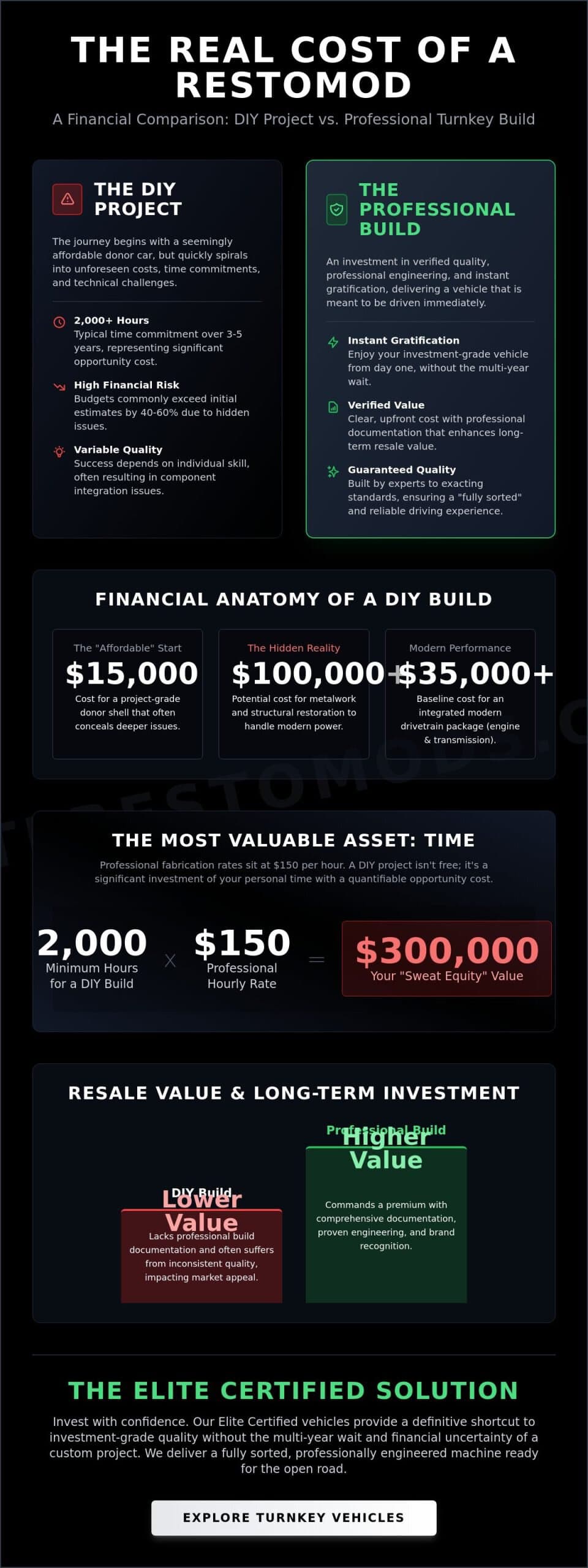
- Uncover why a $15,000 donor shell often conceals six figures in required metalwork and structural restoration before a single performance part is installed.
- Quantify the 2,000-hour labor commitment and determine if your personal time is best spent in the garage or enjoying the open road.
- Evaluate the cost of DIY restomod vs buying complete through the lens of long-term resale value and the necessity of professional build documentation.
- Understand the “fully sorted” premium and why the first 500 miles of a new build are the most expensive and technically demanding to navigate alone.
- Learn how Elite Certified standards provide a definitive shortcut to investment-grade quality without the multi-year wait of a custom project.
Calculating the True Financial Landscape of a DIY Restomod
The allure of the barn find is a powerful drug. It begins with a modest $15,000 investment in a vintage shell, a figure that feels manageable for a passion project. However, this initial acquisition is frequently the first step into a financial labyrinth where the cost of DIY restomod vs buying complete begins to diverge significantly. For the uninitiated, the conservation and restoration of road vehicles has evolved into a high-stakes engineering discipline. It’s no longer just about aesthetics; it’s about the complex marriage of 1960s steel with 2026 performance standards.
To better understand the scale of this undertaking, watch this expert comparison between the two paths:
The Initial Acquisition and Metalwork Reality
A solid donor car, such as a 1966 Mustang hardtop, currently commands roughly $22,500. While rougher project cars are available for under $10,000, they often represent the most expensive path forward. The phrase “mostly rust-free” is the most dangerous term in the DIY lexicon. In a professional shop, hidden oxidation and frame fatigue can necessitate $100,000 in unforeseen metalwork to ensure the chassis can handle modern power. Repairing an original frame to meet modern structural alignment standards often costs more than a bespoke aftermarket chassis, yet many builders don’t discover this until they’ve already spent thousands on a compromised foundation.
Component Inflation and the 2026 Parts Market
The 2026 market for high-performance hardware is defined by precision and price. A Gen 4 Coyote 5.0L crate engine with an automatic transmission costs approximately $11,799, while a 460 HP version paired with a 10-speed automatic reaches $24,995. If you’re seeking a complete drivetrain upgrade package including the engine and transmission, expect to start at $35,000. Beyond the marquee components, the financial “leakage” of a DIY build is found in the details. Shipping fees for heavy crates, specialized tool rentals, and the endless cycle of consumable shop supplies like welding gas and abrasives create a steady drain on capital. Most home-built projects eventually exceed their original estimates by 40 to 60 percent, as the reality of global supply chains and the rising cost of artisanal interiors and climate control kits take their toll on the budget.
The Invisible Expenses: Labor, Expertise, and Opportunity Cost
While mechanical components have clear price tags, the true cost of DIY restomod vs buying complete is often measured in years rather than dollars. A professional, show-quality build typically requires between 4,000 and 5,000 hours of specialized labor. Even a focused hobbyist might spend 2,000 hours over three to five years attempting to reach a similar standard. This leads to a critical question of opportunity cost. If you value your time at even a modest professional rate, the “savings” of a DIY build vanish instantly. Every weekend spent grinding rust or chasing a wiring fault is time stolen from your career, your family, or the open road.
The Automotive Restoration Market Size reflects a growing professional sector because enthusiasts increasingly recognize that modern engineering requires more than just a set of wrenches. Integrating a Gen 4 Coyote engine or a 6.4L Hemi into a vintage chassis involves complex EFI mapping and CAN bus communication that often baffles the casual builder. Without the cohesive engineering of a master builder, DIY projects frequently become a collection of high-end parts that don’t talk to each other, resulting in a car that looks the part but fails to deliver a refined driving experience.
The Skill Gap and Subcontracting Costs
Most enthusiasts eventually hit a technical ceiling. Tasks such as show-quality paint work, which can range from $5,000 to over $10,000, or artisanal interior fabrication, which can exceed $50,000, almost always require outsourcing. You’ll also find that professional shops often charge a premium to “fix” or complete a DIY project that has stalled. The cost of modern diagnostic equipment and specialized fabrication tools alone can add thousands to a home budget. If you prefer to skip the steep learning curve and focus on the visceral thrill of the drive, exploring our current inventory of finished builds is often the more pragmatic financial move.
The Emotional Toll of the Unfinished Project
The “project car” is a staple of automotive culture, yet industry sentiment suggests that roughly 70 percent of DIY restorations are sold unfinished. The honeymoon phase of a build is bright and exciting, but it often fades into a multi-year burden that occupies valuable garage space and mental energy. A stalled project isn’t just a financial drain; it’s a source of persistent anxiety. When a build drags into its fourth or fifth year, the emotional cost of a car you can’t drive begins to outweigh the pride of having built it yourself. Choosing a complete, professionally sorted vehicle replaces that anxiety with instant gratification and the confidence of modern operational reliability.
Buying Complete: The Price of Professional Engineering and Instant Gratification
Choosing to purchase a completed vehicle is more than a matter of convenience; it’s a strategic acquisition of professional engineering. While the cost of DIY restomod vs buying complete often looks similar on a balance sheet, the turnkey path eliminates the arduous “sorting phase” that frequently plagues home builds. Every custom project undergoes a break-in period where mechanical tolerances are tested and minor gremlins are exorcised. In a professional build, these critical first 500 miles are handled by master technicians before the vehicle ever enters your collection. This ensures that the marriage of brute force and refined modern comfort is seamless from the first turn of the key.
The financial structure of buying complete also offers distinct advantages for the modern investor. Unlike a collection of parts sitting in a garage, a finished, high-performance vehicle is a recognized, tangible asset. This allows collectors to utilize specialized classic car financing to fund their passion. By leveraging professional funding, you can secure an investment-grade machine while maintaining liquidity, rather than enduring the unpredictable cash drain of a multi-year DIY project.
The Value of a Turn-Key Asset
A professional build provides a predictable, investment-grade asset from day one. When you acquire a vehicle with a known provenance, you aren’t just buying a car; you’re investing in a documented history. This documentation is vital for long-term resale liquidity. A backyard project often lacks the meticulous records required by high-end collectors and auction houses. In contrast, a professionally sorted machine comes with comprehensive build books and quality assurances that provide absolute peace of mind. It’s the difference between a weekend hobby and a bespoke piece of functional art.
Reliability and Modern Operational Standards
Professional shops achieve a level of fit and finish that is simply unattainable in most home environments. It requires specialized jigs, climate-controlled paint booths, and advanced diagnostic suites. Beyond the aesthetics, the integration of safety features like three-point harnesses and modern six-piston disc brakes requires a holistic engineering approach. The Elite Restomods process focuses on this rigorous quality assurance, ensuring that every component, from the independent rear suspension to the modern climate control kit, functions as a unified system. This level of reliability allows you to enjoy the vehicle as it was intended: on the road, not on a lift.
DIY vs. Buying Complete: A Strategic Comparison Framework
The decision between a multi-year garage commitment and an immediate acquisition is a fundamental choice between two distinct lifestyles. On one side lies the pride of build, a deeply personal journey of creation that often takes a backseat to the reality of the cost of DIY restomod vs buying complete. On the other, the joy of driving provides the raw, visceral experience of a machine that is ready for the canyon road today. Over a five-year ownership window, the professional build typically emerges as the more stable financial choice, as it avoids the compounding expenses of mid-project corrections and uncertified engineering.
Resale reality is the ultimate arbiter of value in the 2026 market. High-end collectors and auction houses prioritize “fully sorted” vehicles with comprehensive professional documentation. This paperwork serves as a certification of engineering integrity, ensuring that the integration of modern power and vintage aesthetics meets rigorous safety standards. While a DIY builder may see their car as a labor of love, the market often views it through the lens of risk. Professional builds mitigate this risk through established quality assurance processes, protecting your capital from the depreciation that often hits unverified hobbyist projects.
Investment-Grade vs. Hobbyist Quality
Professional restomods are engineered to hold value even during fluctuating market shifts. The presence of an original VIN and a clear title, paired with a documented build from a reputable source, creates a liquid asset. This is where the custom restomod builder you choose determines your long-term ROI. A master builder understands how to balance brute force with refined comfort, selecting components that complement each other rather than competing for space or power. This cohesive approach ensures that the vehicle remains a bespoke piece of functional art rather than a collection of mismatched parts.
The Sorting Phase: DIY Pain vs. Professional Polish
Every new build enters a sorting phase, a critical period where technicians troubleshoot minor leaks, rattles, and electrical gremlins. In a home garage, this phase can last for years, and many DIY builds never truly leave it. The frustration of a car that is “almost ready” but remains unreliable can sour the ownership experience. A professionally polished vehicle arrives with these issues already resolved through hundreds of hours of testing. If you value your time and desire a machine that is ready for reliable daily driving immediately, you should explore our Elite Certified restomods to see the difference that professional engineering makes.
The Elite Certified Solution: Why Turn-Key is the Ultimate Investment
The Elite Certified standard is the definitive answer to the complex calculations surrounding the cost of DIY restomod vs buying complete. While a home build often represents a fragmented collection of components, an Elite Certified vehicle is a unified masterpiece of engineering. Every car in our collection undergoes a rigorous, multi-point quality assurance process designed to eliminate the uncertainty of vintage ownership. We don’t just sell cars. We provide a bridge between a long-held dream and a high-performance reality. This turn-key approach ensures that your capital is protected within an investment-grade asset that is ready for the show field or the open road immediately.
By curating a premier inventory of fully sorted machines, we simplify the ownership experience through bespoke service and support. You avoid the three-year build queue and the technical frustrations detailed in previous chapters. Instead, you step directly into the driver’s seat of a vehicle that has been vetted by master builders. This exclusivity is the hallmark of a world-class curator, ensuring that every mechanical intricacy has been addressed before the vehicle enters your climate-controlled storage.
Exclusivity and Pride in Every Build
We treat each vehicle as a bespoke piece of functional art. The visceral excitement of modern power, delivered by industry-standard hardware like the Gen 4 Coyote or LS3, is perfectly paired with nostalgic, era-correct design. This duality defines our brand. Our vehicle sourcing services ensure that only the finest icons enter our program, maintaining a level of exclusivity that a backyard build simply cannot replicate. It’s the marriage of brute force and refined comfort, executed with a level of perfectionism that honors the soul of the original machine while embracing modern operational reliability. You aren’t just buying a machine; you’re acquiring a legacy.
Your Journey to Excellence
We invite you into a transformative narrative that extends far beyond a simple transaction. Whether you are seeking a custom build service or looking to upgrade your collection through our professional consignment program, we provide a steady and purposeful communication flow. Your journey doesn’t end at the purchase. It begins the moment you realize the modern capabilities of your new icon. To find your next drive, we encourage you to navigate our current inventory and experience the confidence that comes with professional craftsmanship. Excellence isn’t found on the garage floor or in rust repair. It’s found on the pavement, under the sun, behind the wheel of a perfectly sorted restomod.
Securing Your Automotive Legacy
Navigating the complex cost of DIY restomod vs buying complete requires a shift in perspective from hobbyist to investor. You’ve seen how the invisible drain of 2,000 labor hours and the escalating prices of precision components can transform a passion project into a multi-year burden. A professional build isn’t just an acquisition; it’s the strategic choice to prioritize immediate performance and documented provenance over the uncertainty of the garage floor. By choosing a fully sorted icon, you replace the anxiety of the sorting phase with the visceral thrill of a machine that’s engineered for the modern era.
We invite you to Explore our current inventory of fully sorted Elite Certified Restomods to find a vehicle that meets our rigorous Quality Assurance standards. With access to specialized classic car financing and national enclosed transport available, the path to owning a bespoke piece of functional art has never been more seamless. Your dream machine shouldn’t be a collection of parts and promises. It should be a high-performance reality that’s ready to ignite your senses today. The road is waiting.
Frequently Asked Questions
Is it cheaper to build a restomod or buy one already finished?
Buying a finished vehicle is almost always more cost-effective than starting from scratch. Professional builders leverage established supply chains and specialized labor efficiencies that individual hobbyists simply cannot replicate. When you analyze the cost of DIY restomod vs buying complete, the total investment in parts, tools, and outsourced labor for a home build rarely matches the immediate market value of a professionally sorted machine.
How much does a professional restomod build typically cost in 2026?
A high-quality professional build generally ranges from $40,000 to $120,000 for standard performance upgrades and aesthetic refinements. However, show-quality projects featuring bespoke engineering and high-performance drivetrains frequently start at $300,000 and can exceed $400,000. These figures reflect the meticulous labor required for concours-level finishes and the integration of sophisticated modern hardware like the Gen 4 Coyote or specialized independent suspension systems.
What is the average time required to DIY a full restomod project?
A comprehensive DIY project typically requires between 2,000 and 5,000 hours of specialized labor to complete. For the average enthusiast working on weekends, this translates to a multi-year commitment that often stretches between three and five years. Professional shops achieve superior results in a fraction of that calendar time by employing master fabricators and technicians who work in parallel on the vehicle’s structural and mechanical systems.
Do DIY restomods have good resale value compared to professional builds?
Professional builds command a significant premium in the resale market due to verified engineering standards and documented build histories. Collectors prioritize the peace of mind that comes with a known builder’s reputation and rigorous quality assurance. While a DIY build represents a personal labor of love, it often lacks the standardized documentation and certified reliability that high-end buyers require when evaluating the cost of DIY restomod vs buying complete.
What are the most common hidden costs in a classic car restoration?
Hidden costs often manifest as unforeseen rust repair, structural fatigue, and the high price of specialty shipping for heavy components. A donor car that appears solid can require $100,000 in corrective metalwork once the shell is stripped and inspected. Additionally, consumable shop supplies, specialized tool rentals, and the need to outsource complex tasks like EFI tuning or custom upholstery can inflate a modest budget by 40 to 60 percent.
Can I finance a restomod that I am building myself?
Financing for a DIY project is exceptionally difficult to secure because lenders cannot easily verify the value of a disassembled asset. Most traditional and specialized lenders require a finished, appraised vehicle as collateral for a loan. In contrast, completed restomods are eligible for specialized classic car financing, allowing you to leverage the vehicle’s tangible value to fund your passion while maintaining your personal liquidity and capital.
What does it mean for a restomod to be “fully sorted”?
A fully sorted vehicle has completed its critical break-in period and undergone rigorous troubleshooting to eliminate minor mechanical and electrical gremlins. This process ensures that every system, from the climate control to the fuel mapping, functions with modern operational reliability. Achieving this state requires hundreds of test miles and expert diagnostic work, a standard that distinguishes Elite Certified machines from the typical projects found in the secondary market.
Is a restomod a better investment than a factory-original restoration?
Restomods currently offer superior market growth and broader appeal due to their modern drivability and enhanced safety features. While factory-original cars appeal to a specific niche of preservationists, the global market shows a strong preference for vehicles that combine classic aesthetics with high-performance reliability. This demand drives higher resale values and greater liquidity, as modern collectors prioritize the ability to utilize and enjoy their investment on the road.