
The most expensive restomod you’ll ever buy is the one built to look fast on a showroom floor but wasn’t engineered to survive an hour of real-world driving. It’s a common trap in a global restoration market projected to reach $7.9 billion this year. While the silhouette of a classic muscle car evokes a deep, visceral nostalgia, the mechanical reality underneath must be uncompromisingly modern. Knowing the critical questions to ask when buying a restomod is the only way to ensure you’re investing in a masterwork rather than a surface-level restoration. You deserve the raw excitement of a vintage legend tempered by the confidence of 2026 engineering.
We understand that a high-end build is more than a machine; it’s a bespoke piece of functional art and a significant financial asset. This guide provides a technical framework to evaluate cooling systems, wiring integrity, and structural modifications with the precision of a master builder. You’ll learn how to interrogate a seller’s documentation and verify that every component, from the crate engine to the modern coilover suspension, was installed for performance. We’ll help you validate the vehicle’s long-term value and safety so you can drive with absolute pride.
Key Takeaways
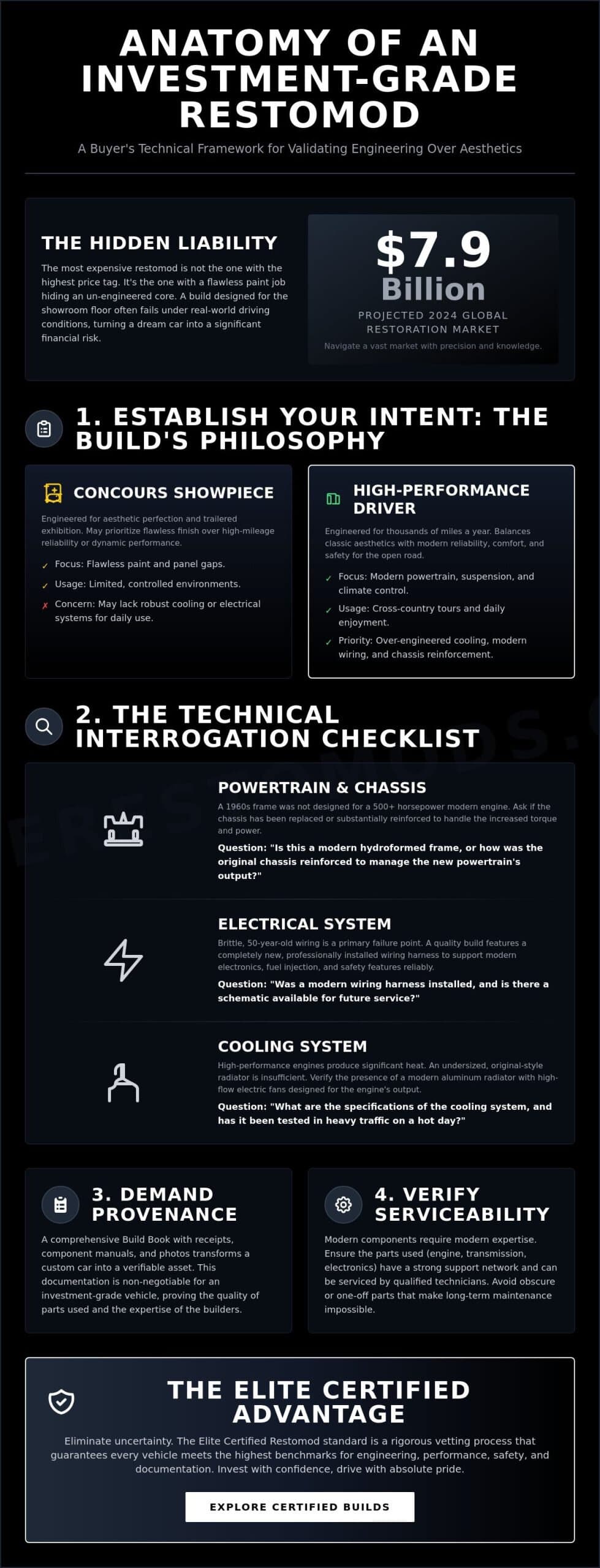
- Define your driving goals before the inspection. A vehicle built for the concours circuit requires a different engineering philosophy than a daily driver designed for the open road.
- Use a specific framework for questions to ask when buying a restomod to validate the mechanical integrity of the powertrain, cooling, and electrical systems. These invisible details separate reliable builds from aesthetic-only projects.
- Demand a comprehensive Build Book to verify the vehicle’s provenance. Detailed documentation transforms a custom machine into a verifiable, long-term financial asset.
- Evaluate the serviceability and support network of the build. Ensure that modern performance components can be maintained by qualified technicians without compromising the vehicle’s artisanal character.
- Discover how the Elite Certified Restomod standard eliminates market uncertainty. This rigorous vetting process ensures every vehicle meets the highest benchmarks for safety and engineering excellence.
Establishing the Baseline: Why Your Restomod Interrogation Starts with Intent
A restomod is not merely a car; it is a bespoke piece of functional art. It represents a deliberate marriage of brute force and refined comfort. While a traditional restoration seeks to preserve the past, a restomod seeks to perfect it. This distinction is vital for any collector looking to secure a long-term financial asset. Before diving into technical specs, your first set of questions to ask when buying a restomod should focus on the underlying philosophy of the build. You are looking for a narrative of transformation, not just a list of parts.
Success in the 2026 collector market requires understanding the difference between restoration and restomod. One prioritizes historical accuracy, while the other prioritizes modern operational reliability. You must determine if the vehicle was engineered to be a static showpiece or a high-performance machine capable of daily utilization. The entry-level question for any seller must be about the intended use-case. A build designed for the lawn at Pebble Beach has a vastly different mechanical soul than one built to conquer a cross-country tour.
To better understand the choice between starting from scratch or purchasing a finished masterpiece, watch this helpful video:
The Crucial Difference Between Restored and Re-engineered
Many builds on the private market are simply “lipstick on a pig.” They feature fresh paint and a modern crate engine but retain antiquated chassis geometry and brittle, decades-old wiring. You must ask if the build was a ground-up transformation. A truly investment-grade vehicle is fully sorted. A fully sorted restomod is one that has undergone rigorous road testing and quality assurance to ensure every component works in harmony. This level of perfectionism is what separates a professional build from a hobbyist project. You can learn more about the standards required for this level of excellence by reviewing our meticulous build process.
Defining Your Ownership Goals
Your intent dictates the engineering requirements. Are you planning to drive 5,000 miles a year or 500? High-mileage goals require modern climate control, premium sound deadening, and integrated infotainment that mirrors a modern luxury experience. If you crave a raw, vintage feel, you might sacrifice some refined modern performance for mechanical feedback and visceral engine noise. The trade-off between heritage aesthetics and contemporary operational reliability is a personal choice. Be honest with yourself about your needs before you begin the interrogation. A daily driver requires a level of perfectionism in the cooling and electrical systems that a weekend show car might never test.
Under the Hood: Technical Questions to Validate Mechanical Excellence
The roar of a high-performance V8 is intoxicating, but the engineering that supports that sound determines whether the vehicle is a masterpiece or a liability. When compiling your list of questions to ask when buying a restomod, the mechanical interrogation must be relentless. You are looking for a symphony of modern components working in perfect synchronization with a vintage soul. Aesthetics may win trophies, but meticulous engineering wins the road.
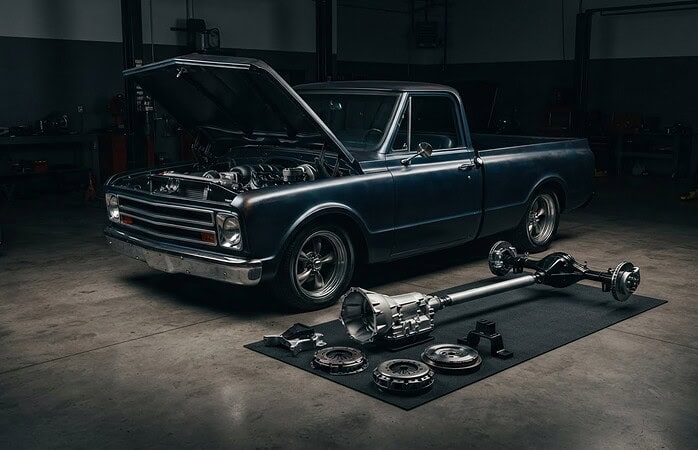
Understanding what to know before buying a restomod involves looking past the chrome to the logic of the build. A factory frame from 1969 was never designed to manage the violent torque of a 2026-spec powertrain. You must verify that the chassis has been reinforced or replaced with a modern hydroformed frame capable of handling 500 or more horsepower without twisting. This structural integrity is the foundation of a safe, high-performance investment. You can see these engineering standards firsthand by browsing our current inventory of engineered masterpieces.
Powertrain and Drivetrain Interrogation
Is the engine a factory-fresh crate motor or a rebuilt salvage unit? A modern LS3 crate engine, typically valued around $7,200, offers a baseline of reliability and a predictable power curve that a salvaged block cannot guarantee. Ask about the engine management system and whether it features a modern ECU that allows for diagnostic plug-ins. The transmission choice is equally critical. You need to know if the gearbox is electronically controlled to manage heat and shift points effectively. Finally, ask about the rear-end gear ratio. A ratio optimized for stoplight acceleration might make highway cruising at 75 mph a loud, high-RPM chore.
Electrical Systems and Cooling Logic
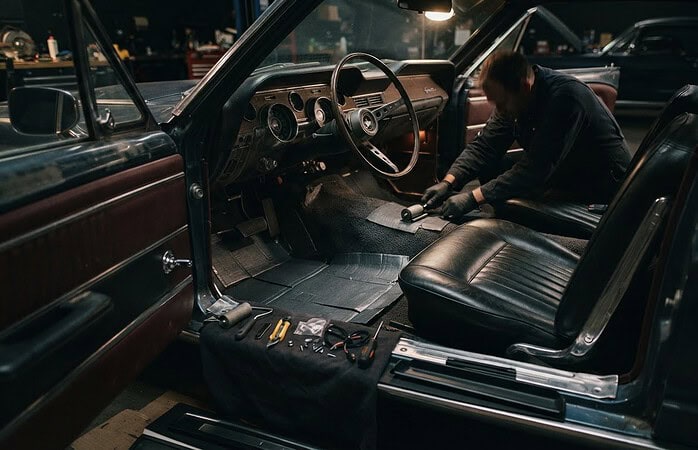
Electrical failures and overheating are the two most frequent reasons a restomod ends up on a flatbed. Ask if the wiring harness is a bespoke unit designed for this specific chassis or a generic kit that relies on universal grounding points. High-traffic environments are the natural enemy of custom builds. You must interrogate the seller on how the cooling system was calculated. Does it feature a high-capacity aluminum radiator with pulse-width modulated fans? Beyond the engine, ask about thermal management for the cabin. A world-class build uses specialized insulation to keep the heat of a modern powertrain from migrating through the firewall and floorboards, ensuring your comfort remains as refined as the car’s exterior finish.
Do not be distracted by the visual appeal of oversized calipers. You must ask about the master cylinder ratio and whether the pedal feel is consistent with the vehicle’s stopping power. A mismatch here leads to a wooden pedal or dangerously long stopping distances. A truly sorted build ensures that the brute force of the engine is always balanced by the precision of the brakes and the responsiveness of the suspension.
Beyond the Paint: Verifying Engineering Standards and Provenance
A flawless finish can mask a multitude of sins. While the visual impact of deep, mirror-like paint is undeniable, the true value of a custom build lies in its transparency. Every masterpiece requires a paper trail. This is why your questions to ask when buying a restomod must extend to the vehicle’s provenance and the standards of its assembly. You are not just purchasing a machine; you are acquiring a legacy of craftsmanship that must be legally and technically sound.
Beyond the surface, there are critical technical aspects to evaluate in a restomod, such as chassis integrity and wiring logic, which are only verifiable through meticulous record-keeping. A professional builder treats documentation with the same reverence as the metalwork itself. If a seller cannot provide a clear manifest of the high-performance parts used, or a detailed testing protocol, the vehicle’s long-term reliability remains a gamble. You deserve the confidence that comes with a fully vetted asset.
The Anatomy of a Professional Build Book
A professional Build Book is more than a folder of receipts; it is a technical blueprint for future serviceability. It should contain bespoke wiring diagrams, specific paint codes for future touch-ups, and part numbers for every wear item from brake pads to fuel filters. Photo documentation of the metalwork is vital. You need to see the vehicle in its raw, stripped state to verify a rust-free foundation before the filler and primer were applied. This level of detail ensures that your investment remains maintainable for decades to come.
Title and VIN Verification
The legal foundation of your investment must be unshakeable. You must ask about the title status to avoid the pitfalls of “rebuilt” or “salvage” designations that can devastate resale value. Ensure the VIN on the frame matches the body and the paperwork. In the world of high-end custom builds, provenance is the ultimate protector of value. A clear, clean title from a reputable source is non-negotiable. It transforms a collection of parts into a recognized classic icon with a modern soul.
Finally, inquire about the quality assurance protocol. A masterwork is never finished the moment the last bolt is tightened. It requires a “shakedown” period. Ask how many test miles were logged and what adjustments were made during this phase. At Elite Restomods, our rigorous quality assurance process ensures that every vehicle is fully sorted before it reaches your garage. This commitment to perfectionism is what separates an investment-grade masterpiece from a surface-level restoration.
Living with a Legend: Practical Questions for Long-Term Ownership
Owning a high-end restomod is a transformative experience. It bridges the gap between the visceral thrill of a vintage muscle car and the effortless reliability of a modern luxury sedan. However, the true test of a build occurs long after the initial transaction. Your final set of questions to ask when buying a restomod must address the practicalities of long-term ownership. These inquiries ensure that the vehicle remains a partner for the open road rather than a delicate sculpture requiring constant intervention. Asking the right questions to ask when buying a restomod now prevents mechanical frustration later.
Maintenance and Technical Support
Are the wear items easily accessible? You don’t want a simple belt failure to ground your vehicle for weeks while you wait for a bespoke part from a boutique manufacturer. Ask if the brakes, belts, and filters can be sourced from a standard local parts store. A professional builder prioritizes serviceability by using industry-standard hardware. It’s also vital to ask if the builder offers a dedicated support line for post-purchase technical questions. Reliable Elite Restomods services provide the peace of mind that expert guidance is only a phone call away if a modern component behaves unexpectedly. You need to know that the craftsmanship is backed by professional authority.
Ergonomics and Safety
Vintage aesthetics shouldn’t come at the cost of physical exhaustion. Ask if the seats have been modified or replaced with modern frames designed for long-distance comfort. Ergonomic refinements determine whether you’ll actually enjoy a five-hour drive or merely tolerate it. Safety is equally paramount. Inquire about modern integrations like three-point seat belts, LED lighting for superior night visibility, and reinforced door structures. The goal is a vehicle where the power steering and braking feel linear and predictable. This predictability mirrors the behavior of a 2026 performance car rather than a vague, drifting classic. You’re looking for the confidence of modern engineering in a heritage package.
Finally, ask about the specific finishes used to prevent long-term corrosion. Even if you plan to utilize our Climate-Controlled Storage, the vehicle needs a foundation of modern epoxies and specialized undercoatings. These chemical barriers protect the artisanal metalwork from the elements. A master build is designed to be utilized and enjoyed, not just displayed. If you’re ready to find a vehicle that balances brute force with refined daily usability, explore our collection at Elite Restomods.
The Elite Certified Advantage: Securing an Investment-Grade Masterpiece
Navigating the private market for a high-end build often feels like a high-stakes interrogation. While you now possess the essential questions to ask when buying a restomod, the burden of technical verification remains a significant undertaking. The risk of inheriting a builder’s mechanical shortcuts is a heavy weight for any serious collector. Elite Restomods exists to eliminate this uncertainty. We act as the world-class curator and master builder, bridging the gap between your long-held dream and a tangible, high-performance reality. Every vehicle in our care is treated not merely as a machine, but as a bespoke piece of functional art.
The Elite Quality Assurance Protocol
Our commitment to excellence is codified in a rigorous multi-point inspection. We understand that a truly investment-grade vehicle must be fully sorted before it ever reaches your collection. This means we handle the meticulous shakedown process that many private sellers avoid. Our technicians scrutinize every electrical connection, thermal barrier, and suspension geometry setting to ensure the car is ready for reliable daily driving. By following the Elite Restomods process, we separate master builds from surface-level restorations. We do the technical heavy lifting so you can focus on the visceral thrill of the drive. No detail is too small to be overlooked in our pursuit of perfection.
Finding Your Investment-Grade Icon
Purchasing from a premier dealership provides a level of security that the private market simply cannot match. It’s about more than just the car; it’s about a seamless ownership experience that protects your asset from day one. We offer specialized Classic Car Financing to streamline your acquisition and Enclosed Vehicle Transport to ensure your masterpiece arrives in showroom condition. This professional authority ensures that your investment is legally sound, mechanically superior, and aesthetically perfect. You aren’t just buying a car. You’re securing a legacy of modern engineering and heritage design.
The search for your next automotive icon ends here. You no longer need to worry about the hidden pitfalls or the anxiety of mechanical reliability. Our inventory represents the pinnacle of the restomod movement, where brute force meets refined comfort in every curve of the metal. We invite you to explore our current inventory of Elite Certified Restomods and discover what it means to drive a vehicle that’s been engineered to perfection. Your journey toward owning a modern legend starts with a single, confident choice.
Command the Road in a Masterpiece of Modern Engineering
The transition from a vintage dream to a high-performance reality requires more than just passion; it requires a systematic approach to quality. You have learned that validating a build’s intent and interrogating its mechanical soul are the only ways to separate a true masterwork from a compromised restoration. Documentation and provenance are the guardians of your vehicle’s long-term financial value. Armed with these precise questions to ask when buying a restomod, you can navigate the 2026 market with the absolute confidence of an expert curator.
At Elite Restomods, we’ve eliminated the guesswork through our rigorous Elite Certified Quality Assurance protocol. Our investment-grade, fully sorted vehicles are supported by specialized financing and expert national transport to ensure your acquisition is as seamless as the drive itself. We invite you to experience the marriage of brute force and refined comfort. Browse our inventory of fully sorted, Elite Certified Restomods and secure your place behind the wheel of a legend that has been perfected for the modern era. Your masterpiece is waiting.
Frequently Asked Questions
Is a restomod a good financial investment compared to an original restoration?
High end restomods often represent a more liquid investment in the 2026 market due to their superior usability and broad appeal. The global restomod market is projected to reach 7.9 billion dollars this year, driven by a new generation of collectors who prioritize modern performance over strict originality. While numbers matching restorations hold value for purists, the increasing demand for drivable classics makes a professionally engineered restomod a robust long term financial asset.
Can I daily drive a restomod car comfortably?
You can certainly utilize a professionally built restomod as a daily driver if it features the correct ergonomic and mechanical refinements. Modern climate control systems, premium sound deadening, and updated suspension geometry transform the vintage driving experience into something that rivals contemporary luxury. These builds are designed to be enjoyed on the open road, not just displayed in a collection, offering a unique marriage of brute force and refined comfort.
What is the most important mechanical question to ask when buying a restomod?
The most critical inquiry involves the cooling and electrical logic used to support the high performance powertrain. When considering the technical questions to ask when buying a restomod, you must verify if the wiring is a bespoke professional unit and if the cooling system was engineered for high traffic environments. These components are the most frequent failure points in custom builds, and their integrity determines whether your investment is truly roadworthy.
How do I verify the quality of the metalwork under a fresh paint job?
Request the Build Book to review photo documentation of the vehicle in its raw, stripped state. A master builder will document every stage of the metalwork before any filler or primer is applied. This transparency is the only way to ensure you aren’t purchasing a vehicle with hidden rust or structural compromises. A rust free foundation is the bedrock of any investment grade masterpiece.
Are restomod cars harder to insure than standard classic vehicles?
Restomods require specialized agreed value policies rather than the actual cash value policies used for standard automobiles. You must disclose every modification to your insurer to ensure full coverage in the event of a loss. A professional appraisal is essential to establish the vehicle’s true worth, which is often significantly higher than a stock classic due to the extensive modern engineering and artisanal craftsmanship involved.
What should I look for in a restomod builder’s reputation?
Look for a builder who demonstrates consistent perfectionism and provides a clear quality assurance protocol. A reputable builder functions as a world class curator, offering comprehensive documentation and a shakedown period for every vehicle. This professional authority ensures the car is fully sorted before delivery. It’s also vital to ask about their post purchase support network to ensure long term serviceability for your bespoke machine.
Does a modern engine swap decrease the value of a classic car?
A professional engine swap typically increases the value and desirability of a classic car in the current market unless the vehicle is an exceptionally rare, museum grade survivor. Most collectors in 2026 value the reliability and power of a modern crate engine, which accounts for a 39.5 percent share of the restoration market. The ability to turn the key and drive with confidence often outweighs the historical significance of an original, less reliable powertrain.
How do I handle maintenance for a car with a mix of vintage and modern parts?
Maintenance is managed through the detailed part manifest provided in the Build Book. This technical blueprint lists the specific part numbers for all modern wear items, such as brake pads, filters, and belts. One of the primary questions to ask when buying a restomod is whether these components are industry standard. If the builder used recognized hardware, your local specialist can handle routine service with the same ease as a modern performance vehicle.