
Can tiny measurements change how a classic engine feels on the road? They can. To understand what a blueprinted engine is, look beyond a standard rebuild: components are measured, machined, and balanced to specific targets so they work together more consistently. The aim is smoother operation, not a guaranteed lifespan.
A careful rebuild restores worn parts, but blueprinting adds precision that can matter when you want a classic car to feel composed as well as powerful. This article explains what the process involves, how it differs from reconditioning, and how clearances, machining, and balancing can affect smoothness and longevity. The right approach depends on the engine’s condition, its components, and how you plan to use it, whether for dependable cruising or a more performance-focused build.
Key Takeaways
- Blueprinting measures and matches engine components to precise targets, rather than simply replacing worn parts.
- Compare blueprinting with reconditioning by looking at the build’s goal: restoring serviceable condition or refining how components work together.
- Balancing can reduce vibration and stress on engine parts, supporting smoother operation and potentially longer-lasting components.
- Deck and cylinder machining influence alignment and surface finish, so the right approach depends on the engine’s design and intended use.
Engine parts and components
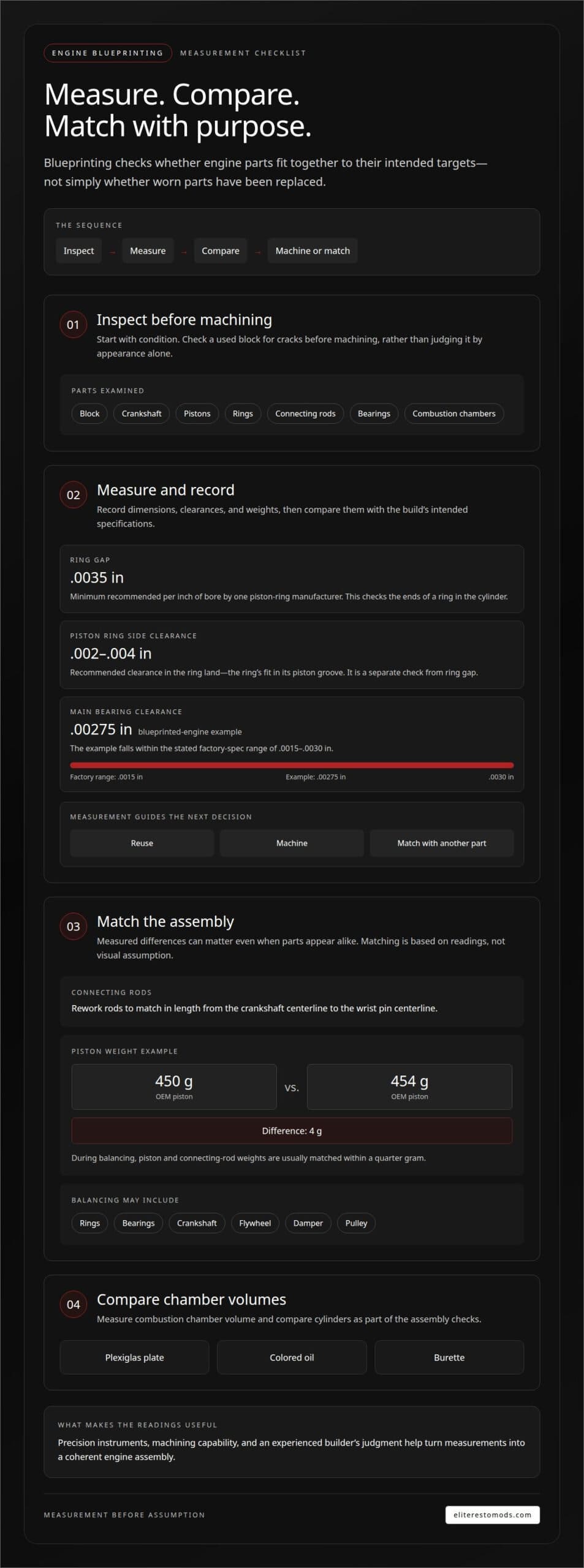
Blueprinting begins with inspection, followed by measurement, comparison with the engine’s intended specifications, and selective machining or component matching. The builder examines the block, crankshaft, pistons, rings, connecting rods, bearings, and combustion chambers. These measurements show whether parts fit together as intended, rather than relying on the assumption that factory components are identical.
A practical first step is checking a used block for cracks before machining. The builder then measures each component and records its dimensions, clearances, and weight. Those readings help determine whether a part can be reused, needs machining, or should be matched with another component. Blueprinting calls for precision instruments and an experienced engine builder who can interpret the readings against the build targets.
Clearances illustrate why measurement matters. One piston-ring manufacturer recommends a minimum ring gap of .0035 inch per inch of bore, while piston ring side clearance in the ring land is recommended at .002-.004 inches. These are distinct checks: ring gap concerns the ends of a ring in the cylinder, while side clearance concerns the ring’s fit in its piston groove. Main bearing clearance also needs measurement. A blueprinted-engine example uses .00275 inches, within a factory-spec range of .0015 to .0030 inches.
Matching components can reveal differences that visual inspection misses. Connecting rods should be reworked to match in length from the crankshaft centerline to the wrist pin centerline. In one example, OEM pistons weigh 450 grams and 454 grams, a four-gram difference. During balancing, piston and connecting-rod weights are usually matched within a quarter gram. The process may also include rings, bearings, crankshaft, flywheel, damper, and pulley.
Combustion chamber volume is another measurement. A plexiglas plate, colored oil, and a burette allow the builder to measure chamber volume and compare cylinders. Inspection tools, precision measuring equipment, machining capability, and specialist judgment all help turn raw measurements into a coherent engine assembly.
A used block should be checked for cracks during the initial assessment. Doing this before machining lets the builder consider the block’s condition alongside its measured dimensions, rather than assuming it is ready for the next stage based on appearance alone.
Engine blueprinting versus reconditioning
Reconditioning restores an engine to serviceable condition by addressing wear, damage, or failed parts. It may involve cleaning, inspection, replacing worn components, and machining surfaces where needed. Blueprinting has a different aim: measuring components against selected specifications and refining how they fit together. A reconditioned engine can run well without every component being matched beyond standard requirements. A blueprinted build focuses on precision across the engine assembly, not just returning individual parts to usable condition.
Consider a rebuild using factory components. Balancing isn’t essential in every case, unless the goal is to refine the engine as much as possible. With aftermarket crankshafts, connecting rods, or pistons, balancing is recommended because those parts may differ from the original combination. The builder evaluates the components, identifies relevant clearances and targets, then measures and adjusts parts accordingly. The distinction is one of scope and intent: reconditioning addresses condition; blueprinting adds systematic measurement and refinement.
In the United States, engine blueprinting costs depend on the engine’s condition, the components selected, and the machining and balancing required. The cost is determined after assessing those project details. A rebuild requiring extensive corrective work differs from one with serviceable parts and a clearly defined specification.
Blueprinting also has drawbacks. Additional measurement, machining, and component matching increase the work involved, while unnecessary machining can remove material without improving the build. Incorrect measurements or unsuitable targets can leave clearances outside the intended range. The builder must match specifications to the engine design, parts, and intended use. For a rebuild using factory components, balancing may add little value when the goal is restoring serviceable operation rather than refining the assembly as much as possible.
Reconditioning can suit an engine that needs dependable restoration without extensive refinement. Blueprinting is more relevant when precise relationships between components matter, especially with a custom combination. The decision depends on the engine’s condition, the parts being used, and the standard the finished build is intended to meet.
Engine smoothness and longevity
Blueprinting aims to make engine components work together more precisely. Balancing can reduce vibration and stress on main bearings, helping parts last longer. Most factory engines, including most performance engines, weren’t fully balanced. Blueprinting can refine an assembly beyond its original production balance, especially when the build uses aftermarket components.
At 3,500 rpm, a piston changes direction 7,000 times a minute. That repeated movement makes rotating and reciprocating balance consequential: uneven mass can contribute to vibration as engine speed rises. In a balancing operation, specialists match component weights and account for the rotating assembly. The result can feel more composed through the rev range, while reduced vibration limits unnecessary loading on engine parts.
Blueprinting doesn’t add a fixed amount of horsepower. It’s a precision process, not a standalone power upgrade or horsepower rating. Any performance change depends on the components, clearances, machining, and overall build specification. Balancing an engine with aftermarket crankshafts, connecting rods, or pistons can support smoother operation, but it doesn’t guarantee a particular power gain.
The word “blueprinted” alone doesn’t specify an engine’s emissions result or warranty coverage. Emissions compliance depends on the completed engine and applicable requirements; warranty coverage depends on the written terms. Blueprinting describes measurement and assembly practices, not certification or a promise about either outcome.
Longevity also depends on how the engine is built and used. Blueprinting can help reduce vibration-related stress, but it can’t prevent wear caused by unsuitable clearances, poor lubrication, overheating, or demanding operation. A careful build aligns component measurements with the engine’s design and intended use. For a classic car driven on the road, that means balancing refinement with a specification suited to regular use, rather than pursuing performance changes without considering their effect on the whole assembly.
Machining the engine deck and cylinders
The block’s deck and cylinder bores establish critical surfaces and alignments. The deck is where the cylinder heads meet the block, so machining addresses the surface that supports this joint. For a V8, align boring helps maintain equal deck heights and keeps the crankshaft parallel to the decks. That relationship supports consistent geometry across the engine, rather than leaving alignment to assumptions during assembly.
Align boring corrects the main-bearing tunnel so the crankshaft sits in the intended relationship to the block’s decks. This matters because the crankshaft connects to the pistons through the connecting rods. If block alignment is off, components may not follow the intended paths through their operating cycle. Machining must therefore work from measurements of the specific block, not a generic notion of what every V8 requires.
Cylinder finishing is another precise operation. A hone refines the bore surface after machining, preparing it for the piston rings. The appropriate finish depends on the engine application and ring requirements. A cylinder-finishing hone of 220-280 grit is used for some engine applications. That range is not a universal target; the machinist selects the finish to suit the combination being assembled.
Deck and bore work should be considered alongside the engine’s other dimensions. The machinist evaluates the block, determines whether surfaces or alignments need correction, and then machines only as required by the build specification. This measured approach helps preserve material while establishing the geometry needed for the chosen components. A V8 block, for example, benefits from align boring when the goal is equal deck heights and a crankshaft parallel to those decks.
For a classic build where block geometry and cylinder finishing matter, explore custom build services as a next step in shaping the engine around the car.
Elite Restomods
Elite Restomods can help you place engine decisions within the broader vision for a classic-car build. If you’re weighing precision machining against other priorities, its Custom Build Services provide a way to shape a vehicle around your goals, from its character and performance direction to how you plan to enjoy it. The right conversation starts with the whole car, not one measurement in isolation.
For buyers considering a finished vehicle instead of a bespoke project, Elite Certified Restomods offer another path. Each option suits a different stage: developing a custom build or choosing a completed restomod. Contact Elite Restomods to discuss your classic-car plans.
Shape the Next Chapter of Your Classic
Understanding what a blueprinted engine is gives you a clearer starting point for deciding how a classic should drive and feel. The next step is connecting that mechanical ambition with the character of the whole vehicle: its intended use, the driving experience you want, and the build decisions that support it. Precision matters most when it serves a coherent vision.
Elite Restomods offers several paths for classic-car enthusiasts, including Elite Certified Restomods, a Consignment Program, and Custom Build Services. Whether you’re considering a finished restomod or planning a more personal direction, those options can help frame the next stage of your project. Bring your questions and aspirations together, then contact Elite Restomods about your engine. Your classic can carry its heritage forward while becoming a car you’re excited to drive.
Frequently Asked Questions
What does a blueprinted engine mean?
A blueprinted engine is assembled using measured components matched to chosen specifications. Think of “blueprinted” as describing the build method, not a separate engine type or a guaranteed performance level. The term alone doesn’t tell you which specifications were used; the build’s goals and component choices determine what the measurements mean.
What measurements and tolerances are checked when blueprinting an engine?
Builders measure dimensions, clearances, component weights, and combustion chamber volumes, then compare those readings with the build targets. What matters is how each reading relates to the rest of the assembly. For example, a machinist considers whether the bore, piston, and ring combination work together. Measurement records can clarify which specifications guided machining and assembly.
How is a blueprinted engine different from a standard rebuilt or performance engine?
A standard rebuild focuses on restoring an engine’s condition, while blueprinting describes a measurement-led approach to assembly. A performance engine describes an intended role or setup, not necessarily how precisely it was measured. A rebuild using factory replacement parts can also be blueprinted, while a modified performance build isn’t automatically blueprinted unless its components are measured and matched to defined targets.