
The most aggressive suspension isn’t automatically the right choice for a restomod. Choosing suspension for a restomod build means matching the setup to how you’ll drive the car, how much power it puts down, and how much of its original character you want to preserve.
That balance matters. A well-matched setup can help a classic feel composed on the road while giving a high-power build the control its performance demands. The right choice might retain and refine leaf springs, use coil springs with separate links, or adopt a three-link or four-link rear suspension. Each changes how the car responds, and none is a universal upgrade.
This guide compares the main approaches and explains how spring rates, shock tuning, suspension geometry, and chassis goals shape the decision. You’ll see when a factory-style refresh makes sense, when corrected geometry or a link-style setup may better suit the build, and what to consider before choosing a direction. The goal is modern control without losing the character that made the car worth building.
Key Takeaways
- Keep a leaf-spring setup in consideration when its simplicity and load-carrying character suit the build; tune springs and shocks as a system.
- Use aftermarket control arms and corrected geometry to address how a classic responds in corners, not simply to lower its stance.
- Consider a three-link or four-link rear when separating axle location from spring support fits the car’s performance goals.
- For a custom or high-power build, prioritize how the car will be driven and how its components work together instead of copying another setup.
Performance-tuned leaf springs and torsion bars
Choose suspension based on the car’s weight, intended use, and desired handling. Leaf springs and torsion bars preserve distinct mechanical character, while link and coil systems offer different ways to manage axle movement.
Performance-Tuned Leaf Springs
Leaf springs support vehicle weight and locate the axle, making them a durable choice for vintage 4x4s and load-carrying builds. Their simplicity can transmit more bumps into the cabin, while hard launches can twist the spring and cause axle wrap. Performance tuning pairs spring rate with shock valving and vehicle weight. A triangulated 4-link separates axle location from spring function, unlike leaf springs, but requires a different chassis layout.
Torsion Bars
A torsion bar acts as a spring by twisting as the suspension moves. Unlike a leaf spring, it uses a different springing mechanism; unlike a coilover, it doesn’t combine a coil spring and shock absorber in one assembly. Its suitability depends on the vehicle’s existing design and the build’s goals. Coil springs support the vehicle’s weight, while suspension links control axle movement, offering another way to tune ride, handling, and articulation.
| Setup | Key distinction | Consider for |
|---|---|---|
| Stock or leaf spring | Retains a familiar solid-axle layout | Original character or vintage 4×4 use |
| Coilover | Combines spring and shock | Custom tuning |
| Double-wishbone | Uses control arms at each wheel | Independent front suspension |
| Independent rear | Allows each rear wheel to move separately | Independent rear-wheel response |
No single suspension type suits every classic. Stock, coilover, double-wishbone, and independent rear suspension each fit different designs and goals. Unlike a leaf-spring solid axle, independent rear suspension lets each rear wheel respond separately, while a solid axle connects their movement.
For U.S. builds, inspection, emissions, safety, and ride-height requirements depend on the state; treat local rules as design constraints. Kit and installation price depends on the vehicle, parts, fabrication, and labor, and is given after a quote request.
Plan brakes, steering, wheels, and chassis reinforcement alongside the suspension so the components work together. Alignment, spring rates, and shock valving affect tire contact, ride comfort, and handling, so tune them to the vehicle’s weight and intended use. Common mistakes include choosing springs without matching shocks, overlooking geometry, and selecting a setup unsuited to the car’s weight or driving purpose.
Aftermarket control arms and corrected geometry
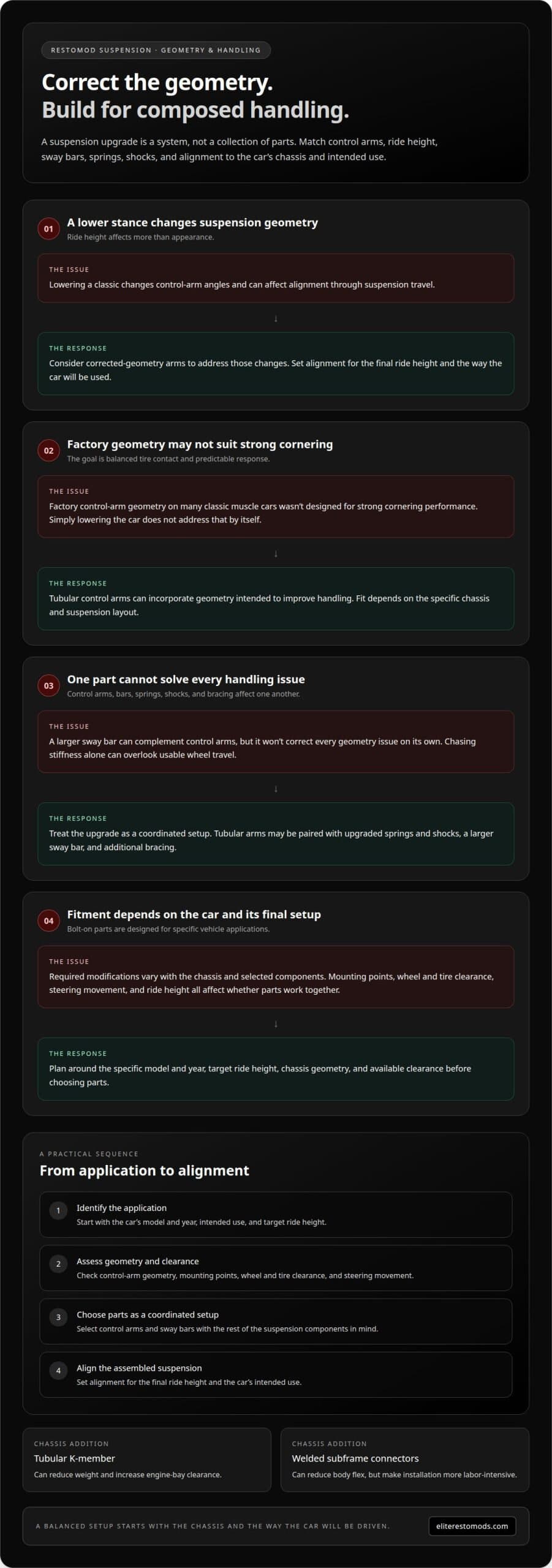
Factory control-arm geometry on many classic muscle cars wasn’t designed for strong cornering performance. Aftermarket arms can correct that geometry, while springs, shocks, sway bars, and bracing help complete the upgrade. The goal is balanced tire contact and predictable handling, not simply a lower stance. Choosing suspension for restomod build performance starts with defining how you want the car to behave on the road.
Tubular control arms replace factory-style components with a different structure and may incorporate geometry designed to improve handling. Fit depends on the specific chassis and suspension layout. A bolt-on upgrade can combine tubular arms with upgraded springs and shocks, a larger sway bar, and additional bracing. These parts work as a system: changing one component can affect how the others respond.
Lowering a classic car changes control-arm angles and can affect alignment through suspension travel. Corrected-geometry arms can help address those changes, while alignment settings should suit the final ride height and intended use. This is a key consideration when choosing suspension for restomod build goals, especially when a lower stance still needs to deliver composed road manners.
Sway bars help limit body roll in corners by connecting the frame rails while allowing suspension flex. A larger bar can complement tubular control arms, but it won’t correct every geometry issue on its own. Pair the components thoughtfully to preserve usable wheel travel and stable cornering instead of chasing stiffness alone.
Which kits fit popular classics? Bolt-on suspension upgrades are designed for specific vehicle applications, and required modifications vary with the chassis and components selected. Fitment planning accounts for model and year, mounting points, wheel and tire clearance, steering movement, and intended ride height. These details help determine whether the parts will work together.
As a practical sequence, identify the car’s application and target ride height, then assess control-arm geometry and available clearance. Choose arms and sway bars as a coordinated setup, then align the assembled suspension. A tubular K-member can also reduce weight and increase engine-bay clearance, while welded subframe connectors can reduce body flex but make installation more labor-intensive.
Three-link and four-link rear suspension
Three-link and four-link systems replace a leaf-spring rear layout with links that locate the axle. In both designs, links manage axle movement while coilovers can support the vehicle’s weight. Choosing suspension for a restomod build means weighing packaging and driving goals alongside the desired rear-axle response.
Three-Link Rear Suspension
A three-link rear suspension uses two lower links and one upper link to locate the axle. Compared with a four-link, it has one fewer locating link while still separating axle location from spring function. Coilovers can support the vehicle’s weight, and shocks control suspension movement. This layout suits builds seeking link-based axle control without retaining leaf springs.
Four-Link Rear Suspension
A four-link uses two upper and two lower links to locate the rear axle, with coilovers supporting the vehicle’s weight. Classic-car conversion kits can replace factory suspension, including leaf springs, with a four-link arrangement. There’s no single power rating that applies to every system: capacity depends on the links, brackets, welds, axle, and tire traction. Match those components to engine torque and intended use.
Before a four-link conversion, evaluate the chassis mounting points and axle placement. The new links need room to move through suspension travel without interfering with the exhaust, driveshaft, or frame. Coilover position and shock travel also affect rear suspension response during acceleration and on uneven pavement. The conversion changes how the axle is located, not just the spring type.
Compare systems by packaging, traction goals, and fabrication needs. A three-link uses fewer links, while a four-link adds another axle-locating link and is a common leaf-spring replacement in classic-car conversions. For owners choosing suspension for a restomod build, link geometry, coilover placement, and chassis mounts belong in the same plan. Choose the layout to suit engine output and intended use, then design the mounts and suspension travel as one package.
Suspension for custom and high-power builds
Choose suspension based on intended use, engine output, and tire fitment. Drag racing, track events, and street driving place different demands on springs, shocks, and chassis components, so a setup copied from another build may not suit your car.
Start with the driving brief: frequent street cruising calls for a different balance than hard launches or track use. Then match spring rates and shock valving to the vehicle’s weight and desired response. Adjustable shocks let you tune compression and rebound, helping the suspension control movement without relying on spring changes alone.
Tire size is part of the suspension decision, not a finishing detail. A modified 1966 Mustang was reported to have front-tire rubbing with 245-width tires despite adjustments. That example shows why wheel clearance, steering movement, ride height, and suspension travel must be considered together before finalizing a wider tire package.
Power also changes what the rear suspension must manage. Leaf springs can experience axle wrap during hard launches, while link-style systems separate axle location from spring support. Traction bars or a pinion snubber can help address axle wrap in low- to mid-horsepower applications. For a high-power build, assess the entire setup, including axle location, spring support, shocks, and chassis structure.
Use this sequence to plan the package: define whether the car is for street, drag, or track use; establish engine output and vehicle weight; choose tire dimensions and check clearance; then tune springs, geometry, and shocks as a matched system. A poorly designed lift can worsen ride quality, driveline angles, and handling stability. Lift height alone doesn’t determine ride quality, so evaluate the whole setup rather than stance alone.
For a restomod planned around a specific driving character, explore custom build services as a way to align suspension choices with the broader build.
Elite Restomods: Custom Build Services
Elite Restomods’ Custom Build Services are a natural next step when you want suspension choices considered as part of a complete restomod. Share how you plan to drive the car, what character you want to preserve, and the performance you envision. These priorities help shape a build around the vehicle rather than treating suspension as an isolated upgrade.
Whether you’re refining a classic for confident street cruising or building for stronger performance, the suspension must work with the car’s weight, tires, chassis, and intended use. Elite Restomods can incorporate those decisions into the broader custom-build process, balancing modern capability with the original car’s character. If you’re considering a completed vehicle instead, Elite Certified Restomods offer another route to a finished build.
Contact Elite Restomods to discuss your restomod build goals.
Turn Your Build Vision Into a Clear Direction
Start by defining how you want the car to feel on the road. Is your goal composed everyday cruising, sharper cornering, or a forceful launch? Consider that driving character alongside the vehicle’s originality, power, and tire plans. This gives the suspension decision a purpose beyond appearance and helps guide the broader build.
Choosing suspension for a restomod build is part of shaping a complete car, not an isolated parts decision. Elite Restomods offers Custom Build Services for owners developing a bespoke restomod, alongside Elite Certified Restomods for those considering a completed vehicle. Its Consignment Program is another option for owners preparing to sell a classic. Each service fits a different point in the ownership journey.
When you’re ready to discuss the direction of your project, contact Elite Restomods. A thoughtful plan can bring modern capability and classic character together in a car built to be driven and enjoyed.
Frequently Asked Questions
What are the pros and cons of front and rear coilover conversions for classic cars?
Coilover conversions can offer convenient spring-and-shock packaging and adjustability, but they need careful integration with the classic car’s existing chassis. Front and rear conversions may involve different mounting and clearance considerations, so the setup at one end doesn’t automatically suit the other. Before choosing a conversion, consider wheel travel, tire clearance, vehicle weight, and how you’ll drive the car. A street cruiser may need a different tune from a track-focused build.
Which suspension upgrades improve handling without making a restomod uncomfortable on the street?
For a street-driven classic, start with sound shocks, a precise alignment, and spring perches that reduce friction, then assess whether a thicker front sway bar suits the car. This measured approach can sharpen response without committing immediately to a very stiff spring package. Match any spring change to the shocks, and avoid lowering springs without suitable shock control. The right balance depends on vehicle weight, road use, and the handling feel you want.
Which restomod suspension kits fit popular classic cars, and what measurements or modifications are required?
Bolt-on kits are designed for specific vehicle applications, and required modifications vary by chassis and components. Check the model and year, mounting points, wheel and tire clearance, steering movement, and intended ride height.
What components should be upgraded together, including brakes, steering, wheels, and chassis reinforcement?
Plan brakes, steering, wheels, and chassis reinforcement alongside the suspension so the package works as a whole. Match alignment, spring rates, and shock valving to the vehicle’s weight and intended use.