

The grippiest tire isn’t automatically the right tire for your pro-touring build. A setup that feels composed on a dry cornering run may involve trade-offs in wet-weather use, ride comfort, tread life, or fitment. Choosing the best tires for a pro touring car means balancing those factors against how you drive and the capabilities of the car beneath you.
That balance matters. Classic lines and modern power deserve more than a tire chosen for appearance or a single performance number. Tire dimensions need to work with the wheels and available clearance, while the tire’s intended use should suit the suspension, brakes, and everyday demands of the build.
This guide offers a framework for comparing summer performance, all-season performance, and track-focused categories, along with the specifications that help explain their trade-offs. You’ll also find a fitment checklist to help organize the information for your build. Elite Restomods’ custom-build approach considers drivability, suspension, and braking as connected parts of a complete vehicle, and tire selection belongs in that same conversation. The goal is a classic that feels composed on the road, not merely convincing in the garage.
Key Takeaways
- The best tires for a pro touring car depend on how you use it, from everyday drives to spirited roads and events.
- Learn how tire width, aspect ratio, and wheel diameter work together in a size designation, and why an example size isn’t a universal fit.
- Compare summer performance, all-season performance, and track-focused tires by their strengths and trade-offs before narrowing your options.
- Use a step-by-step fitment checklist to document wheel details, assess actual clearances, and verify ratings for your intended setup.
- Tire decisions connect to wheels, suspension, brakes, and the broader vehicle build. Elite’s AIM Quality Assurance Methodology assesses several of these systems as part of a whole-vehicle review.
What Makes a Tire Right for a Pro-Touring Car?
A pro-touring car brings classic character together with modern road performance, but no single tire is right for every build. The best setup balances grip with everyday manners, fitment, weather capability, and the way the car will actually be driven. A tire that suits a weekend street car may not be the best match for one that regularly sees track events.
Start with your priorities, not a product name. The best tires for a pro touring car fit the wheels and vehicle, suit the expected conditions, and support the owner’s real driving habits. Sidewall markings help identify a tire’s dimensions and capabilities. The tire code is a useful reference when comparing those details.
For a visual look at the balance between vintage appearance and modern performance, watch this discussion:
How Will You Actually Drive the Car?
Be specific about the car’s usual role. Routine street use may put predictable road manners and comfort high on the list. Spirited drives on winding roads can make responsive handling and grip more important, while track-oriented use brings different demands. A car that attends an occasional event may need a broader compromise than one built around regular performance days.
Consider the conditions you encounter, too: typical temperatures, rain, road surfaces, and whether the car is driven year-round or mostly in favorable weather. Write down how often each use case occurs. That distinction helps prevent a rare track day from dictating a tire choice that feels less suitable during the many ordinary miles between events.
Why Grip Is Only Part of the Decision
More grip can be appealing, but it isn’t the only measure of a satisfying setup. Tire construction and compound can influence how a car responds, while comfort, road noise, and tread life may matter more on a car used for longer journeys. These characteristics involve trade-offs and vary by tire design. Don’t assume that one category or rating guarantees a particular result.
What the driver feels also depends on the whole combination: the car’s weight and power, wheel and tire fitment, suspension setup, road surface, weather, and driving style. A tire that feels composed on one vehicle may behave differently on another. Match performance priorities to real use, not just the most ambitious scenario on the build sheet. The central decision is to choose for the car you’ll drive, not an imagined one.
How to Read Tire Specifications for a Pro-Touring Setup
A tire size is more than a shorthand label. It describes key dimensions, but it doesn’t confirm that the tire will suit a particular wheel or clear a particular car. Treat any published setup as a reference point, not a prescription. The best tires for a pro touring car need to meet the vehicle’s requirements as well as its intended role.
What Tire Size and Wheel Dimensions Tell You
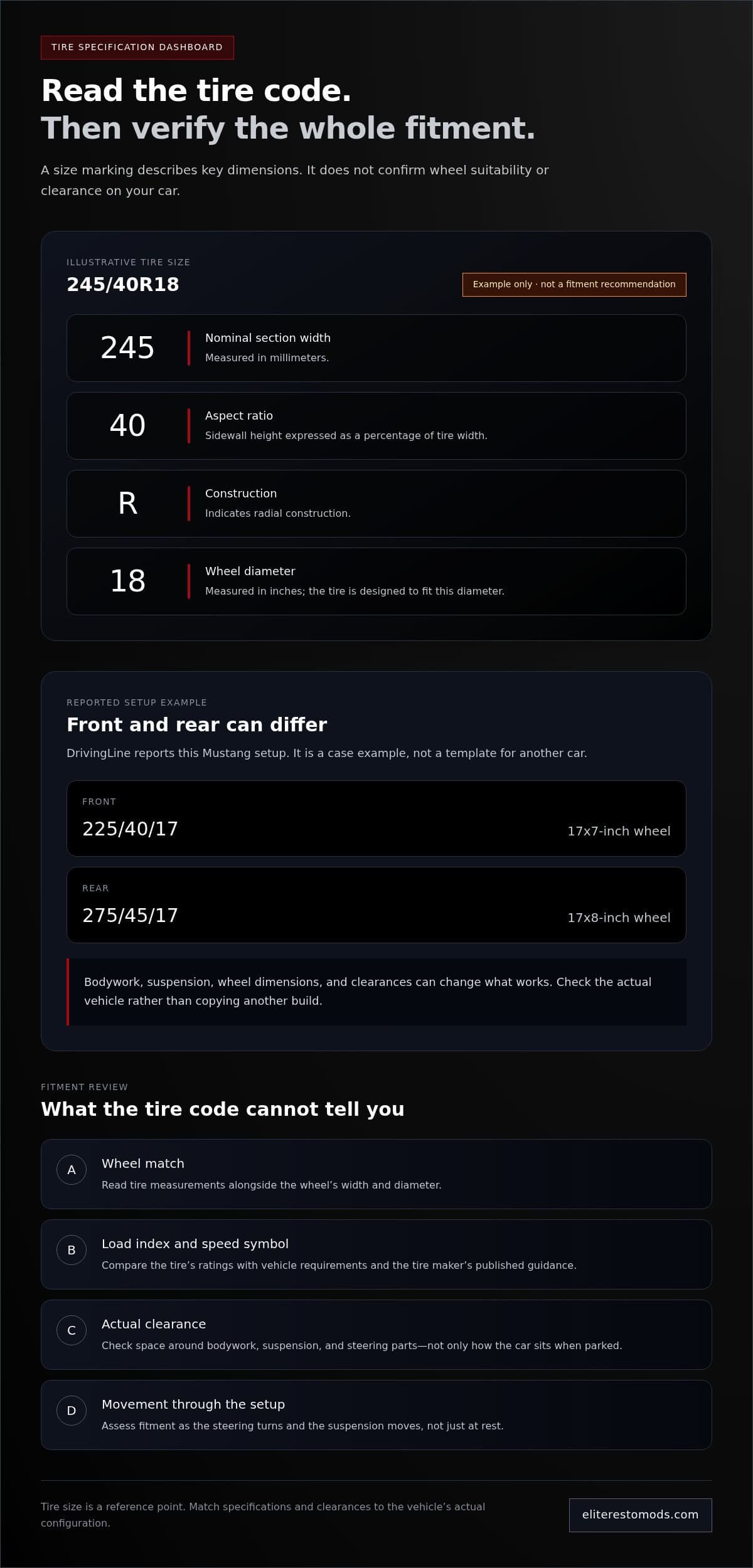
Consider this illustrative size: 245/40R18. It’s an example for reading the format, not a fitment recommendation.
- The first number, 245, is the nominal section width in millimeters.
- The second number, 40, is the aspect ratio: the sidewall height expressed as a percentage of the tire’s width.
- The letter R indicates radial construction.
- The final number, 18, is the wheel diameter in inches that the tire is designed to fit.
Read those measurements alongside the wheel’s width and diameter. A tire size alone doesn’t tell you whether the wheel is appropriate or whether the assembly will fit the car. Front and rear sizes can differ, but don’t copy a staggered setup from another build without checking the vehicle itself.
For example, DrivingLine reports a Mustang setup with 225/40/17 front and 275/45/17 rear tires on 17×7-inch and 17×8-inch wheels. That’s a case example, not a template. Different bodywork, suspension, wheel dimensions, and clearances can change what works. Evaluate tire size alongside wheel dimensions and vehicle clearance.
Which Ratings and Fitment Details Need Attention?
Size is only one part of the specification. The load index indicates the load a tire is rated to carry under specified conditions; the speed symbol identifies its speed rating under the conditions defined by the manufacturer. Compare both with the vehicle requirements and the tire maker’s published guidance. Don’t infer suitability from appearance, a familiar size, or a performance label alone.
Next, assess clearance on the actual car. Look for space between the tire and bodywork, suspension components, and steering parts. A wheel-and-tire combination may sit neatly at rest yet approach nearby components as the steering turns or the suspension moves. Evaluate fitment through the vehicle’s range of movement, not just by how the parked car looks.
That distinction matters on a carefully finished build. A wider tire may create a purposeful stance, but appearance can’t establish proper clearance or rating suitability. Record the wheel dimensions and tire specifications, then compare them with the vehicle’s actual configuration and manufacturer guidance. A setup seen on another car can inform the discussion, but it can’t replace checking your car.
For readers planning a complete restomod, Elite’s custom build process offers broader context for how individual choices fit into a considered vehicle project.
Which Tire Category Fits Your Pro-Touring Driving?
Tire categories offer a useful starting point, not a final verdict. An ultra-high-performance summer tire, an all-season performance tire, and a track-focused option are designed around different priorities, and details vary by manufacturer and model. The best tires for a pro touring car depend on your climate, how the car is used, and how its complete setup supports those demands.
| Tire category | May suit | Trade-offs to consider |
|---|---|---|
| Ultra-high-performance summer | Drivers prioritizing responsive handling and performance in suitable warm-weather conditions | Seasonal limits and everyday comfort or tread-life priorities may narrow its fit for some owners |
| All-season performance | Street-driven cars that need a performance-oriented option across varied conditions | Its balance of capabilities may differ from a tire focused more narrowly on warm-weather performance |
| Track-focused | Cars used for performance events where event demands guide the choice | Street manners, weather suitability, and permitted use depend on the tire’s specifications |
Use the table to identify what to investigate, not to assume every tire in a category behaves alike. Compare the manufacturer’s intended-use description, seasonal guidance, and specifications for the particular tire. Then weigh those details against the car’s actual role.
Street-Focused Performance Versus Track-Focused Options
A street-focused performance tire is intended for road use, while a track-focused option places greater emphasis on event demands. That distinction can involve compromises in comfort, noise, and weather flexibility, but the degree depends on the tire itself. DrivingLine’s Nitto NT555 G2 review is one example of a product positioned for street-and-track appeal. Treat that as a claim about the reviewed tire, not proof that every tire with similar positioning suits every event or car.
Track suitability depends on the tire’s specifications, the event’s conditions, and the vehicle’s setup. Read the tire maker’s use guidance before treating a street-and-track description as a fit for repeated or dedicated event use.
When Weather and Everyday Comfort Matter
For a car driven in varied weather, an all-season performance category may be worth comparing with a summer-focused option. Seasonal labels alone don’t establish how a specific tire handles your local conditions. Tire makers’ descriptions and weather guidance should shape the decision, especially if the car may encounter cold temperatures or wintry roads.
Comfort and noise matter differently to an owner who takes long road trips than to one who mainly drives to events. Look for manufacturer information about intended use, then consider how the tire’s stated priorities align with your expectations. Don’t assume a category guarantees a particular ride or noise level.
For a car being shaped as a complete restomod, tire-category decisions belong in the broader build conversation. Elite’s custom-build process reflects that whole-vehicle perspective, where choices are considered in relation to the finished car rather than in isolation.
A Practical Fitment Checklist Before You Buy Pro-Touring Tires
A tire setup that looks right in a photo may not suit your car. Use this sequence to move from broad intentions to a documented fitment decision. Separate what you’ve observed on your vehicle from what you’ve merely seen on another build. The best tires for a pro touring car need to work with the actual wheels, clearances, and manufacturer guidance for that specific setup.
Record the Car, Wheel, and Driving Requirements
Start with a written baseline. Record the vehicle details and current configuration, then note the wheel and tire information as it appears on the components or in their documentation. Include any front-to-rear differences. These details help frame the comparison, but they don’t prove that a different size will fit.
- Define the car’s use. Note whether it’s primarily a street car, sees spirited drives, attends events, or serves a mix of roles. Include the typical weather and road conditions you expect.
- Record wheel and tire details. Write down the wheel diameter and width, current tire size, and any front-to-rear size differences. Keep observed measurements distinct from assumptions based on another vehicle.
- Check physical clearance. Assess space around bodywork, suspension components, and steering parts. Account for steering movement and suspension travel, rather than judging clearance only with the car parked and its wheels straight.
- Verify ratings and guidance. Compare load and speed ratings with vehicle requirements and the tire manufacturer’s specifications. Use documentation for the exact tire and wheel combination, not a general category description.
- Confirm and document the final setup. Bring the vehicle details, wheel measurements, tire specifications, use priorities, and clearance observations together. Record the selected specifications in the build plan so the decision stays connected to the complete configuration.
Check Clearance and Validate the Final Choice
Evaluate clearance on the car itself, through the operating range relevant to steering and suspension. A combination that appears to fit at rest may have less room as the wheels turn or the suspension moves. Note what has actually been checked, and don’t treat another car’s successful setup as evidence that yours has the same space or geometry.
Ratings matter as much as dimensions. The load rating relates to the tire’s carrying capacity under the manufacturer’s specified conditions, while the speed rating identifies its speed capability under those conditions. Match them to vehicle requirements and tire-maker guidance. Don’t assume that a wider tire, a familiar size, or an attractive stance makes a combination suitable.
For a custom build, a clear fitment record helps keep individual choices aligned with the finished car. Elite’s custom build process provides a starting point for considering the vehicle as a complete project, rather than a collection of isolated parts.
How Tire Choices Fit Into a Complete Pro-Touring Restomod
A tire isn’t an isolated upgrade. Its dimensions and intended use have to make sense alongside the wheels, suspension, brakes, and the way the car will be driven. A powerful engine and capable chassis can’t make a tire suitable if the overall combination doesn’t match the vehicle’s requirements. The best tires for a pro touring car are chosen as part of a coherent setup, not simply for appearance or a single performance priority.
Treat the Tire as Part of the Vehicle’s Complete Setup
Consider how each decision affects the next. Wheel dimensions shape which tire sizes can be considered; tire choice, in turn, needs to suit the car’s fitment and intended driving. Suspension and brake upgrades also belong in the discussion, since a restomod’s systems work together on the road. A tire decision made without the rest of the configuration in view can leave important trade-offs unaddressed.
Elite’s AIM Quality Assurance Methodology assesses drivability, suspension, brakes, fuel, electric, exhaust, exterior, and interior. These categories reflect a broad, whole-vehicle approach to quality. The methodology does not represent a dedicated tire inspection or a guarantee of tire performance. Its scope underscores why tire selection belongs in a wider conversation about how the finished vehicle is intended to function.
That perspective matters whether a car is being curated or built from the ground up. A choice that looks compelling on paper still has to align with the vehicle’s use, wheel setup, and broader engineering decisions. For a custom build, the intended driving experience can help shape those choices from the outset instead of leaving tire selection as an afterthought.
Explore a Fully Sorted Restomod or Custom Build
Some buyers want a finished restomod that brings classic design together with modern capability. Others want to shape a custom build around their priorities. Elite offers investment-grade, fully sorted restomods and custom builds through world-class fabrication, with the Elite Performance Center as part of its in-house service offering. These are different paths to a considered vehicle, and the right one depends on the ownership experience you’re seeking.
As you evaluate a complete car or a build direction, keep the tire conversation tied to the wider setup: intended use, wheel and tire fitment, suspension, and braking. No single choice guarantees a particular road result. Instead, let your priorities inform the vehicle as a whole, so the finished classic feels purposefully engineered as well as beautifully realized.
If you’re considering a fully sorted restomod, explore current restomod inventory to see available vehicles and consider how a complete build aligns with the driving experience you want.
Make Your Next Build Decision With Confidence
The most rewarding setup is one that feels right in the moments you actually drive: a calm cruise, a favorite stretch of road, or an event that puts the chassis to work. Use those moments to define what you want from the car before settling on the best tires for a pro touring car. Clear priorities give every later decision a purpose, from the stance you envision to the way the car should respond on the road.
Think of tire choice as part of the character you’re creating. A pro-touring build can preserve the unmistakable presence of a classic while bringing modern capability into every drive. Start with a complete vision, then make considered choices that support it.
Ready to explore what that vision could look like? Explore current restomod inventory and find inspiration for the next chapter of your classic-car journey.
Frequently Asked Questions
What tires are best for a pro-touring car?
The best tires for a pro touring car depend on the car’s main job and the conditions it encounters. A street-driven build that occasionally takes on a spirited road may call for a different balance than a car regularly prepared for performance events. Compare tire categories and specific manufacturer guidance against your climate, driving pattern, and vehicle setup. Choose the option that supports the experience you want without overlooking practical use.
Are all-season tires suitable for a pro-touring car?
They can suit a pro-touring car used on the street in varied conditions, but suitability depends on the specific tire and the weather it’s designed to handle. An owner who drives through changing seasons may value a different balance from someone who takes a warm-weather car out occasionally. Check the manufacturer’s seasonal and use guidance, especially if the car may encounter cold conditions or snow.
Can I use track tires on a street-driven pro-touring car?
Possibly, but don’t assume a track-focused tire is appropriate for regular road use. The exact tire’s intended-use information and specifications matter, as do the event conditions and the car’s setup. If the car spends most of its time on public roads, compare the manufacturer’s guidance for street use, weather, and operating conditions before choosing a tire designed with track demands in mind.
How do I know what tire size fits my pro-touring car?
Start with the vehicle’s original documentation or existing tire information as a reference, then account for modifications to the wheels, suspension, and body. Confirm the tire is compatible with the wheel and check the actual car for clearance, rather than relying on appearance or a size that worked elsewhere. A build record with measured wheel details and observed clearances can help keep the final decision grounded in your vehicle.
Does a wider tire always provide more grip?
No. Width alone doesn’t establish how much usable grip a tire will provide. The tire’s design, the wheel it’s mounted on, the vehicle’s weight and setup, and the road and driving conditions all affect how the combination behaves. A wider size that doesn’t suit the wheel or available space can create fitment problems without delivering the intended result. Compare the complete tire-and-vehicle combination, not width in isolation.
What tire specifications should I check before buying?
Review the tire’s size, compatible wheel dimensions, load and speed ratings, and the manufacturer’s intended-use and seasonal guidance. Make sure ratings align with the vehicle requirements, and compare information for the exact tire model rather than relying on a category label. If the car has been modified, its current configuration matters; original documentation may be a starting reference, not the whole answer.
Can I copy the tire setup from another pro-touring car?
Use another build as inspiration, not as proof of fitment. Even similar-looking cars can differ in wheel dimensions, suspension components, body clearances, and intended use. A staggered setup that works on one vehicle may not suit yours. Before adopting any example, compare its documented specifications with your own car and verify wheel compatibility and clearance through steering movement and suspension travel.