
The most expensive mistake you can make on a vintage build isn’t buying the wrong car, but failing to respect the mechanical harmony required to keep it on the road. Classic style. Modern power. Meticulous execution. You likely started this journey to relive the golden age of American muscle, not to watch your investment sit in a shop for years while your budget evaporates into incompatible parts. Identifying the specific restomod build mistakes to avoid is the difference between owning a functional piece of art and falling into the soul-crushing project car trap.
It’s a sobering reality that a high-end rolling chassis with an LS3 or Coyote drivetrain can cost $125,000 before the bodywork even begins, especially with professional labor rates now averaging $140 per hour. We understand the desire for that raw, visceral excitement paired with refined luxury craftsmanship. This guide masters the intricacies of high-end builds by highlighting the errors that compromise performance and investment value. We’ll explore how to achieve a fully sorted vehicle that drives like a modern sports car while navigating the technical integration and financial realities of the 2026 market.
Key Takeaways
- Understand the true cost of metalwork and why selecting the right base vehicle is the most critical decision for your long-term return on investment.
- Master the art of drivetrain integration to ensure your modern engine’s torque doesn’t overwhelm a chassis designed for a different era.
- Uncover the invisible system failures, from cooling to wiring, that represent the most common restomod build mistakes to avoid for turn-key reliability.
- Learn how to manage the meticulous final details of a build to prevent feature creep and preserve your project’s completion timeline.
- Discover how professional documentation and the build story elevate a project into an Elite Certified asset with lasting investment value.
The Foundation Trap: Why Choosing the Wrong Base Vehicle Destroys ROI
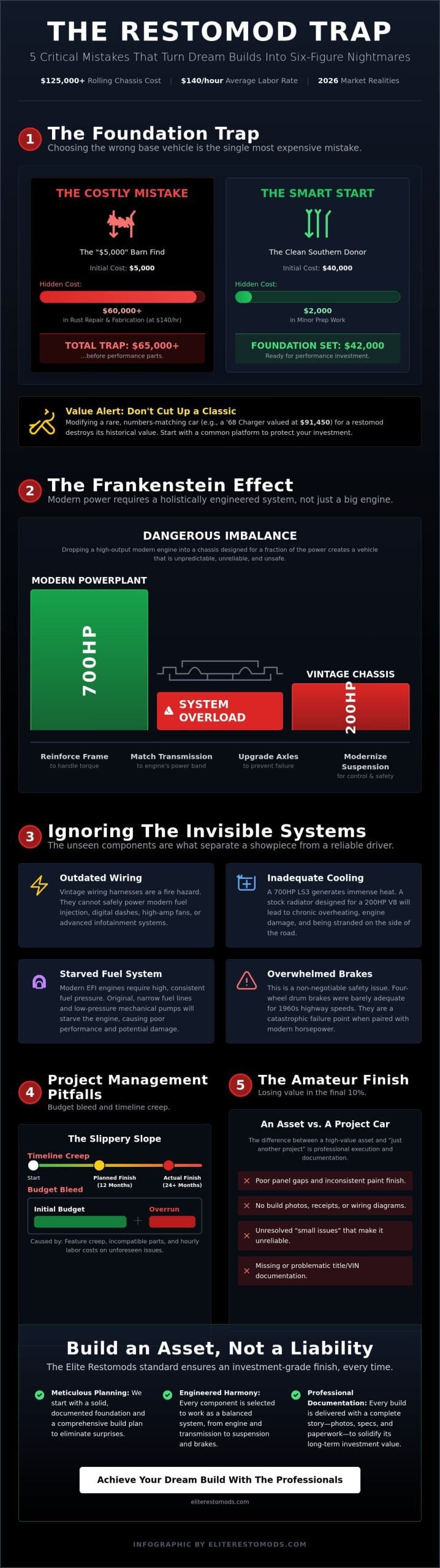
The allure of a five thousand dollar barn find is a powerful siren song for the aspiring builder. It promises a blank canvas and a low entry cost, but this is often the first of many restomod build mistakes to avoid. In the current market, the financial math of metalwork is unforgiving. With professional labor rates now averaging $140 per hour, a “cheap” project car requiring three hundred hours of rust repair and panel alignment will quickly exceed the cost of a pristine, southern donor vehicle. You aren’t just buying a car; you’re buying a foundation for modern performance.
A common error is selecting a numbers-matching, rare icon for a high-end build. While a 1968 Dodge Charger in excellent condition is valued near $91,450 according to recent 2026 market data, cutting into its original floor pans to fit a modern four-link suspension destroys the very rarity you paid for. The goal of sophisticated automotive restoration in the restomod world is to enhance usability without erasing value. Starting with a clean, common platform allows you to invest your capital into performance upgrades rather than expensive historical preservation.
To visualize the complexities of starting your first project, watch this insight from a first-time builder:
The High Cost of Hidden Rust
Modern paint is a triumph of chemistry, but it cannot mask structural decay for more than a season. If you’re dropping a 700 horsepower LS3 crate engine into a chassis with compromised torque boxes or thin frame rails, you’re building on a house of cards. Modern suspension loads from Wilwood brakes and coilover kits place immense stress on the vehicle’s skeleton. Sourcing a high-quality donor for $40,000 is almost always more cost-effective than attempting to salvage a rust-compromised shell that requires $60,000 in custom fabrication to become roadworthy.
Title and VIN Documentation Pitfalls
Your six-figure investment is only as valid as the paper behind it. Missing titles or non-transferable custom VINs can stall a professional build indefinitely, especially when navigating state-specific engine swap regulations. Before a single wrench turns, verify that your documentation is national-ready. At Elite Restomods, we emphasize that a bespoke piece of functional art must have a clean history to maintain its investment-grade status. You can learn more about our meticulous standards by reviewing our build process, which ensures every vehicle is fully sorted from the paperwork to the final polish.
Mechanical Mismatches: Avoiding the Frankenstein Effect in Drivetrain Selection
A high-performance crate engine is the heartbeat of a modern build, yet horsepower alone does not define excellence. One of the most frequent restomod build mistakes to avoid is the “Frankenstein Effect,” where a powerful drivetrain is shoehorned into a vehicle without considering technical harmony. Dropping a 700hp LS3 into a chassis originally engineered for 200hp creates a dangerous imbalance. Without a reinforced frame and a drivetrain capable of managing that modern torque, you aren’t building a sports car; you’re building a liability. True performance requires a systematic approach where every component, from the flywheel to the rear axles, speaks the same mechanical language.
Achieving this balance is what separates a backyard project from professional restoration standards. Consider the transmission and rear-end ratios. A common error is pairing a modern six-speed manual with vintage gearing designed for three-speed automatics. This mismatch often results in a car that screams at highway speeds or bogs down in lower gears, effectively neutralizing the benefits of a modern engine swap. If you want to see how a fully harmonized drivetrain feels in practice, our current inventory showcases vehicles where every gear ratio is meticulously selected for peak driveability.
Engine Swap Compatibility Errors
Fitting a wide Coyote engine or a deep-sump LS3 into a narrow vintage engine bay often requires significant structural modification. This isn’t just about clearance; it’s about maintaining geometry. Builders often overlook the complexity of electronic integration, assuming a basic harness will suffice. In reality, modern EFI systems and digital controllers require precise wiring to ensure the beast under the hood behaves with turn-key reliability. Meticulous planning here prevents the project car trap where a vehicle runs but never performs to its true potential.
Suspension and Braking Cohesion
Stopping power must always outpace acceleration. Installing Wilwood or Brembo calipers without matching the master cylinder and pedal ratio is a recipe for a wooden, unresponsive brake pedal. Similarly, retaining a vintage steering box while adding high-performance coilovers creates a disjointed driving experience. The goal is the Pro-Touring standard: a vehicle that offers the raw, visceral roar of American muscle but handles with the surgical precision of a modern European sports car. Mismatched braking and suspension components are critical restomod build mistakes to avoid if you value safety and investment value.
The Reliability Gap: Overlooking the Invisible Systems That Make a Car Driveable
A flawless finish and a hand-stitched interior create the immediate visual impact of a masterpiece, but the soul of a professional build lies in the systems you cannot see. The most devastating restomod build mistakes to avoid often involve the “invisible” infrastructure: cooling, wiring, and fuel delivery. A vehicle that looks like a million dollars but overheats in traffic or suffers from intermittent electrical gremlins is not a bespoke piece of functional art. It’s a liability. True automotive excellence requires that every hidden component performs with the same turn-key reliability as a modern luxury sedan.
Data from high-end build breakdowns shows that a professional fuel system alone, including the tank, lines, and labor, can cost nearly $10,000. This investment is necessary because modern EFI systems demand consistent, high-pressure fuel delivery that vintage tanks simply cannot provide. Without a baffled, EFI-ready tank, your engine will suffer from fuel starvation during the high-G cornering made possible by your new suspension. Reliability is not a luxury; it’s an engineering requirement for any vehicle meant to be driven and enjoyed.
Thermal Management in Tight Spaces
The cooling system is the primary failure point for high-horsepower restomods. Cramming a 700hp LS3 or a supercharged Coyote engine into a vintage engine bay creates a massive thermal load in a confined space. You cannot rely on a standard radiator. A professional build utilizes a high-efficiency aluminum radiator paired with a custom-fabricated shroud to ensure every cubic inch of air is pulled through the core. High-CFM electric fans are an absolute necessity to maintain stable operating temperatures in vintage engine bays during summer idling. Additionally, heat shielding is critical to protect sensitive modern electronics and ECU modules from the radiant heat of high-performance headers.
Wiring and Electronic Integration
Attempting to patch a sixty-year-old wiring harness into a modern engine controller is a recipe for disaster. Patchwork wiring leads to voltage drops, sensor errors, and potential fire hazards. A professional standard requires a complete bespoke wiring harness that integrates everything from the EFI to modern infotainment and Dakota Digital gauges. These digital systems offer the precision of the twenty-first century while preserving the iconic vintage aesthetic of the original dashboard. To ensure your dream doesn’t become a technical nightmare, learn about our meticulous build process and how we handle the complex “nerves” of every vehicle we curate. This systematic approach prevents the budgetary bleed and timeline creep that often haunt lesser builds.
Project Management Pitfalls: Budgetary Bleed and Timeline Creep
Starting a build is an emotional journey. Finishing it is a logistical war. One of the most expensive restomod build mistakes to avoid is underestimating the complexity of the final assembly phase. Industry veterans often refer to this as the “last 10%” of the build, yet this stage can consume nearly 50% of the remaining budget. This is where the bespoke details live: the hand-stitched upholstery, the custom-fit glass, and the meticulous adjustment of panel gaps. Without a disciplined project manager, these finishing touches can spiral into a financial abyss that compromises the vehicle’s ultimate quality.
Feature creep is another silent killer of automotive dreams. It begins with a simple thought: “While we’re here, why not add a supercharger?” or “Let’s upgrade the interior to carbon fiber.” Each mid-build specification change creates a domino effect across the entire engineering system. A change in engine output requires a different cooling capacity, which may necessitate a modified radiator support, which then impacts the front-end aesthetics. This cycle doesn’t just drain your bank account; it kills the timeline. Managing multiple specialized shops for paint, upholstery, and mechanical work only exacerbates this, often leading to a cycle of finger-pointing when components don’t integrate perfectly.
The Realistic Restomod Budget
Professional grade excellence requires a transparent financial framework. With national average labor rates for specialty shops sitting at $140 per hour, the cost of craftsmanship adds up quickly. A full professional turn-key build in 2026 typically starts at a minimum of $300,000. For many collectors, the most efficient path to ownership is bypass the stress of a years-long project. A “fully sorted” car often costs less than building one from scratch because you avoid the ROI gap where build costs frequently exceed market value. Explore our current inventory of sorted restomods to see the value of a completed masterpiece versus a multi-year project car trap.
Timeline Management
A professional build timeline is built on milestones, not guesses. Avoiding the “parts-on-order” stall requires pre-planning the supply chain months before a single bolt is turned. High-end components like bespoke wheels or custom wiring harnesses can have lead times exceeding twenty weeks. A master builder synchronizes these deliveries with the paint and body phases to ensure the flow of work never stops. The final phase must include a rigorous QA and testing period, where the vehicle is driven for hundreds of miles to ensure turn-key reliability. If you are ready to move from the drawing board to the driver’s seat, our custom build services provide the single-source accountability needed to bring your vision to life without the typical project management pitfalls.
The Professional Standard: Ensuring an Investment-Grade Finish Every Time
The transition from a high-performance machine to a bespoke piece of functional art requires more than just high-end parts. It requires a standard of excellence that transcends the average restoration. One of the primary restomod build mistakes to avoid is treating the completion of the mechanical work as the end of the journey. For the modern collector, the goal is turn-key reliability, a state where the visceral excitement of a 700hp LS3 is matched by the refined comfort of a modern luxury vehicle. This level of execution defines an investment-grade asset, separating a hobbyist project from an Elite Certified masterpiece.
Preserving investment value depends heavily on the build story. Detailed documentation, including every technical specification and a clear narrative of the transformation, is essential for future resale. In a market where a vehicle with $150,000 in build costs might only be valued at $75,000 at auction, professional-grade documentation acts as a hedge against the ROI gap. It proves that the vehicle is “sorted,” a term that implies every system has been tested, adjusted, and perfected over hundreds of road miles. This documentation transforms a machine into a curated history, ensuring that the soul of the vintage vehicle is preserved alongside its modern capabilities.
The Value of Certification
A rigorous inspection process protects the buyer from the structural and mechanical errors discussed in previous sections. While a “finished” car might look perfect under showroom lights, a “sorted” car performs flawlessly on the open road. This distinction is critical when you consider that SEMA-level projects regularly cost between $300,000 and $800,000. Certification ensures that the meticulous nature of the build process is verified by experts, providing peace of mind and protecting your capital. Read more on our automotive blog to understand how we define these professional benchmarks and protect against common restomod build mistakes to avoid.
The Elite Restomods Advantage
Our curated inventory eliminates the risks associated with independent builds by offering vehicles that have already achieved this professional standard. We bridge the gap between childhood dreams and high-performance reality by ensuring that vintage aesthetics are always paired with unrivaled modern performance. By choosing a pre-vetted asset, you avoid the years of waiting and the budgetary bleed typical of custom projects. We don’t just sell cars; we curate the marriage of brute force and refined comfort. For a deeper look at what makes a vehicle truly investment-grade, explore our Classic Car Restomods for Sale: The 2026 Guide to Investment-Grade Performance.
Drive Your Legacy into the Future
Mastering a high-end build requires more than a vision; it demands a disciplined approach to engineering and financial management. From selecting a structurally sound foundation to ensuring every cooling and electrical system is fully sorted, the path to automotive excellence is paved with technical precision. Identifying restomod build mistakes to avoid early in the process ensures that your investment results in a bespoke piece of functional art rather than a lingering project car trap. True performance is found when vintage aesthetics and modern power live in perfect, reliable harmony.
You don’t have to navigate the complexities of modern engineering alone. We provide a bridge between your nostalgia for classic muscle and the turn-key reliability of the twenty-first century. Our Elite Certified quality assurance process guarantees that every vehicle meets unrivaled professional standards before it reaches your door. With specialized classic car financing options and nationwide enclosed vehicle transport, we make the transition to ownership as seamless as a flawlessly executed gear change. Browse our inventory of fully sorted, investment-grade restomods and reclaim the joy of the open road. Your dream machine is waiting to roar.
Frequently Asked Questions
What is the most expensive mistake in a restomod build?
Identifying restomod build mistakes to avoid starts with your donor choice; underestimating metalwork labor is the most costly error. With professional labor rates now averaging $140 per hour, hundreds of hours spent on rust repair can quickly exceed the purchase price of a high-quality shell. Starting with a clean foundation is always more cost-effective than salvaging a decayed one.
Is it better to build a restomod or buy one already finished?
For most collectors, purchasing a pre-finished, Elite Certified vehicle is the more efficient path to ownership. Building a car from scratch often results in an ROI gap where the owner spends $150,000 on a vehicle that may only value at $75,000 upon completion. Buying a sorted car allows you to skip the multi-year timeline and avoid the common project car trap while securing immediate investment value.
How much does a professional restomod build typically cost in 2026?
A professional, turn-key restomod build typically requires a minimum investment of $300,000 in the current 2026 market. High-quality builds often range between $80,000 and $400,000, depending on the complexity of the drivetrain and the level of bespoke interior work. These figures reflect the rising costs of meticulous craftsmanship and the advanced engineering required to achieve modern performance in a vintage chassis.
Can any classic car be turned into a restomod?
While nearly any vintage vehicle can be modified, the most successful platforms are those with robust aftermarket support and clear mechanical flaws to improve. We’re seeing a major shift towards 1990s and early 2000s donor cars like the E36 BMW M3 and Nissan Skyline GT-R. Iconic muscle cars remain the gold standard, but starting with an extremely rare numbers-matching icon can be a mistake as modifications often decrease its historical value.
What engine is best for a reliable restomod build?
Modern crate engines like the LS3 or Coyote are the premier choices for achieving turn-key reliability and visceral power. These engines provide a predictable performance curve and integrate seamlessly with modern electronics when installed by experts. Choosing a proven crate solution is a strategic way to address restomod build mistakes to avoid when planning your drivetrain.
How do I ensure my restomod keeps its investment value?
Maintaining a comprehensive build story and professional documentation is the key to preserving investment value. You should treat the restoration as a transformative journey and record every technical specification and part used. An Elite Certified inspection further validates the quality of the work, distinguishing your vehicle as a piece of functional art rather than just another modified project car.
Why do so many restomod projects stay in “paint jail” for years?
Vehicles often stay in paint jail because of poor supply chain planning and the unexpected complexity of body alignment. High-end paint jobs can cost up to $100,000 and require hundreds of hours of meticulous prep work. Professional shops avoid this by setting realistic milestones and pre-ordering all necessary components to prevent the parts-on-order stall that kills build momentum.
What are the safety requirements for a custom restomod?
Safety in a high-performance build requires a holistic approach to the chassis and braking systems. Modern torque demands a reinforced frame, while modern acceleration requires matched braking systems like Wilwood or Brembo calipers paired with the correct master cylinder. Compliance with state-specific engine swap regulations, such as California’s BAR standards, ensures your vehicle remains road-legal and safe for daily use.