
What if the gleaming 1967 fastback you’re about to buy is actually a dangerous assembly of mismatched parts hiding beneath a flawless finish? You want the soul of a vintage icon paired with the turn-key reliability of modern engineering. Classic style. Modern power. Securing a rigorous pre purchase inspection for modified classic car services is vital in a market where specialized inspections for vintage builds now average $349.99 according to 2026 industry data from Iconic Motor Car Inspection. It’s about more than just checking for rust; it’s about validating the integrity of a bespoke piece of functional art.
We know you crave the visceral excitement of a Coyote swap but fear the hidden nightmare of poor wiring or structural fatigue. You believe a car should be driven, not just displayed. This guide teaches you how to evaluate the complex marriage of vintage aesthetics and modern performance to ensure your next restomod investment is as reliable as it is iconic. We’ll preview the essential 270-point checklist that professional builders use to ensure your vehicle is fully sorted for the open road.
Key Takeaways
- Understand why a standard inspection lacks the technical depth required to audit high-performance custom builds and complex modern electronic integrations.
- Learn how to detect hidden structural rot and excessive body filler using specialized tools to ensure the vintage chassis can handle modern horsepower.
- Discover the critical checkpoints for engine swap execution, focusing on cooling system capacity and the precision of bespoke wiring harnesses.
- Master the technical audit of pro-touring upgrades like Wilwood brake kits and coilover suspensions to ensure your pre purchase inspection for modified classic car is truly comprehensive.
- Gain the confidence to distinguish between a visual masterpiece and a professional build that is truly fully sorted for the visceral demands of the road.
Why a Standard PPI Fails a Modified Classic Car
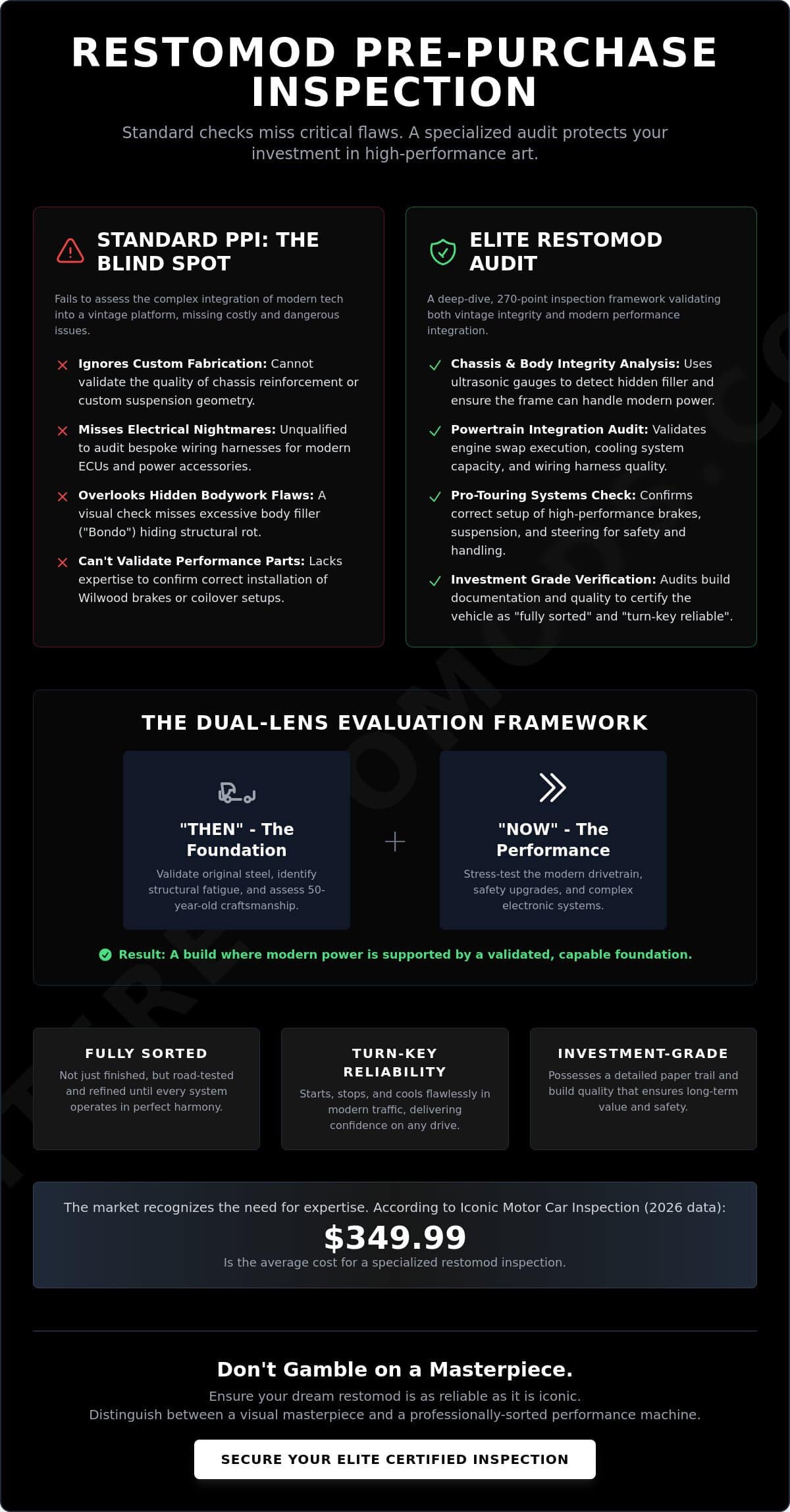
A standard pre-purchase inspection is a logical starting point for most car buyers, yet it often falls short of the mark when evaluating a high-performance restomod. While a typical mechanic can identify a leaking shock or a worn tire, they’re rarely equipped to audit the complex marriage of a vintage 1960s chassis and a modern 600-horsepower drivetrain. As of May 2026, specialized inspections for these unique machines have become a necessity, with prices for expert audits now averaging $349.99 according to Iconic Motor Car Inspection. This specialized pre purchase inspection for modified classic car builds focuses on the quality of custom fabrication and the seamless integration of aftermarket components that a standard checklist simply ignores.
Your neighborhood mechanic might understand a standard brake job, but they often lack the specialized knowledge to audit a bespoke Wilwood system or the geometry of a custom four-link suspension. The financial stakes are incredibly high. Overlooking a poorly executed LS3 swap or a compromised frame reinforcement can turn an investment-grade vehicle into a costly liability. You aren’t just buying a car; you’re buying a piece of functional art. If the modern components aren’t integrated with precision, the vehicle’s performance and safety are compromised.
To better understand the depth required for this process, watch this helpful video:
The Dual-Lens Evaluation Framework
A professional pre purchase inspection for modified classic car assets requires a dual-lens approach. First, we assess the “Then” by validating the original steel and identifying structural fatigue in the 50-year-old foundation. We then pivot to the “Now,” stress-testing the modern drivetrain and safety upgrades. The synergy between these two eras is where most builds fail. If a high-torque Coyote engine is dropped into a chassis without proper subframe connectors, the torque can literally twist the vintage body panels over time. Our meticulous process ensures that the modern power is supported by a foundation capable of handling the roar of the beast.
The Gearhead Lexicon of Inspection
Understanding the industry language is vital for any collector. A “fully sorted” vehicle isn’t just finished; it’s been road-tested and refined until every system operates in harmony. “Turn-key reliability” means the car starts, stops, and cools itself perfectly in modern traffic, regardless of the temperature outside. For a car to be “investment-grade,” it must possess a detailed paper trail of the build story, documenting every bespoke choice from the hand-stitched interior to the specific gear ratios in the rear end. A restomod PPI is a comprehensive audit of both 20th-century craftsmanship and 21st-century performance technology designed to ensure safety and investment value.
Evaluating the Foundation: Chassis and Body Integrity
The skeleton of a restomod defines its soul. You might see a flawless, deep-gloss finish, but a professional pre purchase inspection for modified classic car investments looks for the structural truth hidden by layers of premium clear coat. While a basic classic car inspection checklist covers visible rust, a high-end audit uses ultrasonic thickness gauges to detect “bondo” and hidden rot in critical areas. We’ve seen builds where 30% of a quarter panel was sculpted from filler rather than meticulously shaped steel. That’s a deal-breaker for a vehicle meant to handle modern speeds and cornering forces.
A comprehensive pre purchase inspection for modified classic car builds must prioritize the integrity of the metalwork. We meticulously examine the floor pans and trunk floors, often peeling back bespoke carpeting to ensure the original steel hasn’t been compromised by decades of moisture. If the mini-tub modifications for those massive rear tires weren’t welded with surgical precision, you’re looking at a structural liability. We also look for signs of prior accident damage that may have been masked by modern finishes; a slightly tweaked frame rail can ruin the handling of even the most expensive pro-touring setup.
The Truth Beneath the Flawless Finish
Master metalwork is rare. Poorly executed repairs often hide behind the shine of a six-figure paint job. We look for panel gap consistency across the entire body. If a door gap varies by more than 2mm from top to bottom, the chassis might be sagging or twisted. Using a magnetic paint depth gauge, we can identify exactly where the metal ends and the filler begins. This isn’t just about aesthetics; it’s about knowing if the car can survive the stresses of high-performance driving. You can see how we vet these structural details in our bespoke build process.
Structural Reinforcement for Modern Power
Modern beasts like the LS3 or Coyote produce torque levels that 1960s engineers never imagined. This brute force necessitates chassis stiffening to prevent the body from twisting under load. We inspect subframe connectors and roll cages to ensure they’re gusseted and tied directly into the frame rails, not just bolted to the floor. For those eyeing a classic Mustang, we check the torque boxes and front shock towers for stress cracks. On a K5 Blazer or C10, we focus on the steering box mounting area and rear spring hangers. These are the three critical points where 500 lb-ft of torque meets 50-year-old steel. If these areas aren’t reinforced, the frame will eventually fatigue and fail.
The Mechanical Heart: Modern Power Meets Vintage Iron
The visual allure of a vintage silhouette is only the beginning. Once the hood is released, the true character of the build reveals itself. A thorough pre purchase inspection for modified classic car enthusiasts must move beyond the surface to scrutinize the modern heartbeat of the machine. Whether it’s a high-revving Coyote, a torque-heavy LS3, or a modern Hemi, the execution of the swap determines if the car is a masterpiece or a mechanical liability. We look for precision in every bracket, hose, and mounting point to ensure the engineering matches the aesthetic.
Modern powerplants generate significant heat that vintage engine bays weren’t originally designed to dissipate. We check if the high-capacity aluminum radiator and electric fan setup are properly rated for the engine’s specific output. A 600-horsepower beast requires a cooling system that won’t flinch in heavy summer traffic. Fuel systems are equally critical for performance and safety. We look for high-pressure EFI lines, proper regulators, and baffled fuel tanks designed to prevent fuel starvation during spirited cornering. Safety isn’t an optional upgrade; it’s the baseline for any Elite Certified Restomod.
Engine Swap Integration and Management
The difference between a professional build and a backyard project often lies in the wiring. We look for bespoke looms that are neatly routed, labeled, and protected from high-heat sources like headers. A “rat’s nest” of tangled wires under the dash is more than an eyesore; it’s a recipe for intermittent failures and potential fire hazards. ECU mounting and accessibility are also vital for future tuning or diagnostics. The seamless integration of modern engine management is the primary key to achieving genuine turn-key reliability in a vintage environment.
Drivetrain and Performance Exhaust
A powerful engine is useless if the drivetrain can’t deliver that force to the pavement reliably. We audit the rear end to see if the original 10-bolt or 12-bolt housing has been upgraded with hardened axles and appropriate gear ratios to match the modern overdrive transmission. Vibration at highway speeds often points to poor driveshaft balancing or incorrect pinion angles caused by the custom swap. We also evaluate the exhaust tuck and ground clearance. If the performance exhaust hangs too low, the car becomes a chore to drive on anything but a perfectly flat track. We meticulously check for leaks at custom mating points where modern metallurgy meets vintage iron to ensure the roar of the exhaust isn’t accompanied by the drip of vital fluids.
Specialized Systems: Suspension, Brakes, and Electrical
The visceral thrill of 600 horsepower is meaningless if the vehicle can’t stop or turn with modern precision. A specialized pre purchase inspection for modified classic car assets must go deep into the pro-touring architecture. We don’t just look for pads and rotors; we conduct a full brake system audit. This includes verifying the master cylinder bore size is correctly matched to Wilwood or Baer six-piston calipers. If the hydraulic ratios are off, the pedal feel will be wooden or dangerously soft. Steering rack integration is another frequent failure point. We check for “bump steer,” a condition where the wheels steer themselves as the suspension travels, often caused by incorrect tie-rod geometry in modified front ends.
Classic style. Modern power. These two worlds only coexist safely when the supporting systems are flawlessly executed. We meticulously examine the steering shaft’s U-joints and collapsible columns to ensure they’re securely phased. A high-performance beast requires a steering system that offers immediate feedback without the vague play typical of original 1960s gearboxes. We ensure every component, from the rack bushings to the power steering cooler, is rated for the increased demands of a modern performance build.
Suspension Geometry and Stance
A perfect stance is the hallmark of a world-class build, but it shouldn’t come at the cost of drivability. We identify poorly executed lowering kits, such as cut springs or blocks, which compromise the ride quality of a bespoke machine. Our inspectors examine tubular A-arms and adjustable coilovers for proper clearance and alignment. High-performance driving puts immense stress on bushings and ball joints. We look for premature wear that indicates the suspension wasn’t tuned for the added weight of a modern powertrain. Choosing a custom restomod builder who understands these physics is the difference between a car that handles like a dream and one that fights the driver at every corner.
The Modern Electrical Loom
Electrical systems are the “silent killer” of vintage reliability. We test modern gauges and digital dashes for surgical accuracy, ensuring they communicate perfectly with the ECU. The integration of climate control systems like Vintage Air is a meticulous task; we verify the ducting is secure and the compressor doesn’t drag down the idle. Modern lighting, such as LED conversions, must be wired through relays to avoid melting 50-year-old switches. Because these cars are packed with modern electronics, a battery tender is a prerequisite for any climate-controlled storage. We ensure the build includes a discrete charging port to maintain the system’s health. If you’re ready to ensure your next investment is as safe as it is stunning, explore our specialized restomod services today.
The Elite Certified Standard: Peace of Mind in a Bespoke Machine
The search for a vintage icon often leads to private sellers or generic auctions. However, the risk of inheriting someone else’s mechanical shortcuts is high. While a third-party pre purchase inspection for modified classic car builds provides some data, it lacks the weight of a professional guarantee. At Elite Restomods, we don’t just inspect; we curate. Every vehicle in our inventory undergoes a rigorous vetting process that ensures the beast under the hood behaves with the refinement of a luxury timepiece. We treat every machine as a bespoke piece of functional art.
Classic style. Modern power. Our fully sorted philosophy is the cornerstone of our reputation. Most restorers finish a build and move on. We don’t. We drive our cars. We stress-test the LS3 crates, the Wilwood brakes, and the cooling systems in real-world conditions. This ensures that when you turn the key, you’re greeted with immediate performance, not a troubleshooting session. This level of quality assurance simplifies the ownership experience, allowing you to focus on the raw, visceral excitement of the drive. Buying an Elite Certified Restomod means choosing a vehicle that has already survived our own uncompromising scrutiny.
Our Meticulous 100-Point Inspection Process
We bridge the gap between your childhood dreams and a tangible, high-performance reality through a systematic audit. Our 100-point inspection goes beyond a standard pre purchase inspection for modified classic car requirements by evaluating the actual drivability and long-term reliability of the modern-vintage marriage. We ensure every stitch in the hand-finished interior and every bolt in the pro-touring suspension meets our unrivaled standards. A turn-key experience is non-negotiable for high-performance machinery. You can view our fully sorted inventory to see the results of this perfectionism in action.
Your Journey to Iconic Ownership
Owning an iconic piece of American muscle should be a transformative journey, not a logistical headache. We’ve refined every aspect of the acquisition process to reflect the exclusivity of our vehicles. This includes offering specialized classic car financing and enclosed vehicle transport to protect your investment from the elements. Every car tells a build story, and we invite you to start yours with absolute confidence. From initial sourcing to the final roar of the engine in your driveway, we are the bridge to your automotive future. You can learn about our process to understand how we bring these modern legends to life.
Securing Your Automotive Legacy
The visceral roar of a modern powerplant in a vintage body is a dream that requires meticulous validation. You now understand that a standard inspection misses the nuance of pro-touring geometry and bespoke wiring looms. A professional pre purchase inspection for modified classic car assets is the only way to ensure your investment is as reliable as it is iconic. By focusing on the synergy between vintage steel and 2026 performance technology, you protect yourself from the hidden costs of a compromised build.
At Elite Restomods, we eliminate the uncertainty of the private market. Every vehicle in our inventory is fully sorted and road-tested to ensure it’s ready for the demands of the open road. We provide specialized classic car financing and national enclosed vehicle transport to make your acquisition as seamless as the shifts in a modern transmission. Explore our curated inventory of Elite Certified Restomods and find the machine that speaks to your soul. Your journey toward unrivaled performance and timeless style starts today.
Frequently Asked Questions
Is a pre purchase inspection necessary for a car that looks mint in photos?
Yes. High resolution photography can easily mask structural rot or poor fabrication hidden beneath a deep gloss finish. Physical verification is mandatory because photos can hide 30% of a car’s structural flaws or mismatched components. You can’t see a twisted frame or a parasitic electrical draw in a JPEG. A physical audit is the only way to verify that the beauty isn’t just skin deep.
Can any mechanic perform a pre purchase inspection for a modified classic car?
No. A neighborhood mechanic is trained for factory specifications, not bespoke fabrication. They won’t understand the nuances of a pro touring suspension or how a Coyote engine should be integrated into a 1960s chassis. You need a specialist who speaks the gearhead lexicon of high performance restomodding and understands the synergy between vintage aesthetics and modern performance technology.
What are the most common red flags found during a restomod inspection?
We frequently discover “rat’s nest” wiring under the dashboard and stress cracks in the frame near the steering box. Another major red flag is a cooling system that lacks the CFM rating to handle the roar of a modern beast in traffic. These issues signal a build that was rushed rather than meticulously curated. Finding mismatched fuel system components is another sign that the car isn’t fully sorted.
How much does a professional pre purchase inspection for a modified car cost in 2026?
As of May 2026, a specialized pre purchase inspection for modified classic car assets averages $349.99 according to data from Iconic Motor Car Inspection. This investment covers the dual lens audit of vintage integrity and modern performance. It’s a small price to pay for securing a six figure investment. This cost ensures you aren’t buying a polished turd with hidden structural rot or dangerous wiring shortcuts.
Should I perform a compression test during a restomod PPI?
Yes, especially for high performance crate engines that are meant to be driven hard. A compression test provides a snapshot of the engine’s internal health and verifies the modern performance technology hasn’t been abused. Even a relatively new LS3 can suffer from poor tuning or improper break in procedures. Verifying that all cylinders are within 10% of each other ensures the mechanical heart of the machine is sound.
What happens if the inspector finds rust on a car marketed as ‘rust-free’?
Finding hidden rot in a “rust-free” car indicates a lack of transparency or a poor restoration. If the structural integrity is compromised, the cost of repair can quickly exceed the vehicle’s value. It serves as a critical negotiation point or a valid reason to walk away from the deal. It’s better to discover these flaws during the inspection than after the enclosed transport arrives at your door.
How do I evaluate the quality of a modern engine swap like an LS3 or Coyote?
Evaluate the bespoke wiring harness and the clearance of the headers rather than just the engine itself. A quality swap looks like it belonged there from the factory with clean mounting points and accessible ECU placement. We check the fuel system to ensure it uses high pressure lines rated for modern EFI requirements. If the integration looks messy, the performance will likely be unreliable on the open road.
Does a PPI include a valuation of the classic car?
A pre purchase inspection for modified classic car builds is a technical audit, not a formal appraisal. While the report informs the value by detailing the condition of the bespoke components, it doesn’t provide a specific market price. The inspection report gives you the leverage to determine if the asking price aligns with the actual mechanical reality. It’s the foundation for a confident and informed purchase decision.