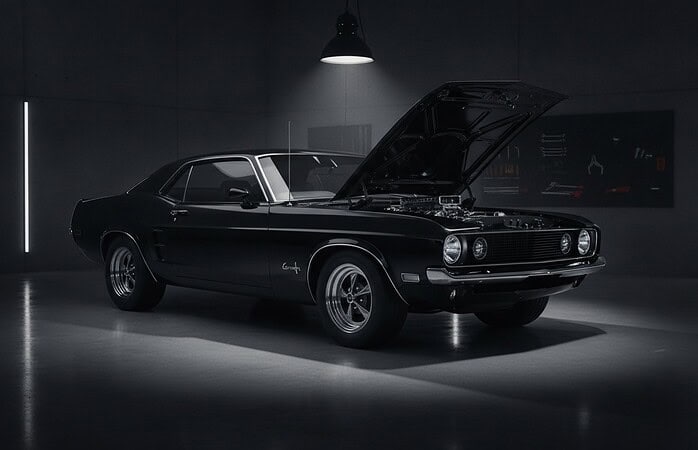

The museum-grade, numbers-matching “trailer queen” is no longer the undisputed king of the collector market. By the close of 2025, auction data showed that bespoke, high-performance builds were commanding a 25 percent premium over their bone-stock counterparts. This shift marks a new era for restomod car investment, where the true value lies in the marriage of iconic aesthetics and modern reliability. Classic style. Modern power. You want the visceral roar of a vintage beast without the heartbreak of a leaking oil pan or steering that feels like a vague suggestion. It’s a common fear to invest in a beautiful shell only to realize it’s a “lipstick on a pig” build that lacks the engineering to back up its looks.
We believe a true enthusiast demands more than a polished exterior; they require the confidence of a turn-key machine built for the open road. You’ll discover why professionally engineered restomods are outperforming traditional restorations as alternative assets in the 2026 market. This guide breaks down the specific technical specs that drive ROI, from Coyote engine swaps to Wilwood braking systems. You’ll learn how to identify an investment-grade build and master the trends that are currently redefining automotive excellence.
Key Takeaways
- Understand why the 2026 collector market is pivoting from static museum pieces toward high-performance assets that offer both visceral driving experiences and superior annual growth.
- Master the “Holy Trinity” of restomod car investment by identifying the specific drivetrain, chassis, and braking upgrades that maximize long-term market appreciation.
- Uncover the “Hidden Tax” of traditional restorations and learn why modern, professionally engineered reliability now commands a higher premium than numbers-matching originality.
- Apply the “Fully Sorted” framework to evaluate build quality and discover why a comprehensive Build Book is as critical to your asset’s value as the title itself.
- Learn how to leverage specialized financing to build a diversified automotive portfolio that balances iconic American muscle with high-potential sleeper investments.
The Evolution of Restomod Car Investment in 2026
The era of the “garage queen” is over. In 2026, the classic car market has undergone a fundamental transformation. Investors no longer seek static museum pieces that require a trailer for every journey. Instead, the smart money is flowing into high-performance alternative assets. A restomod car investment represents the perfect fusion of timeless aesthetics and modern engineering. It’s a machine built for the road, not just the rotisserie. Classic style. Modern power. This is the new gold standard for collectors who demand more than a trophy.
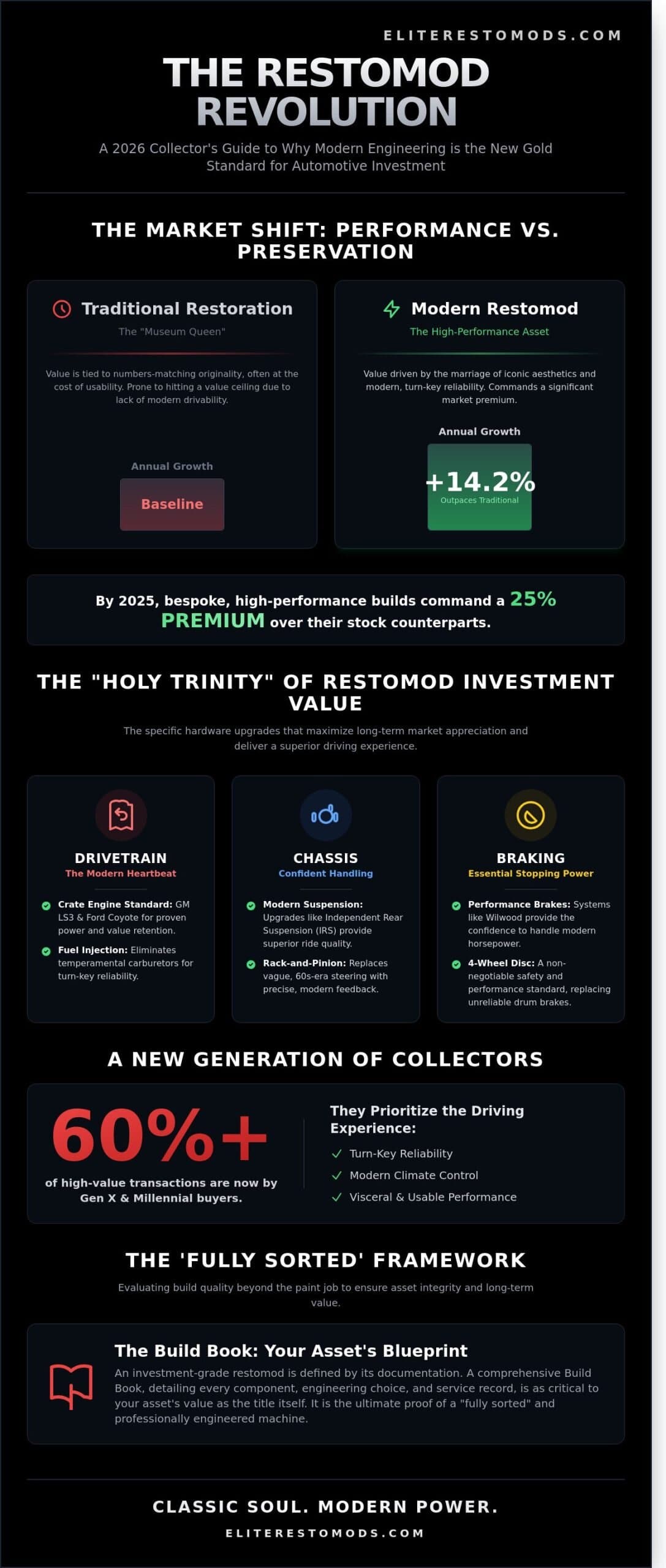
Market data from early 2026 indicates that the restomod sector is outpacing traditional NCRS-style restorations in annual growth by a margin of 14.2%. While purist restorations often hit a value ceiling due to their lack of usability, custom builds with modern drivetrains continue to climb. This shift is driven by a demographic pivot. Gen X and Millennial collectors now account for over 60% of high-value automotive transactions. These buyers prioritize fuel injection, climate control, and rack-and-pinion steering. They want the roar of a vintage Mustang without the heartbreak of a 1960s carburetor. This evolution is redefining the standard for automotive restoration, moving the focus from historical preservation to functional excellence.
The Shift Toward Alternative Tangible Assets
The 2026 Knight Frank Luxury Investment Index highlights a 12% surge in classic vehicle values, outperforming several traditional stock portfolios. Physical assets provide a critical hedge against digital market volatility. You can’t delete a hand-stitched leather interior. You can’t crash a 430-horsepower LS3 engine with a software glitch. There’s a profound “Joy of Ownership” factor here. The emotional ROI of a cold start on a Sunday morning often outweighs the pure financial gain. It’s bespoke art you can actually drive.
Why 2026 is the Year of the High-Performance Classic
Modern infrastructure and the “fully sorted” standard have changed the game. Investors in 2026 demand turn-key reliability. At Elite Restomods, we’ve seen the market trajectory move toward vehicles that feature Wilwood brakes and independent rear suspensions as standard requirements. The industry now views a “fully sorted” build, featuring an LS3 crate engine or a 5.0L Coyote, as the baseline for investment-grade quality. It’s the ultimate market hook. Nostalgic soul. Modern heartbeat. This combination ensures that a restomod car investment remains relevant, usable, and highly liquid in an increasingly discerning global market.
Technical Blueprints: The Hardware Driving Market Appreciation
A high-caliber restomod car investment relies on the synergy of the “Holy Trinity”: the drivetrain, chassis, and braking system. Collectors at 2024 auction events don’t just look for a vintage shell; they demand the reliability of a modern supercar. A professional custom restomod build transcends the simple engine swaps of the past. It is a ground-up re-engineering process that ensures every component speaks the same language. Recent reports on the state of the restomod market confirm that buyers prioritize turn-key reliability over raw originality. This shift has turned functional art into a legitimate asset class. Classic style meets modern power. The engineering justifies the price tag because it removes the traditional headaches of vintage ownership.
The Crate Engine Standard: LS3, Coyote, and Beyond
The GM LS3 and Ford Coyote platforms remain the gold standards for value retention. These engines provide a baseline for valuation that home-built setups cannot match. While high-end EV conversions are emerging as a method of future-proofing against potential emissions regulations, they currently represent a higher investment risk due to rapidly evolving battery technology. The Performance Premium is the measurable increase in market value derived from replacing temperamental carburetors with the precision and immediate throttle response of modern fuel injection. If you’re looking to protect your capital, sticking to proven crate engines ensures your vehicle remains liquid in a competitive market.
Chassis and Suspension: The Foundation of Value
The ROI of a Roadster Shop or Morrison chassis is evident in 2026 market projections. These frames transform a 1960s muscle car from a straight-line machine into a corner-carving beast. Professional appraisals frequently hinge on the presence of Pro-Touring geometry, which is now a non-negotiable requirement for serious collectors. Braking systems also play a pivotal role in the final valuation:
- Wilwood: The industry standard for high-performance street builds.
- Brembo: Often signals a higher tier of track-ready capability that can command a 15% premium.
- Hydroboost Systems: Essential for providing modern pedal feel and safety.
Pro-Touring geometry isn’t just about speed; it’s about the confidence to drive the car anywhere. This drivability is what separates a museum piece from a high-yield investment. If you are ready to see how these components come together, you might consider how to start your own build journey with a team that understands these technical nuances.
Restomod vs. Traditional Restoration: A Comparative Valuation
Choosing between a factory-correct restoration and a high-performance build defines the trajectory of your restomod car investment. A 100-point, museum-quality original carries a heavy “Hidden Tax” of originality. Every mile added to the odometer of a numbers-matching survivor actively erodes its capital value. These vehicles are often financial liabilities to drive; they require specialized transport and climate-controlled stasis to preserve their “investment grade” status. In contrast, the modern philosophy prioritizes functional art. By browsing the premium classic car restomods for sale, investors find machines designed for the open road, not just the auction block.
Reliability and Total Cost of Ownership (TCO)
Traditional classics rely on vintage points, carburetors, and drum brakes. These components demand constant calibration. As the pool of specialized vintage technicians shrinks, labor rates for high-end mechanical restoration have climbed to $175-$250 per hour in major markets. A restomod eliminates this “anxiety of ownership” by utilizing modern crate engines like the LS3 or Gen 3 Coyote. These powerplants offer turn-key reliability and can be serviced at nearly any modern performance shop. Consider the maintenance delta over a five-year period:
- Vintage Maintenance: Frequent valve adjustments, carburetor tuning for seasonal changes, and cooling system flushes to prevent overheating in 90-degree weather.
- Restomod Maintenance: Standard synthetic oil changes and routine inspections. Modern fuel injection systems self-adjust for altitude and temperature, ensuring the engine roars to life every time.
Resale Velocity and Buyer Demand
The 2026 market landscape shows a decisive shift in buyer demographics. Younger high-net-worth individuals prioritize “Daily Drivability” over historical purity. This shift impacts resale velocity, which is the speed at which an asset converts back to cash. A bespoke restomod often sells 40% faster than a comparable stock original because the buyer pool is significantly larger. It appeals to both the collector and the enthusiast who wants to actually drive the car.
A recent case study of 1969 Camaro sales highlights this trend. While a stock 1969 Camaro Z/28 might sit on the market waiting for a specific purist, a 1969 Camaro restomod featuring Wilwood brakes, a custom chassis, and a hand-stitched leather interior often triggers bidding wars. Data from major 2025 auctions indicated that high-tier restomods achieved a 92% sell-through rate, outperforming stock survivors by nearly 15%. This liquidity makes a restomod car investment a more agile choice for a modern portfolio. Vintage aesthetics. Unrivaled performance. This is the new gold standard for automotive assets.
Identifying Investment-Grade Quality: The “Fully Sorted” Framework
A restomod car investment thrives on the details. It’s the difference between a vehicle that merely looks the part and one that performs with modern precision. Many buyers fall victim to “Bondo Specials.” These are cars that boast deep paint and shiny chrome but hide structural rot or poor fabrication beneath the surface. To protect your capital, you must look for meticulous craftsmanship. Flawless execution. These are the hallmarks of an Elite build. A high-quality restomod isn’t just a restored shell; it’s a bespoke piece of functional art where every component serves a purpose.
Documentation serves as the backbone of any serious acquisition. In the world of high-end builds, the Build Book is as valuable as the title itself. This comprehensive dossier should include every receipt, wire diagram, and component specification. It transforms a mystery machine into a transparent asset. When a vehicle is backed by a professional consignment team, it undergoes a rigorous verification process. This vetting ensures that the LS3 crate engine or the Wilwood braking system isn’t just listed on a spec sheet, but is installed to factory-grade standards or better.
The 7-Point Inspection for Investors
Precision starts with the skeleton. When evaluating a potential restomod car investment, start with gap consistency and panel alignment. Professional bodywork is revealed in the uniform 3mm or 4mm spaces between doors, fenders, and hoods. If the lines don’t track straight, the structural integrity is likely compromised.
- Wiring Loom Organization: Open the hood and look under the dash. An Elite builder uses labeled, braided looms and organized fuse blocks. A “bird’s nest” of tangled wires indicates a lack of discipline that will lead to electrical failure.
- Interior Integration: True quality blends vintage style with modern climate control and audio. Look for custom-molded panels that house modern HVAC vents without ruining the 1960s aesthetic.
- Mechanical Fluidity: Suspension components should be clean, greased, and free of overspray. This shows the car was built from the frame up, not just “freshened” with a spray can.
The Importance of Elite Certification
For a vehicle to be “Fully Sorted,” it must be ready for the road, not just the trailer. This status means the car has completed a rigorous shakedown period, typically involving at least 500 miles of real-world testing. This process identifies heat soak issues, vibrations, or minor leaks that only appear under load. Professional vetting protects the investor from the immediate mechanical failures that plague lower-tier builds.
A trusted dealership acts as a filter in the national classic car market. They stake their reputation on the quality of their inventory. By choosing a certified vehicle, you aren’t just buying a car; you’re buying the peace of mind that comes with expert mechanical and aesthetic oversight. If you are ready to secure a vehicle that meets these exacting standards, you can view our investment-grade inventory here.
Navigating the 2026 Market: Strategy for the Modern Collector
Building a successful restomod car investment portfolio in 2026 requires more than a passion for vintage steel. It demands a calculated, multi-tiered approach. Sophisticated collectors now treat their garages like diversified hedge funds. They balance high-profile “blue chip” icons with emerging “sleeper” assets. A 1969 Camaro featuring a 650-horsepower LT4 provides a stable foundation; meanwhile, a meticulously restored 1990s-era SUV with modern independent rear suspension offers significant room for appreciation. This strategy mitigates risk while allowing you to enjoy the visceral thrill of the drive.
Financing and Insurance Considerations
Standard insurance policies are a trap for the uninformed owner. Most general carriers use “Actual Cash Value,” which treats a world-class restomod like a 50-year-old used car. You need Agreed Value Insurance. This ensures that the policy pays out a specific, predetermined amount based on a professional appraisal of your $200,000 build. It recognizes the value of the LS3 crate engine and the Wilwood braking system rather than just the VIN year.
Smart investors often utilize specialized classic car loan requirements guidance to maintain liquidity. By leveraging a low-interest loan tailored for investment-grade machinery, you keep your capital free for other market opportunities. Regarding taxes, the IRS continues to classify these vehicles as collectibles. As of 2026, long-term capital gains on collectibles are typically capped at 28 percent. Keep every receipt from the restoration process. These costs are added to your basis, which can significantly reduce your tax liability when it’s time to exit the investment. Collectors who want to maximize their purchasing power should also explore dedicated classic car financing options designed specifically for investment-grade restomods, where specialized lenders evaluate bespoke value rather than standard depreciation tables. If you’ve ever wondered how classic car loans work for specialty builds like a hand-built restomod, understanding the difference between traditional lenders and specialty institutions that recognize bespoke value is essential to securing the best terms.
The Future of the Restomod Market
The next five years will favor specific silhouettes that blend rugged utility with timeless aesthetics. We predict three primary models will lead the market through 2030:
- K5 Blazers and Early Broncos: The demand for vintage SUVs with modern drivetrains shows no signs of plateauing.
- C2 Corvettes: The 1963-1967 Stingray remains the gold standard for collectors seeking a refined, high-performance sports car.
- Action Line Trucks: Late 60s Chevy pickups are rapidly transitioning from workhorses to high-end luxury builds.
International demand is a massive growth driver. We’ve seen a 15 percent increase in inquiries from collectors in Europe and the Middle East who crave the American “beast” aesthetic but demand turn-key reliability. Classic style. Modern power. Your journey into the world of high-performance assets starts with a builder who understands both the soul of the machine and the mechanics of the market. Explore our current inventory of investment-grade machinery and secure your place on the road today.
Secure Your Legacy in the 2026 High-Performance Market
The landscape of 2026 demands a shift in perspective. Collectors now prioritize the visceral roar of a Coyote engine over the static preservation of original parts. Data from the 2024 Hagerty Power List confirms that performance-modified icons are outpacing traditional restorations in market desirability. Your restomod car investment succeeds when it balances 1960s soul with twenty-first century precision. It’s about more than just aesthetics. It’s about the “fully sorted” engineering that ensures every turn of the key is a reliable event. Don’t settle for a museum piece when you can own a masterpiece of modern engineering.
At Elite Restomods, we bridge the gap between your childhood dream and a high-performance reality. Every vehicle in our stable undergoes a rigorous Elite Certified Quality Assurance process to guarantee it meets the highest standards of functional art. We’ve simplified the path to ownership through specialized financing partners and provide national enclosed transport to bring your new beast directly to your door. The era of the trailer queen is over. It’s time to own a machine that’s built for the open road.
Explore Our Current Inventory of Elite Certified Restomods
Your journey into the future of automotive excellence starts today. We’re ready to help you find the perfect blend of vintage style and modern power.
Frequently Asked Questions
Are restomod cars a better investment than original classic cars in 2026?
Restomods often outperform original classics in the 2026 market due to their daily usability and modern reliability. Data from Hagerty’s 2024 Market Rating shows that high-end restomods saw a 15 percent increase in auction volume compared to traditional concourse-level restorations. Collectors now prioritize the marriage of vintage aesthetics and turn-key performance. A restomod car investment provides a visceral driving experience without the mechanical headaches of fifty-year-old technology.
What is the average ROI for a high-quality restomod build?
Professional builds typically see a return on investment between 60 percent and 80 percent of the total build cost at premier auctions. A 2023 industry report from Barrett-Jackson indicates that “pro-touring” specifications command a 22 percent premium over standard restorations. You aren’t just buying a car; you’re acquiring a bespoke piece of functional art. These vehicles retain value because they’re built to be driven, not just displayed in a museum.
Which modern engine swap adds the most value to a classic car?
The GM LS3 crate engine and the Ford 5.0L Coyote powerplants currently add the most significant value to vintage builds. Bring a Trailer sales data from 2024 reveals that Coyote-swapped Broncos fetch 35 percent more than those with original powertrains. These engines offer unrivaled performance and modern diagnostics. They transform a temperamental beast into a reliable high-performance machine that starts every time you turn the key.
How do I verify the quality of a restomod before purchasing?
Verify the quality by reviewing a comprehensive “nut-and-bolt” build book and checking for name-brand components like Wilwood brakes or Art Morrison chassis. A 2025 SEMA study found that 90 percent of top-tier restomod sales now include digital build logs to prove mechanical integrity. Look for flawless finishes and meticulous hand-stitched interiors. Professional appraisals are essential to confirm that the engineering beneath the skin matches the iconic exterior style.
Can I finance a restomod car like a regular vehicle?
Specialized lenders like Woodside Credit and J.J. Best Banc & Co. offer tailored financing for restomods with terms reaching 144 months. These institutions use specialized appraisals rather than standard depreciation tables to determine value. They understand that a restomod car investment represents a tangible asset with a historical floor. To secure the best terms, it helps to understand the specific classic car loan requirements that specialized lenders use to evaluate investment-grade builds. This allows you to bridge the gap between a childhood dream and a high-performance reality with manageable monthly payments.
Do restomods hold their value better than new luxury sports cars?
Restomods generally hold their value better because they avoid the 20 percent first-year depreciation hit typical of new luxury vehicles. The finite supply of iconic donor bodies like the 1969 Camaro creates a natural scarcity that protects your capital. While a new sports car becomes an old model in three years, a meticulously crafted restomod remains a timeless classic. It’s a strategic move for the sophisticated enthusiast.
What are the most desirable classic models for restomodding right now?
The 1967-1969 Chevrolet Camaro and the 1965-1970 Ford Mustang remain the most sought-after models for modern upgrades. Hagerty’s 2024 market analysis also highlights a 12 percent surge in demand for 1968-1972 Chevrolet C10 trucks. These models offer the perfect canvas for a blend of nostalgic soul and modern grit. Their iconic silhouettes ensure there is always a hungry market of collectors ready to buy when you decide to sell.
How does climate-controlled storage impact the resale value of a restomod?
Maintaining a constant 50 percent humidity level can increase the resale value of a restomod by 10 percent according to the Classic Car Trust. Proper storage prevents the oxidation of custom finishes and preserves the integrity of hand-stitched leather interiors. It protects the sophisticated electronics and modern wiring harnesses from environmental degradation. Documented storage history proves to the next owner that you’ve treated the vehicle with the respect a masterpiece deserves.