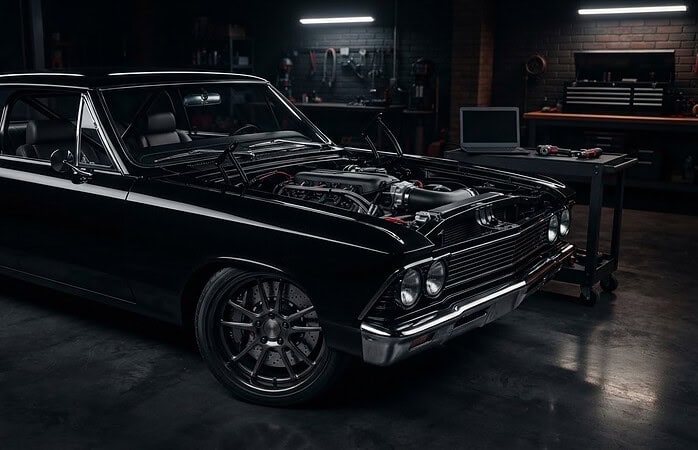

A standard bank sees a 1969 Mustang as a fifty-seven-year-old liability, yet you know it’s a bespoke masterpiece of modern performance. Most traditional lenders automatically reject vehicles over twenty years old, completely ignoring the unrivaled value of an LS3 crate engine or a hand-stitched interior. It’s a common hurdle for collectors who understand that true automotive art requires more than a basic consumer loan. To bridge this gap, you must master the specific classic car loan requirements for 2026 to ensure your next investment-grade restomod gets the backing it deserves.
You’ve spent years dreaming of that perfect blend of vintage aesthetics and turn-key reliability. We’re here to make sure the financing process is as smooth as a Wilwood braking system. This guide provides the blueprint for securing long-term, low-rate approval by accurately documenting your vehicle’s modern upgrades and high-end craftsmanship. We’ll explore the essential documentation for custom builds, the role of specialized appraisals, and how to choose a lender that speaks the language of high-performance machinery. From proving the worth of a Coyote swap to navigating specialized insurance, you’ll gain the confidence to move from the showroom floor to the open road.
Key Takeaways
- Understand why a FICO score of 700+ and a 10% to 20% down payment are the essential benchmarks for financing high-performance, investment-grade machinery.
- Learn how to navigate specialized classic car loan requirements by utilizing professional appraisals that accurately value bespoke restomod craftsmanship over standard depreciation curves.
- Discover the critical steps to preparing a comprehensive application, from securing specialized pre-approvals to documenting the meticulous “build story” of your vehicle.
- Explore how “Elite Certified” status simplifies the financing journey by providing lenders with the quality assurance they need to fund your next automotive masterpiece.
Understanding Why Classic Car Financing Requirements Differ from Modern Auto Loans
A standard 2026 commuter vehicle is a depreciating asset. It loses roughly 15% of its value the moment it leaves the dealership lot. High-end vintage machinery follows a different trajectory. This is why classic car loan requirements are fundamentally more rigorous and specialized than those for a modern daily driver. Lenders aren’t just financing a mode of transportation; they’re collateralizing a piece of history that, if maintained properly, will likely increase in value over time.
Traditional banks rely on automated depreciation curves to manage risk. They struggle with the “collateral gap” found in vintage steel. A computer algorithm sees a 1968 chassis and assigns it a scrap value, failing to recognize the $30,000 LS3 crate engine or the precision-engineered Wilwood braking system tucked behind the wheels. In the 2026 market, “fully sorted” vehicles represent the gold standard for lenders. A car that’s turn-key and ready for a cross-country haul carries significantly less risk than an unrestored project. Lenders favor restomods because modern reliability ensures the asset remains protected and operable, rather than sitting as a pile of parts in a garage.
The Role of Vehicle Age and Condition
Most national lenders draw a firm line at the 20 or 25-year mark for standard financing. Once a vehicle crosses this threshold, it transitions from a “used car” to a “collector vehicle” in the eyes of a financial institution. This distinction is critical for anyone researching what is considered a classic car. While a used car is a utility, a collector vehicle is a legacy. To bypass traditional age-based rejections, many enthusiasts seek “Elite Certified” status. This designation proves to the bank that the vehicle has undergone a professional inspection, ensuring the frame, drivetrain, and electrical systems meet modern safety and performance standards.
Depreciation vs. Appreciation: The Lender’s Perspective
Restomods are viewed as investment assets rather than liabilities because they combine historical soul with contemporary performance. While a factory-spec modern luxury car loses value with every mile, a rare 1970 Mustang with a Coyote swap often sees its price floor rise as the availability of donor bodies shrinks. Modern drivetrains stabilize the resale value for the lender, providing a safety net that raw vintage mechanics cannot offer. This stability directly impacts the loan-to-value (LTV) ratio. When a vehicle is rare and mechanically sound, lenders are more willing to offer higher LTVs, sometimes covering up to 90% of the purchase price, because they know the market demand for “new-old” performance remains insatiable. Meeting classic car loan requirements starts with choosing a vehicle that the bank views as a growing asset.
The Four Critical Requirements for Classic Car Loan Approval
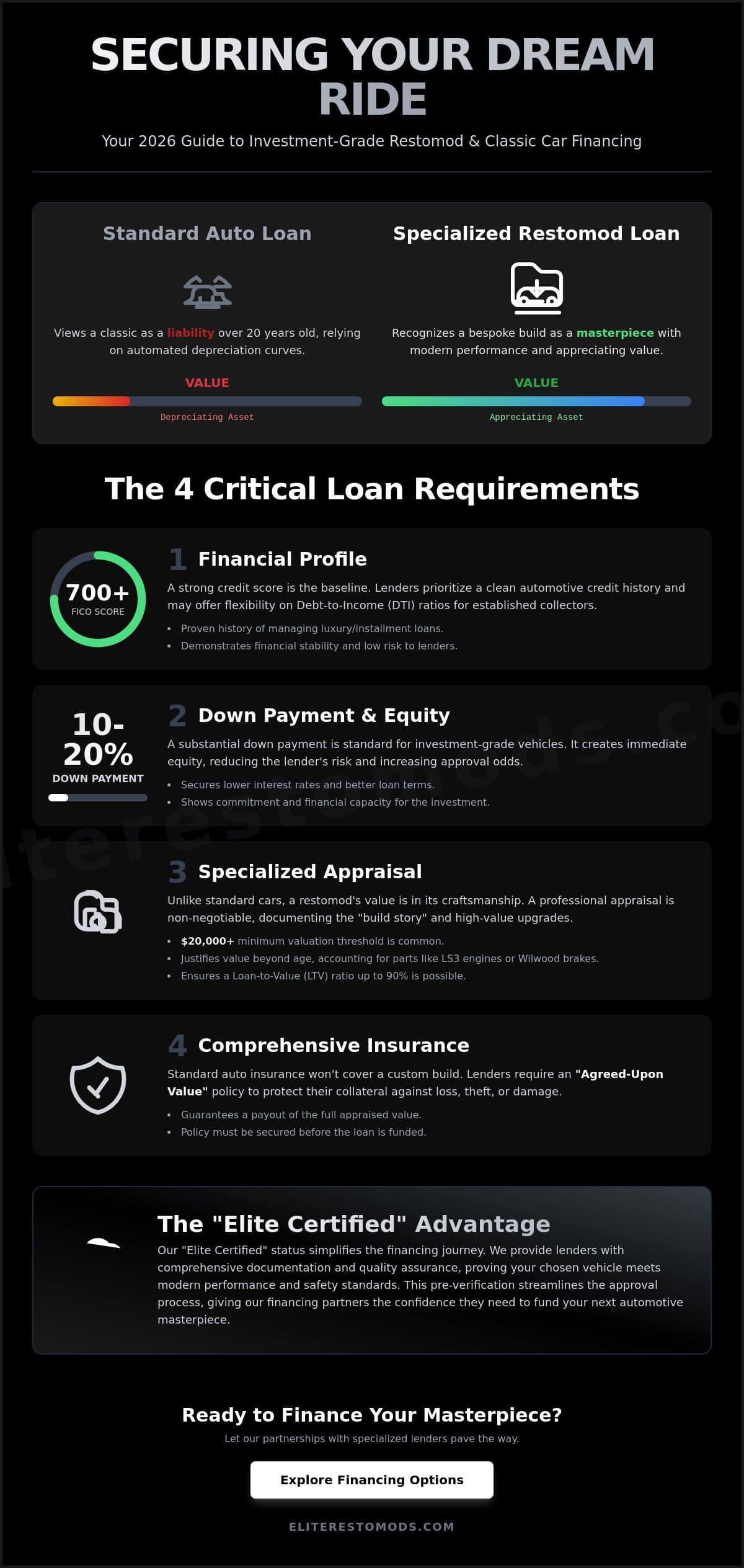
Securing financing for a vintage beast requires more than just a passion for chrome. Classic style. Modern power. Lenders view these vehicles as investment assets rather than simple transportation. To meet modern classic car loan requirements, you must demonstrate both financial stability and an appreciation for the asset’s value. Most premium lenders establish a $20,000 minimum valuation threshold for eligibility. This floor ensures the vehicle is a true collector piece rather than a project car. They also demand a clean title, free of salvage or rebuilt brands, to protect their collateral.
Credit Score and Financial History
A FICO score of 700 is the typical baseline for competitive interest rates. Lenders look deeper than the three-digit number. They prioritize a clean automotive credit history. If you’ve successfully managed high-limit credit cards or previous luxury installment loans, you’re viewed as a lower risk. Specialized lenders often show more flexibility with debt-to-income (DTI) ratios than traditional big-box banks. They understand that a collector’s liquid assets might be tied up in other high-performance machinery. Because these vehicles must meet specialized appraisal standards to secure insurance, lenders rely on that valuation to justify the loan-to-value ratio. Understanding how do classic car loans work in the specialty market reveals why these institutions evaluate collectors differently than standard borrowers.
Down Payment and Equity Positions
Expect to put 10% to 20% down for investment-grade cars. This industry standard creates immediate equity. It provides the financing company with skin in the game from the borrower, which often triggers a lower APR. You don’t always need cash for this requirement. Many collectors use trade-in equity from existing vehicles to cover the down payment. This strategy is common when upgrading from a stock vintage model to a bespoke restomod that offers turn-key reliability. A significant down payment signals that you’re a serious collector who values the meticulous craftsmanship of the build. It bridges the gap between a childhood dream and a tangible, high-performance reality.
Navigating Restomod Valuations and Specialized Appraisal Standards
Standard valuation tools like NADA or Kelly Blue Book are designed for mass-market commuters. They fail to account for the $150,000 in engineering that separates a standard vintage coupe from an Elite Certified restomod. Lenders need more than a VIN to approve a six-figure loan. They require a story told through data. Understanding how to get a classic car loan involves bridging the gap between a fifty-year-old chassis and its 21st-century components. Professional third-party appraisals act as the primary evidence. These experts look beyond the year and model to assess the quality of the fabrication. They use “comparable sales” from high-end auction houses like Barrett-Jackson or Bring a Trailer to justify the valuation. This market data proves that the investment is backed by real-world demand, ensuring the classic car loan requirements are met with precision.
Proving the Value of Performance Upgrades
A detailed Build Sheet is your financial resume. It lists every component from the Wilwood six-piston brakes to the hand-stitched leather interior. Modern engine swaps, such as the LS3 or Gen 3 Coyote, add quantifiable value because they offer turn-key reliability. Lenders view these as risk-reduction features. You must distinguish between the “cost of build” and “market value.” A bank won’t lend on the total labor hours alone. They lend on what the car is worth in a 2026 market. Documenting these bespoke features ensures the car is viewed as a high-performance asset. It’s about the marriage of brute force and refined comfort.
Working with Specialized Valuation Guides
Lenders often turn to the Cars of Particular Interest (CPI) guide for baseline figures. However, performance-oriented restomods require a “stated value” policy rather than “actual cash value.” Stated value protects the specific investment in high-end modifications. This distinction is vital for those looking at Classic Car Restomods for Sale: The 2026 Guide to Investment-Grade Performance. It ensures the loan reflects the car’s true capability. Vintage aesthetics. Modern power. The right valuation makes both possible.
- Build Sheet: Acts as the financial resume for the vehicle.
- LS/Coyote Swaps: Provide quantifiable reliability and value.
- Stated Value: Essential for protecting bespoke modifications.
- Comparable Sales: Uses 2025 and 2026 auction data to justify six-figure loans.
The process of meeting classic car loan requirements is a transformative journey. It takes the reader from the initial spark of recognition to the final realization of the car’s modern capabilities. No detail is too small to be overlooked in the pursuit of automotive excellence. We bridge the gap between your childhood dream and a tangible, high-performance reality.
How to Prepare Your Application for an Investment-Grade Vehicle Loan
Securing a high-end restomod is a deliberate act of curation. It’s the bridge between a childhood obsession and a sophisticated asset. Meeting classic car loan requirements isn’t just about your credit score; it’s about proving the value of the machine you’re about to command. Preparation separates the casual observer from the owner of a bespoke 600-horsepower masterpiece. To move from the showroom to the open road, you must follow a systematic path to approval.
- Step 1: Secure a pre-approval from a specialized collector car lender who understands the appreciation curves of high-performance builds.
- Step 2: Gather comprehensive vehicle documentation, including the detailed build story and at least 20 high-resolution photos showing the chassis, engine bay, and interior.
- Step 3: Obtain a quote for specialized collector car insurance, which is a non-negotiable requirement for 95% of specialized lenders.
- Step 4: Verify the title status. Ensure the VIN is clean with no “salvage” or “rebuilt” brands that could slash the vehicle’s valuation by 40% or more.
- Step 5: Finalize the sales agreement with a reputable dealer like Elite Restomods to provide the lender with a clear, professional invoice of sale.
Gathering the Right Documentation
Lenders treating these vehicles as investment-grade assets require a deeper dive into your financial profile. You’ll need two years of tax returns and a credit score typically exceeding 700 to unlock the most competitive 2026 interest rates. Beyond personal data, the vehicle’s pedigree is paramount. A “fully sorted” inspection report from the builder speeds up the process significantly. This document proves the mechanical integrity of the LS3 crate engine or the precision of the Wilwood braking system. For more on why these technical upgrades drive value, read The 2026 Guide to Restomod Car Investment: Why Performance is the New Premium. Professional documentation ensures the lender sees the car as a tangible asset rather than a risky hobby.
Choosing the Right Insurance Partner
Standard insurance providers often fail to grasp the nuance of a $200,000 restoration. They use “Actual Cash Value,” which depreciates your car the moment it leaves the lot. Meeting classic car loan requirements requires “Agreed Value” coverage. This ensures that if a total loss occurs, you’re covered for the full appraised amount. Be mindful of mileage restrictions. Most policies cap annual driving at 2,500 or 5,000 miles. These limits protect the vehicle’s condition but can influence your loan terms if the lender perceives a higher risk of wear. Vintage soul meets modern protection. It’s about preserving the roar of the engine and the value of the investment. For a comprehensive overview of structuring your funding strategy, the classic car financing guide for investment-grade restomods outlines how to identify specialized lenders who recognize bespoke value and create a seamless path from initial design to final approval.
Securing Your Dream Build with Elite Restomods’ Financing Partnerships
Meeting classic car loan requirements often feels like a complex mechanical diagnostic. We’ve spent years cultivating vetted lender relationships to bridge the gap between vintage soul and modern financial scrutiny. Most traditional banks struggle to value a 1969 Camaro with a 2026 performance heart. We’ve solved that problem. By partnering with specialists who understand the intrinsic value of a bespoke build, we turn a daunting approval process into a streamlined victory lap. Our lenders recognize that an Elite Restomod isn’t just a car; it’s a high-performance asset with a documented pedigree.
The Elite Certified Advantage
Our 150-point Elite Certified inspection provides a comprehensive digital footprint of the vehicle’s condition, which effectively eliminates the valuation anxiety that typically plagues classic car lending. We act as the technical intermediary for our clients, providing the granular data lenders crave. This includes specific LS3 crate engine specs, the precision of Wilwood braking systems, and chassis reinforcement details. This one-stop-shop transparency ensures the loan reflects the true market value of the bespoke engineering involved, making the financing process as smooth as our hand-stitched interiors.
Our turn-key philosophy is the ultimate leverage for the modern collector. Lenders view project cars as high-risk liabilities with uncertain completion dates and ballooning costs. An Elite Restomod is the opposite. It’s a finished product ready for the open road the moment the keys hit your hand. This shift from “project” to “product” makes meeting classic car loan requirements significantly easier. You’re financing a finished masterpiece with a predictable market trajectory, not a garage full of expensive potential.
Next Steps: From Approval to the Open Road
We coordinate final loan disbursements directly with our enclosed transport services to ensure a seamless handoff. Protecting the finish is as vital as the engine’s roar. We often recommend that clients utilize Climate Controlled Car Storage: The Science of Preserving Investment-Grade Vehicles to safeguard their investment from the elements immediately upon delivery. This professional approach to preservation often gives lenders additional confidence in the long-term value of the collateral.
Classic style. Modern power. Your childhood dream is no longer a distant memory or a grainy poster on a bedroom wall. With the right financial structure and our meticulous attention to detail, that dream becomes a tangible, high-performance reality. It’s time to stop waiting and start driving. We’re here to ensure the transition from the showroom floor to your private collection is as flawless as the paint on your new build.
Drive Your Legacy Into the Modern Era
Navigating the 2026 market requires more than just a passion for vintage steel; it demands a strategic approach to classic car loan requirements. Success hinges on aligning your financial profile with specialized appraisal standards that recognize the value of high-performance modern upgrades. Securing an investment-grade vehicle depends on documenting the build’s mechanical pedigree and its market trajectory as outlined in our 2026 Guide for Collectors. It’s about proving that your dream machine is a stable, appreciating asset.
Elite Restomods transforms this complex process into a seamless journey. Our Elite Certified Quality Assurance program ensures every LS3 crate engine and Wilwood brake system meets the rigorous scrutiny of our partnerships with top-tier collector lenders. We specialize in investment-grade restomods ready for daily driving, providing the turn-key reliability that modern collectors demand. We’ve spent years perfecting the marriage of brute force and refined comfort so you don’t have to navigate technical hurdles alone.
Explore Our Elite Certified Inventory and Get Pre-Approved Today
The keys to your bespoke masterpiece are within reach. It’s time to stop dreaming and start driving.
Frequently Asked Questions
What is the minimum credit score for a classic car loan in 2026?
Lenders typically require a minimum FICO score of 700 to meet classic car loan requirements in the specialty market. This threshold ensures you access the most competitive interest rates and favorable terms for high-value assets. While some subprime lenders exist, top-tier firms often look for scores above 740 to approve the lowest down payment options. It’s about proving financial stability to match the caliber of the machine.
Can I get a classic car loan for a vehicle I want to restore myself?
Most specialized lenders won’t finance a project car intended for a DIY restoration. They require the vehicle to be in “turn-key” condition or undergoing a professional build by an established shop. Financing companies prioritize collateral value, which is difficult to quantify when a car is in pieces. If you’re building a bespoke masterpiece, look for “construction loans” specifically designed for professional shop environments.
How long are the typical loan terms for a restomod?
Loan terms for restomods and collector vehicles can extend up to 144 months. This 12-year window allows for lower monthly payments on high-end builds that often exceed $100,000 in value. Long-term financing reflects the enduring value of these vehicles. They don’t depreciate like a standard commuter car, so lenders are comfortable with extended schedules that respect the asset’s longevity.
Do classic car loans have mileage restrictions?
Most classic car loan requirements include annual mileage limits ranging from 2,500 to 5,000 miles. These restrictions preserve the vehicle’s market value and reduce the lender’s risk. Some specialized policies allow for pleasure driving without a hard cap, but exceeding 5,000 miles usually triggers a shift into standard auto loan territory. It’s the price of maintaining a pristine, low-mileage investment.
Is a down payment always required for collector car financing?
Expect to provide a down payment of at least 10% to 20% for most collector car loans. While zero-down offers appear in the standard market, the specialty world relies on “skin in the game” to secure bespoke assets. For a $150,000 restomod, a $15,000 deposit is standard practice. This initial equity protects both the collector and the lender against market fluctuations.
Can I refinance an existing classic car loan?
You can refinance a classic car loan if the vehicle’s appraised value has increased or if market interest rates have dropped. Many collectors refinance after a major engine upgrade or interior overhaul to capture the new equity. If your 1969 Camaro now sports a $20,000 LS3 crate engine, a new appraisal could unlock better terms. It’s a strategic move for any serious portfolio.
What is the difference between “Agreed Value” and “Stated Value” insurance?
Agreed Value insurance pays the exact amount listed on your policy if a total loss occurs. Stated Value only pays up to the listed amount or the actual cash value, whichever is lower at the time of the accident. For a custom build with Wilwood brakes and a hand-stitched interior, Agreed Value is the only way to guarantee your investment. It eliminates the guesswork of depreciation.
Does the engine type (e.g., LS swap) affect my loan approval?
Modern powerplants like a 430-horsepower LS3 or a 5.0L Coyote engine often make loan approval easier because they improve reliability. Lenders view these high-performance swaps as value-adds that enhance the car’s drivability and resale appeal. A vintage shell paired with a modern beast under the hood represents the perfect marriage of nostalgia and engineering. It’s a turn-key reality that banks trust.