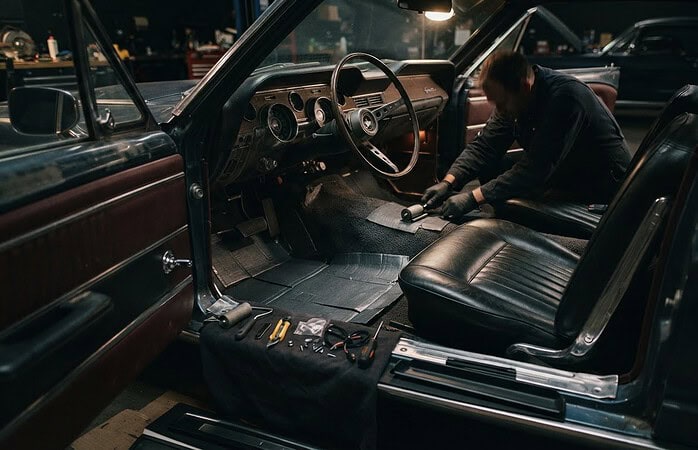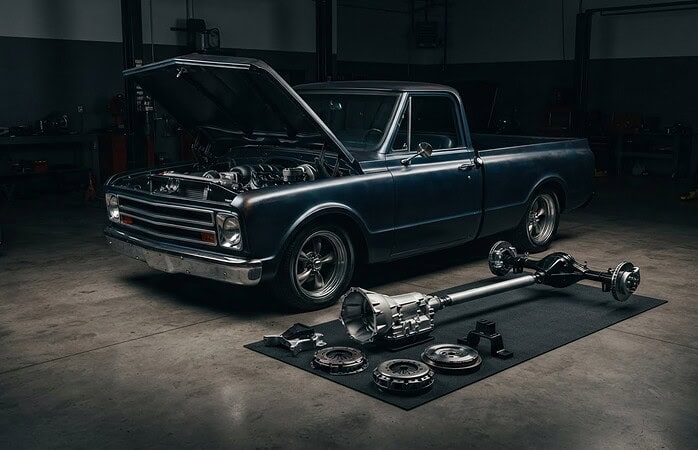

The true measure of an automotive masterpiece isn’t found in its ability to sit still; it’s found in the visceral thrill of the open road. Your vintage asset deserves more than a temperamental carburetor or the constant fear of a summer afternoon stall. Selecting the best modern engine for classic car projects is the definitive step in transforming a nostalgic icon into a reliable, high-performance reality. It’s about bridging the gap between 20th-century design and 21st-century precision.
You likely appreciate the heritage of your vehicle but dread the mechanical anxiety of cold starts and the lack of replacement parts for aging blocks. We understand that an elite restomod is a bespoke piece of functional art, and choosing the wrong powerplant can compromise both the driving experience and the vehicle’s investment value. This guide provides an expert breakdown of the most sophisticated engines available in 2026, from the brutal 1,004-horsepower Chevrolet ZZ632 to the refined efficiency of the Ford 5.0 Coyote. You’ll discover how to achieve modern operational reliability while preserving the raw, nostalgic soul that makes your classic truly irreplaceable.
Key Takeaways
- Understand why modern fuel injection and contemporary cooling systems are essential for eliminating the mechanical anxiety of vintage carbureted engines.
- Compare the performance characteristics of the GM LS and Ford Coyote series to determine the best modern engine for classic car projects that prioritize power and aftermarket support.
- Learn how to protect your vehicle’s investment grade status by selecting a powerplant that blends heritage aesthetics with modern operational reliability.
- Identify the necessary chassis modifications and structural reinforcements needed to safely integrate high-horsepower contemporary crate motors into vintage frames.
- Explore the Elite Certified Restomods philosophy of delivering fully sorted, road-ready machines that function as bespoke pieces of functional art.
The Evolution of Power: Why Modern Engines Define the 2026 Restomod Era
The golden age of automotive design left us with silhouettes that command respect, yet the mechanical reality under the hood often tells a different story. In the past, owning a vintage icon meant accepting compromises: temperamental carburetors, unpredictable cooling, and the persistent smell of unburnt fuel. Today, the divide between traditional preservation and modern operational reliability has never been wider. Owners are no longer content with survivor status if it means the car spends more time on a lift than on the road. The shift toward investment-grade builds reflects a desire for machines that perform as flawlessly as they look, moving beyond hobbyist tinkering into the sphere of professional master-building.
Modern engineering has fundamentally changed the stakes. Performing a strategic engine swap is no longer viewed as a loss of character; instead, it’s the ultimate act of preservation. By integrating contemporary technology, we ensure these machines remain relevant and usable in modern traffic. Finding the best modern engine for classic car projects involves more than just raw power. It’s about selecting a heart that pulses with the precision of a 2026 supercar while encased in the steel of a 1960s legend. These builds prioritize daily driveability without sacrificing the visceral excitement of the original era, allowing you to enjoy the car rather than just displaying it.
To better understand the nuances of modern power versus traditional builds, watch this helpful comparison:
The Death of the Cold Start
The morning ritual used to involve a delicate dance with the throttle and a prayer for the battery. Modern ECU-controlled systems have silenced that struggle. High-pressure fuel injection and digital ignition timing provide immediate, crisp throttle response regardless of the ambient temperature or altitude. This shift reduces maintenance overhead for the discerning collector, allowing you to focus on the drive rather than the diagnostic. In an era of high-end custom builds, reliability is the new luxury. 2026 technology allows for advanced thermal management and integrated diagnostics, ensuring that higher horsepower doesn’t compromise engine longevity. Every component is meticulously selected to ensure the vehicle remains fully sorted and ready for the road.
Heritage Meets High Performance
A bespoke build should feel like a time traveler. We maintain the aesthetic soul of the vehicle, using artisanal finishes and period-correct details, while upgrading the mechanical heart to something far more potent. There is a visceral thrill in feeling a modern V8 scream toward its redline within a lightweight vintage chassis. This marriage of brute force and refined comfort has become the standard for premier custom vehicles. The restoration process is a transformative journey, taking the driver from the initial spark of recognition to the final realization of the product’s modern capabilities. If you are looking for an uncompromising driving experience, you can explore our classic car restomods for sale to see this philosophy in action. Every project we curate is treated as a piece of functional art, designed to be utilized and enjoyed.
The Industry Standards: Analyzing the Best Modern V8 Crate Engines
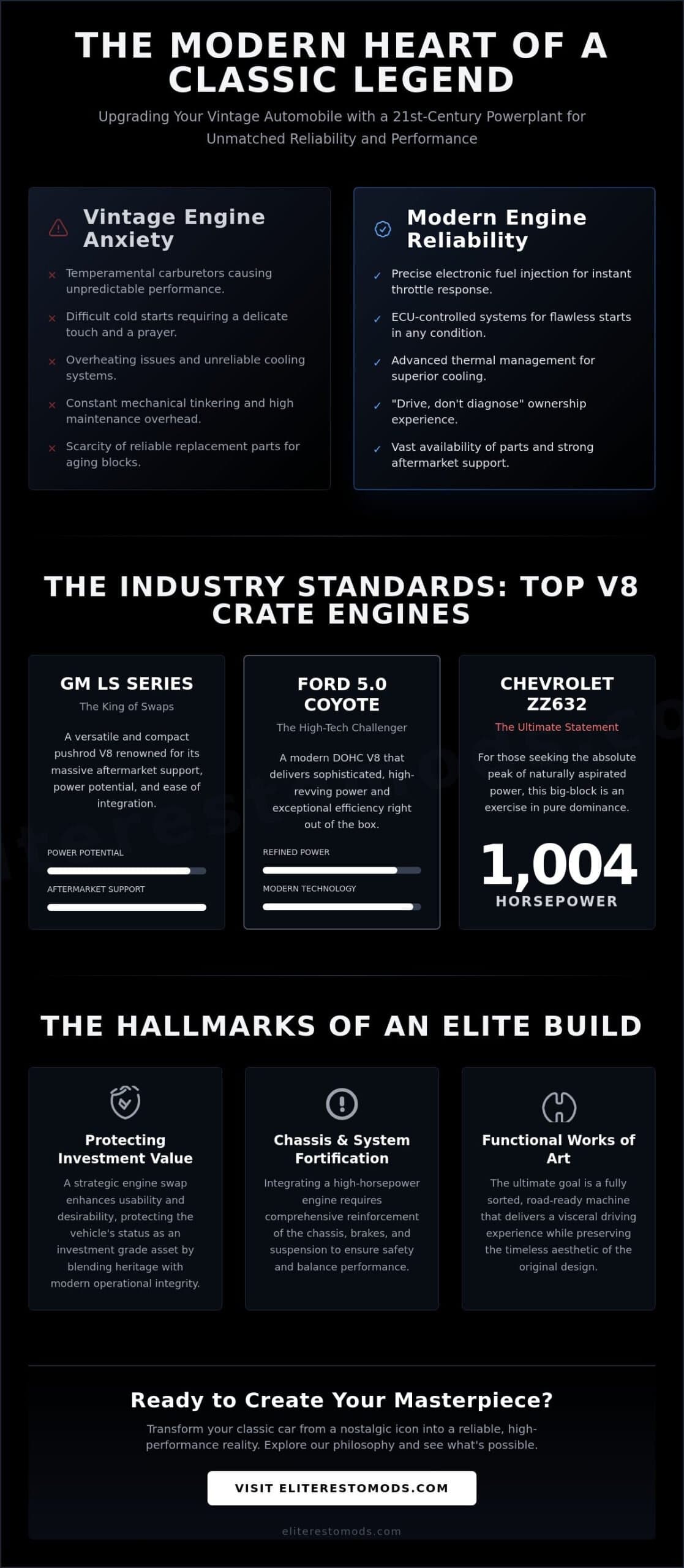
The heartbeat of the American restomod is the V8. It’s a symbol of raw power and unyielding performance. Choosing the best modern engine for classic car builds requires a delicate balance of heritage and technical capability. Today, the landscape is defined by three major manufacturers: General Motors, Ford, and Mopar. Each platform offers a distinct personality and a specific set of engineering advantages that cater to different driving styles and aesthetic goals. Whether you’re seeking the versatility of a pushrod small block or the high-revving sophistication of an overhead-cam masterpiece, the 2026 crate engine market provides a solution for every vision.
General Motors continues to dominate the landscape with the LS and LT series. These engines are the undisputed kings of the engine bay. The LS3 remains a staple for its incredible versatility and compact footprint. For those seeking a higher tier of performance, the direct-injected L8P small block offers 523 horsepower for approximately $8,948.80, providing a modern foundation for a reliable daily driver. At the extreme end of the spectrum, the ZZ632/1000 big-block delivers a staggering 1,004 horsepower, though its $32,935 price tag reflects its status as the pinnacle of internal combustion. The Drive’s 2026 Crate Engine Guide highlights these GM units for their unparalleled aftermarket ecosystems, making them the most logical choice for many master builders.
GM LS and LT: The Master Builder Choice
The LS376/525 remains the most popular choice for custom projects because it balances 525 horsepower with a relatively simple installation process. It fits where other engines won’t. We’re also seeing a sophisticated shift toward direct-injected LT4 engines. These units are the elite choice for those demanding extreme output and contemporary fuel management. The availability of parts is endless. Every component is designed for seamless integration, ensuring that the vehicle remains fully sorted and ready for the road. This ease of packaging allows us to maintain the original lines of the car while hiding a modern monster beneath the hood.
Ford Coyote: Sophistication and Speed
Ford enthusiasts have found their holy grail in the 5.0L Coyote V8. It’s a high-revving masterpiece of overhead-cam engineering. Starting at $11,500, the Coyote utilizes Twin Independent Variable Cam Timing to optimize power delivery across the entire RPM range. This technical advantage provides a smooth yet aggressive power delivery that’s perfectly suited for investment-grade Mustangs and Broncos. While its physical width can present packaging challenges in narrower vintage engine bays, the result is a vehicle that feels as agile and responsive as a contemporary supercar. If you’re envisioning a high-performance build but need a professional curator to realize the vision, our custom build services provide the expertise required to execute these complex integrations.
Beyond these standards, Mopar enthusiasts rely on the Gen III Hemi for iconic muscle car presence. The 6.4-liter 392 Hemi remains a favorite for its brute force and unmistakable sound. For those seeking something truly unique, the 2026 market also offers niche options like turbocharged setups or exotic swaps. These projects require a level of bespoke craftsmanship that goes beyond standard integration, treating every vehicle not merely as a machine, but as a piece of functional art.
Beyond Horsepower: Evaluating Reliability, Driveability, and Resale Value
The prestige of a restomod is often measured by what lies beneath the hood. While peak horsepower numbers capture headlines, the true value of an investment-grade build is defined by its pedigree. Selecting the best modern engine for classic car projects isn’t just about speed; it’s about the long-term appreciation of the asset. A vehicle that pairs a legendary silhouette with a professionally integrated, brand-new powerplant will always command a premium over a build using salvaged components. This distinction is critical for collectors who view their garage as a portfolio of functional art. The mechanical heart must be as impeccable as the aesthetic finish.
High-end builds require a level of perfectionism that extends to every bolt and wire. It’s the difference between a machine that simply runs and one that performs with contemporary precision. In the 2026 market, the correlation between modern reliability and daily enjoyment has become the primary driver for bespoke commissions. Owners want the ability to drive through modern traffic without the constant fear of overheating or mechanical failure. Achieving this requires a master builder who understands the soul of the vintage asset but possesses the vision to bring it into the modern era.
Investment-Grade Engineering
High-end auctions consistently demonstrate that buyers value certainty. A brand-new crate engine, such as the 525-horsepower LS376 priced from $11,923, offers a level of transparency that a junkyard pull simply can’t match. When every mile is documented and every component is factory-fresh, the vehicle’s provenance is solidified. Professional shop labor for these swaps typically ranges between $5,000 and $15,000, with general shop rates averaging $137.50 per hour. This investment in expertise pays dividends in resale value. A fully sorted engine bay, free of cluttered wiring and cooling compromises, signals to a future owner that the car was built with absolute excellence in mind.
The Driveability Factor
Reliability is the foundation of enjoyment. A modern engine swap eliminates the anxiety of stalling at a stoplight or struggling with vapor lock on a summer afternoon. By utilizing contemporary engine management systems, we create a smooth luxury experience that retains the visceral thrill of a vintage V8. Achieving the perfect balance of raw power and refined comfort is what separates a standard swap from the best modern engine for classic car integration. Meticulous thermal management ensures the engine remains within its optimal operating window, even during spirited driving. If you’re ready to begin this transformative journey, our meticulous build process ensures your vision is realized with absolute precision.
The Technical Blueprint: Steps to a Successful Modern Engine Integration
The transformation of a vintage asset into a high-performance masterpiece requires more than a simple bolt-in approach. It’s a comprehensive engineering project that demands a vision for the entire vehicle. Identifying the best modern engine for classic car projects is merely the first step in a complex developmental narrative. Brute force requires balance. A chassis designed in the mid-20th century was never intended to withstand the 650 lb-ft of torque generated by a supercharged LT4. Without structural reinforcements, such as boxed frames or custom subframe connectors, the visceral excitement of a modern powerplant can quickly compromise the vehicle’s structural integrity. We treat every integration as a bespoke piece of functional art, ensuring the platform is as rigid as it is powerful.
Precision is the hallmark of an elite build. Beyond the frame, the supporting infrastructure must be equally sophisticated. Modern fuel injection systems require high-pressure delivery, often necessitating custom stainless steel fuel tanks with integrated baffles and high-volume pumps. Cooling is another critical factor. To prevent overheating in modern traffic, we utilize advanced multi-pass aluminum radiators paired with high-cfm electric fans. This level of meticulous detail ensures that the vehicle remains fully sorted and ready for the road, regardless of the conditions. If you are ready to entrust your vision to a professional custom restomod builder, our team possesses the expertise to execute these complex mechanical journeys with absolute perfection.
Transmission and Drivetrain Synergy
The drivetrain must be viewed as a single, cohesive unit to achieve a seamless driving experience. Pairing a high-output engine with an inadequate transmission is a mistake that compromises both performance and reliability. Choosing between a modern 6-speed manual for a visceral connection or an advanced 10-speed automatic for effortless gear transitions depends on the intended soul of the build. To manage the increased power, a high-strength rear end, such as a Ford 9-inch with 31-spline axles, is often a necessity. This synergy ensures that every bit of modern torque is efficiently transferred to the pavement, providing the immediate sensation of contemporary supercar performance.
Electronics and Management
The nervous system of a modern restomod is its wiring harness. Integrating contemporary engine data with digital or high-end analog gauges requires a systematic, logical breakdown of the electrical system. Plug-and-play solutions from industry leaders provide the reliability needed for investment-grade builds, but the final execution requires a master’s touch. We ensure that all modern amenities, from climate control to power steering, work in perfect harmony with the new ECU. This technical work creates a bridge between a long-held dream and a tangible reality, resulting in a vehicle that offers refined comfort without sacrificing its historical atmosphere.
The Elite Standard: Choosing a Modern Powerplant for Your Next Build
The pursuit of automotive perfection culminates in a vehicle that transcends its era. At Elite Restomods, our philosophy is rooted in the belief that every machine must be fully sorted and ready for the road. We do not merely perform swaps; we engineer transformations. Selecting the best modern engine for classic car projects is a task we approach with the precision of a master builder and the vision of a world-class curator. Every Elite Certified Restomod represents a deliberate balance between raw, visceral excitement and refined, luxury craftsmanship. It is a marriage of heritage and capability that ensures your investment remains both a joy to drive and a bespoke piece of functional art.
Our meticulous quality assurance process defines our status in the industry. Before a vehicle earns its certification, every system is subjected to rigorous testing to ensure modern operational reliability. This commitment to excellence means that when you turn the key, the experience is predictable, powerful, and flawless. We treat the restoration process as a transformative journey. It is an invitation to participate in the realization of a high-performance reality where no detail is too small to be overlooked. By focusing on investment-grade builds, we provide our clients with assets that command respect at any venue, from local gatherings to premier international auctions.
Curating the Ultimate Driving Machine
Our focus remains steadfast on vehicles that offer the perfect marriage of historical design and contemporary power. We understand the soul of a vintage asset. However, we also possess the technical expertise to bring it into the 2026 era. The peace of mind that comes with a professionally engineered engine swap is invaluable. It allows you to focus on the sensation of the drive rather than the mechanics of the machine. Whether it is the high-revving sophistication of a Coyote V8 or the brute force of a supercharged LT4, our builds prioritize driveability. You can witness this commitment to excellence by exploring our current Elite Certified Restomod inventory, where each vehicle is a testament to our master-building standards.
Your Vision, Our Expertise
We simplify the ownership experience for the discerning classic car enthusiast. The role of our master builders is to act as the bridge between your long-held dream and a tangible, high-performance product. We assist in selecting the best modern engine for classic car applications that match your specific driving goals, whether you seek a cross-country tourer or a track-capable monster. Our team handles the complexities of structural reinforcement, electronic integration, and thermal management. This allows you to enjoy the final realization of the product’s modern capabilities without the traditional frustrations of vintage ownership. We invite you to explore our curated selection and begin your own journey toward owning a masterpiece of modern engineering.
Realize Your Vision of Automotive Perfection
The journey from a vintage relic to a contemporary masterpiece requires a deliberate commitment to excellence. You’ve discovered how the integration of high-performance crate engines eliminates the mechanical anxieties of the past while elevating the vehicle’s status to an investment-grade asset. Identifying the best modern engine for classic car builds is about more than just peak horsepower; it’s about the technical synergy of a fully sorted drivetrain and the sophisticated management of modern electronics. Every component must work in harmony to preserve the nostalgic soul of the machine while granting it the reliability of a 2026 supercar.
At Elite Restomods, we specialize in this transformative process through our rigorous Elite Certified quality assurance process and meticulous investment-grade vehicle curation. We handle the complexities of engineering so you can enjoy the visceral thrill of the drive. Our national enclosed vehicle transport ensures your asset arrives in pristine condition, ready for the road. It’s time to bridge the gap between your long-held dream and a high-performance reality. Explore our inventory of fully sorted, modern-powered restomods and find the machine that speaks to your passion. Your next chapter on the open road is ready to begin.
Frequently Asked Questions
Will a modern engine swap decrease the value of my classic car?
A professionally executed swap typically increases the market value of a classic car by enhancing its driveability and reliability. Collectors in 2026 increasingly prioritize investment-grade restomods over temperamental survivors. By selecting the best modern engine for classic car projects, you ensure the vehicle functions as a piece of art rather than a stationary display. Documentation of the build and using factory-new crate engines are critical for maintaining this premium valuation.
What is the most reliable modern engine for a classic Chevy truck?
The Chevrolet L8P crate engine is an exceptionally reliable choice for classic Chevy trucks, providing 523 horsepower from a robust 6.6-liter small block. Priced from $8,948.80, it offers contemporary fuel injection and thermal management that vintage blocks simply cannot match. This engine provides the brute force needed for a truck’s utility while ensuring modern operational reliability for daily use. It’s a cornerstone for creating a fully sorted pickup.
How much horsepower is too much for a vintage chassis?
Most vintage chassis require significant structural reinforcement when exceeding 400 to 500 horsepower. While the 1,004-horsepower ZZ632/1000 big-block represents the pinnacle of performance, its power will twist an original unreinforced frame. We recommend boxed frames or custom subframe connectors for any high-output build. Achieving a balance between raw power and structural integrity is essential to ensure the vehicle remains safe and enjoyable on the road.
Can I keep the original manual transmission with a modern engine swap?
You can retain an original manual transmission using specialized conversion kits, but it’s rarely recommended for high-performance builds. Vintage gearboxes were not engineered to handle the torque loads of a modern V8 like the LS376/525. For a seamless driving experience, we suggest pairing your engine with a modern 6-speed manual or a 10-speed automatic. This synergy ensures the drivetrain functions as a cohesive unit, providing contemporary precision and durability.
Do modern engine swaps require special maintenance compared to original engines?
Modern engine swaps actually reduce maintenance overhead compared to vintage mechanical setups. These powerplants utilize electronic fuel injection and digital ignitions, eliminating the need for constant carburetor tuning or point adjustments. You’ll follow standard service intervals for modern vehicles, such as routine synthetic oil changes and coolant flushes. This reliability allows you to spend more time enjoying the visceral thrill of the drive and less time on diagnostic repairs.
What is the difference between an LS swap and an LT swap?
The primary difference lies in the fuel delivery and internal architecture. LS engines use port fuel injection and remain a favorite for their compact packaging and massive aftermarket support. LT engines, like the L8P, feature direct injection and advanced variable valve timing for improved efficiency and power. While the LS is often the best modern engine for classic car versatility, the LT series represents the latest evolution in General Motors’ engineering.
Are modern crate engines emissions-legal for older vehicles?
Federal compliance requires that a modern engine swap includes all original emissions equipment from the donor engine, including catalytic converters and ECU programming. The EPA has clarified that removing this equipment violates the Clean Air Act. In California, Senate Bill 1392 is currently under consideration to exempt 1981 and newer collector cars from smog checks, but it hasn’t yet been signed into law as of May 2026. Always research local regulations before beginning.
How long does a professional modern engine integration typically take?
A professional modern engine integration typically takes between 100 to 300 labor hours, depending on the complexity of the build. This timeline includes chassis reinforcement, custom plumbing, and meticulous wiring harness integration. While a DIY swap might stretch over a year, a dedicated master builder ensures the project moves from initial spark to final realization with purposeful speed. Our focus is on delivering a vehicle that is fully sorted, road-ready, and impeccably finished.