
The most reliable engine for your restomod isn’t found on a spec sheet; it’s earned through the meticulous marriage of heritage steel and modern electronics. When weighing the LS swap vs Coyote swap reliability, many builders focus solely on the block’s reputation rather than the complex ecosystem required to sustain it. You want a vehicle that ignites with a crisp, authoritative roar every time you turn the key. You don’t want a masterpiece that spends its life on a lift due to thermal management issues or harness failures.
We understand the anxiety of investing in a vintage asset only to be sidelined by electronic gremlins or the fear of future parts scarcity. This guide will uncover the engineering truths behind these two powerhouses to ensure your build remains a high-performance investment for years to come. We’ll examine the structural differences, current 2026 regulatory landscapes, and the integration secrets that separate a simple engine change from a bespoke piece of functional art. From the compact efficiency of the LS3 to the sophisticated overhead cams of the Gen 4 Coyote, your path to mechanical perfection starts here.
Key Takeaways
- Understand how the fundamental design differences between GM pushrod and Ford DOHC architectures impact your vehicle’s mechanical endurance over time.
- Discover why the integration of complex ECU ecosystems and thermal management systems is the true deciding factor in LS swap vs Coyote swap reliability.
- Gain insights into the 2026 parts ecosystem and maintenance schedules to ensure your investment remains on the road rather than in the shop.
- Identify how professional installation standards and fuel system engineering dictate the long term survival of your chosen modern powerplant.
- Explore the rigorous quality assurance protocols used to transform high performance hardware into a reliable, investment grade masterpiece.
The Architecture of Dependability: LS vs Coyote Reliability in 2026
Reliability isn’t a happy accident. It’s the calculated result of engineering choices made decades ago and refined for the 2026 landscape. When evaluating LS swap vs Coyote swap reliability, you’re choosing between two distinct mechanical philosophies. The General Motors approach favors the elegant simplicity of the pushrod design. It’s a compact, high-torque solution that has powered everything from heavy-duty trucks to world-class supercars. This architecture serves as the backbone of many custom build services because its predictable nature ensures a consistent, high-end experience for the owner.
Conversely, the Ford Coyote represents a shift toward high-revving, overhead-cam sophistication. This architecture offers a different kind of endurance, one rooted in precision and volumetric efficiency. While the LS relies on displacement and a streamlined valvetrain, the Coyote utilizes technology to maximize every cubic inch of its 5.0-liter heart. Both platforms have evolved significantly, moving past early teething issues to become the reliable titans they are today.
To better understand the mechanical soul of these powerplants, watch this detailed comparison:
The Pushrod Advantage: Why Simplicity Equals Longevity
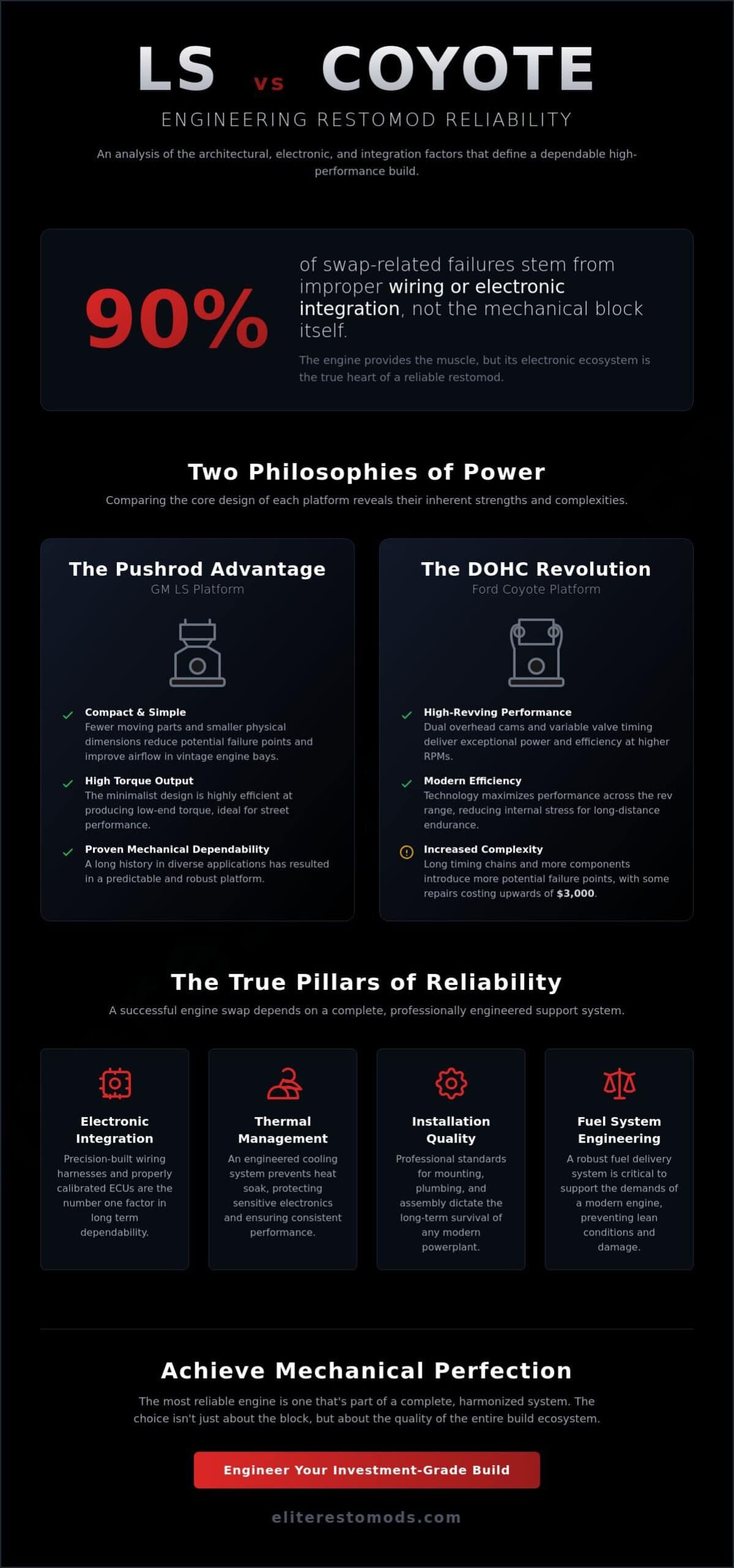
The GM LS engine family remains a benchmark for mechanical dependability due to its minimalist design. By housing the camshaft within the engine block, the LS eliminates the need for long, complex timing chains that can stretch or fail over time. This pushrod configuration results in fewer moving parts, which naturally reduces potential failure points during spirited driving. The compact dimensions of the LS3 also allow for superior airflow around the block in vintage engine bays, mitigating the heat soak that often plagues more crowded setups. From the early LS1 to the modern LS3 crate engines, the focus has always been on maximizing power through efficient, uncomplicated geometry.
The DOHC Revolution: Coyote Engineering and Efficiency
Ford’s Dual Overhead Cam (DOHC) architecture brings a different set of strengths to the table. The Coyote engine utilizes variable valve timing to optimize performance across the entire RPM range, reducing internal stress by ensuring the engine always operates at peak efficiency. This sophistication is a key factor when comparing LS swap vs Coyote swap reliability for long-distance touring. Early iterations faced minor oil consumption hurdles, but the Gen 3 and Gen 4 versions have introduced hardened components and improved cooling passages to ensure long-term durability. While a timing chain guide failure on a Coyote can be a $3,000 repair, the system’s ability to sustain high RPMs without valve float offers a significant advantage for those who demand modern, track-ready performance from their bespoke vehicle.
Electronic Complexity and Thermal Management: Navigating Swap Vulnerabilities
A masterfully restored classic is only as good as its nerve center. While the mechanical block provides the muscle, the electronics provide the soul; and often, the source of significant frustration. Industry professionals frequently observe that nearly 90 percent of swap-related failures stem from improper wiring or electronic integration rather than mechanical breakdown. When assessing LS swap vs Coyote swap reliability, the conversation must shift from the cylinder heads to the wiring harness. A high-performance V8 is a volatile asset if its sensory data is compromised by heat or poor connectivity.
Modern engine management requires a level of precision that vintage chassis weren’t designed to accommodate. Choosing between LS and Coyote swap options involves navigating two very different electronic landscapes. The LS platform benefits from decades of aftermarket standardization, making its integration relatively predictable. The Coyote, however, demands a more sophisticated approach due to its complex variable valve timing and high-definition sensor arrays. Precision is paramount here.
Wiring and ECU Integration: The Brain of the Build
The LS platform thrives on accessibility. Standardized harnesses have turned the LS into a near plug-and-play solution for many builders. In contrast, the Ford Coyote utilizes a specialized Control Pack that requires meticulous execution to function within a non-Ford environment. Modern builds increasingly rely on CAN bus systems to communicate between the engine, transmission, and digital instrumentation. This interconnectedness means a single loose ground or a poorly crimped pin can lead to intermittent stalling or “limp mode” events. For those seeking investment-grade dependability, professional-grade wiring isn’t a luxury; it’s the foundation of every successful custom build service project.
Cooling the Beast: Radiator and Airflow Solutions
Thermal management is the silent killer of modern engine swaps. A high-compression LS3 or a high-revving Coyote generates significantly more BTUs than the original small blocks of the 1960s. Cramming these powerplants into narrow engine bays creates a literal pressure cooker. To maintain LS swap vs Coyote swap reliability during a mid-August cruise, the cooling system must be engineered as a cohesive unit. This requires more than just a large radiator.
- High-Flow Radiators: Multi-pass aluminum cores provide the surface area needed to shed heat quickly.
- Precision Shrouding: An electric fan is only effective if it pulls air through the entire core, not just the center.
- Fluid Isolation: Dedicated oil and transmission coolers prevent heat transfer between systems, extending component life.
Sensors must be positioned away from exhaust headers to prevent data drift. Properly routed harnesses, protected by high-temperature looming, ensure that the ECU receives accurate signals even after hours of high-performance operation. It’s this level of detail that transforms a simple swap into a reliable long-term asset.
Long-Term Ownership: Maintenance Cycles and Parts Ecosystems
A restomod is more than a machine; it’s a legacy. When you commit to a build, you’re planning for a decade of sunrise drives and cross-country rallies. True longevity is found in the infrastructure supporting your engine. In the debate of LS swap vs Coyote swap reliability, the 2026 parts ecosystem reveals a stark contrast in ownership experiences. With the EPA finalizing the rescission of the Greenhouse Gas Endangerment Finding in February 2026, the focus has shifted toward maintaining mechanical integrity while navigating an evolving regulatory landscape. One platform offers the comfort of universal familiarity, while the other provides the prestige of modern factory backing.
Maintenance schedules for both platforms are remarkably similar to their modern donor vehicles. Expect oil changes every 5,000 to 7,500 miles and spark plug intervals at 100,000. However, the cost of these cycles diverges when specialized components are required. An LS and Coyote engine swap comparison often highlights that while both are durable, the complexity of the Ford DOHC architecture can lead to higher repair bills. For instance, a timing chain guide failure on a Coyote engine can cost approximately $3,000 to rectify, whereas the simpler LS valvetrain rarely demands such intensive intervention.
The Universal LS Ecosystem
The LS remains the most supported engine swap on the planet. This ubiquity is a safety net for the adventurous owner. If a water pump or an alternator fails in a remote town, the local parts store likely has the component on the shelf. This universal language of the LS platform ensures minimal downtime. Beyond emergency repairs, the aftermarket for performance upgrades is vast. You can enhance your build’s character without compromising factory-level durability. This accessibility is why we often feature LS-powered vehicles in our inventory of investment-grade classics.
Ford Performance Support for the Coyote
The Coyote platform appeals to those who value a cohesive, factory-engineered ecosystem. Ford Performance has revolutionized the swap process with their Power Module kits. These include the engine, transmission, and electronics in one validated package. This approach offers a level of reliability that mimics a showroom-floor Mustang. However, this premium experience comes with a higher maintenance budget. Coyote engines require specialized tuning to manage their variable valve timing effectively. Components like the high-pressure fuel pumps and complex sensor arrays are often more expensive than their GM counterparts. When weighing LS swap vs Coyote swap reliability, the Coyote’s long-term support is bolstered by Ford’s commitment to its crate engine program, ensuring parts remain available even as technology advances.
Beyond the Block: Why Installation Quality Dictates Engine Longevity
The heated debates found on social media often miss the mark. They argue over brand loyalty while ignoring a fundamental engineering reality: the builder’s hand matters more than the manufacturer’s logo. When analyzing LS swap vs Coyote swap reliability, we must look beyond the iron or aluminum block. A world-class engine is only as dependable as the systems that feed it. If the integration is flawed, even the most durable crate engine will succumb to premature failure. True longevity in a restomod is a product of total vehicle synergy, where every component is curated to support the modern heart beating under vintage steel.
Precision is the difference between a project car and a bespoke masterpiece. We treat every installation as a transformative journey, ensuring that the brute force of a modern V8 is tempered by refined engineering. A poorly routed wiring harness or a neglected cooling passage can compromise the most expensive build. Reliability is earned through the meticulous calibration of every supporting system, transforming a collection of high-performance parts into a cohesive piece of functional art.
Fuel Systems and Filtration
Modern fuel injection demands surgical precision. Unlike the carburetors of the past, contemporary EFI systems require consistent high pressure to maintain an optimal air-fuel ratio. Fuel starvation is a silent killer, leading to lean conditions that can melt pistons in seconds. Achieving long-term LS swap vs Coyote swap reliability requires a fuel system that accounts for the G-forces of modern handling. We utilize baffled, stainless steel fuel tanks equipped with high-volume internal pumps. These systems ensure a steady flow of high-octane lifeblood, regardless of whether you’re carving through a mountain pass or idling in coastal traffic. High-efficiency filtration is equally vital, protecting sensitive injectors from the microscopic debris often found in aging fuel infrastructures.
Driveline Synergy: Transmissions and Rear Ends
Power is useless without control. Matching a high-revving Coyote or a torque-heavy LS with the wrong transmission is a recipe for mechanical stress. Modern 6-speed and 10-speed transmissions do more than just provide extra gears; they reduce engine wear by keeping the powerplant within its most efficient operating window. This driveline harmony is essential for a vehicle that feels refined at triple-digit speeds yet remains docile in the city. Selecting the right partner for this transformation is the most critical decision you’ll make. You can learn more about this process in our definitive guide to choosing a custom restomod builder in 2026. Our custom build services prioritize this holistic engineering approach to ensure your investment remains a source of pride, not a project in perpetuity.
The Elite Standard: Engineering Reliability into Every Bespoke Build
Excellence isn’t found in a crate. It’s forged in the workshop. Our approach to LS swap vs Coyote swap reliability transcends the standard internet debates by focusing on the total integration of the powerplant into the chassis. We don’t just install engines; we curate mechanical experiences. Whether you prefer the raw, pushrod power of a Chevy or the high-tech, high-revving soul of a Ford, the reliability of your investment depends on the precision of the build. We act as the bridge between your long-held dream and a high-performance reality where modern capability meets timeless design.
A vehicle from our studio isn’t just a machine. It’s a bespoke piece of functional art. We understand that our clients demand more than just a running engine. They want a classic car that starts every time, stays cool in heavy traffic, and maintains its value for decades. This level of perfectionism requires a world-class curator who understands the soul of a vintage asset but possesses the vision to bring it into the modern era. We eliminate the developmental hurdles that often plague home-built projects, delivering a product that’s fully sorted from the moment it leaves our care.
The Elite Certification Process
Every vehicle we produce or represent undergoes a rigorous quality assurance journey. This isn’t a simple visual check. It’s a systematic, logical breakdown of every mechanical and electronic system. We subject our builds to extensive road testing phases to ensure that thermal management is optimized and engine management maps are flawless. From the climate control’s icy breath to the authoritative roar of the exhaust, every detail is scrutinized. This meticulous nature ensures that every system operates at peak performance under real-world conditions. You can view our current selection of professionally engineered vehicles at inventory to see the results of this dedication.
Investing in a Fully Sorted Powerplant
Buying an elite-certified restomod is an investment in peace of mind. You’re not just purchasing a car; you’re securing a legacy that’s already cleared the most difficult engineering hurdles. Our custom build services are designed for the enthusiast who values minimal maintenance downtime and maximum driving pleasure. We treat the restoration process as a transformative journey, inviting you to participate in the realization of a high-performance icon. By marrying brute force with refined comfort, we create vehicles meant to be utilized and enjoyed, not just displayed. Discover how we can bring your vision to life through our comprehensive custom restomod builder services.
Securing Your Automotive Legacy: The Path to Perfection
Choosing between a pushrod powerhouse and a high-revving DOHC masterpiece is a defining moment for any collector. We have explored how the LS swap vs Coyote swap reliability debate is ultimately settled by the quality of the engineering behind the build. Whether you prioritize the mechanical simplicity of the LS or the sophisticated efficiency of the Coyote, your vehicle’s longevity depends on a holistic approach to thermal management, electronic integration, and driveline synergy. It’s about more than just the engine; it’s about the soul of the machine.
The journey from a vintage dream to a high-performance reality requires a builder who treats every detail as essential. We provide the peace of mind that comes with Elite Certified Quality Assurance and comprehensive investment-grade documentation. Your masterpiece deserves nothing less than perfection, and we ensure its safe arrival at your door. The road ahead is meant for driving, not troubleshooting. We invite you to Explore Our Inventory of Fully Sorted, Investment-Grade Restomods today. With nationwide enclosed transport available, your next automotive icon is closer than you think. Start your journey toward a reliable, visceral driving experience now.
Frequently Asked Questions
Is an LS swap more reliable than a Coyote swap for a daily driver?
The LS engine generally offers a slight advantage for daily driving due to its streamlined pushrod architecture. Fewer moving parts translate to a lower statistical probability of mechanical failure over thousands of miles. While the Coyote is exceptionally reliable, its DOHC complexity requires a more rigid adherence to specialized maintenance schedules to ensure peak performance during routine use.
Why do Coyote swaps often cost more to ensure long-term reliability?
Long term reliability for the Coyote platform involves a higher initial investment in specialized electronics and premium hardware. The Ford Control Pack and variable valve timing systems are more intricate than the standardized LS equivalents. This complexity ensures modern efficiency but necessitates higher quality sensors and high-pressure fuel components that carry a premium price tag compared to the common LS parts ecosystem.
Can a high-mileage LS engine still be a reliable swap candidate?
A high-mileage LS engine can remain a viable candidate if the internal components are meticulously inspected and refreshed. The iron and aluminum blocks are famously durable; however, for a bespoke project, we recommend lower-mileage donor units or new crate engines. This approach ensures that the foundation of your investment matches the high-end craftsmanship of the rest of the vehicle.
How does modern electronic fuel injection impact the reliability of these swaps?
Modern electronic fuel injection is the cornerstone of restomod dependability for both platforms. EFI systems provide real-time adjustments to air-fuel mixtures, ensuring your classic starts instantly regardless of temperature or altitude. By replacing the temperamental nature of vintage carburetors with digital precision, EFI reduces engine wear and prevents the fuel-washing of cylinder walls that often shortens engine life.
What are the most common failure points in a Coyote engine swap?
The most frequent failure points in a Coyote swap are related to electronic integration and timing chain guide wear. Improperly grounded wiring harnesses or poorly routed sensors can cause intermittent stalling or sensor drift. Additionally, while rare in low-mileage units, the timing chain guides are a known wear item that requires professional attention to prevent costly internal damage over time.
Does the physical size of the Coyote engine affect its long-term reliability in older engine bays?
Physical dimensions play a critical role in thermal management for the Coyote engine. Its wide DOHC heads occupy significant volume in vintage engine bays, which can restrict the natural evacuation of heat. To maintain LS swap vs Coyote swap reliability, builders must employ superior radiator designs and high-flow electric fans to mitigate the increased risk of heat soak in these tighter spaces.
Which engine swap has better parts availability for roadside repairs?
The LS platform remains the undisputed leader in terms of roadside parts availability. Because these engines were utilized in millions of GM trucks and passenger cars, most local retailers stock essential components like alternators, water pumps, and spark plugs. This ubiquity provides a sense of security for owners who intend to utilize their restomods for cross-country journeys rather than just local displays.
How does thermal management differ between the LS and Coyote platforms?
Thermal management strategies differ based on the engine’s footprint and internal heat generation. When comparing LS swap vs Coyote swap reliability, the compact LS allows for better airflow around the block, making it easier to cool with standard high-performance radiators. The Coyote produces more localized heat in the cylinder heads, demanding a more aggressive cooling system with multi-pass cores and dedicated oil coolers.