

What changes when you leave a prized vehicle with someone else to sell? A consignment agreement for vehicles should answer that before you hand over the keys. It sets out the owner’s and seller’s roles, how the vehicle may be marketed and shown, which costs or commission may apply, and what happens when a buyer is ready. Don’t assume the consignment paperwork is itself a bill of sale or title-transfer document. The distinction matters when you’re deciding who controls the vehicle and how you’ll receive the proceeds.
It’s reasonable to want a professional sales process without giving up clarity or control. Before signing, understand the agreement’s terms, the sale approval process, responsibility for the vehicle while it’s consigned, and the steps for ending the arrangement. This guide explains what a vehicle consignment agreement does, which details deserve careful review, and how consignment compares with selling directly. Elite Restomods’ consignment program provides marketing and sales representation for specialty vehicles. A clear agreement helps keep expectations grounded from handoff to final sale.
Key Takeaways
- Understand what a consignment agreement authorizes and how the selling representative’s role is defined.
- Review vehicle details, sale authority, money terms, custody responsibilities, and exit provisions before signing.
- Know the difference between a consignment agreement for vehicles, a title, and documents that record a completed sale.
- Trace how costs, proceeds, and sale approval are handled so the financial expectations are clear.
- Weigh organized marketing and sales representation against your responsibilities as the owner, without assuming a particular sale outcome.
What Is a Vehicle Consignment Agreement, and What Does It Set Out?
A consignment agreement for vehicles is a written arrangement in which the owner authorizes another party to market and sell the vehicle under agreed terms. It defines the relationship between the owner and selling representative, including what the representative may do and what the owner can expect during the process. The agreement gives the sale a framework, but it doesn’t promise a buyer, a particular price, or a completed transaction.
Ownership and physical custody are separate questions. A vehicle may be placed in someone else’s care without the agreement alone resolving every question about title or ownership. The paperwork should clarify the intended arrangement and how sale documents will be handled. Title and transaction procedures vary by jurisdiction, so verify applicable requirements through relevant official guidance before acting. A general overview of consignment agreement can also help explain the underlying arrangement.
For a broader introduction to how a consignment sale works, watch:
Who are the parties, and what does each do?
The owner is the consignor: the person entrusting the vehicle for sale. The selling representative is the consignee: the party authorized to present and market it. Depending on the written agreement, the consignee’s work may include arranging custody, preparing the vehicle for presentation, communicating with prospective buyers, and coordinating transaction steps. Those responsibilities aren’t automatic. Read the agreement to see exactly what authority you grant, what remains your responsibility, and whether specific decisions require your approval.
How does consignment differ from selling outright?
With consignment, you authorize another party to seek a buyer on your behalf under the contract’s terms. In an outright sale, you sell directly to a buyer or dealer, and the transaction is handled as a purchase rather than an ongoing sales arrangement. The distinction affects what each party is expected to do, but the agreement must supply the specifics: payment timing, how proceeds are handled, who completes each transaction step, and what happens if no sale is made. Don’t assume these details.
For example, a representative might be authorized to advertise a classic car and coordinate buyer inquiries, while you retain approval over an offer. Another agreement may set those boundaries differently. The written terms, not a general understanding of “consignment,” should guide the arrangement. Clear roles help both parties manage the sale carefully, particularly when the vehicle’s history, condition, and presentation deserve close attention.
Which Vehicle Consignment Agreement Terms Should You Read Closely?
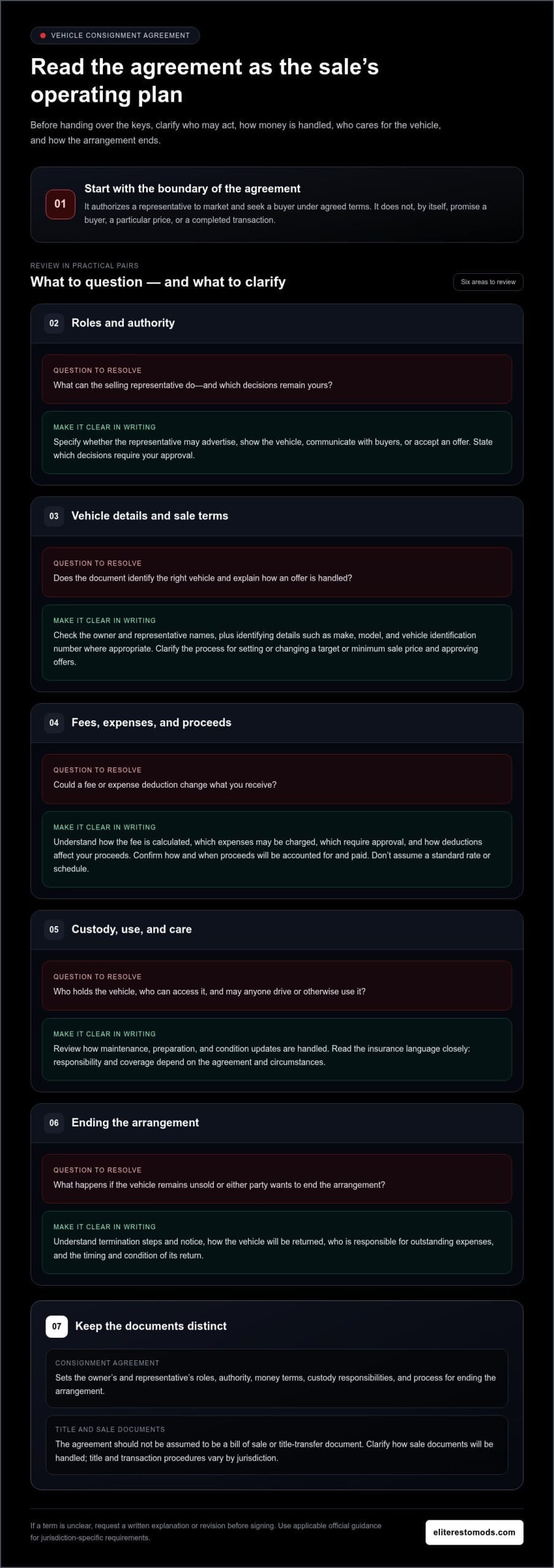
Read the agreement as an operating plan for the sale, not just permission to display a vehicle. A consignment agreement for vehicles can address who may act, what they may do, how money is handled, and what happens if the arrangement ends without a sale. These are common topics to understand, not a claim that every jurisdiction requires the same clauses. Wording and applicable rules can vary, so don’t treat a general checklist as a substitute for jurisdiction-specific guidance.
Start with identification. Check that the document accurately names the owner and selling representative and describes the vehicle clearly enough to distinguish it, including identifying details such as make, model, and vehicle identification number where appropriate. Then examine the authorization: does it cover advertising, showing the vehicle, communicating with prospective buyers, or accepting an offer? Note any limits on the representative’s authority and which decisions require your approval.
How should price, fees, and expenses be described?
Look for a clear process for setting or changing the target or minimum sale price. The agreement should explain whether the representative can present or accept an offer without your approval and how you’ll be asked to decide. Review the fee calculation and any expense deductions in plain language: what may be charged, which expenses need approval, and how deductions affect your proceeds. Confirm how and when the sale proceeds will be accounted for and paid. Don’t infer a standard rate or payment schedule.
Small wording differences can matter. “Expenses may be deducted,” for example, leaves practical questions unless the agreement explains which expenses count and how they’re documented. If a term is unclear, request a written explanation or revision before signing. A federal rule addressing consignment sales in the alcohol industry appears in the consignment sales regulations. Its scope is specific to that industry, so it shouldn’t be treated as a rule for vehicle agreements.
Who is responsible for the vehicle while it is consigned?
Review who holds the vehicle, who can access it, and whether anyone may drive or otherwise use it. Check how maintenance, preparation, and condition updates are handled, especially if the vehicle has distinctive finishes or components that need careful presentation. Read the insurance language closely: responsibility and coverage depend on the agreement and circumstances. Don’t assume the contract makes either party responsible for every possible loss or damage.
Finally, look for the arrangement’s end points. Understand how either party can terminate it, what notice or steps are required, and how the vehicle is returned if it remains unsold. Clarify responsibility for outstanding expenses and the timing and condition of the vehicle’s return. These details can make a specialty-vehicle sale more orderly and help prevent mismatched expectations. Elite Restomods’ consignment services support the marketing and sales representation of classic cars and high-quality restomods.
How Does a Consignment Agreement Relate to Vehicle Title and Sale Documents?
A consignment arrangement can involve several documents, each with a different job. The agreement describes how the owner and selling representative will work together. Title records relate to ownership, while sale documents record details of a transaction. Keeping those functions separate helps prevent a common misunderstanding: authorizing someone to market a vehicle does not, by itself, explain every step needed to document a later sale or transfer.
A consignment agreement for vehicles can set out the representative’s authority, the parties’ responsibilities, and the process they’ve agreed to follow. Title and sale paperwork serve different purposes. The exact documents, timing, and responsibilities may depend on the state and transaction, so don’t assume a particular sequence applies everywhere.
| Document | Main purpose | What to understand |
|---|---|---|
| Consignment agreement | Records the arrangement between the owner and selling representative. | Review the authorization, responsibilities, offer and expense process, custody terms, and how the arrangement may end. |
| Vehicle title | Relates to recorded vehicle ownership. | Understand what the title shows and what steps may be needed to update ownership for the specific transaction. |
| Sale documentation | Records details associated with a vehicle sale. | Check which documents apply to the transaction and how they relate to payment and any ownership-transfer steps. |
What does the consignment agreement establish?
The agreement is the reference point for the parties’ working arrangement. It can explain what the representative is authorized to do, how offers will be handled, which expenses may be charged, and how the vehicle will be managed while listed. It can also describe what happens if the owner or representative ends the arrangement before a sale. These written terms clarify expectations, but they aren’t a substitute for ownership records or transaction paperwork.
For sellers looking at the legal background, a law review analysis of the Uniform Commercial Code and consignment law explores the complexities of consignment arrangements. Its discussion provides context, not a vehicle-specific checklist or a substitute for guidance on requirements that apply to a particular transaction.
What role do title and sale documents play?
Title documentation relates to recorded ownership. Sale documents, meanwhile, capture information about the transaction. Which forms are used, who completes them, and when they are handled can differ across states and transactions. Avoid relying on a universal rule about who holds or signs a title at each stage. Instead, make sure the agreement’s description of the sale process aligns with the applicable title and transaction procedures.
A consignment agreement explains the selling arrangement; title and sale documents address ownership and transaction records. Before signing, identify which document answers each question and where the process moves from marketing into a completed sale. That distinction gives every piece of paperwork a clear role.
How Can You Review a Vehicle Consignment Agreement Before Signing?
Review the agreement carefully before signing or handing over the vehicle. A clear process helps you spot mismatched expectations while there’s still time to resolve them. Separate commercial questions, such as who approves an offer or how expenses are handled, from legal questions, such as title procedures or jurisdiction-specific requirements. For the latter, verify current guidance that applies to your transaction or consult a qualified legal professional.
- Match the parties and vehicle. Confirm that the owner and selling representative are correctly identified, and compare the vehicle description and identifying details against your records. Correct errors before they carry into advertising or later paperwork.
- Map the representative’s authority. Read what the representative may do, including advertising, arranging viewings, communicating with buyers, negotiating, or accepting an offer. Check whether your approval is needed before a sale is finalized. No single authority structure applies to every agreement.
- Trace the money. Identify how the sale price is set, how offers are presented, and which fees or expenses may be deducted. Look for the process and timing for accounting for proceeds and paying you. If a deduction or approval step is vague, ask for specific written wording rather than relying on an informal explanation.
- Assess custody and care. Determine where the vehicle will be kept, who can access or use it, and how maintenance, condition updates, and insurance are addressed. The contract and circumstances shape those responsibilities, so don’t assume either party automatically covers every possible loss or damage.
- Check the term and exit process. Find the agreement’s duration and how either party can end it. Read what happens if the vehicle remains unsold, including retrieval arrangements, any outstanding expenses, and how its condition will be documented at return.
What should you clarify about authority and communication?
Look for a practical communication plan. Does the agreement explain how you’ll receive buyer inquiries and offers, how viewing arrangements are handled, and when you’ll be updated? If you want final approval on a proposed sale, make sure that expectation is stated clearly. Professional consignment can pair thoughtful vehicle presentation with organized marketing and sales representation. Explore Elite Restomods’ consignment services as you consider the approach that fits your vehicle.
How should you assess the term and an unsold vehicle?
Read the exit terms as carefully as the start-of-sale terms. Confirm how notice is given, where and when the vehicle can be retrieved, and how expenses are settled if no sale occurs. A condition record can help both parties understand the vehicle’s state at return. To see how the service journey is organized, review the consignment process overview.
Before you sign, put unresolved questions in writing and make sure the final agreement reflects the answers. If a point concerns state-specific legal or title procedures, verify it separately rather than treating a commercial explanation as legal guidance. Clarity first, then decide whether the arrangement suits your selling goals.
What Does a Well-Managed Vehicle Consignment Experience Look Like?
A well-managed consignment sale pairs considered presentation with clear roles. The representative may coordinate marketing, detailing, and buyer communication, while the owner stays informed about the agreed process, fees, approvals, and responsibilities. Professional support can make the selling experience more organized, but it doesn’t guarantee a buyer, a particular sale price, or a specific timeline. The written terms should still match the owner’s expectations.
Specialty vehicles have a story as well as a specification. A thoughtful presentation can help communicate a car’s condition, history, craftsmanship, and distinctive features to prospective buyers. That work is most effective when the agreement and service scope explain what the representative will handle and what the owner must provide or decide. A clear consignment agreement for vehicles helps turn those expectations into a defined working arrangement.
What can professional consignment help organize?
Elite Restomods’ consignment service includes marketing, detailing, and sales representation for classic cars and high-quality restomods. Coordinating these activities can give a vehicle a consistent presentation, from preparation through buyer inquiries. Review vehicle consignment services alongside the proposed terms to understand how the described support fits your priorities.
Owners still have an active role. You may need to provide vehicle records, share accurate information about condition and history, make decisions on offers, and meet any responsibilities set out in the agreement. Understand fees and expenses before the arrangement begins. A careful review helps distinguish what the representative will manage from what remains yours to handle.
How can owners make an informed next move?
Start with useful preparation. Gather available ownership and service records, note known repairs or modifications, and write down what matters most to you, such as approval over offers, communication preferences, or the vehicle’s care while it is presented. These details can help frame a practical conversation about the service scope and written agreement.
- Compare the proposed marketing, detailing, and sales support with the work you expect the representative to perform.
- Check that fees, expenses, owner approvals, and communication responsibilities are expressed in understandable terms.
- Make sure unresolved points are clarified in writing before signing or delivering the vehicle.
Elite Restomods’ classic car consignment guide offers broader context on presenting and selling specialty vehicles. Use it as background while you compare the service scope and agreement terms with your goals. If professional representation feels like a fit, you can discuss vehicle consignment as a considered next step.
There’s no need to rely on assumptions about a “standard” agreement. Clear documentation and direct communication matter more. When both parties understand their responsibilities, expectations, and the process, you can make a more informed decision about entrusting a distinctive vehicle to a consignment sale.
Move Forward With a Clear Plan
The right selling arrangement should feel considered, not rushed. Once you understand the proposed terms, decide what a successful experience means to you: how involved you want to be in buyer conversations, what communication you value, and which decisions you want to retain. Those priorities can guide a focused discussion before the vehicle enters the sales process.
Elite Restomods offers professional vehicle consignment to owners across the United States. If you’re ready to explore how that approach could fit your plans, begin with a conversation about your vehicle’s story and your expectations. A well-understood consignment agreement for vehicles can help set the stage, but the decision remains yours.
Explore professional vehicle consignment and take the next step with confidence. Your vehicle’s next chapter can begin with a clear plan.
Frequently Asked Questions
What is a vehicle consignment agreement?
A vehicle consignment agreement is a written arrangement authorizing a representative to market and seek a buyer for an owner’s vehicle under defined terms. It can clarify the representative’s scope, how offers are handled, and what information the owner is expected to provide. For example, an owner might use it to document whether the representative can arrange buyer viewings. Read the actual wording rather than relying on a verbal description of the arrangement.
Is a vehicle consignment agreement the same as a bill of sale?
No. A consignment agreement records the sales arrangement between the owner and representative; a bill of sale is generally associated with documenting a vehicle transaction between a seller and buyer. One doesn’t automatically replace the other. For instance, signing a consignment agreement to begin marketing a car doesn’t itself document a completed sale to a later buyer. The documents used and their roles can depend on the transaction and jurisdiction.
Can I set a minimum sale price in a vehicle consignment agreement?
You can discuss a minimum or target price and have the agreed approach recorded in writing. The key is to spell out how offers below that amount will be handled and whether the representative needs your approval before proceeding. For example, state whether an offer can be relayed for your decision or whether any negotiation is authorized. The consignment agreement for vehicles should make these boundaries clear rather than leave them to assumption.
Who is responsible for a vehicle while it is on consignment?
Responsibility depends on the written agreement, the vehicle’s custody, insurance arrangements, and the circumstances of any incident. Don’t assume that possession alone decides who bears responsibility for every type of damage or loss. Before delivery, document the vehicle’s existing condition, note included accessories, and retain a copy of the record. Then compare the agreement’s terms for access, use, care, and insurance with that documentation.
What happens if a consigned vehicle does not sell?
If no buyer completes a purchase, the next steps should follow the agreement’s term and exit provisions. Those terms may address how the owner retrieves the vehicle, whether any agreed expenses remain outstanding, and how its condition is recorded at return. Before the arrangement begins, make sure you understand the practical retrieval process and any notice steps. Don’t assume the vehicle will automatically be returned on a particular date.
Does consigning a vehicle transfer ownership to the dealer?
Consigning a vehicle doesn’t, by itself, establish that ownership has transferred to the dealer. The agreement authorizes a sales arrangement, while ownership records and transfer paperwork have separate functions. The details depend on the documents and applicable jurisdiction, so avoid relying on a general rule about who holds or signs the title at each stage. Review the contract alongside official guidance for the relevant transaction before completing paperwork.
Should a vehicle consignment agreement be reviewed by an attorney?
An attorney’s review can be useful if the agreement is unclear, the vehicle has a complex ownership history, or the transaction involves terms you don’t understand. Legal and title procedures can vary by jurisdiction, so a qualified professional can help interpret how local requirements apply to your circumstances. You can prepare questions by marking unclear language about authority, costs, insurance, or ending the arrangement. Don’t sign wording you can’t explain back in plain language.