
What if the key to a remarkable custom car isn’t spending more, but making every decision serve the build you imagined? Managing a custom car build budget can feel daunting when the dream includes mechanical upgrades, paint, bodywork, and a finished interior. Parts are only one part of the picture. Installation, fabrication, and finishing work can all affect the total as the project takes shape.
It’s natural to wonder whether an early estimate will reflect the finished scope, or whether one tempting upgrade will push spending off course. A clear budget gives you a practical way to make choices without losing sight of the car you want to drive. This guide explains how to define the work, separate essentials from optional refinements, and track estimates, approved decisions, and actual spending as the build progresses.
You’ll also learn to treat scope changes as deliberate trade-offs rather than surprises, with a contingency for uncertainty. For a tailored custom build, the budget is a shared framework for aligning your vision with the work and bringing classic character and modern capability together.
Key Takeaways
- Define the finished car and project scope before estimating, so the budget reflects more than the starting vehicle.
- Group planned work into mechanical, body and paint, and interior categories to make priorities easier to compare.
- Use contingency to prepare for uncertainty, not as an open-ended allowance for adding upgrades.
- Make managing a custom car build budget easier by keeping the baseline plan, approved changes, revised estimates, and actual spending distinct.
- Align the desired outcome with priorities across mechanical upgrades, paint, bodywork, and interior customization.
Why managing a custom car build budget starts with a clear scope
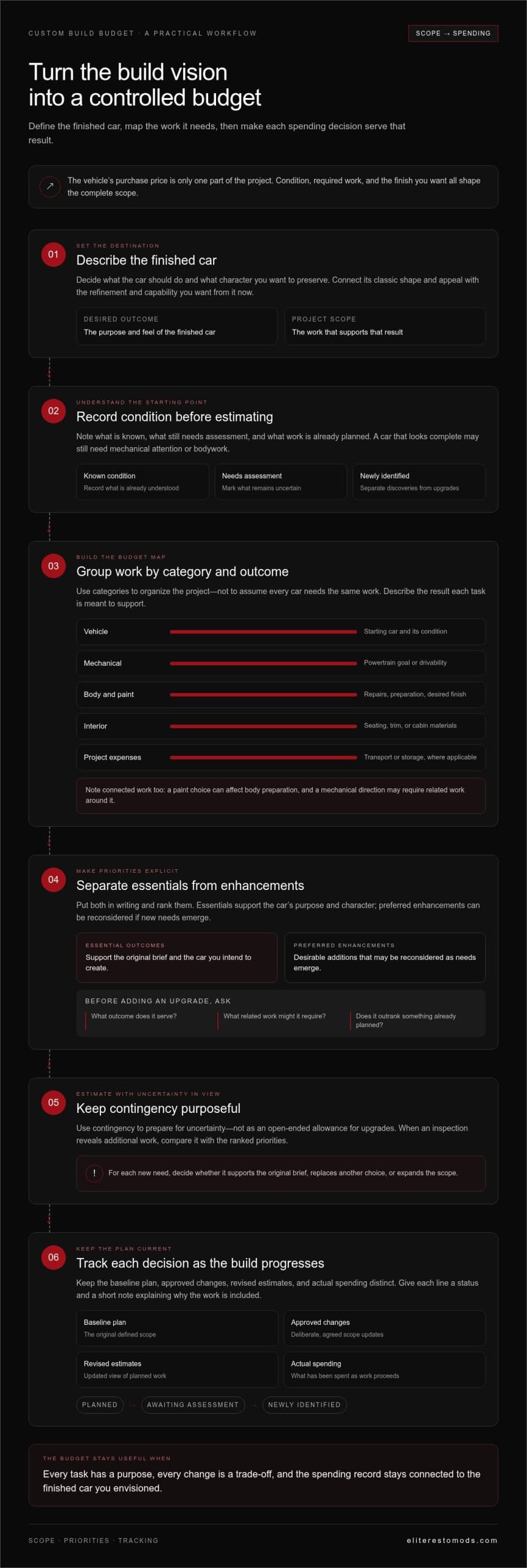
A classic car can represent a particular combination: the shape and character that first caught your eye, paired with the refinement and capability you want from it now. Turning that idea into a workable plan means defining what the finished car should do, what work will support that result, and how you’ll assess spending decisions along the way. A custom-build budget is that plan, not just a target figure.
The vehicle’s purchase price is only one part of the project. Its condition, the work required, and the finish you want all affect what it takes to reach your goal. A car that appears complete may still need mechanical attention or bodywork. A requested change may also involve related work beyond the component itself. A clear scope brings those connections into view before decisions start to blur together.
As a general reference, Custom car describes the range of modifications that can shape a vehicle. For budgeting, the point isn’t to choose every possible modification. It’s to identify which changes belong to your vision and which are simply tempting additions.
Scope clarity is the foundation of budget control. It turns a dream into defined work, and defined work into deliberate spending decisions.
What belongs in a custom car build budget?
Start with categories broad enough to capture the project without assuming every car needs the same work. A useful first pass includes the vehicle, mechanical work, body and paint, interior customization, and project-related expenses such as transport or storage where applicable. The starting vehicle and intended result determine which categories matter and how much detail each one needs.
For each category, describe the outcome rather than just naming a part. “Modernize the driving experience” is a goal. Listing the mechanical work intended to support it makes that goal easier to estimate and review. Likewise, “refresh the cabin” becomes more useful when you identify the interior elements that matter most. This gives each spending decision a clear purpose.
How does a defined scope protect the original vision?
Separate essential outcomes from preferred enhancements before work begins. Essentials support the car’s purpose and character. Enhancements may be desirable, but could be reconsidered if new needs emerge. Put both in writing and rank them. If an inspection reveals additional work, compare it with those priorities and decide whether it supports the original brief, replaces another choice, or expands the scope.
This is especially useful when an upgrade sounds appealing on its own. Ask what outcome it serves, what related work it may require, and whether it outranks something already planned. That pause helps keep the build focused on the car you set out to create.
Elite Restomods’ tailored custom build services put scope-setting into practical project planning, aligning your desired outcome with mechanical upgrades, paint, bodywork, and interior customization. The budget becomes a shared reference for discussing priorities, rather than a figure detached from the finished car.
The main cost categories to map before a custom car build begins
A useful budget map starts with the car as it is, not only the car you hope to drive. Record its known condition, note what still needs assessment, and connect each proposed task to the intended result. This helps distinguish planned upgrades, chosen to shape the finished car, from repairs or additional work identified as the project progresses.
Budget categories depend on the vehicle’s condition and the build scope. There’s no universal checklist that fits every car, so use categories to organize the work rather than assume that every item applies.
How should you account for mechanical, body, and interior work?
Break the main work into clear groups, then describe the desired outcome in each one. Mechanical planning might focus on a powertrain goal or improved drivability. Body and paint planning could include repairs, panel preparation, or the finish you want. Interior work might prioritize seating, trim, or cabin materials. These are examples, not a prescription. A sound body or an interior you want to preserve may need little or no work.
Consider how choices interact. A mechanical direction may affect what the car needs around it, while a particular paint finish can influence the body preparation required. Interior materials also shape the cabin’s character and may compete with other priorities for attention. Note these connections beside the relevant tasks so each category reflects the complete work, not just an isolated upgrade.
Which project expenses are easy to overlook?
The visible transformation isn’t the whole project. Alongside work on the car, list any applicable project expenses, such as transport or storage. Keep them separate from mechanical, body, paint, and interior work so you can see what supports the build without confusing it with a vehicle upgrade. The supporting needs will vary from project to project.
Assessment can also change the budget picture. A review of the vehicle’s condition may reveal repair needs that weren’t part of the original upgrade plan. Record those separately, explain what prompted them, and show how they affect the intended result. This preserves the distinction between improving the car by choice and addressing needs discovered along the way.
To keep the map useful, give every line a status: planned, awaiting assessment, or newly identified. Add a short note explaining the reason for the work and which category it affects. This makes later updates easier to interpret, especially when a newly discovered repair competes with an optional enhancement.
Project budgeting methods also emphasize organizing work and reviewing the plan as a project develops. The overview of Project Management Budgeting Methods offers a broader framework for that discipline. Applied to a car build, the aim is to make each category understandable and each revision traceable.
With categories mapped, managing a custom car build budget becomes less about guessing at one total and more about understanding what each decision represents. Elite Restomods’ custom build services are tailored to the work a project calls for, helping align your priorities with the car’s mechanical, exterior, and interior goals.
How to balance build priorities, trade-offs, and contingency
A custom build can bring new decisions to light after the original plan is set. A newly identified need may compete with an upgrade you’ve been looking forward to, while a desired finish can involve work elsewhere on the car. Managing a custom car build budget means making those choices deliberately, with the finished car’s character and purpose still in view.
Sort each choice by how directly it supports your core driving and design goals. Contingency is an allowance for uncertainty, not an open invitation to add scope. If a new need arises, record what changed, why it matters, and what decision follows. That gives you a clear basis for keeping the work, revising another priority, or deferring an enhancement.
How much contingency should a custom-build budget include?
There’s no universal allowance that suits every build. The right amount depends on what’s known about the starting vehicle, how clearly the work is defined, and what remains uncertain. Revisit your assumptions as assessment and project information improve. If an unknown becomes a specific repair need, update the plan to reflect what was discovered rather than treating contingency as unallocated spending.
Record the reason for each use of contingency alongside the affected work. This helps distinguish a necessary response to new information from an elective change. It also gives you and the project team a shared record for reviewing what remains possible within the intended scope.
How can you prioritize upgrades without compromising the build?
Classify decisions by how they relate to the car’s purpose. For example, if your goal is a classic silhouette with a more composed modern drive, a choice that supports that experience may take precedence over an optional cosmetic enhancement. The right order depends on your priorities, not a universal ranking.
| Priority | How to think about it |
|---|---|
| Must-have outcome | Directly supports the car’s core driving, usability, or design goal. |
| Desirable upgrade | Elevates the experience, but can be weighed against other planned work. |
| Deferrable choice | Adds refinement without being essential to the intended result. |
When a discovery changes the plan, write down the original choice, the new information, the proposed response, and the trade-off. For instance, you might defer a preferred cabin-material upgrade so a newly identified mechanical need can take priority within the project. The point isn’t to diminish the dream. It’s to protect the outcome that matters most.
For additional context on project development, Elite Restomods’ custom build process complements this kind of planning. Documenting a decision keeps the build’s purpose visible as details evolve and connects each change to the car you set out to create.
A practical system for tracking custom car build spending
A budget can guide the build only if you can compare the original plan with decisions and spending as the work progresses. Keep one shared tracker, whether it’s a spreadsheet or another straightforward record, and make sure everyone involved uses the current version. The goal is clarity, not complicated software.
Use this routine to keep the project’s financial picture clear:
- Record the baseline. List the agreed scope by work category, the initial estimate for each item, and the assumptions behind it. Mark planned work separately from anything still awaiting assessment.
- Log proposed changes. Describe the new work, why it’s being considered, and which part of the original scope it affects. Keep it marked as proposed until a decision is made.
- Document approvals. Once a change is approved, record what was agreed, who approved it, and when it became part of the plan. Add the revised estimate without overwriting the baseline.
- Enter actual spending. Record completed costs against the relevant work item and compare them with the current estimate. Clearly mark work that is planned or in progress.
- Review open decisions. Consider unresolved choices, current estimates, completed spending, and the remaining budget together. Revisit the tracker at project review points so decisions reflect the latest information.
What should a custom-build budget tracker record?
Give each work item its own line, with a description, category, baseline estimate, revised estimate, approved changes, and actual spend. Add the reason for each estimate or change, along with any assumptions that could affect it. That context makes future updates more useful: a revised figure should show what changed, not just that the number moved.
Keep planned work, revised estimates, and completed costs in separate columns or clearly labeled fields. If an assessment identifies a mechanical need, for example, the record should show whether it was included in the original scope, added later, and approved before becoming part of the active plan.
How should you handle a newly discovered need or change?
Pause before adding it to the active plan. Describe the new work and how it relates to the agreed outcome, then compare its effect on the estimate with the project’s priorities. If you approve the change, record the decision and update the revised plan. If you don’t, keep it visible as an open or deferred item rather than silently dropping it.
A useful change-control record explains what changed, why, who approved it, and how it affects the plan. This simple discipline makes managing a custom car build budget more transparent and helps you compare the estimate with actual progress.
For a custom project shaped around your priorities, explore the custom build process and bring your vision, scope, and decisions into one clear conversation.
How Elite Restomods connects custom-build scope with your budget
A budget framework is most useful when it gives your vision a practical shape. It helps turn broad ambitions, such as bringing modern capability to a classic car while preserving its character, into priorities that guide project discussions. Instead of treating every possible upgrade as equally important, connect each proposed area of work to the experience you want from the finished car.
Elite Restomods’ custom-build services cover mechanical upgrades, paint, bodywork, and interior customization. Consider these areas in relation to one another. Your desired driving experience can help define mechanical priorities, while the exterior and cabin express the car’s design character. The budget gives you and the project team a shared way to discuss those choices, consider how they fit the intended scope, and keep decisions grounded in your brief.
How can a custom-build project keep the vision and budget aligned?
Return to your core priorities whenever you consider a proposed area of work. Ask what role it plays in the car’s intended use, appearance, or feel, and whether it supports an essential outcome or adds a preferred refinement. This comparison helps keep decisions coherent. A budget framework supports thoughtful discussion, but it doesn’t promise a fixed final cost or dictate a single version of the finished car.
For example, you may want a classic exterior character and a more contemporary driving experience. Those goals can guide separate discussions about body and paint choices, mechanical work, and interior details while making clear which elements matter most. As the scope takes shape, record what you prioritized and why. Later choices can then be assessed against the same intent instead of decided in isolation.
What is the next step when you are ready to shape a build?
Come prepared with the vehicle’s known details, the outcomes you care about most, and questions about the work you’re considering. Note which choices are essential, which are desirable, and what you’re open to adjusting as the project scope develops. You don’t need every technical answer in advance. A clear sense of the car you want to create is a strong starting point.
Explore Elite Restomods’ custom-build services to see how mechanical upgrades, paint, bodywork, and interior customization can fit into a tailored project. Managing a custom car build budget is an ongoing conversation between the desired outcome and the work chosen to reach it. Clear priorities make that conversation more productive.
When you’re ready to shape your ideas into a project brief, explore the custom-build process and start a conversation about your build.
Turn your vision into a build plan
The right custom car project is more than a collection of upgrades. It’s a chance to shape how a classic looks, feels, and performs, with decisions guided by the experience you want behind the wheel. Managing a custom car build budget gives that vision a practical starting point, helping you move from inspiration to a considered project brief.
Bring your priorities, ideas, and questions into the planning conversation. Elite Restomods creates tailored custom builds across mechanical upgrades, paint, bodywork, and interior customization. Its curated inventory also includes fully sorted, investment-grade restomods that have undergone a quality assurance process. Each choice can be considered in the context of the car you want to create, without losing sight of what matters most to you.
Your dream doesn’t need to be fully engineered before it can take shape. Start with the details you know and the feeling you want the finished car to deliver. Explore Elite Restomods’ custom-build services and take the first step toward making that vision your own.
Frequently Asked Questions
How do you create a budget for a custom car build?
Start by describing how you want to use and experience the finished car, then translate that goal into work the project can define. For example, decide whether preserving the original character, improving everyday drivability, or reshaping the cabin matters most. Assess the starting vehicle, gather estimates for the intended work, and record assumptions that could change. Managing a custom car build budget becomes more practical when priorities guide estimates, rather than the other way around.
What costs should a custom car build budget include?
Include the starting vehicle and relevant mechanical, body, paint, and interior work, along with project-related expenses that apply. Look beyond the headline component: a selected part may require installation, adaptation, or finishing before it delivers the result you want. For example, a powertrain choice may involve related work beyond the engine itself. Listing connected tasks separately helps show what an estimate covers and what still needs assessment.
How much contingency should I set aside for a custom car build?
There isn’t one contingency amount that fits every custom build. The allowance should reflect what’s known about the vehicle, how much of the scope has been assessed, and which uncertainties could affect the work. Before setting it, identify what remains unknown and whether further assessment can clarify it. As the project team learns more, revisit the allowance and record any change in assumptions. Keep contingency distinct from funds intended for optional upgrades.
Why do custom car builds go over budget?
Budgets can drift when a part’s purchase price is mistaken for the full cost of incorporating it, or when the starting car reveals needs that weren’t apparent at first. Changes made one at a time can also expand the project if their combined effect isn’t reviewed. For instance, adding an upgrade may require related modifications or finishing work. Clear estimates, documented approvals, and a visible distinction between planned and added work help explain where the budget is moving.
Can I change the scope of a custom car build after work begins?
Yes, the scope can change, but treat each adjustment as a decision with consequences rather than an informal addition. Describe the new work, identify what prompted it, and consider whether it supports the car’s main purpose. Then review what it may displace, defer, or require elsewhere in the project. Record the agreed change before it becomes part of the active plan, so you and the project team share the same understanding.
How can I track spending during a custom car build?
Use a spreadsheet or shared project record with a separate line for each work item. Track its estimate, approved changes, actual spending, status, and supporting documents such as invoices or receipts. It can also help to distinguish completed spending from approved commitments that haven’t yet appeared as paid costs. Compare those figures during project reviews and flag differences with a short explanation. This gives you a clearer picture than relying on memory or scattered messages.
What should I prioritize if my custom car build budget is limited?
Prioritize the work most closely tied to the car’s essential function and your central reason for building it. If the vehicle needs mechanical attention to deliver the driving experience you want, consider that before optional decorative refinements. Then choose the design details that give the car its distinctive character and identify enhancements that could wait. Ranking choices this way helps preserve the build’s purpose while giving you a thoughtful basis for deferring less essential work.