
A factory-style power steering conversion for a classic Mustang can modernize the drive without abandoning the car’s familiar steering layout. These kits use a remanufactured GM Delphi 600 integral power steering gearbox and bolt to the factory mounting location. You want easier steering, but you also want the right fit for your Mustang’s year, engine, and existing setup. This guide compares factory-style and electric options, then lays out the listed parts and prices for specific applications.
Fitment involves more than matching the model year. Steering-column clearance, pitman-shaft size, clutch linkage, and existing factory power steering can all affect which components the build needs. We’ll explain the key differences and parts involved, and show the listed part numbers and prices by year and engine, so you can understand the requirements before planning your classic Mustang’s transformation.
Key Takeaways
- Electric assist and factory-style conversions use different steering components; the right approach depends on the Mustang’s setup and the driving feel you want.
- Year-specific column connections matter: identify the correct rag joint before matching an electric conversion to your Mustang.
- Factory-style kit fitment can hinge on column clearance, clutch linkage, and pitman-shaft dimensions, so compare the application details before choosing a configuration.
- Listed kit prices vary by model year, engine, and existing steering setup. For a broader build plan, Elite Restomods offers Classic Car Financing.
Electric power steering conversion parts for 1965-1973 Mustangs
Electric assist replaces hydraulic hardware with an electrically assisted steering unit. For 1965-1973 Mustangs, fitment depends on the year and the steering-column connection.
Electric Power Steering Kit Fit
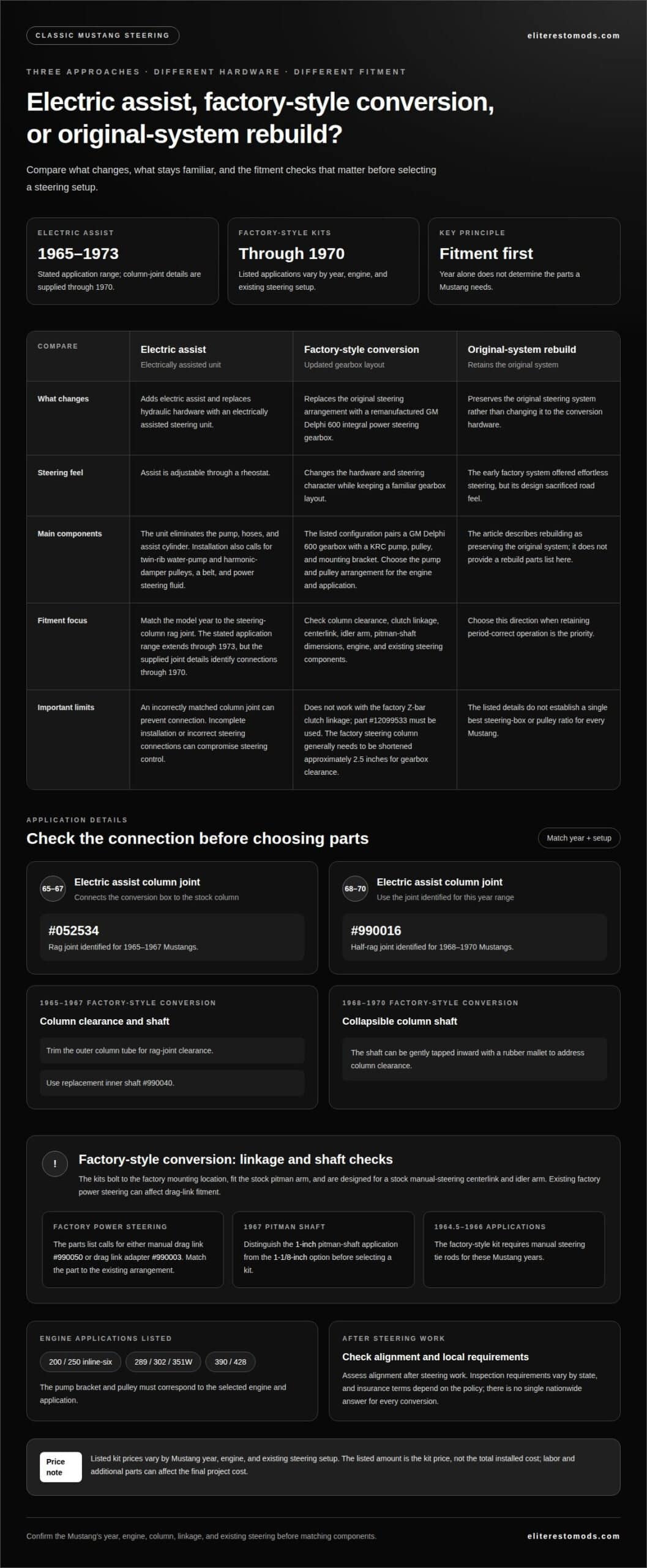
The conversion described for classic Mustangs offers adjustable assist through a rheostat. It eliminates the pump, hoses, and assist cylinder, changing the installation’s hardware and layout. The system is listed for cars with manual or factory power steering. For 1965-1967 Mustangs, the conversion box connects to the stock column with rag joint #052534. For 1968-1970 Mustangs, it uses half-rag joint #990016.
Before selecting parts, match the Mustang’s model year to its column connection. The supplied fitment details identify joints through 1970, while the stated application range extends through 1973. Installation also requires twin-rib water-pump and harmonic-damper pulleys, a belt, and power steering fluid. Those supporting parts matter: the electric assist unit alone does not complete the conversion.
Conversion Problems and Safety Risks
A mismatched rag joint can prevent the conversion box from connecting correctly to the steering column. For example, #052534 applies to 1965-1967 Mustangs, while #990016 is identified for 1968-1970 cars. Incorrectly fitted steering connections or incomplete installation can compromise steering control. The system also carries a California Proposition 65 warning about exposure to chemicals known to cause cancer and birth defects or other reproductive harm.
Assess alignment after steering work. Inspection requirements vary by state, and insurance terms depend on the policy, so there is no single nationwide answer for every Mustang conversion.
When planning, account for the complete parts list, including the specified pulleys, belt, and fluid. A missing supporting component can leave the installation incomplete. Confirm the year-specific column joint and assemble the required parts before installation to help avoid fitment problems and unnecessary rework.
Factory-style power steering conversion
A factory-style conversion adds steering assistance while retaining a familiar gearbox layout. Fit depends on the Mustang’s year, steering column, clutch linkage, and existing steering components.
Conversion Versus Original System Rebuild
A conversion replaces the original steering arrangement with a remanufactured GM Delphi 600 integral power steering gearbox. The early factory system offered effortless steering, but its design sacrificed road feel. Rebuilding preserves that original system; converting changes the hardware and steering character. The right direction depends on whether period-correct operation or an updated setup better suits the car.
These kits bolt to the factory mounting location and fit the stock pitman arm. They’re designed for a stock manual-steering centerlink and idler arm. A power steering conversion for a classic Mustang therefore requires checking more than gearbox fit: the existing linkage and clutch setup matter, too.
Steering Box, Pump, and Pulley Ratios
The listed configuration pairs a remanufactured GM Delphi 600 gearbox with a KRC pump, pulley, and mounting bracket. Choose the kit’s pump and pulley arrangement to match the engine and application. The available fitment details don’t establish a single best steering-box or pulley ratio, so avoid assuming one ratio suits every Mustang.
Engine options include 200/250 inline-six, 289/302/351W, and 390/428 applications. The pump bracket and pulley must correspond to the selected engine. Factory power steering can also affect drag-link fitment, a detail covered with the application-specific parts.
Conversion Kit Installation
Installation starts with checking the column, linkage, and clutch configuration against the kit. The conversion doesn’t work with the factory Z-bar clutch linkage; part number 12099533 must be used. The factory steering column generally needs to be shortened approximately 2.5 inches for gearbox clearance.
For 1968-1970 Mustangs, the collapsible column shaft can be gently tapped inward with a rubber mallet. For 1965-1967 cars, trim the outer column tube for rag-joint clearance and use replacement inner shaft #990040. A custom build plan can account for these fitment details alongside the rest of a Mustang’s configuration.
Part numbers and listed prices
Listed kit prices vary by Mustang year, engine, and factory steering setup. Treat each amount as the kit price, not the total cost of an installed conversion.
For cars with factory power steering, the parts list calls for either manual drag link #990050 or drag link adapter #990003. Match the part to the car’s existing steering arrangement. On a 1967 Mustang, distinguish the 1-inch pitman-shaft application from the 1-1/8-inch option before selecting a kit.
The installed cost differs from the listed kit price. It depends on labor and any additional parts the Mustang’s configuration requires; the listed figures do not give a combined installation total. The kit price alone therefore cannot establish the project’s final cost.
Use the year, engine, and steering type together when comparing these figures. A 1968-1970 V8 kit with manual steering, for example, has a different listed price from its factory-power-steering counterpart. That distinction makes the correct application more important than choosing by price alone.
Which power steering conversion kits fit classic Ford Mustangs by year and engine?
Fitment depends on model year, engine, original steering, and specific shaft dimensions. The listed factory-style applications cover early Mustangs through 1970, with engine and steering configurations determining the correct kit.
For 1964.5-1966 Mustangs, the kit requires manual steering tie rods. Available pump-bracket options cover 200/250 I6, 289/302/351W, and 390/428 engines. A 1966 Mustang with a six-cylinder engine and manual steering, for example, needs the inline-six application rather than a V8 configuration. Original steering type also affects parts selection.
For a 1967 Mustang, identify the pitman or sector shaft dimension before choosing a kit. The listed applications distinguish a 1-inch pitman shaft from a 1-1/8-inch pitman shaft. These measurements correspond to different configurations, so model year alone doesn’t settle fitment. Engine and existing steering setup remain important selection details.
For 1968-1970 Mustangs, kit applications include 200/250 inline-six and 289/302/351W engines. Both manual steering and factory power steering configurations are listed. Cars retaining factory power steering may require a manual drag link or drag link adapter, depending on the existing arrangement. Matching that component prevents choosing a kit based only on engine and year.
Use this sequence to narrow the application:
- Identify the Mustang’s model year and engine family.
- Determine whether the car has manual or factory power steering.
- For 1967, distinguish the 1-inch and 1-1/8-inch shaft applications.
- For 1964.5-1966, include the required manual steering tie rods.
These details define the listed fitment range; don’t assume a 1968-1970 application fits a 1971-1973 Mustang. For a broader ownership plan, explore classic car financing options alongside your Mustang build decisions.
Elite Restomods: Classic Car Financing
Elite Restomods offers Classic Car Financing for enthusiasts planning a considered investment in a classic Mustang. Once you’ve identified the right steering configuration, financing can be a natural next step in planning the broader ownership or build.
For a Mustang that needs a coordinated transformation, Elite Restomods’ Custom Build Services can put mechanical decisions in the context of the complete car. This is useful when steering upgrades are part of a broader vision for how the Mustang should drive and feel. If you’re considering a purchase instead, Elite Certified Restomods offer a path to a finished classic with modernized capability.
Discuss your Mustang plans and financing needs with Elite Restomods.
Plan the Next Chapter of Your Mustang
A power steering conversion for a classic Mustang can be part of a broader vision for how the car looks, feels, and fits your life. Start by considering how you want to use the Mustang, then shape the next decisions around that purpose. A focused plan connects mechanical choices with the car’s overall character.
For a broader transformation, Elite Restomods’ Custom Build Services can support a tailored build. If you’re considering a finished vehicle, explore Elite Certified Restomods. The Consignment Program offers another path for owners ready to move a classic car to its next chapter. Each option suits a different stage of ownership, from refining a personal vision to finding a new home for a vehicle.
Bring your Mustang goals and questions to the conversation, and take the next step at your own pace. Contact Elite Restomods to discuss what comes next. Your classic can remain unmistakably Mustang while reflecting the way you want to drive and enjoy it.
Frequently Asked Questions
How much does a power steering conversion kit for a classic Mustang cost?
The exact amount depends on the Mustang’s year, engine, and whether it already has factory power steering. That figure covers the kit, not the complete installation. The installed total also depends on labor and any additional parts the vehicle’s configuration requires.
What parts are needed to convert a classic Mustang from manual to power steering?
A factory-style setup can include the steering gearbox, pump, pulley, mounting bracket, hoses, column connection, and pitman arm. Some applications also call for a replacement steering shaft or manual steering tie rods. For example, 1964.5-1966 kits require manual steering tie rods, while a 1967 application depends on pitman-shaft dimensions. The needed combination varies with year, engine, and existing steering hardware.
Can a classic Mustang use a modern electric power steering conversion?
Yes. Electric assist is described for 1965-1973 Mustangs, with adjustable assistance controlled by a rheostat. It removes the hydraulic pump, hoses, and assist cylinder. For example, the specified column connection is rag joint #052534 on 1965-1967 cars and half-rag joint #990016 on 1968-1970 cars. The conversion also requires the specified pulleys, belt, and power steering fluid.