
A world-class restomod is not a modified car; it’s a re-engineered modern vehicle wearing a historical skin. The value of such a machine rests entirely on the seamlessness of that marriage. If you’ve ever feared that a stunning exterior might hide a disorganized parts-bin build, you aren’t alone. This restomod buyer’s guide cuts through the noise of the 2026 market to ensure your next acquisition is a masterpiece of functional art rather than a mechanical liability.
You deserve the visceral thrill of a vintage silhouette paired with the unwavering reliability of contemporary fuel injection and precision suspension. We agree that a significant investment should buy more than just nostalgia; it should buy mechanical perfection. You’ll learn to identify the hallmarks of a fully sorted vehicle, from the integration of the wiring harness to the geometry of the chassis. We provide a clear framework for vetting builders and mechanical components, turning your search for a daily-drivable classic into a confident journey toward owning an investment-grade asset.
Key Takeaways
- Distinguish between a standard modification and a re-engineered masterpiece to ensure your vehicle remains a true investment-grade asset.
- Master the technical vetting process by focusing on chassis reinforcement and the seamless integration of modern powerplants like the LS3 or Coyote.
- Use this restomod buyer’s guide to navigate complex market valuations and avoid the common pitfalls of over-capitalized projects.
- Implement a rigorous seven-point inspection strategy designed to expose hidden engineering flaws before they compromise your driving experience.
- Explore how elite services like specialized classic car financing and enclosed vehicle transport can transform your acquisition into a seamless ownership journey.
The Restomod Philosophy: Defining the Investment-Grade Standard
Owning a classic used to be a compromise. You traded mechanical reliability for aesthetic soul, often spending more time in the garage than on the open road. Today, the landscape has shifted. A modern restomod is a bespoke fusion of heritage design and contemporary performance. It’s a machine that captures the raw, visceral excitement of the past without the mechanical anxiety that once defined it. This restomod buyer’s guide explores why the 2026 market increasingly values a vehicle’s ability to be driven over its ability to sit in a climate-controlled vault.
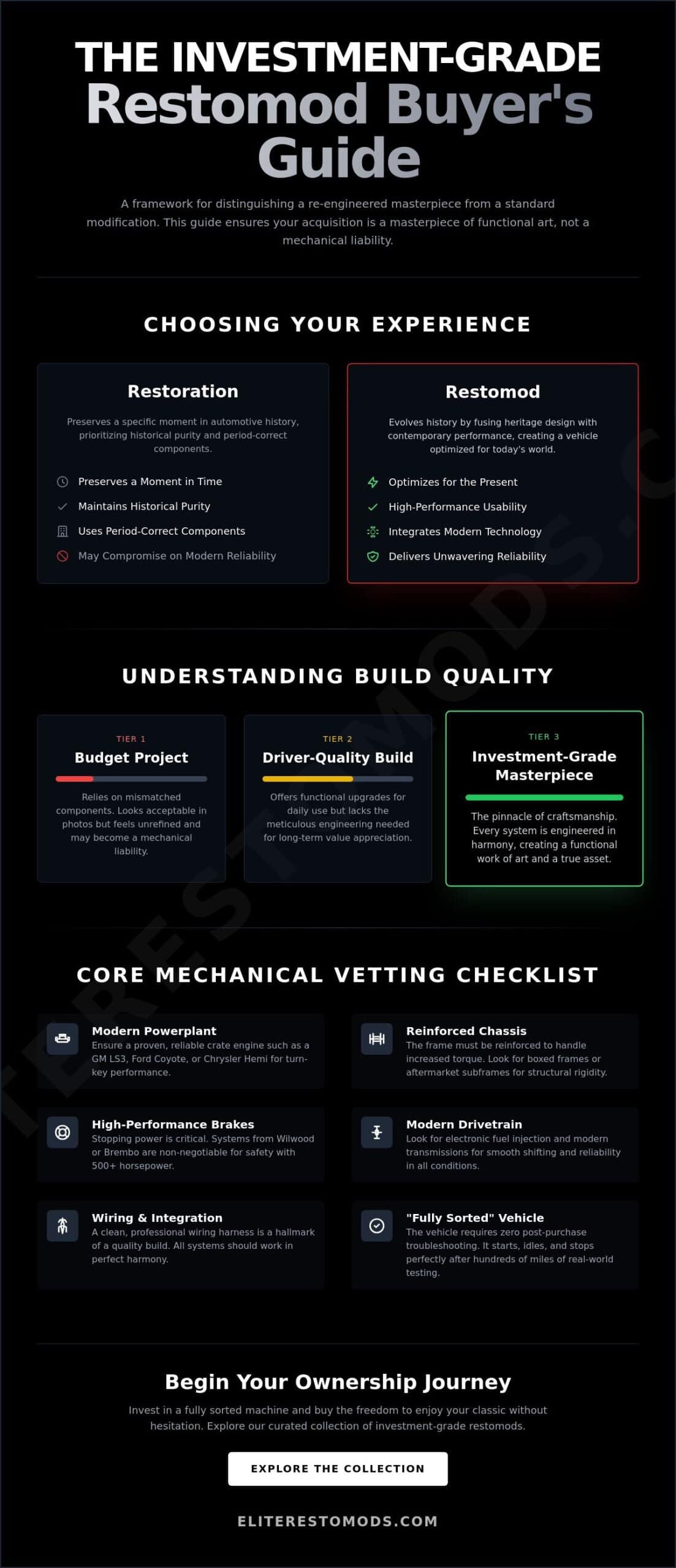
Not all builds are created equal. We categorize modified classics into three distinct tiers to help collectors understand what they are actually purchasing. The budget project often relies on mismatched components that look good in digital listings but feel unrefined on the pavement. The driver-quality build offers functional upgrades but lacks the meticulous attention to detail required for true long-term appreciation. Finally, the investment-grade masterpiece represents the pinnacle of craftsmanship. These are functional pieces of art where every bolt is considered and every system is engineered to work in harmony. As you navigate this restomod buyer’s guide, remember that the most expensive car to own is often the one you bought for the lowest price.
Restomod vs Restoration: Choosing Your Experience
Traditionalists often argue for historical purity, yet the modern collector seeks high-performance usability. When Defining the Restomod, one must understand that it isn’t a rejection of history; it’s an evolution of it. A restoration preserves a moment in time, while a restomod optimizes it for the present. This shift reflects a broader movement in the collector market toward vehicles that can handle modern traffic speeds and climate conditions. It is the perfect marriage of brute force and refined comfort.
The Anatomy of a Fully Sorted Vehicle
A vehicle is only as good as its weakest link. To be fully sorted means the car requires zero post-purchase troubleshooting. It starts every time. It idles in heavy traffic without the temperature needle climbing. It stops with the confidence of a modern supercar. Achieving this level of perfection requires a rigorous quality assurance process that spans hundreds of miles of real-world testing. We view the standard of Elite Certified Restomods as the ultimate benchmark for this industry. This certification ensures that the mechanical integration is seamless, protecting the long-term value of your asset. You can learn more about our rigorous process for achieving this standard. When you invest in a fully sorted machine, you aren’t just buying a car; you’re buying the freedom to enjoy it without hesitation.
Evaluating the Build: Mechanical Integrity and Seamless Engineering
The true soul of a restomod lies in the tension between its vintage silhouette and its modern mechanical heart. It’s not enough for a car to look the part; it must perform with the clinical precision of a contemporary supercar. In any comprehensive restomod buyer’s guide, the evaluation starts with the engine swap. High-performance crates like the GM LS3, Ford Coyote, or Chrysler Hemi are the gold standard. They provide a level of reliability and power that period-correct engines simply cannot match. However, a massive engine is a liability if the chassis hasn’t been reinforced to handle the increased torque. Look for boxed frames or aftermarket subframes that provide the structural rigidity necessary for modern suspension geometry.
Stopping power is just as critical as acceleration. When you’re piloting a vehicle with 500-plus horsepower, manual drum brakes are a relic of the past. Integration of Wilwood or Brembo braking systems is a non-negotiable requirement for safety and performance. These systems offer the heat dissipation and bite needed for spirited daily driving. High-caliber components like these are essential for maintaining the vehicle’s worth over time. Consulting the Hagerty Valuation Tools can provide perspective on how the inclusion of premium hardware impacts the long-term market trajectory of a modified classic.
Power and Precision: The Drivetrain Evaluation
Modern fuel injection and electronic transmissions have revolutionized the classic driving experience. These systems allow for turn-key reliability and smooth shifting, regardless of elevation or temperature. A professional build must also account for the increased thermal demands of a high-output drivetrain. Oversized aluminum radiators and electric fan shrouds are mandatory to prevent overheating in modern traffic. Pay close attention to the wiring. A custom, labeled wiring harness is the hallmark of a master builder. It prevents the electrical gremlins that plague lesser “parts-bin” projects and ensures every modern amenity functions perfectly. You can view examples of these standards in our current inventory of meticulously vetted builds.
The Artisanal Interior: Modern Luxury in a Vintage Shell
The cabin should be a sanctuary of luxury craftsmanship. While off-the-shelf kits are common, an investment-grade restomod features bespoke upholstery and premium leathers. The goal is to integrate modern technology without shattering the vintage atmosphere. This includes the seamless installation of Vintage Air climate control systems and high-end audio hidden behind period-correct facades. Examine the dash modifications. High-end builds use custom-machined bezels and updated gauge clusters that mimic the original aesthetic while providing digital accuracy. It’s this level of detail that distinguishes a functional piece of art from a mere project car.
The Valuation Framework: What Determines a Restomod’s Market Worth?
Determining the fair market value of a modified classic is an exercise in assessing both engineering precision and aesthetic rarity. It’s a complex calculation that transcends the simple sum of a vehicle’s parts. While a traditional restoration relies on numbers-matching components for value, a restomod derives its worth from the quality of its modernization. In this restomod buyer’s guide, we prioritize three core pillars of value: the reputation of the builder, the caliber of the mechanical components, and the transparency of the documentation. A machine that lacks a clear pedigree is often a liability in disguise, regardless of how much was spent on its construction.
Investors must navigate the Build Cost vs. Market Value gap with extreme caution. It’s common for a high-end project to cost significantly more to build than its immediate resale value. To avoid overpaying, focus on vehicles where the engineering integration is seamless. A poorly executed swap can devalue even the most iconic silhouette. In the 2026 market, we’re seeing a surge in demand for specific models like the K5 Blazer and the fastback Mustang. These vehicles are currently achieving record prices when they feature investment-grade upgrades that don’t compromise their historical identity. Beyond the mechanicals, the legal status of the asset is paramount. Ensure the original VIN and title are intact and clear; a modified car with a salvage or reconstructed title will never achieve the same appreciation as one with a clean heritage.
The Builder’s Pedigree and Documentation
A build from a recognized custom restomod builder carries a significant premium. These shops have established a track record of reliability and performance that “home builds” simply cannot replicate. Every elite vehicle should be accompanied by a comprehensive build book. This archive should include high-resolution photos of the metalwork, wiring diagrams, and receipts for every major component. We believe that transparency is the ultimate hallmark of quality. You can see how we prioritize this level of detail by exploring our process for documenting every stage of a transformation. This documentation serves as the vehicle’s resume, proving its value to future collectors.
Protecting the Asset: Insurance and Appraisals
Standard insurance policies are inadequate for high-value restomods. Agreed Value insurance is the only viable option; it ensures that you are covered for the true replacement cost of the vehicle rather than a depreciated book value. Securing this coverage, and often classic car financing, requires a specialized appraisal from an expert who understands the nuances of the modified market. They will look for the same markers of quality found in a professional Restomod Buying Guide, such as suspension geometry and ECU tuning. Ultimately, market value is a reflection of engineering excellence and artisanal finish. When these two elements are perfectly aligned, the vehicle becomes more than just a car; it becomes a secure financial asset.
Navigating the Purchase: Vetting Builders and Verification
Vetting builders and dealerships is the most critical stage of any restomod buyer’s guide. A builder’s reputation is forged through consistency and the ability to execute complex engineering without compromise. When you begin your search, look for facilities that maintain a transparent portfolio of past projects. Red flags often hide in plain sight. Overspray on rubber seals, mismatched body panels, and a chaotic engine bay full of loose wiring are immediate indicators of a “parts-bin” build. A truly sorted machine features an engine bay that mirrors the exterior’s perfection, where every hose and wire is routed with surgical precision.
For out-of-state acquisitions, a professional third-party inspection is a mandatory safeguard. Do not rely solely on a seller’s narrative. An expert inspector should verify the structural integrity of the frame and the quality of the suspension welds. We recommend a “7 Critical Inspection Points” strategy for every potential purchase:
- Panel Alignment: Gaps must be uniform across the entire silhouette.
- Paint Quality: Look for depth and the absence of “orange peel” or overspray.
- Wiring Integration: The harness should be custom-fit and neatly loomed.
- Chassis Integrity: Inspect for boxed frames or modern subframe reinforcements.
- Cooling Capacity: Ensure the radiator and fan setup can handle modern traffic.
- Interior Fit: Custom upholstery should be taut with straight stitching.
- Electronic Reliability: Every modern amenity must function as intended.
The Virtual Purchase: Buying a Restomod Online
Digital transparency is essential when you cannot physically touch the car. High-resolution photography should reveal more than just the glamour; it must show the undercarriage and the suspension geometry. Demand a comprehensive video walkaround that includes a cold start and a demonstration of the vehicle on a lift. This level of detail distinguishes elite curators from standard resellers. You can explore our Classic Car Restomods for Sale guide to see how we present our investment-grade inventory to global clients.
The Test Drive: Sensing the Engineering
The test drive is where the marriage of heritage and modern capability is finally realized. Listen closely. You want to hear the deliberate mechanical feedback of a performance suspension, not the loose rattles of an aging frame. The “turn-in” should be sharp and immediate, lacking the vague steering play common in unrestored classics. Braking must be linear and firm, reflecting the high-end systems we discussed earlier. Finally, test every modern integration. The climate control should respond instantly, and the audio system should sync without hesitation. If the electronics are temperamental, the build is not yet fully sorted. If you are ready to move from research to ownership, view our current inventory of elite builds today.
The Elite Ownership Experience: Beyond the Transaction
Ownership of an investment-grade restomod is more than a simple purchase; it’s a stewardship of re-engineered history. The journey doesn’t end when the papers are signed. It begins with a logistical infrastructure designed to protect your asset’s mechanical and aesthetic integrity. Every elite acquisition deserves enclosed vehicle transport. This service ensures your machine arrives in concours condition, shielded from the abrasive reality of the open road. Once the vehicle is in your possession, the focus shifts from acquisition to the preservation of its modern capabilities and vintage soul.
Maintaining the fully sorted status of a high-performance classic requires a dedicated partner. The Elite Restomods Performance Center serves as this essential resource, offering a sanctuary for technical maintenance and future upgrades. Whether you’re refining the suspension tuning or performing seasonal diagnostics, specialized care is what keeps a bespoke build performing at its peak. This restomod buyer’s guide emphasizes that the value of your investment is directly tied to the quality of its ongoing care. Reliability is not a static state; it’s a standard that must be upheld through meticulous attention to detail.
Preserving the Investment: Storage and Care
Artisanal interiors and custom paint are vulnerable to the elements. Utilizing climate controlled car storage is a non-negotiable requirement for any collector serious about long-term appreciation. These facilities regulate humidity and temperature, preventing the degradation of premium leathers and protecting sensitive modern electronics. A controlled environment ensures that when you turn the key, the experience is exactly as the builder intended. Regular exercise and professional inspections are the final pieces of the preservation puzzle, keeping the drivetrain fluid and the seals intact.
Sourcing and Financing Your Dream Build
Finding a rare silhouette or a specific model often requires looking beyond public marketplaces. A professional vehicle sourcing service acts as your curator, navigating private collections and exclusive networks to find hidden gems. This bespoke approach ensures the donor car or completed build meets the rigorous standards of an investment-grade asset. To make these six-figure acquisitions more accessible, specialized classic car financing offers a strategic advantage. These lenders recognize the inherent value in engineering excellence, providing terms that traditional banks cannot match. They understand that a restomod is a high-performance reality, not just a used car. If you’re ready to secure your place in this exclusive world, explore our current inventory of investment-grade restomods and begin your ownership narrative today.
Driving the Future of Heritage Performance
Mastering the 2026 market requires a keen eye for mechanical integration and an unwavering commitment to builder pedigree. You’ve learned how to identify a truly sorted machine and why the valuation of a modified classic depends on the seamlessness of its modernization. This restomod buyer’s guide has provided the roadmap to securing a vehicle that balances brute force with refined comfort. It’s about the confidence that comes from owning a re-engineered masterpiece that’s ready for the demands of daily driving.
We’re here to bridge the gap between your long-held dream and a high-performance reality. Our Elite Certified Quality Assurance Process ensures every asset in our collection meets the industry’s most rigorous engineering standards. To make your acquisition as effortless as the drive itself, we provide specialized in-house classic car financing and national enclosed vehicle transport. The pursuit of excellence doesn’t end at the workshop door; it continues through every mile you travel.
View Our Inventory of Fully Sorted Elite Certified Restomods
Your vision of a vintage icon with modern reliability is no longer a compromise. It’s a tangible reality waiting for the open road.
Frequently Asked Questions
Is a restomod a better investment than a factory-original classic?
A restomod often yields a better return for collectors who prioritize usability over museum-grade originality. While numbers-matching cars appeal to a specific niche of purists, the 2026 market increasingly favors vehicles that can be driven across state lines without hesitation. An investment-grade build maintains its value through engineering excellence. It’s about the marriage of a timeless silhouette and modern operational reliability.
What is the average cost of a high-quality restomod in 2026?
A professional build in 2026 requires a substantial investment that reflects the thousands of hours of artisanal labor and the cost of premium mechanical components. This restomod buyer’s guide focuses on investment-grade machines that typically represent a significant six-figure commitment. The final value is dictated by the complexity of the chassis work, the rarity of the donor silhouette, and the seamlessness of the modern technology integration. It is an investment in both engineering perfection and long-term aesthetic value.
Can I finance a restomod car like a standard vehicle?
Yes, you can secure specialized classic car financing that recognizes the unique valuation of modified vehicles. Unlike traditional auto loans, these lenders understand that a fully sorted restomod is an appreciating asset rather than a depreciating commodity. They often require a professional appraisal to verify the build’s quality. This approach makes acquiring a high-value functional piece of art much more accessible for serious collectors.
How do I know if a restomod builder is reputable?
A reputable builder provides complete transparency through a documented build book and a physical facility you can visit. Look for a track record of consistent results and a willingness to share detailed photos of the metalwork and wiring integration. Reputable shops stand behind their work with a clear quality assurance process. They treat every project as a transformative journey rather than a simple transaction.
What are the most popular engine swaps for classic restomods?
The most popular choices remain the GM LS3, Ford Coyote, and the Chrysler Hemi due to their immense power and reliability. However, the EV aftermarket is growing at a rate of 18.7% per year according to industry projections, making electric conversions a significant trend for 2026. This restomod buyer’s guide suggests that your choice should align with the vehicle’s intended use. Whether it’s brute force or electric silence, the integration must be seamless.
Is it safe to buy a restomod car online without seeing it in person?
It’s safe to buy online if the seller provides high-resolution digital assets and allows for a professional third-party inspection. You should demand a video walkaround that includes a cold start and a view of the undercarriage on a lift. Most elite transactions now happen across state lines. Using enclosed vehicle transport ensures the car arrives in the same condition seen in the digital portfolio.
Does a restomod require more maintenance than a modern car?
A restomod typically requires less frequent mechanical attention than a standard vintage car but more than a modern daily driver. While the modern drivetrain is reliable, the custom nature of the build means parts are often bespoke. Regular maintenance at a specialized performance center is essential to keep the systems fully sorted. It’s about preserving the engineering integrity that defines the elite ownership experience.
What is the difference between a pro-touring car and a restomod?
The primary difference lies in the intended use and engineering focus of the vehicle. A pro-touring car is engineered specifically for track performance, prioritizing skid pad numbers and lap times. A restomod focuses on the balance of brute force and refined comfort for street use. While both utilize modern components, the restomod emphasizes luxury finishes and daily drivability over raw, track-focused aggression.