

A dead battery in a high-end restomod is more than a missed Sunday drive. It is a potential digital lobotomy for the sophisticated ECU and custom programming that make your vintage asset perform like a modern supercar. You’ve spent months perfecting every stitch of leather and every horsepower curve. The last thing you want is for long term car storage battery maintenance to be the weak link that leads to a lost memory map or a devastating acid leak on your custom paint. It’s a common anxiety for the modern curator. You want the soul of a classic with the reliability of a 2026 daily driver.
We understand that your vehicle is a bespoke piece of functional art. This guide provides a systematic breakdown of how to preserve your investment’s electrical heart through professional maintenance protocols and elite technology. You’ll learn which smart chargers, like the CTEK MXS 5.0 or the NOCO GENIUS10, are safe for your specific battery chemistry. We’ll outline a fail-safe routine that keeps your modernized classic in a perpetual “ready to drive” state. By the end, you’ll have the confidence to step away for the season, knowing your vehicle’s modern engineering remains perfectly preserved within its heritage shell.
Key Takeaways
- Understand how modern ECUs and digital components in a vintage chassis create a constant parasitic draw that requires specialized power management.
- Master the nuances of long term car storage battery maintenance by utilizing microprocessor-controlled tenders that monitor internal resistance to prevent damage.
- Learn the essential protocols for electrical hygiene, from inspecting physical connections to cleaning terminals, before your vehicle enters seasonal hibernation.
- Discover why thermal stability is critical for preserving battery chemistry and preventing the accelerated degradation caused by extreme temperature fluctuations.
- Identify the advantages of professional concierge programs that provide systematic battery health monitoring for high-value automotive assets.
The Hidden Drain: Why Modern Restomods Require Specialized Battery Care
The allure of a restomod lies in that perfect intersection of heritage and high-performance engineering. You have the silhouette of a legend, but the heart of a modern athlete. However, that modern heart requires constant nourishment. Unlike a bare-bones 1960s cruiser, a contemporary build is packed with digital architecture that never truly sleeps. This sophisticated ecosystem demands a higher level of long term car storage battery maintenance to ensure the electronics remain as sharp as the day they were tuned.
Traditional vintage cars could sit for months with a simple terminal disconnect. Try that with a modern restomod, and you might find yourself locked out of an immobilizer or staring at a wiped fuel map. Modern ECUs and power distribution modules maintain a constant, low-level dialogue with the vehicle’s sensors. They are waiting for a signal, keeping data alive, and readying the system for that first turn of the key. To better understand how to protect this delicate balance, watch this helpful video:
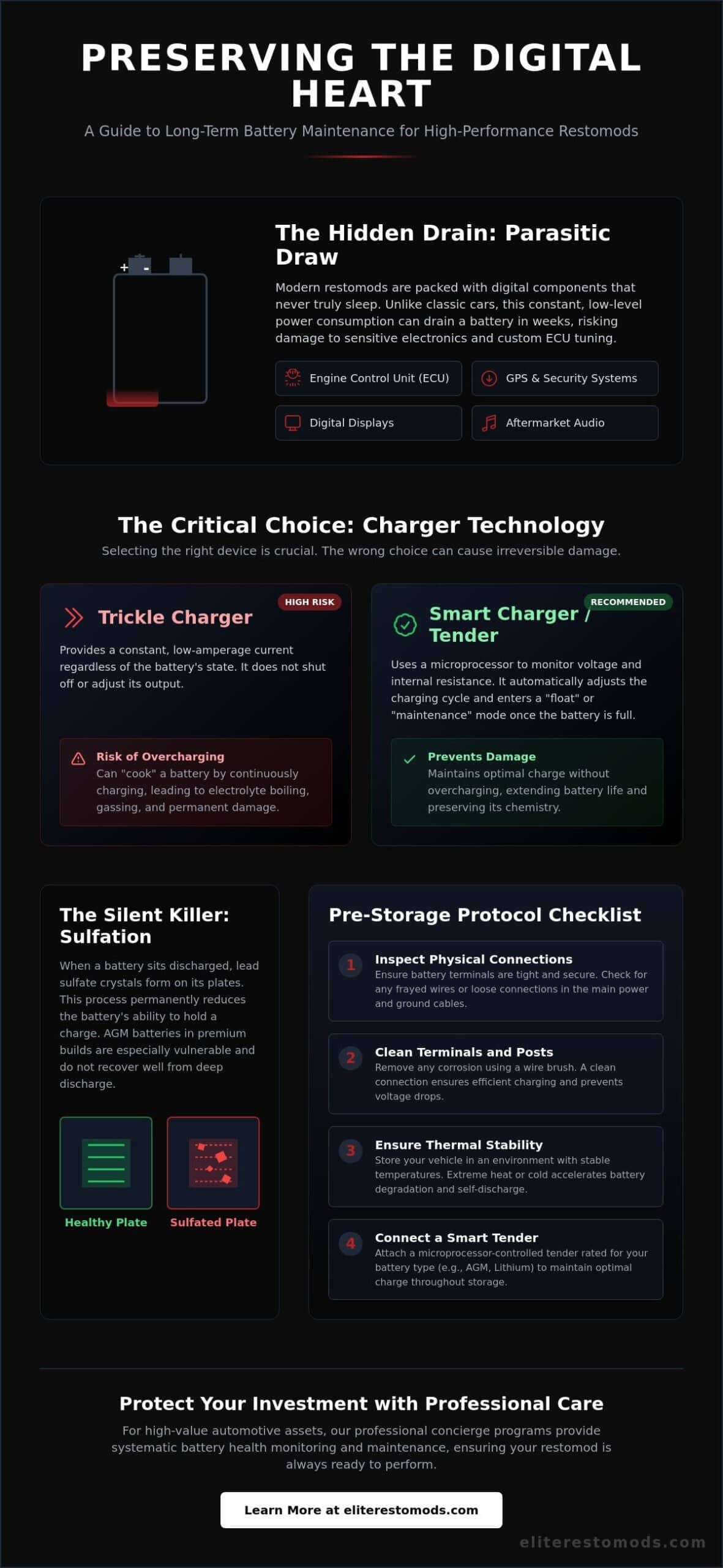
In high-performance builds, the transition from vintage wiring harnesses to modern fuse blocks is transformative. You’ve traded brittle, cloth-wrapped wires for high-grade copper and circuit protection. While this improves reliability, it also centralizes the power distribution for accessories that didn’t exist when the chassis was first stamped. GPS-enabled security systems, aftermarket infotainment units, and digital gauges all contribute to a cumulative parasitic load. If left unmanaged, this invisible drain can deplete a battery’s capacity in a matter of weeks, not months.
Understanding Parasitic Draw in High-Performance Builds
The most common culprits are often the ones designed to protect or enhance your investment. High-end audio systems with internal capacitors and GPS trackers require a constant keep-alive voltage. Modern electronic fuel injection systems also rely on constant memory to store long-term fuel trims and idle settings. Without this steady current, the vehicle effectively loses its learned behavior. This can lead to rough starts or the need for a professional re-tune after a period of dormancy, undermining the precision of our custom build services.
The Risk of Total Voltage Depletion
When a battery sits in a state of discharge, it undergoes a chemical process known as sulfation. This occurs when lead sulfate crystals build up on the plates, a fundamental aspect of lead-acid battery chemistry that can permanently reduce capacity. While traditional cells are susceptible, the high-output AGM batteries often found in premium builds require even more specialized care. They don’t recover well from a deep discharge, and standard chargers often lack the sophisticated algorithms needed to desulfate them. Replacing these specialized units is an avoidable expense that can be prevented with a disciplined long term car storage battery maintenance routine.
Tenders vs. Trickle Chargers: Selecting the Right Technology for High-Value Assets
Precision is not a luxury. It is a requirement for the survival of a high-performance build. When your vehicle transitions from the open road to seasonal rest, the device you choose to maintain its power becomes the most critical component in your garage. Many owners mistakenly use the terms charger and tender interchangeably. This is a dangerous oversight. Choosing the wrong hardware can transform a routine storage period into a costly mechanical failure. For a bespoke machine, the goal of long term car storage battery maintenance is not just to provide power, but to manage the chemical health of the battery with surgical accuracy.
Modernized classics often share maintenance philosophies with advanced electric vehicle maintenance protocols, specifically regarding how they handle thermal stability and voltage regulation. While a standard vehicle might survive on a basic charger, your investment deserves a microprocessor-controlled sentry that understands the nuances of modern electrical loads.
Microprocessor-Controlled Smart Tenders
A smart tender is a sophisticated management system. It utilizes a multi-stage charging cycle consisting of bulk, absorption, and float modes to ensure the battery remains at peak capacity without stress. During the bulk stage, the tender delivers a constant current to reach roughly 80 percent charge. It then transitions to the absorption stage, tapering the current while maintaining a steady voltage. Finally, it enters a float or maintenance mode. In this state, the device monitors internal resistance in real time. It only delivers current when the battery naturally discharges. This technology is essential for specialized AGM batteries from brands like Optima or Odyssey, which require precise voltage thresholds to prevent premature failure. These units also feature temperature compensation, adjusting their output based on the ambient environment to ensure the chemical reaction inside the cells remains stable.
The Dangers of Traditional Trickle Chargers
Traditional trickle chargers are primitive. They deliver a constant, low-amperage current regardless of the battery’s state of charge. This lack of intelligence is an unacceptable risk for high-value assets. Without a microprocessor to cut power, a trickle charger can lead to electrolyte evaporation, effectively boiling the battery from the inside out. This creates a buildup of highly flammable hydrogen gas, a significant hazard in enclosed garages or tight engine bays. Beyond the fire risk, these “dumb” chargers are prone to voltage spikes. These surges can fry the sensitive digital dashes and integrated GPS modules that define a modern restomod build. If you are entrusting your vehicle to our climate-controlled storage facility, we ensure only the highest grade of smart technology is utilized. Protecting your electrical system requires a tool that is as refined as the vehicle it serves.
Preparing Your Electrical System for Extended Hibernation
Hibernation is a ritual of preservation. For a vehicle that represents the pinnacle of bespoke engineering, the preparation process must be as meticulous as the build itself. Before the dust cover is lowered, your focus must shift to the physical integrity of the electrical system. Long term car storage battery maintenance begins with a deep dive into the engine bay to ensure every connection is robust. A loose terminal or a hint of corrosion can undermine even the most advanced smart tender, leading to resistance that generates heat rather than holding a charge.
Start with a visual audit. Inspect the battery tray and the surrounding hardware for any signs of structural fatigue or previous leaks. In a high-performance restomod, the engine bay is a gallery of polished surfaces and custom finishes. Protecting these assets requires a proactive approach to electrical hygiene. Ensuring a stable connection for your maintenance lead is not just about power; it is about protecting the functional art you have spent years perfecting.
Step-by-Step Electrical Preparation
Cleanliness is the foundation of electrical stability. Utilize specialized neutralizing agents to clean the terminals, removing any microscopic acid film that can lead to current creep. Once the surfaces are bright and clear, apply a thin layer of dielectric grease. This non-conductive coating acts as a barrier against atmospheric moisture, preventing the oxidation that plagues vehicles in humid environments. We recommend installing permanent quick-disconnect leads directly to the terminal bolts. This eliminates the need for clumsy alligator clips, which can slip and arc, potentially damaging the refined aesthetics of our custom build process. Routing these leads to a discreet location allows for effortless connection without repeatedly disturbing the hood or trunk.
The Case for Leaving the Battery In-Vehicle
The old-school advice of removing a battery for the winter is often counterproductive for a modern restomod. These vehicles are computers on wheels. Keeping the battery in-vehicle maintains the ECU memory and the “keep alive” settings essential for custom performance tunes. If power is completely severed, you risk losing the nuanced calibration data that defines your driving experience. Leaving the battery in place also preserves the integrity of your weather stripping. Constantly opening and closing panels or leaving them propped open for cables can lead to seal deformation. By maintaining the battery in its natural environment, you ensure the vehicle remains in a “ready to drive” state. When the first warm day of spring arrives, your machine will be ready to perform without the need for digital re-learning or security code resets.
The Impact of Environment on Battery Chemistry and Longevity
Environment is the invisible hand that either preserves or perishes your automotive investment. While the mechanical components of a restomod are built for brute force, the battery chemistry remains a delicate, reactive system. Thermal stability is the silent partner in successful long term car storage battery maintenance. Without a stabilized atmosphere, even the most advanced microprocessor-controlled tender is fighting an uphill battle against the laws of thermodynamics. Your garage should be a sanctuary, not a laboratory for chemical decay.
Extreme temperature fluctuations are more than a nuisance. They are a catalyst for chemical degradation. When a storage space swings from freezing nights to humid afternoons, the internal components of the battery experience constant stress. This thermal cycling accelerates the breakdown of the paste on the lead plates, leading to a loss of cranking amps that no amount of charging can restore. For a vehicle that represents the marriage of vintage soul and modern precision, environmental neglect is an unacceptable risk.
The Science of Thermal Stability
Heat is the primary driver of internal discharge. High ambient temperatures increase chemical activity within the cells, causing the battery to lose its charge at an accelerated rate. Industry data suggests that sealed lead-acid batteries lose about 3 percent of their charge every month under ideal conditions, but this rate spikes significantly as the mercury rises. Conversely, winter storage poses a physical threat to a dormant battery. As a battery discharges, its electrolyte becomes less acidic and more like water. This raises the freezing point, making the battery susceptible to internal expansion and casing failure in unheated spaces. Maintaining a consistent environment between 65 and 75 degrees Fahrenheit provides the optimal stasis for long-term chemical health.
Moisture and Electrical Integrity
Humidity is the silent architect of terminal corrosion. In unconditioned storage, moisture creates a bridge for current to leak across the battery top, further increasing the discharge rate. This condensation doesn’t stop at the terminals. It finds its way into the sensitive electronic boards of your digital dash and the intricate electrical looms that power your custom build. Professional dehumidification is essential to protect both the artisanal leather of your interior and the microscopic traces of your vehicle’s computers. Controlled humidity levels prevent the gradual oxidation of copper wiring connectors that can lead to intermittent electrical gremlins.
To provide your vehicle with the ultimate sanctuary against environmental decay, we invite you to utilize our climate-controlled storage program.
Elite Storage Solutions: Professional Maintenance for Your Investment
Owning an investment-grade restomod is a commitment to excellence. While the protocols discussed in previous sections empower you to manage your vehicle at home, there is a level of oversight that only a professional sanctuary can provide. At Elite Restomods, we don’t just offer square footage. We offer a comprehensive preservation strategy where long term car storage battery maintenance is treated as a critical operational standard, not an afterthought. It is the transition from a machine that merely sits to a machine that is professionally curated for future performance.
The Elite Certified storage experience is built on the concept of total environmental control. We have already explored how heat and humidity act as silent enemies to your electrical integrity. Our facility eliminates these variables. We maintain a precise, stabilized atmosphere that protects the chemical health of your battery and the physical condition of your custom wiring looms. Our team monitors every vehicle with the same perfectionism we bring to our full range of professional vehicle storage services. This isn’t just about plugging in a charger. It is about systematic health monitoring that ensures the longevity of your investment.
The Elite Certified Storage Experience
Our concierge maintenance program includes scheduled battery health checks and real-time tender status monitoring. We verify that every microprocessor-controlled unit is delivering the exact voltage required for your specific battery chemistry, whether it is a traditional lead-acid cell or a high-performance AGM unit. This level of professional oversight prevents the subtle failures that often go unnoticed in a home garage, such as a tripped breaker or a loose connection lead. We act as the bridge between your asset’s dormant state and its peak performance reality, providing a level of reliability that matches the modern engineering within your classic chassis. This level of professional oversight is the final step in mastering long term car storage battery maintenance for high-value assets.
Ready to Drive: The Elite Promise
The ultimate reward for this meticulous care is the Elite Promise: a vehicle that is ready to drive at a moment’s notice. When the season changes and the open road calls, your restomod should be as visceral and responsive as the day it was built. We ensure that your ECU memory is intact, your fuel maps are preserved, and your engine fires with the same brute force you expect from an Elite Certified build. We develop custom maintenance plans tailored to your specific vehicle’s electronic needs, ensuring that every digital component remains in a state of perfect readiness. This is the difference between simple storage and expert curation. If you are ready to add a new legend to your garage, browse our current inventory of fully sorted restomods and experience the standard of excellence we provide.
Protecting the Digital Heart of Your Classic Investment
Mastering long term car storage battery maintenance is the ultimate safeguard for a world-class restomod. It’s about more than just ensuring a clean start when the season turns. You are protecting the custom programming and sophisticated ECU maps that give your vehicle its modern performance edge. By utilizing microprocessor-controlled technology and maintaining strict environmental stability, you prevent the chemical degradation and digital loss that threaten high-value assets. This disciplined approach ensures that the soul of your classic remains perfectly preserved within its modern engineering.
Your vehicle is a bespoke piece of functional art that deserves a sanctuary designed for its specific needs. Our climate-controlled, secure facilities and Elite Certified quality assurance process provide the specialized expertise required for high-performance restomod electronics. Secure your vehicle’s future with Elite Restomods professional storage and enjoy the confidence that comes with world-class curation. We look forward to helping you maintain your machine in a state of perpetual readiness for the open road.
Frequently Asked Questions
Is it better to remove the battery or leave it in the car for winter?
It is generally better to leave the battery inside a modernized classic during the winter. This practice preserves the critical keep-alive memory for your custom ECU and performance tuning maps. Removing power completely can trigger security lockouts or force the system into a frustrating relearning cycle. It also prevents unnecessary wear on hood hinges and weather stripping from repeated access during the storage period.
Will a battery tender damage my car’s modern ECU or digital dash?
A high-quality microprocessor-controlled smart tender will not damage your modern electronics. These devices are designed to deliver a stable, regulated voltage that mirrors the vehicle’s natural charging system. Unlike primitive chargers, they lack the high-voltage spikes that can compromise sensitive digital dashboards or integrated GPS modules. Always ensure the charger is compatible with your specific battery chemistry to maintain total electrical harmony.
How long can a car battery sit in storage without a charger?
Most modernized classics can only sit for two to four weeks before the battery voltage drops below a reliable starting threshold. The parasitic draw from modern security systems, fuel injection memories, and digital clocks creates a constant drain that traditional vintage cars didn’t possess. For effective long term car storage battery maintenance, a dedicated maintainer should be connected if the vehicle will be dormant for more than fourteen days.
Can I use a solar charger for long-term battery maintenance?
Solar chargers are rarely suitable for investment-grade vehicles stored in professional, climate-controlled environments. Their output is inconsistent and relies entirely on high-intensity light which is often absent in secure, indoor garages. Many entry-level solar panels also lack the sophisticated voltage regulation required to prevent overcharging. A hardwired smart tender remains the gold standard for maintaining the delicate electrical heart of a bespoke build.
What is the difference between an AGM battery and a standard lead-acid battery for storage?
AGM batteries utilize a glass mat separator to hold the electrolyte, making them spill-proof and more resistant to vibration than standard lead-acid cells. They typically have a lower self-discharge rate, which is beneficial for seasonal storage. However, they require a specific charging profile with higher voltage precision. Using a standard charger on an AGM battery can lead to undercharging or internal damage over time.
Do I need to check the water levels in my battery before storing it?
You only need to check fluid levels if you are using a traditional, non-sealed lead-acid battery with removable caps. If the plates are exposed, add distilled water to the specified level before connecting a maintainer. Most modern restomods utilize maintenance-free AGM or gel-cell batteries that are completely sealed. These units do not require fluid top-offs, though they still benefit from a thorough terminal cleaning before storage.
Can a battery tender stay plugged in indefinitely?
A smart battery tender is designed to remain connected indefinitely without risking damage to the cells. Once the battery reaches full capacity, the device enters a float mode that only delivers current when it detects a natural drop in voltage. This creates a safe, continuous cycle of long term car storage battery maintenance. This set and forget capability is essential for preserving the soul of a vintage asset during an extended off-season.
What happens if my restomod loses power to its custom engine management system?
Losing power can result in the loss of volatile memory within your custom engine management system. This often includes long-term fuel trims, idle air control calibrations, and even bespoke ignition timing adjustments. When power is restored, the car may experience rough idling or poor drivability as the ECU attempts to relearn its environment. In some cases, high-end security systems may enter a lockout mode that requires a professional reset.