
Entrusting your investment-grade asset to the open highway shouldn’t feel like a gamble with the soul of a vintage icon. In a market where online classic car sales surged to $2.5 billion in 2025, the demand for elite collector car transport companies has reached a fever pitch. You’ve spent months, perhaps years, refining the mechanical intricacies and aesthetic finishes of your vehicle. It’s a bespoke masterpiece that deserves better than a generic trailer or a broker who treats your pride and joy like a common commodity.
We understand the visceral anxiety that comes with watching your car disappear into a trailer, especially with looming driver shortages and volatile shipping rates defining the 2026 landscape. You worry about rock chips, unprofessional handling, or insurance that fails to cover the true market value of a high-performance restomod. This guide eliminates that uncertainty. We’ll show you how to identify carriers utilizing specialized lift-gate equipment and verified coverage that protects your asset from door to door. You’ll learn to navigate the nuances of modern logistics to ensure your vehicle arrives in pristine condition, ready to be driven and enjoyed.
Key Takeaways
- Distinguish between standard auto logistics and the white-glove preservation required for investment-grade assets. High-performance machines demand specialized care.
- Evaluate the operational risks of the broker model compared to the accountability and direct control of asset-based carriers who own the journey.
- Identify the essential hardware, such as hydraulic lift-gates and enclosed trailers, that elite collector car transport companies use to protect your vehicle.
- Implement a professional preparation protocol to document your vehicle’s condition and ensure a seamless, stress-free delivery to your doorstep.
What Defines Specialized Collector Car Transport Companies?
The visceral excitement of vehicle acquisition is often tempered by the logistical reality of national transit. You’ve found the perfect machine. Now, you must protect it. Specialized collector car transport companies offer a level of service that standard haulers simply cannot replicate. They provide a white-glove experience, utilizing trained handlers who treat every car like a curated museum piece. It’s a marriage of modern engineering and old-world respect for craftsmanship. This isn’t just shipping; it’s the final stage of quality assurance for a high-value asset.
Standard logistics prioritize the truck’s schedule. Specialized transport prioritizes the vehicle’s soul. A critical component of this is the Bill of Lading. This document acts as a high-fidelity condition report and a legal safeguard. Many owners find themselves navigating a sea of auto transport brokers who lack direct control over the equipment or the drivers. Choosing a dedicated specialist among collector car transport companies ensures that your investment remains in a fully sorted state from the moment it leaves the shop to its arrival in your driveway.
To visualize the difference in handling and equipment, watch this look at the transport process:
The Crucial Choice: Enclosed vs. Open Transport
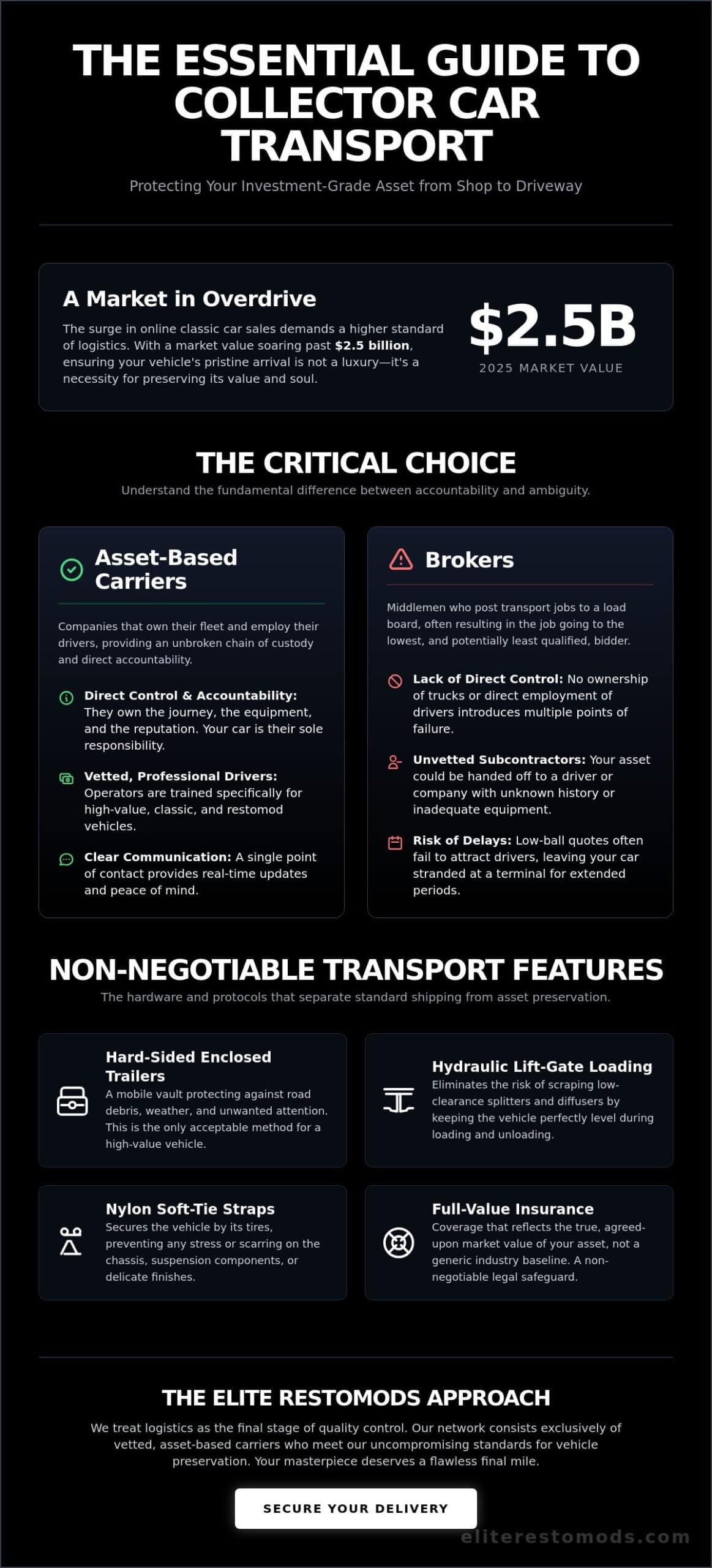
Open transport is an unacceptable gamble for a six-figure restomod. Road debris, acidic rain, and fluctuating weather can degrade a pristine finish in hours. Hard-sided enclosed trailers act as a mobile vault. They shield the artisanal paint and delicate brightwork from the elements. This protection ensures that the vehicle you bought is the vehicle that arrives. It is the only way to maintain the integrity of a high-performance build during a cross-country journey. The interior of these trailers is designed to keep your car clean, dry, and secure from prying eyes.
Investment-Grade Protection Standards
Excellence is found in the technical details. Premier carriers use non-marring nylon straps rather than the brutal metal chains seen on standard haulers. This prevents chassis scarring and protects the intricate suspension components of a modern restomod. Insurance is another vital pillar. Coverage must reflect the true market value of the asset, not just a generic valuation. Climate-controlled environments go even further. They prevent the condensation that leads to hidden corrosion in vintage metalwork. These standards are a non-negotiable part of our restoration process, ensuring every delivery is as perfect as the build itself.
Evaluating Collector Car Transport Companies: Asset-Based vs. Brokers
Precision is paramount. You wouldn’t trust a novice to tune your engine, so don’t trust an unvetted broker with the delivery. The most critical decision in vehicle logistics is choosing between asset-based carriers and brokers. Asset-based collector car transport companies own their fleet and employ their drivers directly. This creates an unbroken line of accountability. They have skin in the game. Their reputation is tied to the physical equipment and the professionals behind the wheel. It’s a model built on control and consistency.
Brokers function as middlemen. They don’t own trucks. Instead, they post your transport job to a digital load board where the lowest bidder often wins. This disconnect creates logistical friction. Direct communication with an asset-based carrier eliminates the anxiety of a third party, providing you with real-time updates and a single point of contact. Elite drivers in this industry undergo rigorous background checks and specialized training. They understand the nuances of high-value machinery, from delicate fuel systems to bespoke interior materials. They treat your car as functional art, not just freight.
The Risks of the Brokerage Model
Many owners are lured by low-ball quotes that seem too good to be true. They usually are. These prices often fail to attract quality drivers, which leads to vehicles being abandoned at terminals for weeks while the broker searches for a cheaper subcontractor. When your car is handed off to an unvetted third party, you lose the chain of custody. High-value assets require a single-truck, door-to-door delivery model to ensure the vehicle isn’t moved or reloaded during transit. Subcontractors often lack the specialized equipment needed for the ground clearance of a modern pro-touring build.
Vetting Your Transport Partner
Verification is the only antidote to uncertainty. Start by asking for the company’s DOT number to confirm their standing with Federal Motor Carrier Safety Administration regulations. A legitimate partner will provide an insurance certificate you can verify directly with their underwriter. Don’t settle for surface-level promises. Ask about their specific experience with low-clearance restomods and the types of tie-down systems they employ. Our team prioritizes these rigorous standards through our enclosed vehicle transport services, ensuring your investment is handled with the same meticulous care we put into our builds. Look for carriers that offer:
- Direct access to the driver’s cellular contact for transit updates.
- Verified cargo insurance that covers the full market value of a custom build.
- A fleet of hard-sided trailers equipped with hydraulic lift-gates.
- Documented experience with high-performance, non-standard automotive geometry.
Essential Features of Premier Collector Car Transport Companies
Mechanical excellence extends beyond the engine bay. It must also define the equipment used to move your vehicle across the country. Premier collector car transport companies invest in specialized hardware designed to accommodate the unique geometry of a high-performance build. This isn’t just about security; it’s about preserving the meticulous work of the restoration process. The distinction between a standard hauler and elite collector car transport companies lies in their refusal to compromise on technical specifications. Every component of the trailer should serve the vehicle’s integrity.
Modern restomods often feature aggressive stances and custom aero components that make traditional loading methods obsolete. A premier service utilizes multi-car enclosed trailers equipped with adjustable decks. These allow for optimal positioning of various vehicle heights while ensuring that no car is subjected to fluid leaks from a vehicle above. Real-time GPS tracking has become a baseline expectation in 2026, providing a digital window into the transit process. This transparency reduces the visceral anxiety of national transit, allowing you to monitor your asset’s journey with surgical precision.
Hydraulic Lift-Gates vs. Traditional Ramps
Gravity is the enemy of a low-clearance restomod. Traditional ramps create steep approach angles that often lead to high-centering or devastating damage to front splitters and carbon fiber spoilers. Hydraulic lift-gates solve this by keeping the vehicle perfectly horizontal throughout the entire loading and unloading sequence. It is a controlled, level ascent into the trailer. For owners of vehicles with modern suspension setups and bespoke bodywork, this technology is a non-negotiable requirement for safe transit. It ensures the car enters the protected environment of the trailer without a single scrape.
Driver Expertise and White-Glove Handling
The driver is the final curator of your automotive dream. At this level of service, they function as specialized technicians who understand the mechanical intricacies of a fully sorted restomod. Surgical-grade cleanliness is the standard. This includes the use of protective floor mats, seat covers, and steering wheel wraps to ensure the artisanal interior remains untouched. A detailed pre-trip and post-trip inspection protocol ensures that the vehicle’s condition is documented with high-resolution clarity. For those seeking the ultimate in protection, our enclosed vehicle transport options prioritize these elite standards. Secure positioning is achieved through floor-mounted D-ring tie-downs, utilizing soft nylon straps that protect the finish of custom wheels and suspension components.
Preparation Protocol for Collector Car Transport Companies
Preparation is a meticulous ritual. It bridges the gap between the static beauty of the garage and the dynamic stresses of the open road. When you engage with premier collector car transport companies, the process begins long before the lift-gate touches the pavement. You aren’t just preparing a car; you’re safeguarding a legacy. This protocol ensures that every mechanical and aesthetic detail remains exactly as intended during the transit journey. It’s about maintaining the soul of the machine while it’s in a state of repose.
Mechanical readiness is essential for a seamless transition. Fuel levels should be maintained at approximately 1/4 tank. This specific volume reduces unnecessary weight while ensuring enough fuel for loading and unloading maneuvers. Check all fluid levels and ensure the battery health is optimal to handle the restart upon arrival. Verify the functionality of the parking brake to ensure the primary securement point is reliable. These steps are the foundation of a professional transit experience with elite collector car transport companies.
Documenting the ‘Fully Sorted’ Condition
Establish a visual baseline with surgical precision. High-resolution photography is your most powerful tool. Capture the undercarriage to document the pristine state of custom suspension and exhaust systems. Detail the engine bay and artisanal interior. This creates an undeniable record of the vehicle’s fully sorted status. The Bill of Lading must serve as a high-fidelity map of the car’s current condition. Note any existing imperfections, no matter how microscopic, at the point of origin. This signed and dated document is the legal cornerstone of professional delivery.
Mechanical and Aesthetic Safeguards
Modern performance tires require specific pressures to avoid shifting on the trailer deck. Ensure tires are at the manufacturer’s recommended inflation levels before loading. Deactivate alarm systems to prevent parasitic battery drain during long-haul transit. Secure or remove custom accessories that might succumb to the subtle vibrations of the road. If you’re looking for a partner who understands the meticulous nature of this process, explore our custom build and transport services. This level of preparation ensures that the visceral excitement of your car’s arrival isn’t marred by avoidable mechanical issues.
- Document the undercarriage, interior, and engine bay with high-resolution imagery.
- Maintain fuel at 1/4 tank to balance weight and operational necessity.
- Deactivate all security alarms to protect battery health.
- Verify tire pressure and parking brake functionality for secure positioning.
- Ensure all loose components or custom accessories are secured or removed.
The Elite Restomods Approach to Seamless Delivery
The acquisition of a world-class automotive asset concludes only when the ignition turns in your driveway. We treat logistics as a critical extension of our craftsmanship. Our team curates the entire transport experience, ensuring that the transition from our facility to your collection is as seamless as a precision gear change. We don’t just call a hauler. We manage a network of vetted collector car transport companies that meet our uncompromising standards for safety and professionalism. This is the final stage of our commitment to excellence, treating every delivery as a high-stakes hand-off of functional art.
Before any Elite Certified Restomod leaves our floor, it undergoes an exhaustive quality assurance check. We verify that every mechanical system is fully sorted and that the aesthetic finish is flawless. Our vetting process for national collector car transport companies is equally rigorous. We prioritize carriers with a proven track record of handling high-value restomods and pro-touring builds. This meticulous oversight reduces the friction of ownership, allowing you to focus on the drive rather than the delivery. It’s a professional logistics management strategy designed for the modern collector.
Beyond Shipping: A Bespoke Delivery Experience
A bespoke delivery experience is woven into our vehicle sourcing and sales process. We don’t view transport as a separate transaction but as a vital part of the developmental narrative. We coordinate with our network of climate-controlled storage facilities to manage mid-transit holds or specific seasonal delivery windows. This logistical synergy extends to our specialized financing options, creating a holistic journey from the first inquiry to the final delivery. Every step is designed to build trust and anticipation, bridging the gap between a long-held dream and a tangible reality.
Ensuring Your Dream Arrives Ready for the Road
The moment of arrival is a visceral experience. When your restomod is offloaded from a hydraulic lift-gate, it should be ready for reliable daily driving. Our commitment to excellence means the car arrives exactly as it was described, with its modern performance capabilities intact and its vintage soul preserved. We invite you to view our current inventory and start your own journey today. Whether you are seeking a custom build or exploring our enclosed vehicle transport options, we provide the professional authority and automotive passion required to protect your investment. Your dream is ready for the road. We ensure it gets there with perfection.
The Final Mile of Automotive Excellence
The journey of a high-performance restomod doesn’t end at the assembly floor. It ends in your hands. Selecting from the premier collector car transport companies is about more than logistics; it’s about protecting a bespoke piece of functional art. You now understand the technical necessity of hydraulic lift-gates and the absolute security of asset-based accountability. These aren’t just luxuries. They are the standards required to preserve the soul of a modern classic during national transit.
We treat every vehicle with obsessive attention to detail. Every machine in our care undergoes meticulous quality assurance to ensure it is fully sorted for reliable daily driving. We partner with premier enclosed transport carriers to guarantee that your investment-grade asset arrives in showroom condition. The bridge between your dream and the open road is built on trust and professional engineering. Your next era of driving excellence is waiting for you.
Discover our curated inventory of Elite Certified Restomods
Frequently Asked Questions
How much do collector car transport companies charge for national shipping?
Rates are determined by a combination of distance, trailer type, and the specific dimensions of the vehicle. National transit costs fluctuate based on seasonal demand and current fuel prices. Peak season from June through September often sees higher rates due to increased volume in the market. It is essential to secure a quote that reflects the high-value nature of your asset rather than seeking the lowest price point.
Is enclosed transport really necessary for a classic car?
Enclosed transit is the only way to guarantee protection against road debris, weather, and environmental contaminants. Open trailers expose artisanal paint and delicate brightwork to acidic rain and physical impact. For investment-grade vehicles, the added security of a hard-sided trailer is a non-negotiable requirement to preserve the car’s fully sorted condition. It ensures the vehicle arrives in the same state it left the garage.
What is the difference between a car shipping broker and a carrier?
A broker acts as a middleman who matches your shipment with a driver from a digital load board. A carrier is an asset-based company that owns the trucks and employs the drivers directly. Choosing asset-based collector car transport companies provides a direct line of communication and a consistent chain of custody. This accountability is vital for protecting high-performance machinery from the risks of subcontracting.
How long does it typically take to ship a collector car across the country?
Cross-country transit generally requires seven to fourteen days depending on the route and weather conditions. Shorter regional journeys may take between two and five days from the point of pickup. Professional carriers prioritize safety over speed, ensuring that every vehicle is loaded and secured with technical precision. Factors like driver hours-of-service regulations and route optimization also influence the final delivery window.
Does my personal car insurance cover my vehicle during professional transport?
Most personal policies do not provide comprehensive coverage while a vehicle is in the possession of a commercial hauler. Professional collector car transport companies carry specialized cargo insurance to protect assets during transit. You must verify that the carrier’s policy limits reflect the current market value of your restomod. Federal regulations require a minimum level of liability, but elite carriers often exceed these requirements significantly.
What should I do if my vehicle is damaged during the shipping process?
Note any discrepancies on the Bill of Lading immediately before the driver leaves the delivery site. Take high-resolution photographs of the damage and compare them to the pre-trip inspection images captured during loading. Contact the carrier’s claims department right away to begin the resolution process. Having a detailed record of the vehicle’s condition at the point of origin is your strongest protection in these rare instances.
Can I ship extra parts or personal items inside the car during transport?
Carriers generally prohibit the inclusion of personal items or loose parts inside the vehicle for safety and liability reasons. Shifting items can cause significant damage to artisanal interiors or delicate glass during the vibrations of transit. Extra weight can also push a trailer over legal limits at highway scales. It is best to ship spare components or accessories through a separate freight service to maintain the vehicle’s integrity.
Why do restomods require different transport considerations than standard classic cars?
Restomods often feature modern aerodynamic components and lowered suspension that create extremely low ground clearance. These technical specifications make traditional loading ramps dangerous, as they can cause high-centering or damage to custom splitters. Specialized lift-gate equipment is required to keep the car level during the loading process. Additionally, the high performance and bespoke nature of these builds demand higher insurance valuations and more sophisticated tie-down methods.