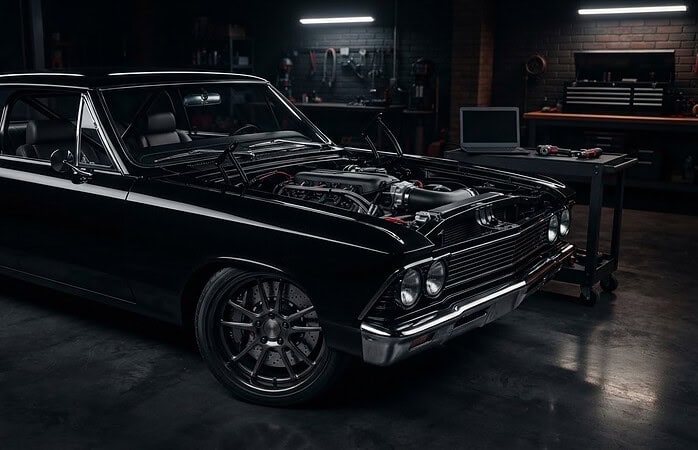

A vintage engine’s roar is timeless, but the abrasive reality of a cross-country interstate is a modern threat that doesn’t respect heritage. You’ve curated a machine that captures a specific era of soul and speed; it’s a bespoke piece of functional art. Entrusting that investment to a standard carrier feels like a gamble you shouldn’t have to take. We understand the anxiety that comes with moving high-value assets across thousands of miles of unpredictable terrain.
This guide breaks down the actual cost to ship a classic car cross country in 2026. You’ll discover the precise variables that dictate premium enclosed transport rates and why this choice is a strategic preservation of your vehicle’s long-term market value. We provide a systematic breakdown of logistics, from the meticulous preparation of custom builds to the specific insurance requirements for 2,500-mile journeys. It’s time to move beyond fluctuating quotes and find the confidence that your dream is protected.
Key Takeaways
- Understand the evolving 2026 market rates to ensure your logistics budget reflects the true value of your vintage asset.
- Learn why the premium for enclosed transport is a necessary investment to shield bespoke finishes from road debris and environmental hazards.
- Identify the specific variables, such as vehicle dimensions and seasonal demand, that determine the total cost to ship a classic car cross country.
- Follow a professional preparation checklist to secure your vehicle’s mechanical integrity and document its condition before the journey begins.
- Discover how leveraging a vetted network of logistics specialists ensures your restomod arrives in showroom condition regardless of the distance.
Understanding the Financial Landscape of Cross-Country Transport
Precision costs money. It’s that simple. When you calculate the cost to ship a classic car cross country, you aren’t just paying for fuel and mileage; you’re investing in the preservation of a legacy. A vintage asset requires a level of care that standard logistics companies simply aren’t equipped to provide. While a high volume broker might offer a tempting quote, the reality of specialized transport involves a more complex financial architecture designed to shield your vehicle from the rigors of the road.
The gap between a broker’s estimate and a carrier’s final price often stems from the difference between generalized transport and bespoke care. Brokers operate on volume, but carriers with the right equipment for a restomod operate on precision. For a high-value classic vehicle in 2026, the typical per-mile premium for specialized transport settles into a range that reflects the necessity of expert handling and superior protection.
To better understand this concept, watch this helpful video:
The Per-Mile Breakdown for 2026
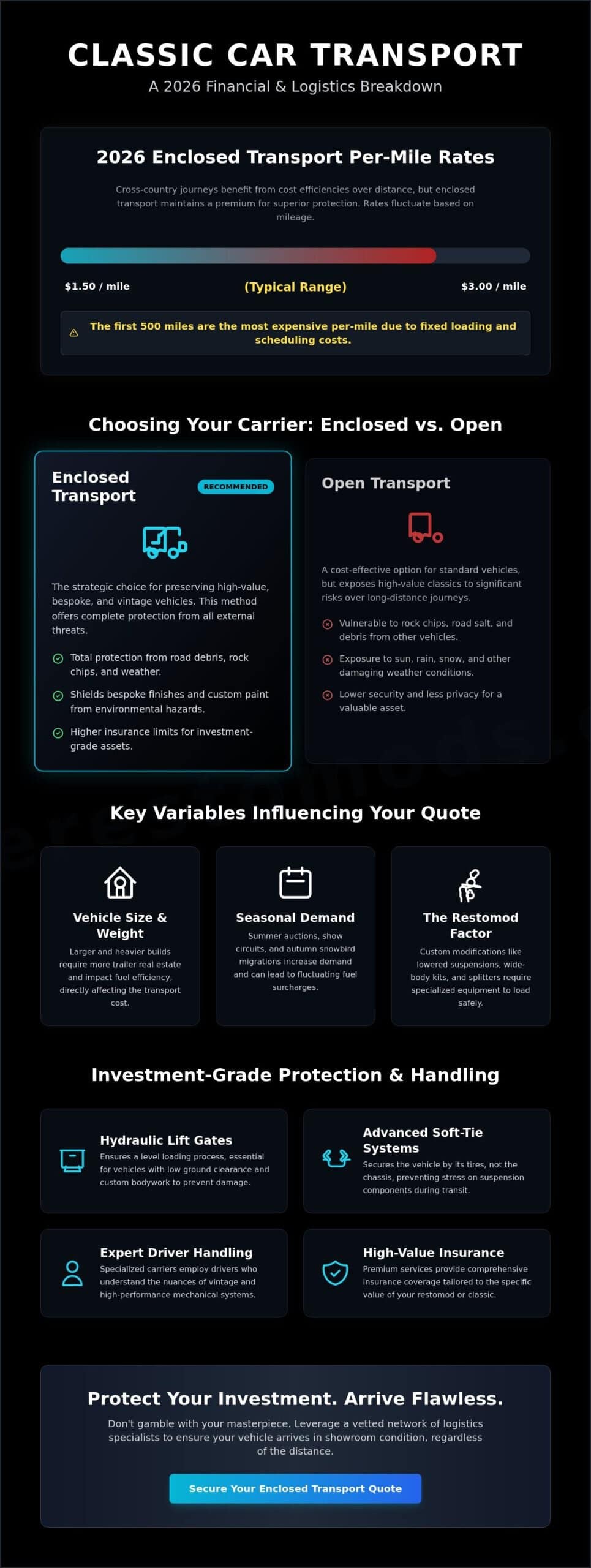
Current market rates for enclosed transport generally fluctuate between $1.50 and $3.00 per mile. This range depends heavily on the total distance of the journey. Logistics providers often utilize distance thresholds where the price per mile decreases as the total mileage increases. However, the first 500 miles remain the most expensive per mile due to the fixed costs of loading, securing, and scheduling a specialized Car carrier trailer. A cross-country haul of 2,500 miles reaches a different level of cost efficiency, yet the premium for enclosed space remains a constant factor in protecting the vehicle’s finish.
Why Classic Transport Commands a Premium
Shipping a piece of functional art requires more than a standard ramp. Professional carriers utilize hydraulic lift gates to ensure a level loading process, which is essential for vehicles with low ground clearance or custom bodywork. These trailers are also equipped with advanced soft-tie systems that secure the car by its tires rather than the chassis, preventing unnecessary stress on the suspension. Beyond the hardware, you’re paying for the expertise of a driver who understands the nuances of vintage mechanical systems and the high insurance limits required for investment-grade assets. At Elite Restomods, we integrate these high standards into our Enclosed Vehicle Transport services to ensure every delivery is as flawless as the build itself.
Key Variables Influencing Your Cross-Country Quote
Precision demands space. A vintage masterpiece isn’t just another VIN on a manifest; it’s a collection of specific engineering choices. When calculating the cost to ship a classic car cross country, the physical footprint of the vehicle serves as the primary baseline. A 1970 Cadillac Eldorado requires significantly more trailer real estate than a nimble Porsche 356. Weight also plays a critical role. Heavier builds, often reinforced with modern chassis components or large displacement engines, impact the carrier’s fuel efficiency and load balancing. Understanding how these specific dimensions affect the cost to ship a classic car cross country is the first step in a successful transport plan.
Timing is everything. The 2026 logistics market remains sensitive to seasonal shifts. Summer months bring a surge in auction activity and show circuits, driving up demand for enclosed space. Similarly, the snowbird migration patterns in late autumn create bottlenecked routes toward southern climates. During these peaks, fuel surcharges can fluctuate rapidly. It’s vital to consult the FMCSA consumer advisory to understand how these market pressures influence broker quotes and carrier availability. Choosing a standard delivery window offers cost stability, whereas expedited requests command a premium for the logistical gymnastics required to reroute a dedicated trailer.
The Restomod Factor: Modifications and Transport
Standard logistics often fail to account for the aggressive stance of a high-performance build. Lowered suspensions and custom front splitters demand specialized race ramps or hydraulic lift gates to avoid catastrophic contact during loading. Wide-body conversions or oversized staggered wheel setups can exceed the standard track width of generic trailers. If you’re moving a non-running project vehicle, the requirement for winches and extra labor will naturally adjust your quote. Every detail of the build’s geometry must be communicated to ensure the equipment matches the machine’s requirements.
Route Complexity and Accessibility
The final mile is the most technical. While door-to-door service offers the ultimate convenience, navigating a 53-foot trailer through narrow residential streets or under low-hanging oak canopies is often impossible. Proximity to major interstate corridors generally results in lower quotes due to higher carrier volume and easier access. If your collection is tucked away in a remote rural area, expect a slight premium for the necessary detour. For those building their dream garage from afar, our current inventory includes detailed logistics support to simplify these complex cross-country transitions.
Enclosed vs. Open Carriers: Evaluating the Price of Protection
Choosing between open and enclosed carriers is a decision that balances financial pragmatism against the pursuit of perfection. While open transport remains the standard for mass-market vehicles, it represents an unacceptable compromise for high-value assets. The gap in the cost to ship a classic car cross country using an enclosed trailer typically ranges from 20% to 60% higher than open alternatives. This premium isn’t an arbitrary fee; it’s the price of a physical barrier between your investment and the world’s abrasions.
At Elite Restomods, we recommend enclosed transport for every certified vehicle we build. It’s a matter of logic. A single rock chip on a bespoke, multi-stage paint finish or the intrusion of corrosive road salt into a meticulously detailed engine bay can instantly diminish the vehicle’s market value. Hard-side enclosed trailers offer the ultimate protection, featuring rigid walls and advanced lift gates, while soft-side trailers provide a more flexible but still secure alternative. For a 2,500-mile journey, the hard-side option remains the gold standard for preserving an elite finish.
The Cost of Risk vs. The Cost of Enclosed
Think of the premium as a strategic preservation cost. A professional repaint or paint correction for a high-end restomod can easily exceed several thousand dollars, a figure that dwarfs the additional expense of an enclosed carrier. Beyond physical damage, the investment-grade status of a vehicle depends on its history and pristine condition. Exposure to the elements during a cross-country haul can lead to micro-abrasions and oxidation that dull the visceral impact of an artisanal finish. Preserving that showroom-ready state is essential for maintaining long-term appreciation and pride of ownership.
Insurance Coverage and Gap Analysis
Standard carrier liability often falls short of the true replacement value of a custom build. Most carriers provide cargo insurance, but the limits are frequently designed for standard production cars, not elite certified restomods. It’s vital to verify these limits before the tires ever touch the ramp. We often advise clients to coordinate with their own collector car insurance providers to ensure secondary coverage is active. This dual-layered approach provides the peace of mind necessary when your functional art is in transit across state lines. Our Enclosed Vehicle Transport network specifically utilizes carriers with high-limit policies tailored for the world of luxury automotive assets.
Strategic Preparation to Mitigate Transport Risks
Preparation is the silent guardian of your investment. When you commit to the cost to ship a classic car cross country, you’re doing more than moving metal; you’re transitioning a piece of your legacy. This phase requires a meticulous pre-flight ritual that mirrors the precision of the build itself. A comprehensive photographic condition report is your primary legal defense against the variables of long-haul logistics. You must capture high-resolution images of every panel, every artisanal interior stitch, and every custom wheel. Use a high-intensity LED light to reveal the true state of the chassis and driveline, ensuring every custom component is documented from a low-angle perspective before it enters the trailer.
The Pre-Transport Mechanical Audit
A restomod is a complex marriage of vintage aesthetics and modern performance hardware. Before loading, perform a rigorous mechanical audit. Check all fluid levels to ensure that high-performance cooling systems or hydraulic lines won’t leak during the vibrations of a cross-country journey. Secure any loose trim or bespoke aerodynamic components that could be compromised by the constant motion of the trailer. Tire pressure must be set precisely to the manufacturer’s specification for your specific wheel setup; this ensures that over-the-tire tie-downs remain secure without placing undue stress on the suspension. This mechanical foresight is essential when managing the cost to ship a classic car cross country, as it prevents unexpected labor fees or delays at the delivery point. If your vehicle features a modern aftermarket alarm, disarm it to prevent a parasitic battery drain that could leave the engine cold upon arrival.
Legal Documentation and the Bill of Lading
The Bill of Lading (BOL) stands as the most critical document in the entire logistics chain. It’s a binding legal contract that defines the condition of your asset at the moment of handover. Treat the pickup and delivery inspections as high-stakes events. If you notice even the slightest discrepancy upon arrival, you must record it on the BOL before the driver departs. Standard brokers often rush this process, but a disciplined approach ensures your rights are protected under federal transport regulations. Maintaining a clear digital trail of communication with the driver provides an extra layer of accountability. This commitment to transparency is a core part of our refined build process, ensuring your functional art is handled with the same reverence we apply in the shop.
Seamless Logistics for Your Elite Certified Restomod
The journey of an Elite Certified Restomod doesn’t end when the last bolt is torqued. It ends when the trailer door lowers in front of your home. We treat national logistics as a continuation of the build process itself. Managing the cost to ship a classic car cross country requires more than just finding a driver; it requires a curated network of specialists who respect the mechanical soul of your vehicle. By overseeing every phase of the transport, we remove the friction often found in third-party brokerage models. You receive a direct line of accountability from the showroom floor to your driveway.
The Elite Transport Standard
Every vehicle in our Elite Restomods Inventory is a bespoke piece of functional art. We believe it should be treated as such. Our commitment to enclosed-only shipping isn’t just a recommendation; it’s our standard operating procedure. We’ve spent years vetting a select group of transport professionals who utilize the latest in soft-tie technology and climate-controlled environments. This ensures that the cost to ship a classic car cross country remains a transparent part of your investment, providing a fixed point of reliability in an often volatile market. For those planning their acquisition, we can even work with you to integrate these logistical expenses into your classic car financing plan, streamlining the path to ownership.
From Our Showroom to Your Driveway
The transition from our facility to your garage is a choreographed event. Before any vehicle is loaded, it undergoes a final, rigorous inspection within our climate-controlled environment. We verify every system, from the modern fuel injection to the artisanal interior finishes, ensuring the car is exactly as described. Coordination is key. We work directly with you to establish a delivery window that fits your schedule, providing consistent updates as the carrier moves across the country. This level of service is a core component of Our Services, bridging the gap between a long-held dream and a tangible, high-performance reality. You aren’t just buying a car; you’re participating in a transformative journey that ends with the key in your hand and the open road ahead. We handle the intricacies so you can focus on the drive.
Securing Your Automotive Legacy
Transporting a high-value asset across the United States is more than a logistical hurdle; it’s a strategic move to preserve your vehicle’s long-term market value. Precision matters. You now understand that the cost to ship a classic car cross country reflects the specialized equipment and expert handling required to shield functional art from the elements. By prioritizing enclosed transport and rigorous mechanical preparation, you ensure that your investment arrives in the same pristine condition it left the showroom. These machines are built to be utilized, and our logistics reflect that purpose.
At Elite Restomods, we eliminate the uncertainty of third-party logistics. Every Elite Certified Restomod in our collection is eligible for specialized enclosed transport through our vetted network of high-end automotive carriers. We provide transparent pricing with no hidden broker fees, allowing you to focus on the excitement of your next drive rather than the anxiety of the journey. Browse our inventory of fully sorted restomods ready for national delivery and take the first step toward realizing your automotive dream. The road is calling, and we’re ready to deliver excellence directly to your door.
Frequently Asked Questions
Is enclosed transport worth the extra cost for a classic car?
Enclosed transport is a strategic investment that shields your vehicle’s long-term market value from the elements. It provides a physical barrier against road salt, rock chips, and unpredictable weather patterns that can ruin a bespoke finish. For a high-value asset, the cost to ship a classic car cross country in an enclosed trailer is a fraction of the price of a professional repaint or paint correction. It is the only way to ensure showroom condition upon arrival.
How long does it take to ship a car cross country in 2026?
Cross-country transport typically takes between 10 and 14 days depending on the specific route and current weather conditions. While regional deliveries might arrive in five to ten days, coast-to-coast hauls require more complex scheduling and mandatory driver rest periods. We prioritize the safety of the vehicle over sheer speed, ensuring that every mile of the journey is handled with the meticulous care your investment deserves. Reliability remains our primary objective.
Can I ship personal items inside my classic car during transport?
Most carriers strictly prohibit personal items inside the vehicle due to weight restrictions and insurance liability. Items left in the cabin or trunk aren’t covered by the carrier’s cargo insurance and can shift during transit, causing internal damage to artisanal interiors. It’s best to clear the vehicle of all non-essential items to ensure a seamless loading process and maintain the integrity of the build’s weight distribution throughout the journey.
How much insurance coverage do I need for a high-value restomod?
Your insurance coverage should match the full replacement value of your elite certified restomod. While carriers provide basic cargo insurance, these limits often fall short of the true worth of a custom build. We recommend verifying the carrier’s policy limits before booking and maintaining your own collector car insurance as a secondary layer of protection. This dual-layered approach ensures your functional art is fully covered during its entire cross-country journey.
Do car shipping quotes change after I book?
Quotes can fluctuate if there are significant delays in booking or sudden spikes in fuel surcharges within the 2026 market. However, a reputable specialist provides transparent pricing that accounts for the specific variables of your vehicle from the start. The cost to ship a classic car cross country should be locked in with a formal agreement to prevent the hidden fees often associated with high-volume brokers who prioritize quantity over quality.
What happens if my classic car is damaged during shipping?
You must document any discrepancies on the Bill of Lading immediately upon delivery and before the driver leaves your property. This document serves as the legal foundation for any insurance claim. If damage occurs, take high-resolution photos and contact the carrier’s claims department right away. Having a detailed pre-transport photographic report is essential for proving the vehicle’s condition prior to loading and ensuring a swift, professional resolution to the matter.
Is it cheaper to ship a car to a terminal or to my home?
Shipping to a terminal is generally less expensive than door-to-door service, but it introduces extra risks for a classic vehicle. Terminals often lack the climate-controlled environments or security protocols required for investment-grade assets. Door-to-door transport offers the ultimate convenience and ensures your car stays in the hands of the professional driver until it reaches your driveway, maintaining a higher level of exclusivity and personalized care during the transition.
How do I pay for cross-country vehicle shipping?
Payment methods typically include wire transfers, credit cards, or certified checks, with many carriers requiring a deposit at the time of booking. For those acquiring a new build, it’s often possible to integrate these logistics costs into your classic car financing plan. This approach simplifies the transaction and ensures that the professional transport of your vehicle is treated as a core part of your overall investment strategy rather than an afterthought.