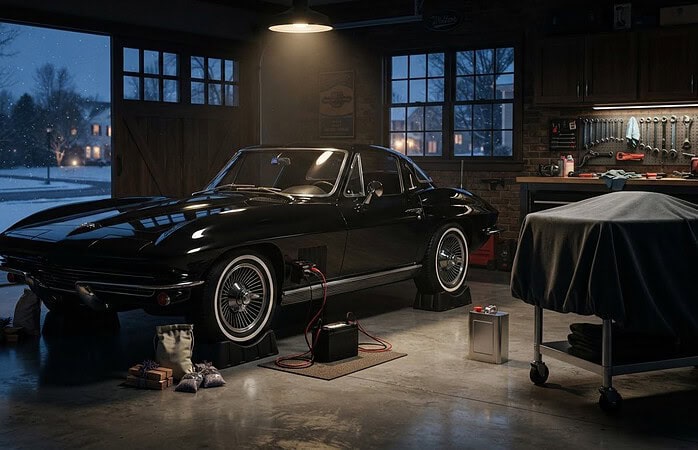

Parking a car is passive. Preserving one is a discipline entirely its own. If you’ve ever pulled a cherished vehicle out of storage only to face gummed fuel lines, flat-spotted tyres, a dead battery, or the sickening evidence of rodent activity in a hand-stitched interior, you already understand the difference. The question isn’t whether your vehicle needs protection during dormancy. It’s whether you’re giving it the professional-grade protocol it actually deserves.
Most owners who research how to store a car long term are looking for a checklist. What they actually need is a preservation strategy, one that treats dormancy not as a pause in your vehicle’s life, but as an active phase of its care. The risks are real and cumulative: humidity silently advances corrosion beneath paintwork, ethanol-blended fuel degrades within weeks, and static weight loads destroy the structural integrity of premium tyre compounds over months.
This guide walks you through the complete professional protocol, from pre-storage mechanical preparation and fuel system treatment to climate control, battery management, and the critical steps that ensure your vehicle wakes up in precisely the condition you left it. Investment-grade machines demand investment-grade care. Let’s give them exactly that.
Key Takeaways
- Knowing how to store a car long term correctly means treating dormancy as an active phase of preservation, not a simple pause — every week of inattention compounds risk across fuel, rubber, battery, and bodywork simultaneously.
- Fresh synthetic oil and a quality fuel stabilizer are non-negotiable first steps before any vehicle enters storage, as acidic contaminants and ethanol degradation begin their damage within weeks of inactivity.
- True climate control goes beyond temperature — maintaining relative humidity between forty and fifty percent is the critical variable that separates genuine preservation from accelerated deterioration of metals, leathers, and seals.
- A smart battery tender, proper tyre load management, and a thorough interior detail before storage are the three most commonly overlooked steps that determine the condition your vehicle wakes up in.
- Investment-grade vehicles demand professional-grade facilities — the right storage provider offers security, environmental oversight, and hands-on maintenance checks that no residential garage can replicate.
Defining Long Term Vehicle Storage and the Preservation Mindset
Thirty days. That’s the threshold where parking ends and preservation begins. Once a vehicle sits dormant beyond that point, the passive forces working against it, oxidising fluids, compressing seals, discharging cells, and cycling condensation, shift from minor inconveniences into genuine threats to mechanical and aesthetic integrity. Understanding how to store a car long term starts with accepting that this threshold exists and that crossing it without a deliberate protocol is a decision with consequences.
The transition from daily driver to stationary asset isn’t simply a matter of finding a space and locking the doors. It demands a fundamental shift in maintenance priorities. A vehicle in daily use self-corrects in ways we rarely notice: the engine reaches operating temperature and burns off moisture, the alternator keeps the battery charged, the tyres rotate and redistribute their load. Remove all of that, and every system begins a slow, silent retreat from its optimal state. Preservation work exists to counteract exactly that retreat, protecting the chemical stability of fluids, the structural resilience of high-performance rubber, and the artisanal integrity of hand-stitched interiors and bespoke paintwork.
Why Standard Garages Often Fail Classic Cars
A residential garage feels like protection. It rarely is. Temperature swings between day and night drive condensation cycles deep into engine blocks and exhaust systems, where trapped moisture initiates corrosion in passages you won’t inspect for months. Concrete floors are particularly treacherous; they draw ambient moisture upward and hold it against underbody steel and aluminium, accelerating oxidation in precisely the areas most difficult to treat. Add the near-universal presence of rodents in uncontrolled environments, and you have a space that actively threatens vintage wiring looms and natural-fibre interior materials. The garage gives the illusion of safety while the damage accumulates unseen.
The Goal of Professional Grade Preservation
Professional preservation isn’t about locking a car away. It’s about keeping every system in a state of readiness. That means maintaining the chemical stability of engine oil, coolant, and brake fluid so they don’t become corrosive agents during dormancy. It means protecting the structural integrity of high-performance tyre compounds against the flat-spotting that static load produces over weeks. For a modern restomod carrying sophisticated electronics alongside its classic architecture, it means ensuring those systems remain primed and protected against voltage drain and humidity-induced degradation.
Investment-grade vehicles are engineered to exacting tolerances. Their storage protocols need to match that precision. Anything less is a compromise the machine will eventually make you pay for.
Mechanical Preparation and Fluid Management Protocols
Before a vehicle crosses the thirty-day dormancy threshold, its mechanical systems need to be placed in a chemically stable, structurally sound state. This isn’t routine servicing. It’s a deliberate intervention designed to neutralise every internal threat that inactivity will amplify over weeks and months. Understanding how to store a car long term at a mechanical level means thinking in terms of chemistry, not just checklists.
Start with the engine oil, and start fresh. Used oil carries acidic combustion by-products that become increasingly corrosive when the engine stops cycling through operating temperatures. Those acids don’t sit harmlessly in suspension; they work against bearing surfaces, cylinder walls, and precision-machined tolerances that took considerable effort to achieve. Fresh full-synthetic oil creates a protective film across every internal surface and maintains its chemical neutrality throughout the storage period. Drain the old oil before the vehicle enters storage, not after it comes out.
Coolant demands the same attention. Modern aluminium-heavy cooling systems are particularly sensitive to pH drift, and coolant that has degraded beyond its effective range will begin attacking the very components it was formulated to protect. Test the pH level before storage; a neutral reading between 7 and 9 is the target. If the coolant is discoloured, depleted, or overdue for a change, flush and refill it before dormancy begins.
Brake fluid is the most commonly overlooked fluid in pre-storage preparation. It’s hygroscopic by nature, meaning it absorbs atmospheric moisture continuously throughout its service life. Once moisture content reaches a critical level, the fluid’s boiling point drops significantly and corrosion begins forming inside caliper pistons and master cylinder bores. If the fluid is dark, cloudy, or approaching its recommended change interval, flush it before storage. The cost of fresh fluid is negligible compared to the cost of seized brake components.
The Science of Fuel Stabilization in 2026
Modern pump fuel is a preservation engineer’s adversary. Ethanol-blended fuels are hygroscopic, attracting moisture from the air inside the tank and triggering phase separation, where water and ethanol separate from the petrol and settle at the lowest point of the fuel system. That layer becomes a corrosion accelerant inside steel tanks and a varnish-forming agent inside injectors and carburettors. A quality fuel stabilizer interrupts this process by slowing oxidation and preventing the gum and lacquer deposits that clog precision fuel delivery components.
The application protocol matters as much as the product itself. Fill the tank to approximately ninety-five percent capacity before adding the stabilizer. A near-full tank minimises the air gap where condensation forms and reduces the surface area of fuel exposed to oxygen. Add the stabilizer to the fuel, then run the engine for a minimum of fifteen minutes. That run time isn’t arbitrary; it’s the window required to ensure the treated fuel circulates fully through the fuel pump, lines, and injectors, protecting the entire delivery system rather than just the tank.
One common piece of advice worth challenging directly: draining the fuel tank before storage. Older guidance recommended this approach, but it creates a different problem entirely. An empty steel tank is exposed to far greater condensation cycling and internal oxidation than a treated, full one. Leave the tank full and treated.
Debunking the Myth of the Periodic Short Start
The instinct to fire up a stored vehicle every few weeks feels responsible. It isn’t. A cold start that runs for five to ten minutes without reaching full operating temperature introduces moisture into the oiling system that never burns off, deposits partially combusted fuel on valve surfaces, and cycles cold, acidic condensation through the exhaust without expelling it. The engine experiences all the stress of starting with none of the thermal benefit of operation. Do it repeatedly and you’re actively accelerating the deterioration you’re trying to prevent.
The protocol is binary. Either drive the vehicle until it reaches full operating temperature, which means at least twenty to thirty minutes of genuine road use, or leave it completely dormant and let your pre-storage preparation do its work. There’s no productive middle ground. For vehicles in professional storage facilities that include scheduled maintenance checks, this decision is managed for you, with any necessary running done properly rather than counterproductively.
For owners of high-performance restomods carrying modern engine management systems alongside their classic architecture, this guidance carries additional weight. Short, incomplete run cycles can trigger fault codes, confuse adaptive fuel mapping, and leave sensitive sensors cycling through incomplete warm-up sequences. The electronics expect a full thermal cycle or nothing at all. If you’re uncertain how your specific build should be managed through a long storage period, the services page at Elite Restomods outlines the maintenance protocols included with professional storage, which is precisely where these decisions belong.
The Technical Necessity of Climate Controlled Environments
Temperature control is only half the equation. Most owners researching how to store a car long term encounter the phrase “climate controlled” and assume it means a space that stays cool and consistent. It doesn’t. True climate control is a dual-variable discipline, and the second variable, relative humidity, is the one that separates genuine preservation from a slow, invisible deterioration that won’t reveal itself until you’re already paying for the consequences.
The target is precise: relative humidity maintained between forty and fifty percent throughout the storage period. Below that range, the materials that define a bespoke interior begin to suffer in ways that are expensive and sometimes irreversible. Hand-stitched leather shrinks and develops surface cracking as it loses its moisture content. Figured wood trim, the kind found in period-correct dashboards and door cappings, splits along its grain as the cellular structure contracts. These aren’t cosmetic inconveniences. They’re structural failures in materials that took artisans considerable time and skill to source and fit.
Push humidity above that range and the threat profile shifts entirely. High ambient moisture triggers the electrochemical process of rust even inside sealed structural cavities, in box sections, sill interiors, and floor bracing where neither inspection nor treatment is straightforward. The damage accumulates in exactly the places you won’t find it until it’s already significant.
Why Humidity is the Silent Enemy of Restomods
Moisture trapped in high-pile carpeting creates the conditions for mould spore colonisation, and once established, those spores are extraordinarily difficult to eradicate from deep-pile fibres and foam backing. Beyond the interior, the electronic control units that define a modern restomod’s capability are acutely sensitive to the micro-corrosion that damp air initiates across exposed connector pins and circuit board traces. Consistent humidity within the correct range also prevents the cyclical expansion and contraction of gaskets and seals that, over months of fluctuation, leads to the weeping and perishing that compromises fluid retention throughout the drivetrain.
Professional Storage vs. Home Solutions
A residential HVAC system isn’t engineered for this. It manages comfort, not conservation. Commercial facilities built for investment-grade vehicles utilise industrial dehumidification systems that maintain precise humidity targets regardless of external seasonal conditions, something a domestic setup simply cannot replicate with any consistency. Dedicated air filtration systems further reduce the accumulation of abrasive particulate matter that settles on delicate paint finishes during extended dormancy, protecting lacquer and hand-applied finishes that took considerable hours to achieve.
For a deeper technical breakdown of what separates a purpose-built preservation environment from a standard garage, the science behind climate controlled car storage outlines the specific environmental controls that investment-grade vehicles require. The difference between adequate and exceptional storage isn’t a matter of opinion. It’s a matter of measurable environmental parameters, and the vehicles that matter most deserve nothing less than exact.
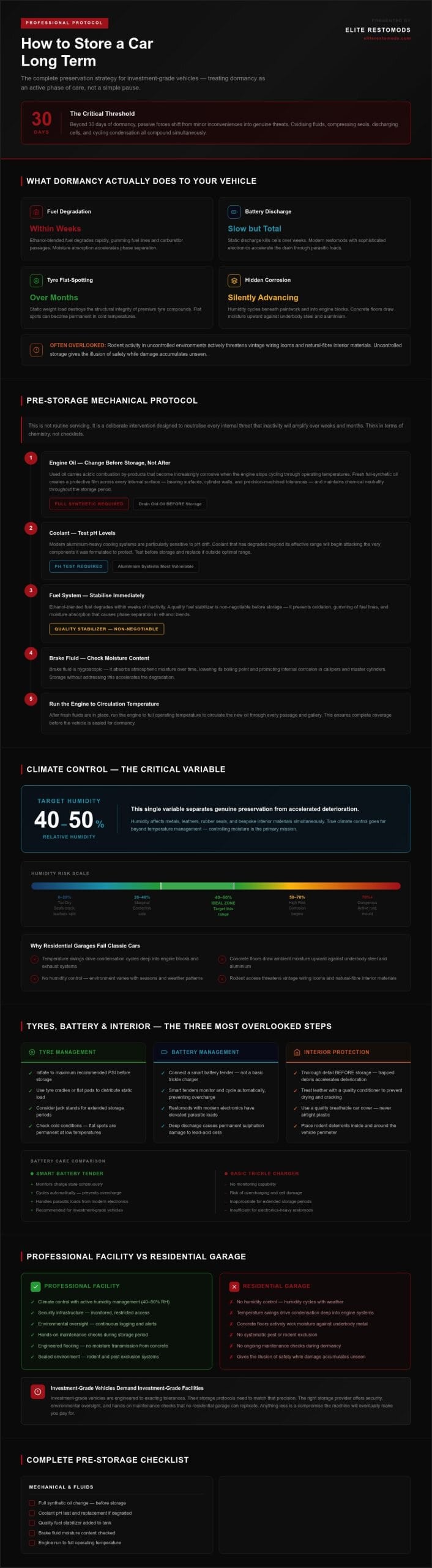
Tires, Battery, and Interior Protection Checklist
Mechanical preparation and climate control establish the foundation. What completes it is the meticulous attention paid to the three systems that degrade most visibly and most expensively during dormancy: the tyres carrying the vehicle’s weight, the battery sustaining its electronics, and the interior absorbing every atmospheric variable the storage environment produces. Getting these right is what separates a vehicle that wakes up ready to drive from one that demands remediation before it can leave the facility.
Begin with a thorough detail before the vehicle enters storage. Not a cosmetic wash, but a systematic decontamination. Road salts, iron fallout, and organic matter trapped in panel gaps and wheel arches are hygroscopic, meaning they actively draw moisture against the paintwork and metalwork beneath. Left in place, they become localised corrosion accelerants working against your investment through every week of dormancy. Clean the vehicle completely, treat the paintwork with a high-quality ceramic or wax sealant, and address any stone chips or paint breaks before storage. Seal the exhaust outlets and fresh air intakes with breathable plugs or steel wool to deny rodents an entry point without trapping moisture inside.
Battery Maintenance for Modern Electronics
Modern restomods don’t sleep cleanly. Alarm systems, engine management computers, real-time clocks, and keyless entry modules all draw continuous current from the battery even when the vehicle is completely stationary. These parasitic loads are small individually, but cumulatively they’ll discharge a battery to a damaging depth within weeks. A simple trickle charger isn’t the answer; it lacks the intelligence to respond to a fully charged cell and will overcharge and gas an AGM battery, permanently reducing its capacity. A microprocessor-controlled smart tender monitors voltage continuously and applies a maintenance charge only when the battery genuinely needs it. Before connecting one, inspect the ground connection at the battery terminal and at the chassis earth point. A loose or corroded ground introduces resistance that skews the tender’s voltage readings and leaves the battery less protected than the readout suggests.
Preserving Tyre Geometry and Rubber Compounds
High-performance tyre compounds are engineered for dynamic load distribution. Static weight concentrated on a single contact patch for months deforms the carcass, producing flat spots that range from a temporary vibration to a permanent structural irregularity depending on the compound and the duration. The protocol has three components. First, increase tyre pressure by approximately ten PSI above the standard operating specification to help the carcass resist deformation under load. Second, never park directly on bare concrete; the cold, damp surface accelerates compound degradation from the contact patch outward. Use carpet remnants, purpose-built tyre cradles, or foam pads to break that contact. Third, apply a quality tyre dressing to the sidewalls before storage. Ozone and UV exposure dry the rubber from the outside in, and a protective dressing slows that process considerably.
One approach competitors often recommend is placing the vehicle on jack stands to eliminate tyre load entirely. It sounds logical. In practice, incorrectly positioned stands concentrate stress on suspension bushings, subframe mounting points, and brake lines in ways that create new problems while solving the flat-spot risk. Proper inflation combined with appropriate ground protection achieves the same protective outcome without introducing structural stress elsewhere.
Knowing how to store a car long term at this level of detail is what keeps an investment-grade machine in concours condition through months of dormancy. For owners who’d rather have these checks managed by specialists, the storage services at Elite Restomods include battery tending and scheduled maintenance checks as part of the facility’s standard protocol.
Selecting Professional Storage for Investment Vehicles
Every protocol covered in this guide, the fluid chemistry, the humidity targets, the battery management, it all depends on one foundational decision: where the vehicle actually lives during dormancy. The facility isn’t a backdrop. It’s the primary variable. Choosing it correctly is the final and most consequential step in understanding how to store a car long term at a professional level.
Residential storage simply can’t replicate what a purpose-built facility provides. Security is the most obvious gap. A domestic garage offers a lock and perhaps a basic alarm. A professional facility built for investment-grade vehicles operates with layered access control, continuous surveillance, and fire suppression systems engineered to protect assets worth considerably more than the average home’s contents. For insurance purposes, this distinction matters. Many specialist classic and collector car policies carry explicit requirements around security protocols and environmental controls, and a residential garage frequently falls short of those thresholds. Before placing any significant vehicle into storage, review the policy terms carefully and confirm the facility meets the insurer’s stated criteria.
Evaluating a provider goes beyond square footage and a climate control claim. The question to ask is whether they have genuine hands-on experience with fully sorted, high-performance vehicles. A facility that stores fleet vehicles or standard daily drivers operates to a different standard than one built around the specific demands of investment-grade restomods. Look for evidence of active maintenance capability, not just passive parking. Elite Restomods’ storage services are built around exactly that distinction, combining a climate-controlled environment with the mechanical expertise to manage what’s stored inside it.
The Benefits of Managed Storage Subscriptions
A managed subscription transforms storage from a static arrangement into an active preservation programme. Tyre pressures are checked and adjusted by automotive professionals who understand compound behaviour, not approximated by an owner with a gauge. Fluid levels are monitored at scheduled intervals. Battery tending is handled with the correct equipment for each battery chemistry. And when you’re ready to collect the vehicle, concierge preparation means it’s genuinely road-ready, not simply unlocked and waiting. That level of oversight is the difference between retrieving a vehicle and retrieving a ready machine.
Preparing for the First Drive After Storage
Even with a flawless storage protocol, the first drive deserves its own discipline. Walk the vehicle before you touch the key. Inspect beneath it for any fluid that may have seeped during dormancy, check belt condition visually, and confirm tyre pressures are adjusted back to standard operating specification. Remove any exhaust plugs or pest deterrents placed before storage. Give the brakes a deliberate, low-speed application before reaching road speed; the disc surfaces will have developed a light surface oxidation layer that clears quickly but deserves a controlled first contact.
For those who want to see what vehicles maintained to this standard look like in practice, the Elite Certified inventory reflects exactly the condition that rigorous pre-storage preparation and professional oversight produces. These aren’t simply preserved cars. They’re machines held in a permanent state of readiness, which is precisely what knowing how to store a car long term is ultimately about.
Your Vehicle Deserves More Than a Locked Door
Knowing how to store a car long term isn’t a single decision. It’s a sequence of deliberate choices, each one protecting what the last one started. Fresh fluids before dormancy begins. Humidity held within the range that preserves leather, metal, and electronics simultaneously. A smart battery tender managing parasitic draw through every week of inactivity. And a facility with the expertise to oversee all of it, not just the space to park it.
These aren’t optional refinements for the especially cautious. They’re the baseline for any vehicle worth protecting. Investment-grade machines carry decades of engineering and artisanship in every panel and component. The storage protocol needs to match that standard, or the dormancy period quietly works against everything you’ve invested in.
Elite Restomods brings climate-controlled preservation, battery tending, and hands-on maintenance expertise together under one roof, specifically for vehicles that demand exactly that level of care. Secure your vehicle’s future with Elite Restomods professional storage and bring it back exactly as you left it, ready to drive.
Frequently Asked Questions About Long Term Car Storage
Is it better to store a car with a full or empty tank of gas?
Store it full, not empty. Fill the tank to approximately ninety-five percent capacity and add a quality fuel stabilizer before dormancy begins. A near-full tank minimises the air space where condensation forms, reducing the moisture that triggers phase separation in ethanol-blended fuels. An empty steel tank is far more vulnerable to internal oxidation than a properly treated full one.
After adding the stabilizer, run the engine for at least fifteen minutes to circulate the treated fuel through the pump, lines, and injectors. That’s the step most owners skip, and it’s the one that actually protects the entire delivery system rather than just the tank itself.
How often should I start my car while it is in long term storage?
The honest answer: don’t start it at all unless you can drive it properly. Short cold starts that don’t reach full operating temperature introduce moisture into the oiling system, deposit partially combusted fuel on valve surfaces, and cycle acidic condensation through the exhaust without expelling it. That does more harm than leaving the vehicle completely dormant with a thorough pre-storage preparation in place.
If the vehicle genuinely needs to be run, commit to at least twenty to thirty minutes of road use to reach full operating temperature. Anything less is counterproductive. Professional storage facilities that include scheduled maintenance checks manage this correctly, which is one of the strongest practical arguments for specialist oversight.
Do I really need a climate controlled unit for my classic car?
For any vehicle carrying hand-stitched leather, bespoke paintwork, or modern electronics alongside its classic architecture, yes, it’s a genuine necessity rather than a luxury upgrade. The critical variable isn’t temperature alone; it’s relative humidity held between forty and fifty percent. Outside that range, leather cracks, figured wood trim splits along the grain, and electronic control units develop micro-corrosion across connector pins and circuit board traces.
A residential HVAC system manages comfort, not conservation. It can’t maintain precise humidity targets through seasonal swings the way industrial dehumidification equipment can. The investment in proper climate control is considerably smaller than the cost of restoring a perished interior or treating rust that’s established itself inside structural cavities.
Should I put my car on jack stands for winter storage?
It sounds logical but it creates its own set of problems. Incorrectly positioned jack stands concentrate stress on suspension bushings, subframe mounting points, and brake lines in ways that can cause new damage while eliminating the flat-spot risk. Unless the stands are positioned with precise knowledge of the vehicle’s specific jacking points, the risk-reward calculation doesn’t favour this approach.
A more reliable protocol is increasing tyre pressure by approximately ten PSI above the standard operating specification, placing a protective barrier between the tyres and the floor surface, and applying a quality tyre dressing to the sidewalls. Proper inflation combined with ground protection achieves the same protective outcome without introducing structural stress elsewhere.
What is the best way to prevent rodents from entering my stored vehicle?
Denial of entry is the only reliable strategy. Plug the exhaust outlets and fresh air intakes with breathable materials like steel wool before storage; rodents won’t chew through it, and it doesn’t trap moisture inside the system the way solid plugs can. Inspect the underside of the vehicle for any gaps around wiring looms, heat shielding, or body seams that offer access to the cabin or engine bay.
Inside the vehicle, remove any food or organic material entirely. Scent-based deterrents like peppermint sachets can help discourage activity but aren’t a substitute for physical exclusion. In a professionally managed storage facility, the controlled environment and regular maintenance checks significantly reduce the conditions that attract rodent activity in the first place.
Can I leave my battery in the car if I use a battery tender?
Yes, provided you’re using the right equipment. A microprocessor-controlled smart tender that monitors voltage continuously and applies a maintenance charge only when needed is the correct tool for a stored vehicle. Standard trickle chargers lack that intelligence and can overcharge an AGM battery, permanently reducing its capacity. Leave the battery in place, connected to the tender, rather than removing it.
Before connecting the tender, inspect both the battery terminal connection and the chassis earth point for corrosion or looseness. A compromised ground introduces resistance that skews the tender’s voltage readings, leaving the battery less protected than the readout suggests. Clean connections are a five-minute job that makes everything downstream more reliable.
How long can a car sit before the tires develop permanent flat spots?
There’s no universal threshold because it depends heavily on the tyre compound, the ambient temperature, and the load the vehicle places on the contact patch. Performance-oriented compounds used on high-specification restomods are generally more susceptible than touring-grade tyres because their softer compounds deform more readily under static load. Flat spotting can begin showing as a vibration within a few weeks in cold conditions, and it can become a permanent structural deformation over several months.
The good news is that the prevention protocol is straightforward. Elevated inflation pressure, a protective barrier between the tyre and the floor, and a quality sidewall dressing address the three main mechanisms of damage simultaneously. If flat spotting has already occurred, gentle driving at progressively higher speeds often allows the compound to recover its shape, though severe cases may not fully resolve.
Do I need to change my oil again after taking the car out of storage?
If the vehicle was stored correctly with fresh full-synthetic oil installed immediately before dormancy began, an oil change isn’t required the moment you retrieve it. The purpose of pre-storage fresh oil is precisely to provide chemically stable, acid-free protection throughout the entire storage period. That protection doesn’t expire the instant the vehicle moves again.
The practical guidance is to check the oil level and condition visually before the first drive and then return to your normal service interval from that point. If the vehicle was stored for an extended period beyond twelve months, or if the pre-storage oil change was skipped, changing it before the first serious drive is the conservative and correct call. Knowing how to store a car long term properly means the post-storage service requirements are minimal rather than remedial.