
Can a vintage icon truly possess the heart of a modern supercar without losing its historical soul? You likely know the frustration of a cold start that refuses to catch or the sudden, suffocating silence of vapor lock in mid-July traffic. It’s the persistent shadow over classic ownership that often keeps many legendary machines confined to the garage. Integrating a modern drivetrain in a classic car isn’t about erasing history; it’s about perfecting the experience. This mechanical rebirth grants your vehicle telepathic responsiveness and relentless power while maintaining the aesthetic integrity of a bygone era.
You deserve a machine that offers turn-key reliability and highway-friendly gearing without sacrificing that raw, analog connection. This article explores how a total drivetrain transformation balances vintage character with the visceral power of modern engineering. We’ll examine the meticulous integration of high-performance LS and LT swaps, the latest advancements in engine management software like FuelTech Vision v2.24, and the evolving regulatory landscape of 2026. This journey transforms your cherished vintage asset into a fully sorted, investment-grade masterpiece designed to be driven and enjoyed.
Key Takeaways
- Understand why traditional carbureted setups fall short and how an integrated system of engine, transmission, and final drive redefines the driving experience.
- Explore the dominance of LS and LT platforms and why a modern drivetrain in a classic car requires a holistic ecosystem of power, transfer, and delivery.
- Learn how advanced Electronic Control Units and direct fuel injection act as the brains behind the brute force to optimize real-time performance.
- Discover the financial logic of restomodding and how modernizing the mechanical soul of a vintage asset increases its value and pool of potential investors.
- See how the Elite Certified standard ensures every build is a fully sorted, functional piece of art through rigorous engineering and quality assurance.
The Evolution of Performance: Why Vintage Drivetrains Fail Modern Expectations
The concept of a modern drivetrain in a classic car represents far more than a simple engine swap. It is the integration of a cohesive, high-performance ecosystem where the engine, transmission, and final drive function as a single, telepathic unit. Original factory setups were designed for a different era. They were built for lower speeds, leaded fuels, and a world where regular roadside adjustments were a standard part of the ownership experience. Today, the demands of the road have shifted. A vintage drivetrain often feels like a relic trying to survive in a high-speed, high-heat environment it was never intended to master.
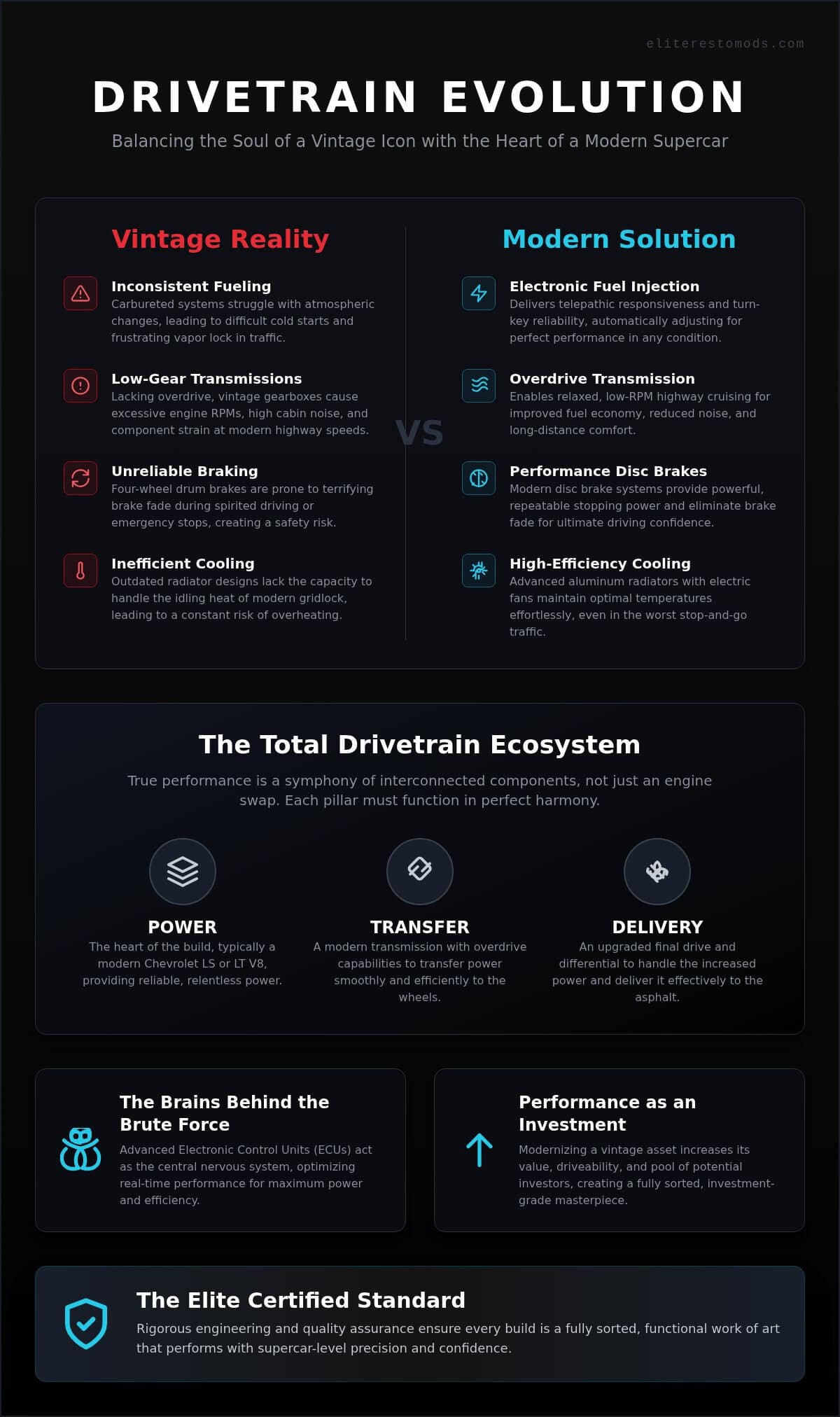
Carbureted engines, while nostalgic in their scent and sound, are inherently temperamental. They struggle with atmospheric changes, leading to inconsistent cold starts that test a driver’s patience. The visceral frustration of vapor lock on a humid afternoon can turn a celebratory drive into a mechanical nightmare. Furthermore, the low-gear factory transmissions of the 1960s lack the overdrive capabilities required for 2026 highway speeds. Attempting to keep pace with modern traffic often results in high RPMs, excessive cabin noise, and a relentless strain on aging components.
To better understand this concept, watch this helpful video:
The Reality of 1960s Engineering in a 2026 World
Vintage engineering requires a level of constant vigilance that many modern collectors find exhausting. Points ignition systems need frequent calibration to maintain timing, and four-wheel drum brakes often suffer from terrifying fade during spirited driving or emergency stops. Cooling systems from decades ago were not designed to handle the idling heat of modern gridlock traffic. This mechanical unreliability creates a psychological barrier. It transforms the pride of ownership into a sense of anxiety, where every strange vibration or rising temperature needle threatens to end the journey prematurely.
- Points ignition requires regular dwell and gap adjustments to prevent misfires.
- Outdated radiator designs lack the surface area and airflow management needed for modern climates.
- Manual steering and unassisted brakes demand physical exertion that detracts from the luxury experience.
Bridging the Gap Between Heritage and Capability
The shift toward restomodding has become the gold standard for high-end automotive enthusiasts. By following the principles of Conservation and restoration of road vehicles, owners can preserve the iconic silhouette of a legend while infusing it with contemporary power. A modern drivetrain allows for genuine daily driveability without sacrificing the vehicle’s aesthetic soul. It provides the confidence to embark on long-distance tours or navigate city streets with the same ease as a contemporary luxury vehicle. The Elite Restomods process focuses on these mechanical modernizations, ensuring that every build is a fully sorted investment asset that performs with supercar-level precision.
The Total Drivetrain Ecosystem: Beyond the Engine Swap
A modern drivetrain in a classic car is a symphony of interconnected components. It is a fundamental mistake to view a restomod project through the narrow lens of a simple engine swap. True mechanical excellence requires a holistic approach that addresses the three pillars of performance: power, transfer, and delivery. When you retrofit an old car with a modern drivetrain, you are orchestrating a complex dialogue between the crankshaft, the gears, and the asphalt. Every piece of hardware must be curated to function in perfect harmony, ensuring the vehicle feels like a cohesive unit rather than a collection of disparate parts.
Modern Powerplants: The LS and LT Revolution
The heart of this ecosystem often begins with the legendary Chevrolet LS or LT platforms. These engines have become the industry standard for a reason. They offer incredible power density and a compact footprint that fits beautifully within vintage engine bays. The LS3 remains a favorite for its reliability and massive aftermarket support, while the newer LT1 brings direct injection and sophisticated variable valve timing into the fold. These crate engines arrive with manufacturer backing, providing a level of peace of mind that no rebuilt vintage block can match. Their aluminum construction significantly reduces front-end weight, which sharpens turn-in and improves the overall handling balance of the chassis.
Transmission Tech: From 3-Speeds to Overdrive Excellence
Brute force requires a sophisticated medium. Horsepower becomes a wasted asset if the transmission cannot manage it with precision. The shift from antiquated three-speed automatics to modern overdrive units is the single most transformative change in a build. For those who crave an analog connection, the Tremec T56 Magnum offers a crisp, bolt-action shift feel that handles immense torque with ease. Conversely, the 10L90 ten-speed automatic provides seamless, lightning-fast shifts that keep the engine in its optimal power band. Overdrive is the secret to modern usability; it allows a high-performance V8 to cruise at highway speeds with the quiet composure of a contemporary grand tourer.
The Final Drive: Putting Power to the Pavement
The narrative of power finds its conclusion at the rear axle. A modern drivetrain demands a robust final drive, such as a Ford 9-inch or a Dana 60, to survive the relentless torque of a modern powerplant. Integrating a limited-slip differential ensures that power is distributed evenly, providing predictable traction during aggressive cornering. Selecting the correct gear ratio is a delicate art. It requires balancing the explosive acceleration needed for the stoplight with the low-RPM efficiency required for long-distance travel. Every component must be meticulously matched to ensure the vehicle feels fully sorted and ready for the road. Explore our custom build services to see how we curate these components into a singular masterpiece of functional art.
Electronic Management: The Brains Behind the Brute Force
The silicon-based intelligence of a modern drivetrain in a classic car is what truly separates a professional build from a weekend project. While the previous sections explored the mechanical muscle of the LS platforms and overdrive transmissions, the Electronic Control Unit (ECU) acts as the sophisticated conductor of this high-performance orchestra. It monitors thousands of variables every second; it adjusts ignition timing, fuel delivery, and transmission shift pressure with a precision that was impossible in the 1960s. This digital oversight ensures that the brute force of a 500-horsepower engine remains manageable, reliable, and efficient.
A critical component of this integration is the modern wiring harness. Original electrical systems are often the primary source of frustration for classic owners. They are prone to shorts, parasitic draws, and brittle connections. A bespoke, modern loom replaces this outdated architecture with cross-linked wiring and weather-sealed connectors. This eliminates electrical gremlins and provides the stable foundation needed for advanced engine management software. Current 2026 systems, such as the Haltech Nexus v.1.47.2 or FuelTech Vision v2.24, offer unprecedented control. Owners can now utilize custom drive modes to switch between a docile street tune and a high-response performance profile at the touch of a button.
Fuel Injection and Cold Start Reliability
The transition from a carburetor to Electronic Fuel Injection (EFI) is the single most transformative upgrade for real-world usability. Unlike a mechanical carburetor that relies on vacuum and atmospheric pressure, EFI utilizes high-pressure injectors and closed-loop fuel mapping. Wideband oxygen sensors provide real-time feedback to the ECU, allowing it to maintain the perfect stoichiometric ratio regardless of altitude or temperature. This technology eliminates the need for constant tuning and ensures turn-key reliability every time you enter the garage. It removes the ritual of pumping the gas pedal and the lingering scent of unburnt fuel on your clothes.
- Closed-loop mapping adjusts air-fuel ratios in real-time based on exhaust gas data.
- Multi-port and direct injection systems provide superior atomization and throttle response.
- Electronic idle control ensures a steady RPM even when the AC compressor kicks in.
Integrating Modern Comforts into a Vintage Cabin
Contemporary drivetrains also solve the power demands of modern luxury. High-output alternators, often producing over 180 amps, provide the necessary current for high-capacity air conditioning systems and premium sound stages. Integrating these features requires a delicate touch to preserve the vehicle’s heritage. Digital gauge integration allows the original dashboard to display accurate data from the ECU via GPS-driven speedometers and electronic tachometers. This creates a seamless experience where the driver enjoys modern accuracy without sacrificing the artisanal finish of a classic interior. Learn more about how we blend these worlds in our mechanical modernization process.
Performance vs. Investment: The Financial Logic of a Modern Drivetrain
The traditional purist debate often centers on a narrow definition of value. Traditionalists argue for the sanctity of numbers-matching components. However, the modern collector market tells a different story. Usability is the new currency. A modern drivetrain in a classic car fundamentally changes the asset’s financial profile by expanding the pool of prospective owners. In 2026, buyers are no longer content with static displays. They demand a machine that performs with the same reliability as a contemporary luxury vehicle. This shift has driven the global classic car restoration and restomod market to an estimated 7.9 billion dollars this year, with restomod builds now accounting for 39.5 percent of that total value.
The financial logic extends into the realm of operational costs. Maintaining a high-strung vintage engine requires a specialized skillset and frequent, expensive intervals. In contrast, a modern powerplant like an LS3 or LT1 offers a level of reliability that drastically reduces the cost of ownership over time. You aren’t just buying performance; you’re investing in the elimination of mechanical anxiety. A professionally engineered drivetrain ensures that the vehicle remains a liquid asset, ready for the road or the auction block at a moment’s notice. Documented builds from recognized masters hold their value far better than fragmented DIY projects, as they provide a clear provenance of quality and engineering integrity.
The Rise of the Investment-Grade Restomod
Current market trends show a clear preference for pro-touring and restomod builds that prioritize daily driveability. This isn’t a passing fad. It’s a fundamental demographic shift. A new generation of collectors is entering the market with a desire for the “poster cars” of their youth, but they have little interest in the temperamental nature of 1960s mechanicals. This demand has created a robust secondary market where high-quality modernizations often command a significant premium over their stock counterparts. To understand the deeper financial nuances, explore our analysis on Are Restomod Cars a Good Financial Investment?
Elite Certified vs. Standard Restoration
The distinction between a standard restoration and an Elite Certified build lies in the depth of the engineering. A standard swap might place a new engine in an old frame, but it often ignores the critical synergy between the transmission, cooling, and electrical systems. A professionally curated build justifies a higher initial acquisition cost because it is “fully sorted.” Every component has been tested and verified to work as a cohesive unit. This level of perfectionism is what creates a true investment-grade asset. When you are ready to begin your journey, consult The Definitive Guide to Choosing a Custom Restomod Builder in 2026 to ensure your vision is realized with world-class precision.
If you are looking to acquire a vehicle that balances historical soul with modern capability, we invite you to browse our current Elite Certified Restomods to find your next masterpiece.
The Elite Certified Standard: Curating Your Modernized Icon
The Elite Restomods philosophy treats every vehicle as a bespoke piece of functional art. We don’t merely assemble components; we curate a legacy. Integrating a modern drivetrain in a classic car requires a level of perfectionism that transcends the typical restoration shop. It is a deliberate marriage of brute force and refined comfort. Our Elite Certified Restomods represent the zenith of this duality. They ensure the relentless power of contemporary engineering is always balanced by luxury craftsmanship. Every detail, from the meticulous wire tucking in the engine bay to the artisanal finishes in the cabin, is executed with professional authority and pride.
The Rigorous Quality Assurance of a Fully Sorted Drivetrain
Every build undergoes a comprehensive quality assurance process designed for absolute reliability and turn-key performance. We subject our drivetrains to rigorous dyno testing to verify power delivery and thermal management under load. This is followed by extensive real-world road miles to ensure system synergy is flawless. Professional cooling and exhaust integration remain critical priorities for our engineering team. These steps prevent the heat soak and cabin resonance that often plague lesser builds. A fully sorted vehicle provides a superior tactile experience. It feels tight and responsive. It is a machine that begs to be utilized and enjoyed, not just displayed behind glass.
Commissioning Your Vision with Elite Restomods
Choosing between our existing inventory and our custom build services depends on your specific vision and timeline. Our inventory features vehicles that have already completed their transformative journey. These assets are ready for immediate enclosed vehicle transport to your private gallery or home. For those with a specific model or unique performance requirement, our commissioning process offers total creative freedom. Our master builders assist in vehicle sourcing and selecting the ideal modern drivetrain in a classic car to match your specific needs. We serve as the bridge between your long-held dream and a tangible, high-performance reality. We manage every mechanical intricacy so you can focus on the visceral excitement of the drive.
Explore our current inventory of Elite Certified Restomods to find your next modernized icon. We invite you to experience the pinnacle of functional automotive art, where history is preserved through the lens of modern perfection.
Mastering the Road in a Modernized Icon
Engineering a modern drivetrain in a classic car represents the ultimate evolution of automotive passion. It’s the definitive bridge between a storied past and a high-performance future. By integrating sophisticated ECU management and high-output powerplants like the LT series, you eliminate the mechanical anxiety of vintage engineering. This transformation ensures your vehicle is a fully sorted, investment-grade asset ready for the demands of the modern road. You no longer have to choose between iconic design and turn-key reliability.
Realizing this vision requires a curator who understands the delicate balance of heritage and innovation. Every vehicle in our collection undergoes a rigorous Elite Certified quality assurance process to guarantee mechanical perfection. We facilitate your journey with specialized classic car financing options and secure national enclosed transport to bring your dream directly to your home. View our inventory of precision-engineered, fully sorted restomods and reclaim the joy of the drive today. Your next masterpiece is waiting.
Frequently Asked Questions
Does putting a modern engine in a classic car ruin its resale value?
Modernizing the mechanical soul of a vintage icon typically enhances its market value by broadening the appeal to collectors who prioritize usability. While a numbers-matching original has its niche, the 2026 market shows a strong preference for vehicles that can keep pace with modern traffic. A professionally integrated modern drivetrain in a classic car transforms the vehicle into a liquid, high-performance asset that commands a premium at auction because it is ready to be driven immediately.
What is the most reliable modern engine swap for a classic muscle car?
The Chevrolet LS3 and LT1 crate engines are widely considered the gold standards for reliability in the restomod world. These powerplants offer a compact footprint and massive aftermarket support, ensuring parts are always accessible. Because they are modern, fuel-injected systems, they provide the turn-key consistency required for daily driving. Selecting a manufacturer-backed crate engine also brings the security of a warranty, which no rebuilt vintage block can offer in the long term.
Can I keep my original manual transmission with a modern engine swap?
You can technically adapt an original manual transmission, but it is rarely the optimal choice for a high-performance build. Older gearboxes often lack the torque capacity to handle the explosive power of a modern V8. They also lack the overdrive gears necessary for comfortable highway cruising. We typically recommend upgrading to a Tremec T56 or similar modern unit to ensure the transmission can survive the relentless force of your new powerplant while providing a crisp, tactile shift feel.
How much does it cost to install a modern drivetrain in a classic car?
The investment required for a total drivetrain transformation varies based on the complexity of the build and the performance targets. Industry data for 2026 indicates that professional drivetrain upgrade packages, including a new crate engine and modern transmission, often start in the mid-five-figure range. This reflects the meticulous engineering required to integrate high-pressure fuel systems, advanced cooling, and electronic management into a vintage chassis. Every project is a bespoke journey tailored to specific engineering goals.
Do modern drivetrains require special maintenance compared to original engines?
Modern drivetrains simplify your maintenance schedule by eliminating the need for constant carburetor adjustments and points ignition timing. These systems utilize standard synthetic fluids and follow service intervals similar to contemporary luxury vehicles. One of the greatest benefits is the inclusion of OBD-II diagnostic ports. This allows any modern technician to quickly scan the system for data, ensuring your vehicle stays fully sorted with minimal downtime and no guesswork involved in tuning.
Will a modern drivetrain swap make my classic car more fuel-efficient?
Yes, a modern drivetrain swap significantly improves fuel efficiency through the precision of electronic fuel injection and the addition of overdrive gears. While a vintage carbureted engine often wastes fuel through poor atomization, a modern ECU optimizes the air-fuel ratio in real-time. When paired with a six-speed or ten-speed transmission, the engine can cruise at much lower RPMs. This creates a more refined driving experience and a much greater range for long-distance touring and weekend adventures.
What is the difference between an LS swap and a full drivetrain modernization?
An LS swap focuses strictly on the engine, while a full drivetrain modernization addresses the entire mechanical ecosystem. True performance requires a holistic approach that synchronizes the engine, transmission, and final drive. A full modernization includes an upgraded cooling system, a high-capacity fuel system, and a robust rear end like a Ford 9-inch. This ensures that every component is engineered to handle the increased power, resulting in a more cohesive, reliable, and balanced machine.
Can Elite Restomods source a specific classic car for a modern drivetrain build?
Elite Restomods provides comprehensive vehicle sourcing services to help you find the perfect foundation for your bespoke build. Our experts understand the specific chassis requirements for a high-performance modern drivetrain in a classic car. We handle the logistical heavy lifting, from initial scouting to enclosed vehicle transport. This allows you to participate in the creative vision of the project while we secure the ideal vintage asset to bring that vision to life with professional authority.