
Your vintage machine is more than stamped steel and leather. It’s a bespoke piece of functional art that deserves a global stage, not a crowded classified page. You’ve likely felt the sting of listing a prized asset only to be met with endless tire-kickers and the visceral anxiety of insecure payment transfers. It’s exhausting. If you’re wondering how does classic car consignment work in a shifting 2026 market, you’re seeking a bridge between your investment and a qualified buyer who respects the soul of the machine.
We agree that your time is as valuable as the mechanical intricacies under the hood. This guide promises to show you how a professional partnership turns the complex burden of selling into a seamless, high-value experience. We’ll explore the strategic nuances of the 2026 buyer’s market, the critical role of documented provenance, and the meticulous marketing resources required to secure a premium return. From climate-controlled presentation to specialized buyer financing, you’re about to discover the path to a truly hands-off, protected transaction that honors the heritage of your vehicle while utilizing modern sales engineering.
Key Takeaways
- Understand how does classic car consignment work by transforming your role from an overwhelmed private seller into a protected principal supported by expert agency.
- Learn the systematic lifecycle of a professional sale, from data-driven valuations to identifying the technical soul of your vehicle through rigorous inspection.
- Navigate the nuances of 2026 fee structures and see how no-sale, no-fee models ensure your interests remain perfectly aligned with your consignment partner.
- Discover why professional detailing and mechanical sorting are essential for positioning investment-grade restomods as bespoke pieces of functional art.
- Explore how leveraging a curated buyer network and specialized financing options can turn a complex transaction into a seamless, high-value success.
Understanding the Classic Car Consignment Model
At its core, classic car consignment is a professional agency agreement where a specialized dealer takes the helm of your vehicle’s sale. It’s a partnership built on transparency. Unlike a standard trade-in where you accept a wholesale price for immediate liquidity, consignment allows you to retain ownership while leveraging the dealer’s infrastructure, reputation, and global reach. To understand how does classic car consignment work, one must view the dealer not as a middleman, but as an expert advocate for the asset’s true value. This is especially vital when dealing with the nuanced definition of a classic car, where condition and provenance dictate every dollar of the final hammer price.
To better understand this concept, watch this helpful video:
High-value restomods demand a distinct strategy. A factory-original survivor speaks for itself through history books, but a bespoke build with a modern LT4 engine and custom chassis requires a technical narrative. It’s about selling the engineering as much as the aesthetic. The market has shifted from dusty local classifieds to a high-speed digital arena. Collectors in Dubai or London aren’t looking at your local paper. They’re looking at curated digital showrooms that project confidence and mechanical integrity.
Consignment vs. Private Sale: A Strategic Comparison
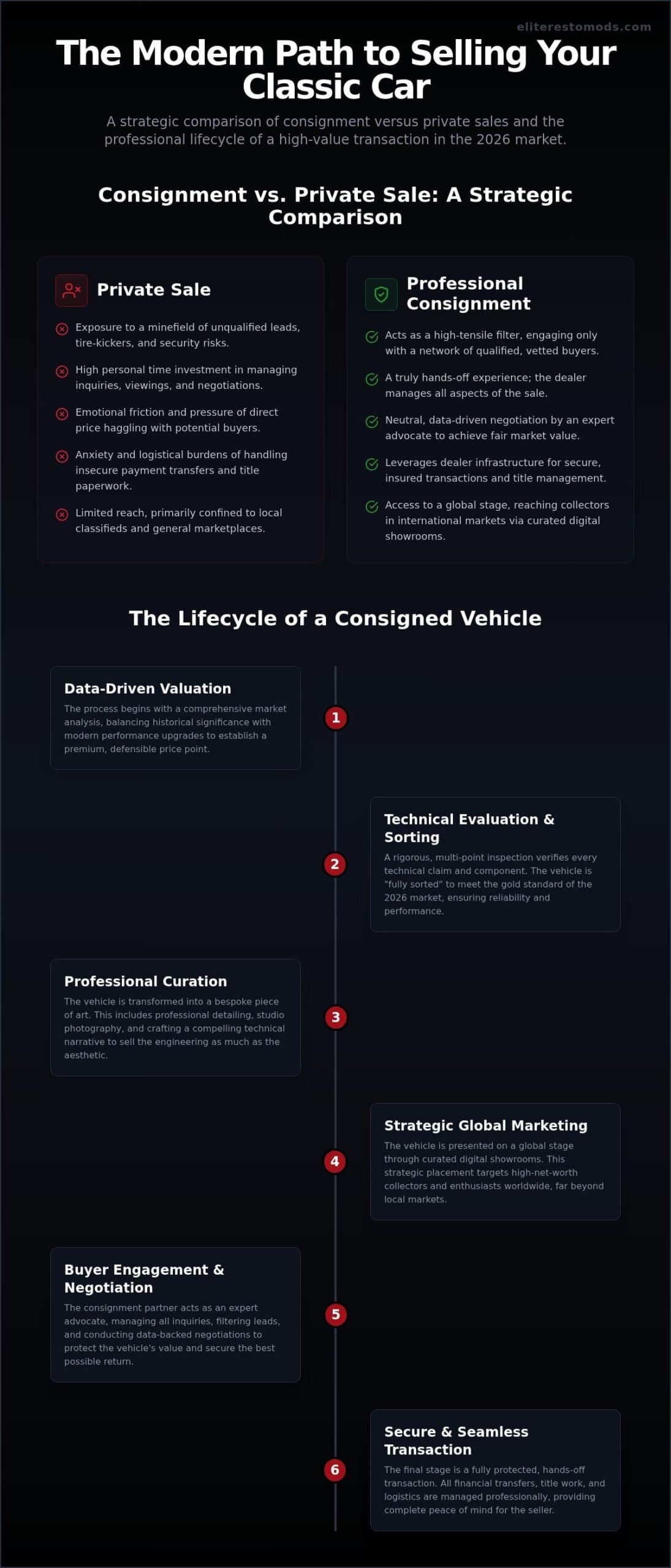
The private market is often a minefield of unqualified leads and security risks. Selling a six-figure asset from your driveway invites tire-kickers who seek a Sunday afternoon thrill rather than a serious transaction. Professional representation acts as a high-tensile filter. It removes the emotional friction of haggling. A neutral third-party negotiator doesn’t just defend the price; they validate it using real-time market data and comparable sales from our current inventory. This ensures you achieve fair market value without the logistical headache of managing title transfers and secure payments.
The Role of the Consignment Dealer as a Curator
Modern buyers aren’t just purchasing a machine; they’re buying into a standard of excellence. An established dealer acts as a brand builder for your car. They provide a layer of professional vetting that an anonymous private seller simply cannot match. This trust is the currency of the collector world. When a vehicle is presented within a curated collection of fully sorted machines, it inherits the prestige of its surroundings. This transforms a simple sale into an event of significance, providing the buyer with the confidence to pull the trigger on a high-value investment.
The Lifecycle of a Consigned Vehicle: From Intake to Sale
The journey from a private garage to a global stage is a transformative process that begins long before the first shutter click. It starts with a data-driven valuation that balances historical significance with modern performance upgrades. To understand how does classic car consignment work, one must see the dealer as a forensic analyst. We verify every technical claim, from the torque specs of a crate engine to the authenticity of the chassis. This phase ensures the car is positioned for maximum market impact while adhering to FTC regulations for consignment, protecting both seller and buyer through absolute transparency.
Intake and Technical Evaluation
A “fully sorted” vehicle is the gold standard in the 2026 market. We don’t just list cars; we vet them. A comprehensive multi-point inspection identifies the technical soul of the build, ensuring every mechanical component performs with the reliability of a modern machine. Modern buyers demand more than a visual scan. They want component lists, dyno sheets, and a clear narrative of the transformation. Every classic has a story. Our role is to translate that history into a compelling value proposition that justifies a premium price point. You can explore our rigorous onboarding process to see how we prepare each asset for its next curator.
Marketing and Buyer Engagement
Visual excellence is the bridge to a global audience. We utilize high-definition video and studio-grade photography to capture the marriage of vintage aesthetics and modern power. The marketing deployment is surgical. We place your vehicle on premier auction sites and collector databases where high-net-worth investors reside. This is where the professional advantage becomes undeniable. The dealer handles the heavy lifting, managing late-night inquiries from overseas collectors and vetting financial qualifications. We ensure you only deal with the final realization of the sale, removing the noise of unqualified leads and allowing the machine’s craftsmanship to speak for itself.
The final stage of the lifecycle is the secure transition of the asset. This involves managing international logistics, enclosed transport, and the complex paperwork associated with high-value title transfers. By the time the keys are handed over, the transaction has been insulated from risk. The seller receives their funds through a secure, verified channel, and the buyer takes delivery of a vehicle that has been professionally curated and prepared for the open road.
Navigating Fees, Insurance, and Financial Security
Transparency is the bedrock of any elite partnership. When considering how does classic car consignment work, the financial architecture must be as robust as the drivetrain of the vehicle itself. Most professional dealers operate on a commission based structure, typically ranging between 5% and 10% of the final sale price. This isn’t merely a fee for showroom space. It’s an investment in a global marketing engine designed to capture a premium return that far outweighs the cost of the commission. A no-sale, no-fee model is particularly advantageous, as it ensures the dealer’s motivation is perfectly synchronized with your goal: achieving the highest possible market value.
Security extends beyond the ledger. While your asset is housed in a professional environment, liability is managed through a dual coverage approach. You maintain your existing policy while the dealer provides comprehensive coverage for the vehicle while it’s under their care. This layer of protection is vital for protecting your consigned vehicle from unforeseen risks. It’s a professional safety net that allows you to remain at ease while your machine is presented to the world’s most discerning collectors.
Understanding the Consignment Agreement
A clear legal contract is the foundation of a successful transaction. These agreements typically span 60 to 90 days, providing a dedicated window to execute a high impact marketing campaign. You should look for absolute transparency regarding marketing expenses and exclusivity clauses. We prioritize a net to seller approach in our consignment program, ensuring you know exactly what your return will be before the deal is finalized. No hidden surcharges. No surprises. Just a clean, professional execution of the sale.
Financial Protections for the Seller
The closing of a deal is where professional authority shines brightest. Dealers act as a secure buffer, facilitating verified payments and managing escrow services to eliminate the risk of financial fraud. This is a critical departure from the uncertainty of private sales. Once funds are secured, the dealer manages the title transfer and ensures a clean legal break. You walk away with your capital, and the buyer takes possession of a vetted asset, with both parties protected by a systematic, ironclad process that respects the gravity of the investment.
Maximizing Value through Professional Presentation and Curation
Visual impact is the silent handshake of a high-value transaction. When a collector enters a premier showroom, they aren’t just looking at a vehicle; they’re evaluating a standard of care. Cosmetic perfection is non-negotiable for investment-grade assets. Professional detailing goes beyond a simple wash. It’s a deep-tissue restoration of the vehicle’s aesthetic soul, from paint correction that removes decades of swirl marks to the artisanal conditioning of vintage leather. This level of preparation is a core component of how does classic car consignment work at an elite level, ensuring the machine is presented as a bespoke piece of functional art rather than a used commodity.
Presentation extends beneath the bodywork. A gorgeous exterior cannot mask a neglected drivetrain. Mechanical sorting is the process of eliminating the small, nagging issues that provide buyers with leverage to haggle. A flickering dash light or a minor oil weep can kill a six-figure deal by suggesting deeper, systemic neglect. By addressing these technical nuances before the car hits the stage, we preserve the integrity of the asking price and build an unshakeable sense of buyer confidence. Organized documentation, including comprehensive build books and historical receipts, serves as the vehicle’s pedigree, proving that the craftsmanship is as deep as the finish.
The ‘Fully Sorted’ Advantage
In the 2026 market, drivability has become the ultimate luxury. A “fully sorted” restomod is a vehicle that has moved past the temperamental nature of vintage engineering. It starts on the first turn of the key. It idles with modern precision. It handles the heat of a summer afternoon without protest. We focus on the marriage of traditional aesthetics and modern operational reliability, ensuring that every component, from the fuel injection system to the climate control, functions perfectly. This technical perfection distinguishes a true investment from a mere project car, positioning your asset for a swift and profitable exit.
Leveraging Dealer Services to Close the Deal
Professional consignment provides tools that a private seller simply cannot access. We expand your buyer pool by offering specialized classic car financing, allowing prospects to leverage their capital while securing a high-value asset. This financial flexibility often makes the difference between a “maybe” and a closed contract. Additionally, we facilitate the logistics of global sales through enclosed vehicle transport, ensuring the machine arrives in pristine condition whether it’s headed across the state or across an ocean. If your vehicle requires a secure environment while awaiting its next curator, you can explore our premium car storage solutions.
Achieving the highest market price requires more than luck. It requires a systematic approach to curation that honors the heritage of the build while utilizing modern sales engineering. To begin the journey of transforming your vehicle into a sought-after investment, consider our premier consignment program today.
Why Elite Consignment is the Standard for Investment-Grade Restomods
Generic consignment warehouses often prioritize volume over value, acting as mere repositories for metal rather than galleries for functional art. At Elite Restomods, we reject the warehouse model in favor of a curated boutique experience. We understand that an investment-grade restomod is a marriage of brute force and refined comfort. To understand how does classic car consignment work at the highest echelon, one must look at the quality of the company the vehicle keeps. Our showroom is not just a floor; it is a collection of fully sorted machines that represent the absolute peak of modern engineering applied to historical aesthetics. We provide a nationwide reach that connects your asset with buyers who value meticulous craftsmanship over a bargain price.
Our ecosystem is designed to simplify every phase of the seller’s journey. We don’t just list a car; we provide a complete infrastructure of support. This includes access to climate-controlled storage for vehicles awaiting their debut and specialized classic car financing that empowers buyers to close high-value deals quickly. By managing the enclosed vehicle transport and every logistical detail in between, we ensure that your only responsibility is the final approval of the sale. This comprehensive approach is why our reputation for perfectionism remains the industry standard for those who refuse to settle for anything less than excellence.
The Power of the Elite Certified Label
The Elite Certified label is our signature of perfectionism. It tells a potential buyer that every mechanical intricacy has been vetted through a rigorous quality assurance process. This isn’t a cursory glance; it’s a systematic deep dive into the build’s DNA. High-net-worth collectors buy from our consignment program because we remove the visceral uncertainty that often plagues the vintage market. They aren’t just buying a machine, they’re buying our reputation for reliability and craftsmanship. You can witness this standard firsthand by browsing our current inventory of world-class builds that define the modern era of classic design.
Starting Your Consignment Journey
Your journey begins with a private consultation where we evaluate the technical and historical significance of your asset. We don’t use cookie-cutter marketing plans. Each custom build receives a bespoke strategy that highlights its unique specifications, from custom chassis work to artisanal interior finishes. This systematic approach transforms the selling experience from a stressful transaction into a celebratory transition. We act as the bridge between your long-held dream and a tangible, high-performance reality for the next owner. Visit our process page to understand how we transform the selling experience through professional curation and master-level presentation.
Securing the Legacy of Your Masterpiece
The journey of an investment-grade vehicle shouldn’t end in a quiet garage; it reaches its peak when it finds a new curator who values its technical soul. You’ve discovered how does classic car consignment work as a professional bridge, transforming a complex sale into a protected, high-value transaction. By focusing on a fully sorted mechanical standard and utilizing global marketing reach, you elevate your machine from a used asset to a sought-after piece of functional art. Professional curation ensures that every detail, from the paint correction to the documented provenance, justifies a premium market return. Vintage style; modern power.
Financial security is the final gear in this systematic process. Through specialized buyer financing and secure title management, the risks of the private market are eliminated. This allows you to focus on the next chapter of your automotive passion while experts handle the heavy lifting. If you are ready to sell, partner with Elite Restomods for professional consignment services. We offer investment-grade detailing and access to a global network of high-net-worth collectors. Your vehicle has a story worth telling. Let’s ensure it’s heard by the right audience. Your dream deserves a flawless realization.
Frequently Asked Questions
What is a standard commission for classic car consignment?
Standard commissions typically range from 5% to 10% of the final sale price. This percentage covers the professional marketing, global outreach, and negotiation services provided by the expert agent. Some high-end curators may implement a minimum fee to ensure the meticulous preparation and showroom presentation meet their rigorous quality standards. It’s an investment that often yields a higher net return than a private sale by attracting premium buyers.
How long does the consignment process typically take to sell a car?
A typical consignment agreement lasts between 60 and 90 days. This window provides sufficient time for a comprehensive marketing deployment and for serious global collectors to perform their due diligence. While some investment-grade assets find their next home within weeks, others may require the full contract duration to find the specific buyer who appreciates the unique engineering and artisanal finishes of the build.
Do I need to keep insurance on my car while it is on consignment?
You must maintain your comprehensive insurance policy while the vehicle is on consignment. This ensures continuous protection of your asset from the moment it leaves your garage. Most reputable dealers provide a secondary layer of coverage, known as bailees’ insurance, while the car is housed in their showroom. This dual-coverage approach provides the highest level of financial protection throughout the transaction.
Can I still drive my car while it is listed for consignment?
Vehicles are generally required to remain on-site in a climate-controlled showroom during the listing period. To understand how does classic car consignment work effectively, one must recognize that availability is key for spontaneous showings and professional photography. Keeping the car in a central, secure location ensures it remains in fully sorted condition and is ready for immediate inspection by qualified buyers.
What happens if my car does not sell within the contract period?
If a vehicle does not sell within the initial contract period, you can typically choose to renew the agreement or retrieve your car. Many professional dealers operate on a no sale, no fee basis for their commission, meaning you aren’t charged if a transaction isn’t finalized. However, you may still be responsible for pre-agreed costs related to detailing or technical reconditioning performed during the intake phase.
Who handles the shipping and transport for a consignment buyer?
The dealer typically coordinates enclosed vehicle transport for the buyer to ensure a seamless transition of the asset. While the buyer usually covers the cost of shipping, the dealer’s logistics network manages the scheduling and professional handling required for high-value machines. This service is a critical component of how does classic car consignment work for international collectors who require white-glove delivery to their private collections.
How is the final asking price for my classic car determined?
The final asking price is determined through a data-driven valuation that balances historical significance with modern performance upgrades. We analyze real-time auction results and comparable sales from our curated inventory to establish a realistic target. This systematic approach ensures the price reflects the true craftsmanship of the build while remaining competitive in the current buyer’s market, where provenance and condition are paramount.
What is the difference between a restomod and a standard restoration in consignment?
A standard restoration focuses on factory-correct preservation, while a restomod blends vintage aesthetics with modern operational reliability. In the consignment market, restomods often command a premium because they offer the visceral excitement of a classic with the power and comfort of contemporary engineering. Buyers in 2026 increasingly prioritize these fully sorted machines that are meant to be utilized and enjoyed on the open road rather than just displayed.