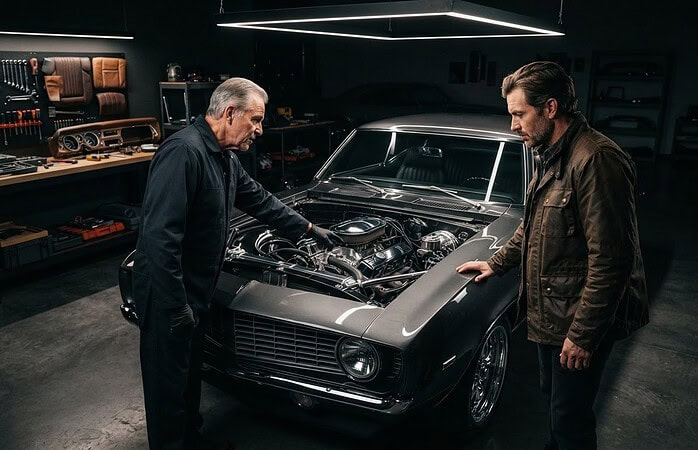

More restoration isn’t always better. Classic car restoration quality standards depend on the car’s purpose: preserving factory originality, meeting show-level expectations, or delivering dependable road use. Resale value depends in part on how well workmanship, documentation, and modifications suit the vehicle and its likely buyers.
That balance matters. A concours-focused restoration may prioritize period-correct details down to individual fasteners, while a driver-focused build can update functional components and retain the car’s distinctive character. Neither approach is automatically superior. The right standard depends on the marque, the vehicle’s condition, and how you plan to enjoy it.
This article explains how restoration style, originality, roadworthiness, and marque-specific needs shape quality and resale value. You’ll learn what careful workmanship looks like, why a model’s identity can influence restoration choices, and how to assess whether a build’s decisions suit its purpose. Heritage deserves precision, as does the drive that follows.
Key Takeaways
- Match the restoration approach to how you’ll use the car, whether that means preserving originality, pursuing show-level detail, or building for regular driving.
- Assess original components, finishes, and marque-specific details before deciding what to preserve or update.
- Look for careful workmanship and clear records of parts, authenticity, and modifications when evaluating a restored car.
- Prioritize structural condition and mechanical function for a road-going classic, while tailoring upgrades to the vehicle’s purpose.
- Explore Elite Certified Restomods or Custom Build Services when you want a classic character paired with modern driving capability.
Preserving original components and finishes
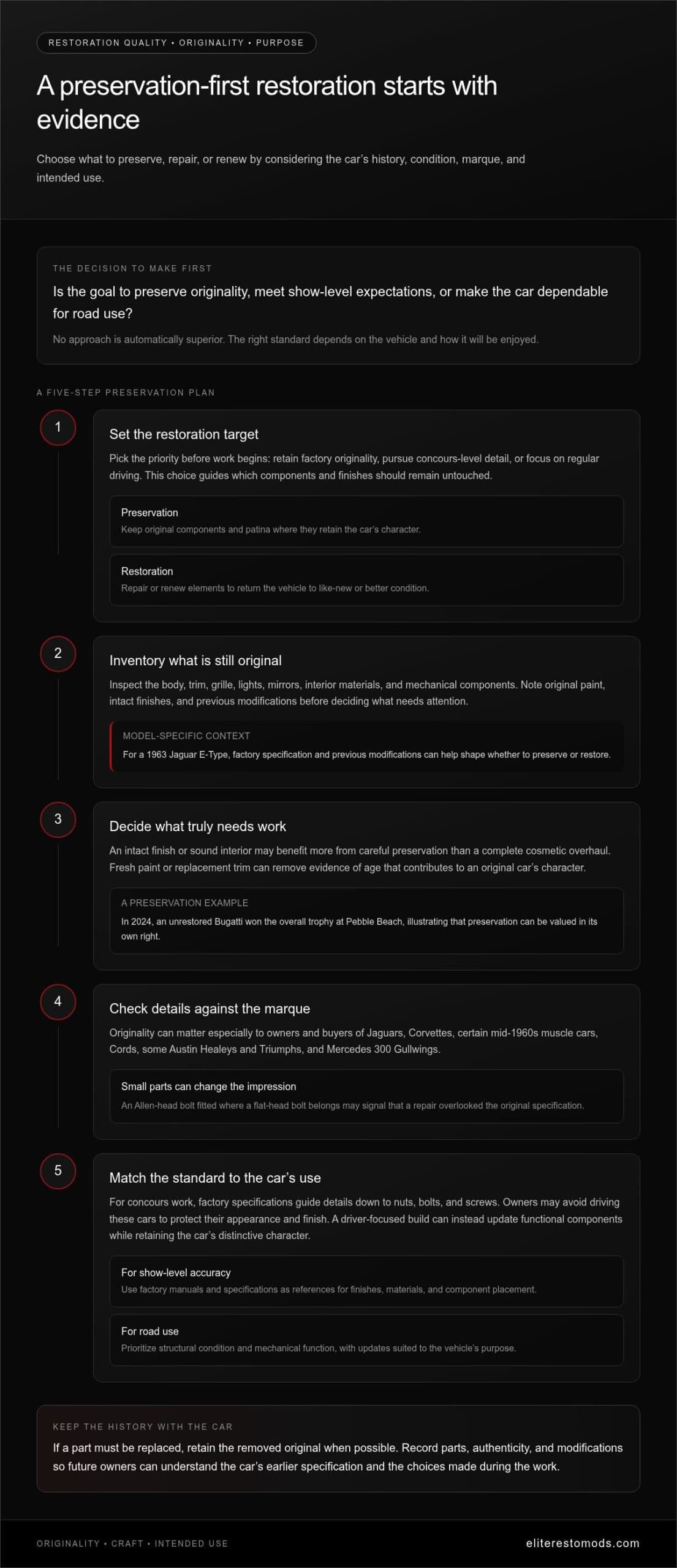
Preservation protects a classic car’s existing character; restoration renews elements that need repair or replacement. The right balance depends on the vehicle’s condition, history, and intended use.
Authenticity and Historical Preservation
Authenticity means retaining a vehicle’s original components and finishes when they preserve its historical character. Original paint, interior materials, and mechanical parts can show how a car has aged and changed over time. For a 1963 Jaguar E-Type, factory specification and previous modifications can help shape the decision to preserve or restore. That context matters: replacing distinctive original elements may alter the story a future owner sees.
Start by identifying what remains original. Inspect the body, trim, grille, lights, mirrors, interior materials, and mechanical components before deciding what needs work. A vehicle with intact paint and a sound interior may benefit more from careful preservation than a complete cosmetic overhaul. If a part must be replaced, retaining the removed original part gives future owners a useful reference and keeps a tangible record of the car’s earlier specification.
Marque and model also influence the value owners place on originality. Jaguars, Corvettes, certain mid-1960s muscle cars, Cords, some Austin Healeys and Triumphs, and Mercedes 300 Gullwings can attract particular interest in original details. A bolt or screw can matter: an Allen-head bolt fitted where a flat-head bolt belongs may signal that a repair overlooked the vehicle’s original specification. Small elements can shape the impression of the whole restoration.
Preservation Versus Restoration
Preservation keeps original components and patina; restoration repairs or renews the vehicle to return it to like-new or better condition. The distinction matters because fresh paint or replacement trim can erase evidence of age that gives an original car its character. In 2024, an unrestored Bugatti won the overall trophy at Pebble Beach, illustrating how preservation can be valued in its own right.
Concours-focused work follows a different priority: the car is expected to match its original manufacture, including nuts, bolts, and screws. Owners may avoid driving concours-restored cars to protect their appearance and detailed finish. That approach suits a display-focused vehicle, but not necessarily one intended for regular road use. Before restoration begins, decide whether originality, show scrutiny, or usable driving matters most. That choice guides which components and finishes should remain untouched.
Concours and traditional restoration styles
Traditional and concours builds prioritize factory specification, but judging systems shape how details are assessed. Let the car’s intended class and use guide the restoration plan.
Factory-Condition Concours Work
Concours restoration aims to return a classic car to factory condition, using original specifications as the reference. Judges assess whether the finished vehicle reflects its manufacture, not simply whether it looks polished. Show-car work can involve consulting factory manuals and specifications, then refining details for close professional scrutiny. In high-end restorations, even panel gaps may be reproduced within fractions of a millimeter.
A carefully restored interior should recover its appearance and function after manufacture. Treat upholstery, trim, controls, and finishes as parts of a historical whole, rather than opportunities for restyling. An altered material or modern component can affect authenticity, even if it looks attractive. Factory documentation helps identify the correct finish and function for each area.
Stock and Concours Approaches
Stock restoration uses period-correct parts to maintain a vehicle’s original specifications; concours work pursues that accuracy under show-level scrutiny. The distinction helps owners select a target before restoration begins. A stock build can prioritize historical correctness, while a concours entry must also present its condition and detail for close inspection. In either approach, increasingly careful research helps prevent attractive but historically inaccurate substitutions.
For example, a factory manual can guide decisions about interior materials, component placement, and finish. Restoration teams can compare those references with the car’s existing configuration, then record where repairs or replacements depart from the documented specification. That record makes the work easier to understand and helps distinguish faithful replacement parts from updates chosen for another purpose.
Restoration Grades and Judging Criteria
Restoration grades describe how closely a car meets a chosen standard, from driver-focused condition to show-level or concours execution. No single grade means the same thing across every judging system, so compare the stated criteria and class requirements. Judges assess factory specification, workmanship, condition, and detail, with close attention to areas relevant to the entry class.
For a show-car restoration, judges may compare the finished work with factory manuals and vehicle specifications. They may assess the interior against its post-manufacture appearance and function, and examine bodywork for precise panel alignment. Look beyond a grade label: read what the class rewards, then assess whether the car’s evidence and finish meet those expectations.
Standards Across Clubs and Organizations
Judging standards differ among clubs because each organization sets its own guidelines, classes, and scoring emphasis. That matters when preparing a car for a particular event: the same restoration can be judged under different criteria. In 2014, the Antique Automobile Club of America published official judging guidelines, demonstrating why entrants should use the rules for their intended organization.
To compare restorations, identify the event’s class, its originality expectations, and the areas judges assess. Then compare those criteria with the car’s documentation, components, and finish. Don’t treat one club’s grade as a universal verdict. A carefully executed restoration may suit a different class or judging emphasis than the one an owner has in mind.
Effects of restoration quality on resale value
A well-restored classic can increase in value over time when the work is done properly. Buyers weigh workmanship alongside the car’s condition, originality, history, and intended use. Applying classic car restoration quality standards consistently makes the vehicle’s condition and restoration choices easier to assess.
Quality shows in more than fresh paint or polished trim. Sound structural repairs, correctly fitted components, and consistent finishes demonstrate careful execution. Rushed bodywork or mismatched parts can undermine confidence, even when a car looks striking in photographs. The strongest evidence pairs visible details with records explaining what was repaired, replaced, or modified.
A high-quality restoration typically begins with a thorough inspection inside and out. The team identifies necessary repairs and plans the work. In a ground-up restoration, mechanical function typically comes before interior and exterior work. Photographs of disassembly and rebuilding, parts lists with sources and authenticity records, and notes on updates create a traceable project history.
Restoration costs in the United States depend on the vehicle’s condition, parts requirements, and customization. Structural, mechanical, interior, and finish work all shape the project’s scope. The restoration plan and amount of work required determine the cost, rather than any single standard figure.
Time follows a similar pattern. A full car restoration can take many years, depending on the vehicle’s condition and required customization. Specialty parts and the sequence of work can also affect progress. A project plan helps show how the restoration’s scope influences its duration.
Provenance, rarity, and production history add context to a buyer’s assessment. Documentation can connect the car’s current configuration to its recorded past and clarify which components remain original. For a rare model, evidence of its specification and restoration decisions can be especially useful to collectors. Investment value depends on how the car’s history, condition, and execution align with its market, not on finish alone.
Common quality problems include rushed bodywork, careless assembly, and components that conflict with the car’s specification. An Allen-head bolt where a flat-head bolt belongs is one possible warning sign. Inspect visible fasteners and finishes, review restoration photographs and parts records, and assess the chassis and mechanical work. These checks help you compare claims with evidence.
For resale, the most persuasive restoration is coherent: the work suits the vehicle, its history, and its intended use. A show-focused finish and a driver-oriented update serve different priorities. Consistent classic car restoration quality standards make those decisions clear to prospective buyers, supporting an assessment based on the build itself rather than appearance alone.
Driver-level restoration and roadworthiness
A driver-level restoration aims to put a classic car in good running condition, with bodywork focused on preventing rust and addressing necessary repairs. It suits owners who want to use the vehicle, not preserve every detail for display. The standard is practical, but still requires careful attention to the chassis, engine, steering, brakes, and other working systems.
Begin with the structure. The chassis forms the vehicle’s foundation, so inspection should identify damage or deterioration that could compromise the rest of the work. Then assess the suspension, steering, and brakes before focusing on paint or interior trim. This order helps reveal whether mechanical repairs or upgrades should shape later decisions.
Engine checks are central to a road-focused restoration. Before starting an engine, inspect lines and hoses for breaks or leaks, replenish the oil, top off the radiator with water, and check the battery charge and ignition system. Mechanical restoration also includes tests to establish whether the engine works and is roadworthy. These steps help identify problems before treating the car as ready for regular use.
A driver-focused build can preserve an original-looking exterior while modernizing functional components. Brake and steering upgrades are common options, including disc-brake conversions and faster-ratio steering boxes. Older hydraulic, transmission, rubber, and electrical components may also be candidates for modernization. Each change should work with the rest of the vehicle. An engine upgrade, for example, may require corresponding changes to the transmission and rear end.
Good road manners depend on how parts work together. Pro-touring builds prioritize handling, stability, and braking, while modern shock absorbers can improve damping control, ride comfort, and handling. Sway bars can reduce body roll in corners, and progressive-rate springs can balance highway comfort with control during more spirited driving. These are design choices, not universal requirements; let the car’s intended use guide the setup.
Classic trucks need particular attention to suspension condition. Hard use can leave components worn, while original designs often prioritized durability over ride refinement. Lowering a truck also calls for attention to suspension geometry, helping preserve handling and avoid premature wear. A suitable setup can improve ride quality while maintaining load-carrying capability.
Driver-level work is the most basic restoration level, but it isn’t necessarily less expensive. Even minimal bodywork can involve substantial mechanical repairs, and the vehicle’s condition determines the work required. Proper restoration quality means matching each repair to its purpose: sound structure, tested mechanical systems, dependable function, and bodywork that protects the car while preserving its classic character.
Brand-specific restoration considerations
A restoration plan should start with the engineering and identity of its marque. A Chevrolet, Ford, air-cooled Volkswagen, and Porsche can call for different decisions, even when owners share the same goal: a classic that feels right on the road. Applying classic car restoration quality standards to a specific make means considering its design, components, and intended use together. That knowledge helps enthusiasts distinguish a thoughtful update from a change that obscures the vehicle’s character.
For some classic-car applications, GM and Ford sell complete modern engine and transmission packages with computer controls. Such a conversion needs system-level planning, not an engine choice in isolation. An engine upgrade may require related changes to the transmission and rear end. A 1967 Ford Mustang restomod with the heart of a 2020 Shelby GT500 illustrates how dramatically a build can reinterpret its original platform. The result should reflect a clear decision about performance, driving use, and the character the owner wants to retain.
An air-cooled Volkswagen presents a different challenge because it wasn’t originally built for performance. Some owners consider an engine upgrade, but more power isn’t automatically the right choice. Assess the vehicle’s purpose and existing systems before deciding. An enthusiast seeking a historically faithful Volkswagen may prioritize different qualities from someone building for more responsive driving. The marque’s original engineering gives context to both approaches.
Shared platforms can also inform marque-specific work. Buick, Oldsmobile, and GMC are GM divisions with platform relationships, allowing projects to draw on suspension knowledge across those brands. That knowledge can help frame technical decisions, but it doesn’t make every component suitable for every model. The individual vehicle’s configuration and condition still matter. Fitment and function should support the specific car, rather than relying on a related model as a substitute for research.
Provenance claims require equal care. A supposedly numbers-matching Porsche 911 can carry important investment implications, so assess identifying details and supporting records before treating the claim as established. This example shows why marque expertise matters: correct identification can shape restoration choices, authenticity, and buyer confidence. Concours expectations make factory specification especially relevant.
Use the make, model, and intended use to guide each major decision. For a Ford or GM restomod, consider the engine, transmission, and rear end as a coordinated system. For an air-cooled Volkswagen, weigh performance goals against its original design. For a Porsche 911, scrutinize a numbers-matching claim against evidence. These are practical ways to apply classic car restoration quality standards without treating every classic as though it shared the same blueprint.
Elite Restomods: Elite Certified Restomods
Elite Restomods offers Elite Certified Restomods for enthusiasts seeking a classic with modern driving capability. If you want a build shaped around your priorities, Custom Build Services can help define the balance between heritage, performance, and usability. Each approach starts with a central restoration question: how should the car feel and function when it’s finished?
Owners preparing to sell can use the Consignment Program, while Climate-Controlled Storage supports vehicle care between drives or during a longer ownership transition. These options suit different stages of a classic car’s journey, from choosing a finished build to managing or safeguarding an existing vehicle.
Contact Elite Restomods to discuss which option best fits your vehicle and plans.
Shape the Next Chapter of Your Classic
The most rewarding build is one that feels right every time you turn the key. Use classic car restoration quality standards as a decision framework, then picture the experience you want: the presence of a period-correct icon, the confidence of modern performance, or a personal blend of both. That vision can guide the choices shaping your car’s identity and how you’ll enjoy it.
Elite Restomods offers Elite Certified Restomods for drivers drawn to classic design with contemporary capability, and Custom Build Services for projects shaped around individual priorities. If ownership is shifting, the Consignment Program offers another path for a vehicle ready for its next chapter. Each option meets a different need, from selecting a finished car to developing a distinctive build or preparing to sell.
Explore the possibilities and contact Elite Restomods to discuss your direction. Your classic’s next chapter starts with the vision you choose.
Frequently Asked Questions
What are recognized quality standards for classic car restoration?
There isn’t one universal grading system for every classic car restoration. Standards depend on the goal: factory-correct presentation, show judging, or dependable use. For concours evaluation, organizations publish their own judging criteria; the Antique Automobile Club of America published official guidelines in 2014. Before comparing two restoration grades, identify the organization and class behind each one. A grade only has meaning alongside the criteria used to assign it.
What do concours, show-quality, driver-quality, and preservation restorations mean?
These terms describe different priorities, not interchangeable levels on one universal scale. Concours work targets factory condition and close judging scrutiny; show-quality work emphasizes a highly finished appearance. Driver-quality focuses on running condition and practical use, while preservation retains original components and patina. For example, a car intended for regular drives may prioritize functional updates, while a display-focused entry may emphasize period-correct details. The right label depends on the car’s purpose.
How can originality and authenticity be verified during a restoration?
Compare the vehicle’s details with factory specifications, then keep evidence of the work. A useful record includes photographs from disassembly, parts lists, authenticity information, and notes about modifications. For a car described as numbers-matching, examine the identity of its major components against supporting vehicle records rather than relying on appearance or a seller’s description. A professional evaluation can help assess a claim, as illustrated by the Porsche 911 example discussed earlier.
What safety and mechanical standards should a restored classic car meet?
No single restoration grade establishes roadworthiness. Assess the car’s structure, engine operation, brakes, steering, suspension, and supporting systems as a connected whole. A running engine alone, for example, doesn’t show that the vehicle is ready for regular driving; hoses, lines, ignition, and battery condition also matter. Evaluate the car against its intended use, and treat any performance change as a reason to assess related drivetrain components.
Are there U.S. laws or inspection requirements for restored classic cars?
Requirements for a restored classic can depend on where the vehicle is registered and how it will be used. Restoration quality criteria, such as concours judging rules, are separate from legal requirements for road use. Before driving or registering a particular vehicle, identify the rules that apply to its location and configuration, including any relevant inspection or emissions requirements. A show award or restoration grade doesn’t itself establish legal compliance.
How much does a quality classic car restoration cost in the United States?
Costs depend on the car’s condition, parts requirements, and customization.