
What if enjoying a classic car didn’t mean bracing for the next mechanical surprise? The concern is understandable: an unfamiliar maintenance schedule, an unexpected fault, or uncertainty about storage can make a cherished car feel more like a responsibility than a pleasure. But overcoming classic car ownership anxiety doesn’t require predicting every problem. It starts with turning uncertainty into a routine you can rely on.
This guide will help you distinguish practical concerns from assumptions and build simple habits around maintenance, recordkeeping, storage, and driving. You’ll also learn how to assess a car’s condition and records, and how a well-sorted vehicle may reduce uncertainty from the outset. For drivers who love classic design but want a more approachable ownership experience, a carefully developed restomod can pair vintage character with selected modernized components. The goal isn’t to keep your car on display or expect a trouble-free experience every moment. It’s to feel prepared enough to turn the key, take the road, and enjoy the drive.
Key Takeaways
- Separate practical ownership concerns from the assumption that every classic is inherently difficult to live with.
- Build a simple readiness routine: understand the vehicle, review its records, plan care, prepare, and drive progressively.
- Compare original classics and restomods by condition, build quality, and intended use, not by label alone.
- Make overcoming classic car ownership anxiety more manageable by identifying your main concern, the evidence you need, and one practical next step.
- Consider how a fully sorted, quality-assured vehicle may reduce uncertainty before ownership and help match the car to your plans.
Why Classic Car Ownership Can Feel Anxious, and What You Can Control
A classic can stir an immediate connection: the shape of the bodywork, the sound of the engine, the feeling of another era brought to life. Then practical questions follow. Will it start? What maintenance does it need? Could a mechanical issue interrupt a drive? Those concerns are real, but they don’t mean classic-car ownership is inherently unmanageable.
Ownership anxiety often comes from uncertainty about a particular car, its upkeep, or how you’ll use it. That’s different from recognizing that no vehicle can be guaranteed trouble-free. If you’re overcoming classic car ownership anxiety, separate questions you can investigate, such as missing service records or unclear storage needs, from the unknowns no plan can eliminate. For a neutral overview of what is a classic car, consider how the term reflects both a vehicle’s age and its cultural significance.
To hear common assumptions about classic-car ownership challenged, watch this video:
Which classic-car ownership worries are most common?
Reliability concerns often center on an unresolved detail: a leak that hasn’t been traced, a starting issue, or uncertainty about when key maintenance was last done. Other worries involve learning an unfamiliar care routine, preserving the car’s condition, or having a drive cut short by a fault. Name the specific concern and gather information about it. Worrying about every possible failure at once rarely points to a useful next step.
What can an owner control before the next drive?
Start with the vehicle’s records. Note completed work, recurring symptoms, and upcoming maintenance. Follow the car’s operating and maintenance guidance, then establish a simple pre-drive routine suited to that vehicle. Check that you know how its controls work and choose an initial trip that feels manageable. A short, familiar route can help you learn how the car behaves before you commit to a longer outing. Preparation won’t promise a trouble-free drive, but it can make your decisions more predictable.
Ownership confidence is preparation that makes decisions more predictable. Set realistic expectations, too: a classic has its own character and may need attention that differs from a modern car. For travel-specific ideas, see the comfortable classic-car road-trip guide. Keep the goal simple: understand what you can, plan for the drive, and leave room to enjoy the car.
Build Confidence with a Clear Classic-Car Maintenance and Readiness Routine
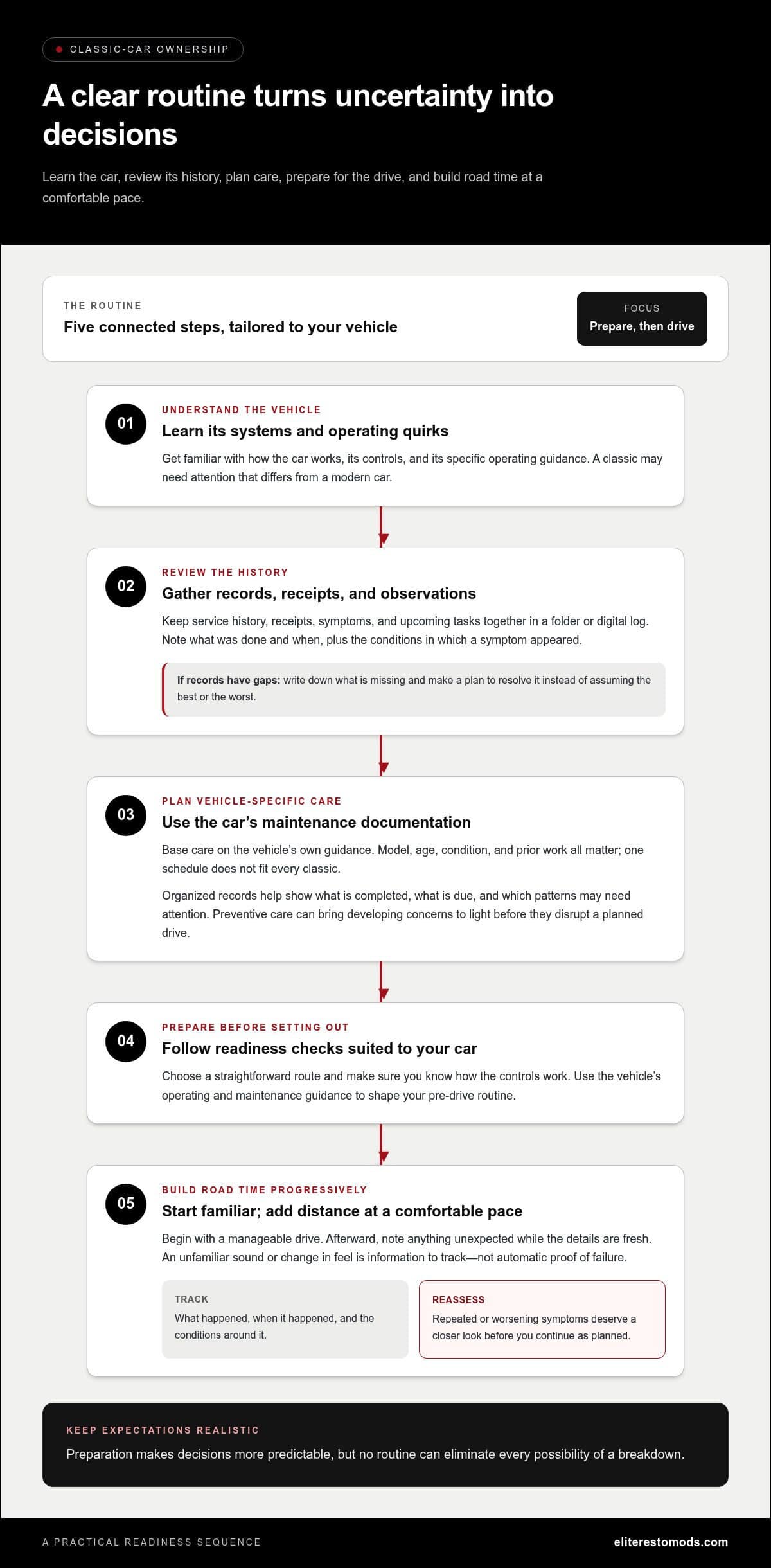
A repeatable routine turns ownership from guesswork into a series of clear decisions. Start by learning the car’s systems and operating quirks. Review its service history, plan care around its specific needs, prepare before each drive, and build road time progressively. This sequence helps you spot what needs attention without treating every unfamiliar sensation as a crisis.
Use the vehicle’s maintenance documentation and service guidance rather than applying one schedule to every classic. Model, age, condition, and prior work all matter. If the records leave a gap, write down what’s missing and make a plan to resolve it instead of assuming either the best or the worst.
How do records and preventive maintenance reduce uncertainty?
Keep service history, receipts, observations, and upcoming tasks together in one organized place, whether that’s a folder or a digital log. Record what was done and when, along with any symptoms you noticed and the conditions in which they appeared. A sound that occurs only on a cold start, for example, is more useful to track than a vague note that the car “sounds different.”
Organized service records help you see what’s been completed, what’s due, and what patterns may need attention. Preventive care can bring developing concerns to light before they disrupt a planned drive, though no routine can eliminate every possibility of a breakdown. For another practical perspective on documentation, storage, and care, see this classic car readiness routine.
How can a new owner ease into regular driving?
Begin with familiar, manageable drives and add distance or complexity at a comfortable pace. Before setting out, follow readiness checks suited to your car and choose a straightforward route. Afterward, note anything unexpected while the details are fresh. An unfamiliar sound or change in feel is information to track, not automatic proof of failure. Repeated or worsening symptoms deserve a closer look before you continue as planned.
For a longer outing, a classic-car road-trip planning guide can help you think through travel-specific preparation. If you’re looking for support with vehicle care and ownership, explore classic-car service options. These habits make overcoming classic car ownership anxiety less about predicting every problem and more about knowing how you’ll respond.
Original Classic or Restomod: Compare the Trade-Offs Behind Ownership Anxiety
Choosing between a largely original classic and a restomod isn’t simply a choice between “unreliable” and “worry-free.” An original car preserves its period character and equipment. A restomod pairs classic styling with selected modernized systems or components. Either can suit the right owner. Condition, build quality, maintenance history, and how you plan to use the vehicle matter more than the label.
| Consideration | Largely original classic | Restomod |
|---|---|---|
| Character | Retains more of the vehicle’s original design and operating feel. | Blends vintage appearance with chosen updates. |
| Mechanical configuration | Generally keeps original equipment, with condition shaped by age and past care. | Includes selected modernized systems or components, depending on the build. |
| Intended use | May appeal to owners who value period authenticity and accept its particular driving experience. | May suit owners seeking classic style for more regular use, depending on its condition and configuration. |
What concerns might an original classic leave unresolved?
Age alone doesn’t tell you how a car will behave. Its current condition, prior maintenance, and the quality of completed work all shape the ownership experience. A well-maintained original may feel more predictable than a neglected example, while retaining period equipment means accepting the design and driving character that came with it. Focus on the specific car’s records and condition, not assumptions about every classic.
How can a restomod change the ownership equation?
A restomod can introduce selected updates while preserving the visual identity that drew you to the car. Modernization doesn’t guarantee freedom from future maintenance or unexpected issues, so the details and quality of the build matter. Elite Certified Restomods undergo a rigorous quality assurance process. Elite Restomods’ curated inventory features fully sorted, investment-grade vehicles presented as ready for reliable daily driving.
When overcoming classic car ownership anxiety, compare each vehicle with your real priorities: original character, intended use, condition, and the maintenance responsibilities you’re comfortable managing. The investment-grade restomods guide offers another perspective as you weigh vehicle approaches. For a broader reflection on the relationship between care and enjoyment, read this perspective on support for more confident ownership. The right choice isn’t a badge or a promise. It’s a match between the car and the way you want to live with it.
Make Classic-Car Ownership Feel Manageable with a Personal Readiness Plan
A personal plan turns a broad worry into a question you can answer. For each concern, write down what’s bothering you, what evidence would clarify it, and the next practical action. If reliability is the worry, for example, review the vehicle’s condition and available service history, then identify what still needs attention. This makes overcoming classic car ownership anxiety a process of informed decisions, not an attempt to eliminate every unknown.
- Main concern: What specifically feels uncertain?
- Useful evidence: What records, vehicle details, or observations could clarify it?
- Next action: What reasonable step can you take once you have that information?
Shape the plan around how you’ll use the car. Occasional weekend drives call for a manageable readiness routine and a place to keep the vehicle protected between outings. Frequent use makes maintenance organization and realistic budgeting more central. Long-term collecting may put greater emphasis on preservation, storage, and documenting the car’s condition over time. Your plan should fit the vehicle’s intended role, not an imagined ideal of ownership.
How should owners prepare for upkeep, storage, and costs?
Set up a budget with separate categories for routine care, unexpected work, and storage. You don’t need to predict every expense to make room for these responsibilities. For storage, consider how often you’ll drive and what conditions support your preservation goals. Secure, climate-controlled storage may be appropriate if you prioritize protection between drives. If storage is a central concern, include Elite Restomods’ climate-controlled storage in your ownership plan.
If financing is part of the decision, include it in your ownership planning alongside maintenance and storage. The aim is to understand how the full commitment fits your circumstances, rather than focusing on the purchase alone. Classic car financing is available through Elite Restomods.
When should you pause, gather information, or move forward?
Pause if an important question about condition, intended use, or your capacity to manage ownership remains unanswered. Identify the missing evidence and the next step that could provide clarity. Move forward when the vehicle’s known condition and responsibilities make sense for the role you want it to play. A written plan helps organize the decision, but it can’t make uncertainty disappear or guarantee a particular outcome.
Use your priorities to guide the final comparison: occasional enjoyment, regular driving, or long-term preservation may each point toward different needs. To explore vehicles with those priorities in mind, browse the curated classic-car inventory and consider how each option aligns with your readiness plan.
Enjoy the Car, Not Just the Idea: Support for More Confident Ownership
A satisfying ownership experience starts with a match between the car’s condition, its intended use, and the care you’re prepared to give it. Records and routines help you manage the vehicle over time. A considered choice can reduce uncertainty before ownership begins. That’s the practical heart of overcoming classic car ownership anxiety. Confidence isn’t the belief that nothing will ever need attention. It’s knowing what you’re choosing and having a sensible plan for living with it.
What can quality assurance clarify before ownership?
A quality assurance process provides useful context when assessing a vehicle’s readiness. Elite Certified Restomods undergo a rigorous quality assurance process, and Elite Restomods’ inventory is curated to include fully sorted, investment-grade vehicles. This can help buyers assess a vehicle beyond its appearance and consider how it fits their intended use. No process can remove every unknown, so weigh that information alongside your plans for driving, upkeep, and storage.
Think about the details that matter to your use. A car presented as ready for reliable daily driving may align with a different ownership plan than one you intend to drive occasionally or preserve as a collector vehicle. Compare the vehicle’s known condition with your expectations, then make a decision grounded in what you know.
What is a useful next step toward a classic you can enjoy?
Use the concerns you’ve identified as a filter. If regular use matters, look for a vehicle whose condition and intended role fit that priority. If you’re focused on a particular style or build approach, compare available vehicles with the same questions in mind. Elite Restomods also offers vehicle sourcing, climate-controlled storage, enclosed transport, financing, custom builds, and consignment services to support different ownership needs.
When you’re ready, learn about the Elite Restomods process to understand the approach behind its vehicles and builds. Then explore the available restomods at your own pace. A classic should be more than an object you admire from a distance. Choose with care, build a practical ownership routine, and leave room for the pleasure of the drive.
Make Room for More Confident Drives
Classic-car ownership feels more manageable when you match the vehicle to your plans, understand its condition, and build simple routines for care and use. Organized records and realistic expectations won’t prevent every surprise, but they can make decisions clearer and help you focus on the pleasure of driving.
That’s the heart of overcoming classic car ownership anxiety: replace vague fears with practical preparation, then choose a car whose character and condition suit the way you want to enjoy it. Elite Restomods offers curated vehicles described as fully sorted and ready for reliable daily driving, with Elite Certified Restomods undergoing a rigorous quality assurance process. Support is available through services including custom builds, consignment, climate-controlled storage, classic car financing, vehicle sourcing, and enclosed transport.
When you’re ready to explore a classic built for real-world enjoyment, explore Elite Restomods and take the next step toward confident classic-car ownership. The right preparation can make the first drive feel less like a leap and more like the beginning of something memorable.
Frequently Asked Questions
Is it normal to feel anxious about owning a classic car?
Yes, it’s understandable to have practical concerns about reliability, maintenance, storage, or an interrupted drive. Those questions don’t mean classic-car ownership is inherently unmanageable. Overcoming classic car ownership anxiety starts with naming a specific worry and identifying what information or action could address it. Reviewing the car’s condition and records can turn a vague fear into a clearer decision, while accepting that no vehicle is entirely free of uncertainty.
How can I feel more confident driving a classic car?
Build familiarity gradually. Start with a manageable drive on a familiar route, follow a readiness routine suited to the vehicle, and note anything that feels unusual afterward. Keep track of when a sound or change occurs rather than assuming one unfamiliar sensation means something is wrong. Reviewing these notes alongside the car’s service history can help you recognize patterns and decide whether anything needs attention before you plan a longer drive.
Are classic cars unreliable compared with modern cars?
There isn’t one answer for every classic. Reliability depends on the specific vehicle’s condition, maintenance history, and mechanical configuration. An older car may have different operating characteristics and care needs than a modern vehicle, but age alone doesn’t establish its current reliability. Assess the individual car and how it has been maintained rather than relying on a broad assumption. A clear understanding of its condition can help set realistic expectations for use.
Can a restomod reduce the stress of classic-car ownership?
A restomod may address some concerns by combining classic styling with selected modernized systems or components, but it doesn’t remove every ownership responsibility. Build quality and current condition still matter. Elite Certified Restomods undergo a rigorous quality assurance process, and Elite Restomods’ curated inventory features fully sorted vehicles presented as ready for reliable daily driving. That can offer useful context before purchase, while routine care and realistic expectations remain part of ownership.
What should I do if I worry my classic car will break down?
Replace the general fear with a specific question: Is there a symptom, a gap in the service history, or an upcoming maintenance task you’re unsure about? Record what you notice, review the vehicle’s maintenance guidance, and plan the next practical step. If a concerning or worsening symptom appears, pause the planned drive until you’ve addressed the concern. Preparation can clarify decisions, though it can’t guarantee that a breakdown won’t happen.
Does storing a classic car properly help reduce ownership worries?
Yes, appropriate storage can support preservation and make the car’s care feel more considered, especially if it spends extended periods off the road. Think about how often you use the vehicle and what conditions suit your preservation goals. Secure, climate-controlled storage is one option to consider. Storage alone doesn’t guarantee a particular condition, so include it as one part of a wider plan for maintenance, records, and regular readiness checks.
Should I choose an original classic or a restomod if I am worried about reliability?
Choose based on the individual vehicle and the kind of ownership experience you want, not the label alone. An original classic preserves more of its period character and equipment. A restomod pairs classic styling with selected updates. Compare condition, build quality, available records, and intended use. A quality assurance process can provide helpful pre-purchase context, but neither configuration guarantees trouble-free ownership. Match the car’s known condition to your plans and expectations.