
A shorter rear-end gear can make a restomod leap off the line, but it doesn’t have to turn every highway drive into a high-RPM workout. With overdrive, a performance-oriented axle ratio can work alongside relaxed cruising. That’s why choosing the right gear ratio for a restomod starts with the whole drivetrain, not a single number.
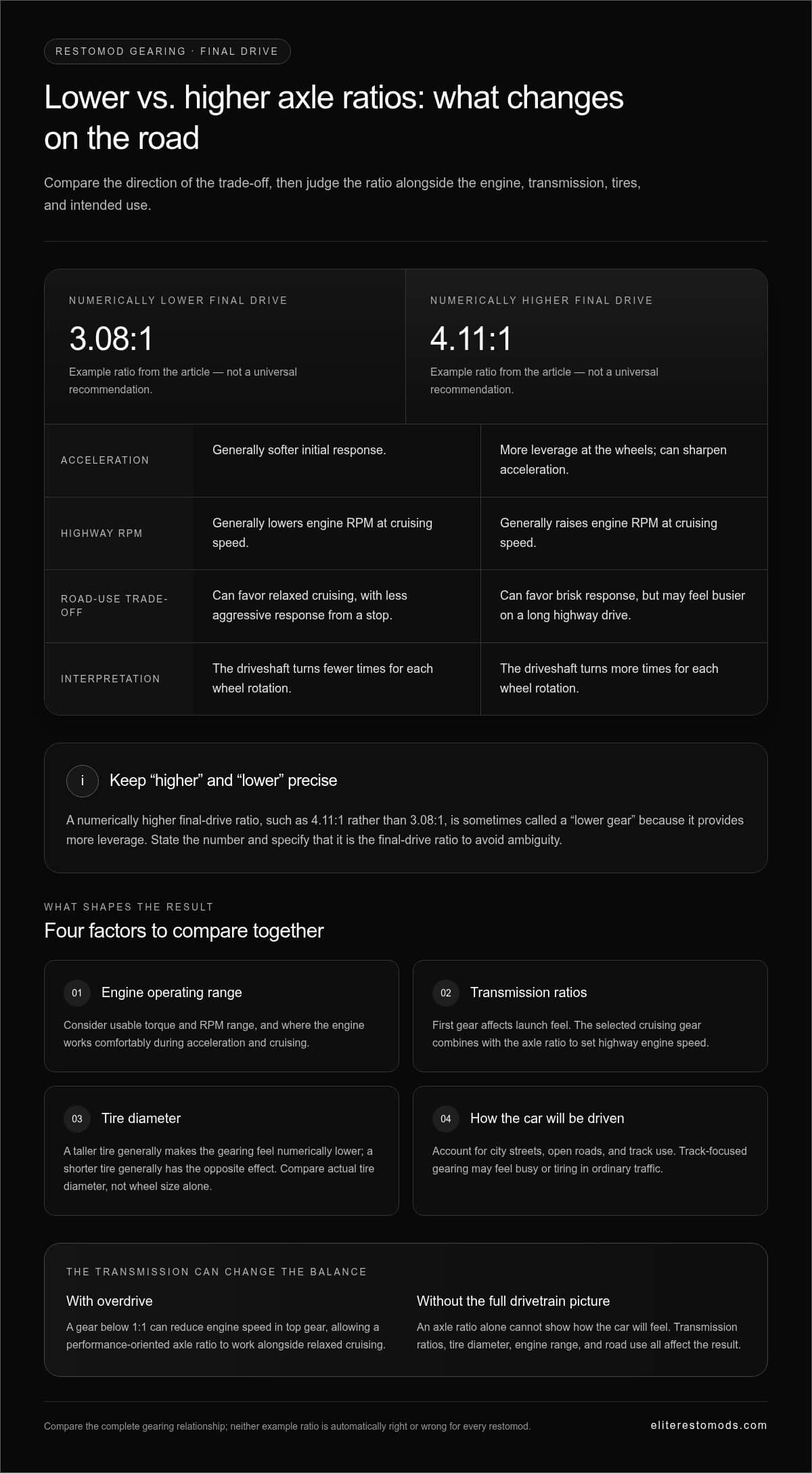
The options can seem confusing at first. A numerically lower final-drive ratio, such as 3.08:1, generally lowers engine RPM at cruising speed. A numerically higher ratio, such as 4.11:1, can sharpen acceleration but raise highway RPM. The right balance depends on the engine’s useful power range, the transmission’s gear ratios and cruising gear, tire diameter, and the roads you expect to drive.
This guide offers a repeatable way to compare those factors and understand how the final-drive ratio affects everyday driving. You’ll see how gearing choices support street comfort, highway cruising, or spirited driving, and how to plan a coherent drivetrain. That system-level approach also informs Elite Restomods’ Custom Builds, supported by world-class fabrication and the in-house Elite Performance Center. All Restomods include a 1 year extended service contract through Classic Vehicle Protection.
Key Takeaways
- Separate the rear axle’s final-drive ratio from the transmission’s gear ratios to understand what each number changes.
- When choosing the right gear ratio for a restomod, compare the engine’s usable RPM range with the transmission’s cruising gear and tire diameter.
- Weigh street, highway, and spirited-driving priorities instead of assuming one ratio suits every build.
- Use the transmission ratios, final-drive ratio, tire diameter, and target road speed to evaluate each option against your intended use.
- Treat gearing as part of the complete build plan, aligning it with the engine, transmission, suspension, and drivability goals.
What Does a Gear Ratio Change in a Restomod?
A restomod’s gearing shapes a familiar choice: lively acceleration, relaxed cruising, or a balance between the two. The final-drive ratio affects how engine power reaches the tires, influencing how quickly the car responds and how fast the engine turns at a given road speed. Choosing the right gear ratio for a restomod is therefore a decision about the whole driving experience, not a search for the largest or smallest number.
What does the final-drive ratio mean?
The final-drive ratio, often called the axle ratio, is set by the differential’s ring and pinion gears. It describes how many times the driveshaft turns for each rotation of the axle and wheels. A numerically larger ratio multiplies torque more at the wheels, all else being equal, while the wheels turn fewer times per driveshaft rotation. Transmission gear ratios are separate: they determine how engine speed and torque are transformed in each selected gear before power reaches the final drive. Together, the transmission and final drive establish the full gearing relationship. For a foundation in the mechanics, see Understanding Gear Ratios.
Example: With a 3.08:1 final drive, the driveshaft turns about 3.08 times for each wheel rotation. With a 4.11:1 final drive, it turns about 4.11 times. If the transmission, tire size, and road speed are otherwise unchanged, the 4.11 ratio generally gives stronger leverage at the wheels and makes the engine turn faster while cruising. These figures illustrate the relationship; they are not recommendations for every restomod.
Why is gear-ratio terminology confusing?
“Higher” and “lower” can mean different things. A numerically higher final-drive ratio, such as 4.11:1 rather than 3.08:1, is often called a “lower gear” because it provides more leverage, similar to selecting a lower transmission gear. But “higher ratio” can also mean a larger numerical value. To keep a build discussion precise, state the number and what it describes. For example, say “a 4.11:1 final drive” rather than just “a higher gear.”
For a restomod, the final-drive ratio is the ring-and-pinion relationship that determines how many driveshaft rotations produce one wheel rotation, shaping wheel torque and engine speed in combination with the transmission and tires.
This distinction matters for a car expected to do more than launch hard. More axle leverage can deliver brisk response from a stop, but the accompanying increase in engine speed may be unwelcome on a long highway run if the transmission lacks a suitably tall cruising gear. Conversely, a numerically smaller ratio can reduce cruising RPM but soften initial response. Neither is automatically right or wrong. The useful question is how the ratio works with the complete drivetrain and the roads the car will travel.
Which Drivetrain Factors Should Shape a Restomod Gear Ratio?
A final-drive ratio only makes sense in the context of the entire drivetrain. The engine’s useful operating range, transmission ratios, tire diameter, and the car’s intended role all shape how the gearing feels. Consider these factors together before comparing axle options, because changing one can alter the effect of the others.
How do engine and transmission change the decision?
Start with the engine’s usable torque and RPM range, not peak horsepower alone. An engine that delivers strong torque at lower RPM may feel responsive without aggressive gearing. An engine that needs more revs to reach its strongest pull may benefit from a different combination. The practical question is where the engine works comfortably during acceleration and at the speeds you expect to cruise.
The transmission adds another layer. First gear affects the leverage available when moving away from a stop. A transmission with a numerically higher first-gear ratio can produce a different launch feel from one with a taller first gear, even when both use the same final drive. At the other end of the gear spread, the selected cruising gear combines with the axle ratio to set engine speed on the highway. Overdrive, a transmission gear below 1:1, can reduce engine speed in top gear and give the overall setup more flexibility.
That’s why choosing the right gear ratio for a restomod requires the engine and transmission specifications, not a ratio recommendation in isolation. A combination suited to one engine’s powerband or one transmission’s gear spread may feel mismatched with another.
Why do tire size and driving plans matter?
Tire diameter changes the effective gearing at the road. A taller tire travels farther with each revolution, which generally makes the gearing feel numerically lower: the engine turns fewer times over a given distance. A shorter tire generally has the opposite effect. So even if the axle ratio stays fixed, changing tire diameter can alter launch response and cruising RPM. Include the actual tire diameter in your comparison, not just the wheel size.
Next, describe how the car will actually be driven. A build used for frequent commuting, relaxed highway miles, or occasional spirited routes may call for a different compromise from a car focused on track sessions. Track-oriented gearing can keep the engine in a useful range during hard acceleration, yet feel busy or tiring in ordinary traffic. A clear picture of normal use makes the numbers more meaningful.
- List the routes you expect to drive most often, including city streets, open roads, or track days.
- Identify your typical cruising speeds and whether sustained highway travel is part of the plan.
- Decide whether launch response, lower cruising RPM, or versatility matters most to you.
- Record the engine’s useful RPM range, transmission ratios, and planned tire diameter before comparing final drives.
This joined-up decision benefits from careful build planning. Elite Restomods’ Custom Build process is supported by world-class fabrication and an in-house Elite Performance Center, providing a way to coordinate drivetrain choices with the restomod’s broader goals.
How Do You Compare Gear Ratios for Street, Highway, and Spirited Driving?
There’s no universal “best” final-drive ratio for a restomod. Compare candidate setups by asking three practical questions: How responsive should the car feel pulling away? What engine speed feels comfortable on your regular drives? How much flexibility do you want across different roads? The answers make choosing the right gear ratio for a restomod a comparison of priorities, not a hunt for one magic number.
| Driving focus | What the setup prioritizes | Trade-off to consider |
|---|---|---|
| Street-focused | Balanced response and manageable engine speed in everyday use | A setup aimed at extra launch response may feel busier during longer drives |
| Highway-focused | Comfortable engine speed during sustained cruising | A taller-feeling combination may soften response from a stop |
| Spirited-use | Strong response and gearing suited to enthusiastic acceleration | Sharper response can mean higher engine speed at cruising speeds |
What should a street-focused restomod prioritize?
Think about the rhythm of ordinary use: stop-and-go traffic, frequent starts, and the occasional open stretch. A street-focused balance should deliver the response you enjoy without making routine driving feel overly busy. The right balance depends on the engine, transmission, tire size, and your preferred driving feel, so “comfortable” won’t mean the same thing in every build.
Consider how often you’ll accelerate from a stop compared with how often you’ll cruise at a steady speed. A setup that feels lively around town may be less appealing if the car spends long periods on faster roads. Likewise, a choice that prioritizes calm cruising can feel less immediate in traffic. Personal preference matters: some owners enjoy assertive response, while others value a composed, easygoing character.
How does highway or spirited use shift priorities?
For sustained highway travel, pay close attention to engine speed in the transmission’s cruising gear. For spirited driving, responsive acceleration may matter more, but the resulting engine speed can also shape the drive to and from those favorite roads. The table outlines broad trade-offs; actual results depend on the complete drivetrain and vehicle setup.
The core trade-off: Gearing that sharpens response can make cruising feel busier, while gearing that favors relaxed cruising can temper acceleration. An overdrive transmission can broaden the choices, but it doesn’t remove the need to assess the engine, tire diameter, and intended use together.
Before settling on a direction, rank your priorities: launch response, cruising comfort, and flexibility. Then compare how each candidate combination serves those priorities instead of judging the axle number by itself. For owners shaping a broader build plan around these goals, Elite Restomods’ Custom Build services provide a path to consider.
How Can You Calculate and Validate a Restomod Gear-Ratio Choice?
A cruising-RPM estimate can turn a shortlist of axle ratios into a more useful comparison. It won’t tell you which setup is best on its own, but it can show how each option may behave at a chosen road speed and whether that engine speed suits the build’s intended use. When choosing the right gear ratio for a restomod, use the calculation as a screening tool, then assess the result against the complete drivetrain and driving plan.
What information do you need before estimating cruising RPM?
Gather the engine’s usable RPM range, the transmission’s ratios, the final-drive ratio, tire diameter, and a target cruising speed. Use the transmission ratio for the gear you expect to select at that speed. If the transmission has overdrive, enter its actual top-gear ratio for the estimate rather than assuming the direct gear is the cruising gear.
For speed in miles per hour and tire diameter in inches, use this common estimate:
Engine RPM ≈ (road speed × transmission gear ratio × final-drive ratio × 336) ÷ tire diameter
The 336 factor converts the units in this formula. Calculate the result separately for each candidate final-drive ratio, keeping road speed, selected transmission gear, and tire diameter consistent. This is an estimate, not a promise of exact engine speed. It assumes the stated tire diameter is representative and doesn’t account for factors such as tire growth or torque-converter slip. For a manual transmission or a locked converter, the estimate is generally a closer guide to the mechanical relationship.
How should you test the choice before finalizing it?
Use a consistent workflow to compare options against the car’s intended purpose:
- Record the engine’s useful operating range and the complete transmission gear ratios.
- Confirm the proposed final-drive ratio and the tire diameter planned for the build.
- Choose a realistic target road speed and the transmission gear the car would use there.
- Estimate engine RPM for each final-drive option using the same inputs and formula.
- Compare the estimates with the engine’s usable range, then weigh the result against your acceleration and cruising priorities.
Look beyond the top-gear estimate. A choice that seems suitable at cruising speed still needs to work with the transmission’s first gear and the engine’s behavior under acceleration. If you change tire diameter or transmission gearing, recalculate: either change affects the combination, even if the axle ratio stays the same. This system-level check keeps the decision grounded in the actual build rather than a ratio borrowed from another car.
Use the calculation to narrow the options, then decide whether the estimated cruising speed suits the way the restomod will be driven. A spreadsheet can make side-by-side comparisons easier, but accurate inputs matter more than a polished table. Elite Restomods’ Custom Build services offer a way to integrate drivetrain choices into a broader project plan.
How Does Gear-Ratio Planning Fit into a Complete Restomod Build?
A gear ratio can’t be judged in isolation. It works with the engine’s power delivery, the transmission’s gear spread, tire size, suspension, and the overall vehicle setup. A change made late in the process can shift the balance established elsewhere: the car may respond differently under acceleration or feel less composed at the speeds it’s meant to cruise. Planning these choices together helps preserve the character and usability the build is meant to deliver.
Why should gearing be considered with the whole vehicle?
Think of the engine, transmission, tires, final drive, and driving plan as one connected system. Choosing gearing before understanding those relationships can create a mismatch between the engine’s useful range and the car’s everyday role. A coordinated Custom Build plan puts drivetrain choices in context with the rest of the vehicle instead of treating the axle ratio as a standalone specification.
For example, a transmission change can alter launch behavior and cruising RPM, while a different tire diameter changes effective gearing at the road. Suspension and drivability goals matter, too: power that arrives abruptly may affect how the car feels through a corner or in traffic. One ratio doesn’t determine the whole driving experience, but each choice contributes to the balance, and changing one part can influence how the others work together.
How can a build process bring the decision together?
Elite Restomods offers Custom Builds supported by world-class fabrication and an in-house Elite Performance Center. Its AIM Quality Assurance Methodology inspects drivability along with suspension, brakes, fuel, electrical systems, and exhaust. Those areas provide broader vehicle context; the inspection isn’t a certification of a specific gear ratio.
A thoughtful build process carries the decision from concept into a complete vehicle. Intended use informs the drivetrain plan, which should make sense alongside the car’s other systems. Elite Restomods focuses on investment-grade, fully sorted restomods intended to be driven and enjoyed, bringing classic character together with modern engineering. The aim is a coherent whole, not a collection of impressive components that don’t work in harmony.
As you shape your plan, make the driving brief specific: how the car should respond, where it will spend its time, and what kind of cruising comfort matters to you. Then consider the engine, transmission, tires, and final drive as a coordinated set. This gives the build team a clearer foundation for evaluating trade-offs and helps keep the result aligned with the experience you want.
To explore Elite Restomods’ approach to bringing a classic car into modern use, explore Elite Restomods.
Turn Your Driving Vision into a Build Plan
The most useful next step is to define the experience you want behind the wheel. Picture the roads you’ll travel, how you want the car to respond, and the cruising character that will make you eager to take the long way home. Those preferences give your build team a practical brief, turning choosing the right gear ratio for a restomod from a number-picking exercise into a decision based on how you’ll use the car.
Bring that vision into the broader build conversation. A considered drivetrain plan can unite the classic character you love with the modern drivability you expect, while leaving room to refine details as the project takes shape. The result should feel deliberate, not dictated by a ratio borrowed from another car.
Explore Elite Restomods’ fully sorted vehicles and custom-build expertise to see how a thoughtful plan can shape a restomod built for the road ahead. Explore Elite Restomods and take the next step toward a car that feels unmistakably yours.
Frequently Asked Questions
What is the difference between a transmission gear ratio and a rear-end gear ratio?
A transmission gear ratio applies to the gear selected inside the gearbox, while the rear-end ratio describes the gearing between the driveshaft and the wheels. Each transmission gear changes how engine speed and torque are delivered; the rear-end ratio then affects the drivetrain in every gear. For practical comparisons, note the transmission ratio and axle ratio separately. Together, they determine the overall gearing in the gear you’re using.
Is a numerically higher gear ratio better for a restomod?
No, a numerically higher rear-end ratio isn’t automatically better. It can provide more leverage at the wheels, which may make acceleration feel more immediate, but it can also raise engine speed at a given road speed. Whether that trade-off suits the car depends on its engine, transmission, tire size, and primary use. Compare how each option affects both the response you want and the cruising behavior you’ll experience.
How does tire diameter affect a car’s effective gear ratio?
Tire diameter affects how far the car travels with each wheel revolution. A taller tire generally acts like a numerically lower final drive, while a shorter tire generally acts like a numerically higher one. For example, if you change to taller tires but keep the same axle ratio, the car may cruise at a lower engine speed. Include actual tire diameter in calculations, since wheel diameter alone doesn’t establish the full tire size.
Can changing the rear-end ratio reduce highway cruising RPM?
Yes. With the same transmission gear, tire diameter, and road speed, changing to a numerically lower rear-end ratio generally reduces engine RPM while cruising. The trade-off may be a softer response during acceleration. If the car has overdrive, its cruising gear also affects engine speed, so compare the full combination before changing the axle ratio. A ratio that lowers RPM on paper still needs to suit the engine’s operating range.
How do I estimate engine RPM at highway speed?
Use this estimate for road speed in miles per hour and tire diameter in inches: RPM ≈ (speed × transmission gear ratio × final-drive ratio × 336) ÷ tire diameter. Enter the ratio of the gear you’ll use at that speed, including overdrive if applicable. The result is an estimate, not an exact reading; tire dimensions and drivetrain behavior can affect actual RPM. Compare the estimate with the engine’s usable operating range.
What happens if the gear ratio does not match the engine and transmission?
A mismatch can make the car feel less suited to its intended use. It might feel sluggish when pulling away, or the engine may turn faster than you’d like during steady cruising. The effect depends on the engine’s useful range, transmission ratios, tire diameter, and driving conditions. Before replacing the rear-end gears, consider whether another part of the combination, such as the transmission or tire size, contributes to the behavior.
Does a restomod need different gearing for street driving and track use?
Not necessarily, but the priorities can differ. Street use may call for a balance that feels composed in traffic and during longer drives, while track use may favor response suited to the course and driving style. A car used for both needs a deliberate compromise, and the transmission’s available gears can influence that flexibility. Choosing the right gear ratio for a restomod means matching the complete setup to how the car will actually be driven.