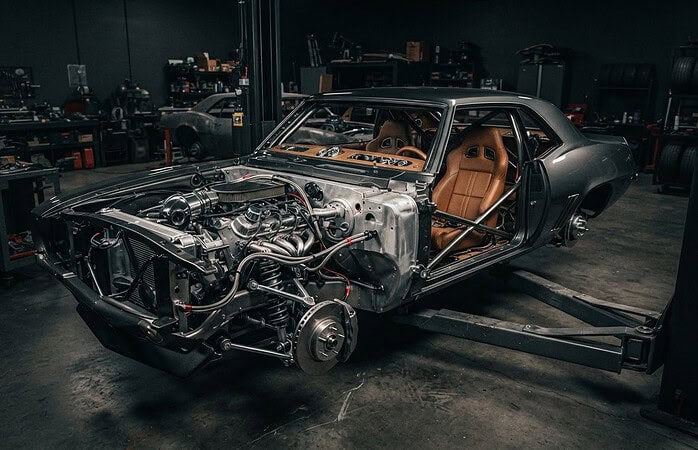

The more prestigious brake kit isn’t automatically the better choice for your restomod. Wilwood vs Baer brake kits for restomods is a comparison best settled by the exact vehicle and how you plan to drive it, not by brand reputation or one enthusiast’s experience. A classic cruiser, a high-powered street build, and a car that sees track time can place different demands on the braking system.
It’s understandable to focus on the names: both brands are familiar to builders seeking modern stopping performance in a period-correct car. But fitment, wheel clearance, brake-system compatibility, and the rest of the vehicle’s setup are what narrow the decision. Compare the details of each specific kit against your car and driving priorities, then consider how the brake package fits into a cohesive build. The goal is a confident choice that works with the car as a whole, not just a compelling set of calipers.
Key Takeaways
- Compare Wilwood vs Baer brake kits for restomods by matching documented kit details to the exact vehicle, wheel setup, and intended use.
- Separate driving priorities from fitment. Street, track, and high-performance builds raise different considerations, but compatibility comes first.
- Use a practical decision process: define how the car will be driven, record its configuration, and assess each kit’s stated specifications.
- Brake selection belongs alongside suspension and drivability in a cohesive restomod build, not as an isolated parts choice.
- Elite’s AIM Quality Assurance Methodology includes brake and suspension inspections. All Elite Restomods also include a 1-year extended service contract through Classic Vehicle Protection.
Wilwood vs. Baer Brake Kits for Restomods: What Should You Compare First?
A restomod’s brakes need to suit the car beneath the bodywork and the roads or circuits it will encounter. Before choosing between Wilwood and Baer, identify the vehicle’s exact configuration and intended use. A kit that looks compelling in a forum comparison may be designed for a different application, wheel setup, or brake-system arrangement.
The right choice depends on the specific vehicle and kit, not the name on the caliper. The Wilwood vs Baer brake kits for restomods comparison is most useful at the kit level: match documented details to your build instead of assigning a fixed advantage to either manufacturer.
Why There Is No Universal Brand Winner
Enthusiast preferences can point you toward options worth investigating, but they can’t establish how a particular kit fits or performs on your car. Each manufacturer offers multiple designs, and components vary across product lines. Even two kits from the same brand may differ in intended use, rotor dimensions, caliper configuration, or included hardware. Treat brand reputation as context, then make your decision using the exact application details and manufacturer documentation.
Which Comparison Criteria Matter for a Restomod?
Start with how the car will be used: relaxed road cruising, spirited street driving, or regular track use. Then examine vehicle application, wheel clearance, compatibility with the existing brake system, included parts, and serviceability. Wheel clearance is the space available between the brake assembly and the inside of the wheel. System compatibility includes whether the kit is intended to work with the car’s master cylinder and any retained electronic controls. The principles of brake systems provide useful background, but they don’t replace application-specific kit instructions.
Use this comparison framework to keep the decision grounded in details you can verify:
- Intended use: What driving demands does the manufacturer describe for the kit?
- Exact application: Does the documentation identify the vehicle and configuration you’re building?
- Components: Which rotor, caliper, and other hardware are included? Compare only specifications stated for each kit.
- Clearance and compatibility: What wheel-clearance and brake-system requirements does the manufacturer document?
- Documentation and serviceability: Are installation instructions and information about replacement or maintenance components available for the exact kit?
Let Documentation Set the Terms
Keep component-level conclusions tied to manufacturer literature. A caliper’s piston arrangement, rotor dimensions, and included hardware can matter, but none should be inferred from a brand name or a comparison involving a different vehicle. Confirm the precise kit application and its stated requirements before drawing conclusions. This also makes individual owner experiences easier to interpret: they can provide context, but they aren’t a substitute for information about your build.
Once you’ve established comparison criteria, assess the specific kit against the vehicle’s wheels, suspension, and existing brake system. That turns a broad brand debate into a practical build decision.
Wilwood vs. Baer: How Kit Design and Driving Demands Change the Comparison
A brake package should suit the car’s real workload. A restomod driven mainly on the road has different priorities from one driven hard on winding roads or used for track sessions. That doesn’t make a street kit or track kit automatically better. It means the intended use should guide which documented features you examine in the exact Wilwood or Baer kit under consideration.
Brand reputation is a starting point; evidence about the exact application supports the decision. Broad comparisons, including JEGS’s street-versus-track framing, can help you decide what questions to ask, but they can’t establish the right match for every vehicle and kit pairing.
Street Driving, Spirited Use, and Track Demands
Street use generally calls for a braking setup suited to routine driving, while spirited driving and track use can involve more frequent, harder braking. These differences affect what’s worth examining in manufacturer documentation, including the kit’s stated intended use, component specifications, and installation requirements. They don’t prove that one brand has greater heat capacity or stopping performance. Keep conclusions tied to the exact kit, not a broad label.
Compare Components and Service Considerations Kit by Kit
Look at the complete package, not a single visible feature. Piston count alone doesn’t establish system capability, and rotor appearance or brand identity can’t confirm how a kit suits a particular build. Compare caliper, rotor, pad, and included-hardware details only where the manufacturer documents them. Then review the exact installation instructions and replacement-component information. The aim is a package whose stated specifications and practical upkeep align with the vehicle and its intended use.
Use this table as a kit-by-kit comparison worksheet. No specific Wilwood and Baer kit pairing is identified here, so the table avoids implying specifications that may not apply to your vehicle.
| Compare | What to record for each exact kit | Why it matters |
|---|---|---|
| Intended use | Manufacturer-stated application and driving purpose | Helps assess whether the kit matches street, spirited, or track demands. |
| Rotor | Documented dimensions and design details | Provides a basis for comparing the packages and assessing wheel clearance. |
| Caliper and pads | Documented configuration, pad specification, and included parts | Prevents assumptions based on piston count or branding alone. |
| Installation and service | Instructions, required components, and replacement information | Clarifies what installation and future maintenance involve. |
For a car that sees occasional track use, confirm that the exact kit documentation supports the intended application instead of assuming its appearance signals track suitability. For a street-focused build, apply the same discipline: compare stated use, vehicle application, and component details. That’s the useful distinction in Wilwood vs Baer brake kits for restomods: compare evidence about the kits, not assumptions about the brands.
Brake choices should also work alongside the broader vehicle plan. Elite’s custom build services bring those decisions into a cohesive restomod project.
Restomod Brake-Kit Fitment: Check the Vehicle, Wheels, and Existing System
Fitment begins with the car, not the badge on the caliper. A restomod’s year, platform, axle configuration, and suspension or brake changes can all affect which kit applications are relevant. Start with the manufacturer’s documentation for the exact kit, then compare its stated application with the vehicle as it’s configured today. Without those details, you can’t make a reliable kit-level conclusion in the Wilwood vs Baer brake kits for restomods comparison.
Confirm Application and Wheel Clearance
Match the kit listing to the vehicle’s platform and year, along with any configuration details the manufacturer specifies. Then review the package’s wheel requirements. Diameter alone may not describe the available space: wheel width, backspacing, and spoke shape can also affect how the assembly sits inside the wheel. Use the kit’s application details, clearance guidance, and any manufacturer-provided diagrams or templates. Don’t assume a wheel that clears one setup will clear another.
Use this checklist to organize the comparison against the kit documentation:
- Record the vehicle’s year, platform, axle setup, and relevant brake or suspension changes.
- Match those details to the kit’s stated application and front or rear configuration.
- Compare the specified wheel dimensions and clearance requirements with the wheels intended for the build.
- Note which rotors, calipers, pads, brackets, and other components the kit documentation says are included.
- Identify the existing brake-system components and compare them with the manufacturer’s compatibility information.
Consider the Brake System as a Complete Setup
A front-kit comparison describes only the front kit. It doesn’t establish how the complete vehicle’s braking system is configured or whether its front and rear components are appropriately integrated. Record the existing master cylinder, any retained ABS, rear brakes, and relevant hydraulic components. Then look for specific compatibility statements in the manufacturer’s documentation. Don’t assume the system is compatible simply because a kit is listed for a related vehicle.
For a restomod with a changed front axle or modified suspension, include those details in the fitment check alongside the wheel setup. Let the kit application and instructions guide what needs to be assessed; no single compatibility rule applies to every combination. If vehicle details, wheel specifications, or existing system components are unknown, pause the comparison until you have enough information to evaluate the actual car against the exact kit.
A Practical Wilwood vs. Baer Decision Framework for Your Restomod
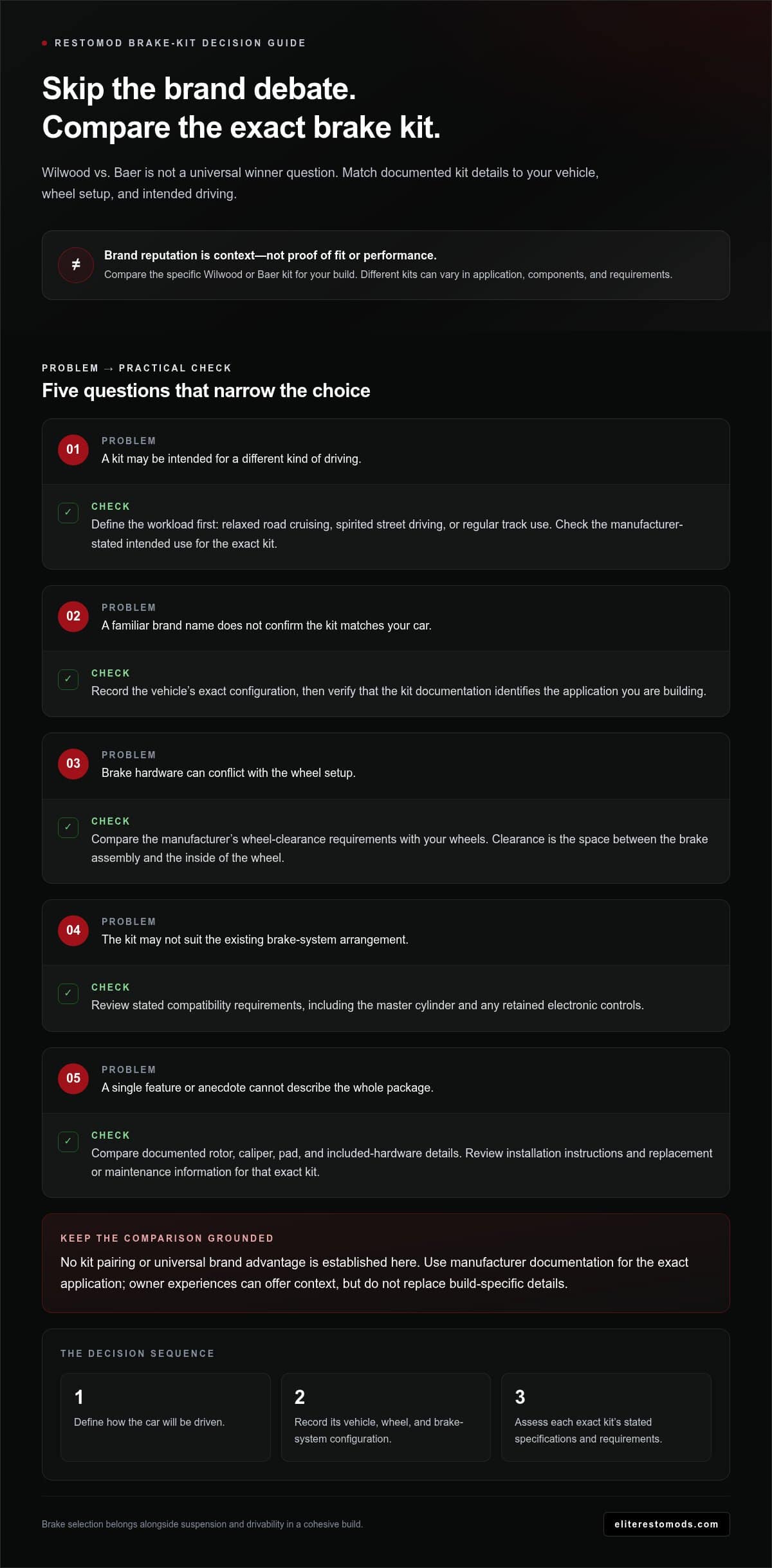
A disciplined choice starts with the build, then narrows to the brake kit. Use this sequence to compare Wilwood and Baer options without letting driving style or brand reputation stand in for verified fitment. Keep the final decision open until you’ve considered the exact vehicle, kit documentation, and system interfaces together.
Match the Kit to How the Car Will Be Driven
Define the car’s routine first: regular road use, occasional spirited driving, or track sessions. That use helps you decide which manufacturer-documented features deserve closer attention, but it doesn’t establish that a kit fits. Horsepower, appearance, or an enthusiast’s preference alone can’t settle the choice. Connect each priority to a specific statement in the kit’s documentation.
- Define the use. Describe how the car will be driven and what demands that places on the braking setup.
- Identify the vehicle. Record its year, platform, axle configuration, and relevant brake or suspension changes.
- Check fitment. Match the exact kit application to the vehicle, then assess documented wheel-clearance and system requirements.
- Compare documented kits. Review each candidate’s stated use, components, installation instructions, and replacement information.
- Assess integration. Consider how the selected package fits with the rest of the vehicle’s brake system and overall build plan.
Use this decision matrix to compare the candidates side by side. Fill it with manufacturer-documented details. An unknown or unanswered item isn’t evidence in favor of either brand.
Driving priority: What matters for the way the car will be used? Record the exact kit feature or intended-use statement that addresses it.
Vehicle application: Does the kit documentation match the vehicle and its relevant configuration? Mark “unresolved” if details don’t align or are missing.
Fitment and compatibility: What does the documentation say about wheels and system interfaces? Leave the result open until you understand those requirements.
Components and service: What parts and instructions are documented, and what replacement information is provided? Compare like with like.
Current result: Suitable for further consideration, ruled out by a documented mismatch, or unresolved. Don’t force a winner where evidence is incomplete.
Resolve a Close Comparison with Documented Fitment
If both kits appear to suit the driving purpose, let verified application and system compatibility guide the next comparison. Review included components and instructions for each exact kit instead of turning a single specification into a performance ranking. Record the selected kit, the documentation used, and the fitment rationale in the build plan. Clear records make the decision easier to revisit as the restomod comes together.
Building the whole car? Review custom-build services as you shape a cohesive plan for the vehicle.
From Brake-Kit Choice to a Cohesive, Quality-Assessed Restomod
A brake kit is one part of a larger mechanical picture. Its selection belongs alongside suspension and drivability considerations because the finished restomod needs to function as a cohesive vehicle, not simply showcase an impressive set of components. The Wilwood vs Baer brake kits for restomods comparison can help narrow a parts decision, but it can’t replace an assessment of how the complete car is assembled and drives.
What a Whole-Vehicle Quality Review Adds
Elite’s AIM Quality Assurance Methodology includes inspections of drivability, suspension, and brakes as part of its broader vehicle-quality approach. These checks assess key systems in the context of a fully sorted restomod intended to be driven. An inspection is part of evaluating a vehicle, not a promise of future performance or freedom from maintenance. Brakes, suspension, and drivability work together, so reviewing them in concert gives a more complete quality picture than judging a brake kit alone.
That distinction matters whether you’re weighing a specific kit or considering a finished car. A standalone kit comparison focuses on documented parts and fitment. A whole-vehicle review considers the brake and suspension systems along with how the vehicle drives, putting individual components into the context of the complete build.
When a Complete Restomod or Custom Build Is the Better Path
If you’re choosing one brake kit for a car you already own, focus on the exact application, fitment, and relationship to its existing system. If you’re planning a complete restomod, brake selection can be part of the larger build rather than a late, isolated choice. That wider perspective helps keep mechanical decisions aligned with the vehicle’s intended character and use.
Elite offers fully sorted restomods and custom builds through its in-house Elite Performance Center. The AIM Quality Assurance Methodology includes brake and suspension inspections. All Elite Restomods include a 1-year extended service contract provided through Classic Vehicle Protection. These details support a broader evaluation of the vehicle and build without suggesting that an inspection removes the need for ongoing care.
If you’re looking beyond a standalone kit decision, explore Elite Restomods inventory to consider complete vehicles, or review custom-build services for a project planned around your goals. The right path depends on whether you’re refining an existing car or shaping a restomod from the ground up. Either way, bring the brakes into the conversation with the rest of the build.
Give Your Restomod a Confident Next Step
The right brake decision is one that suits the car you’re building and the way you intend to enjoy it. Use the Wilwood vs Baer brake kits for restomods comparison to turn research into a clear build direction: choose the exact vehicle, define its role, and keep the brake package connected to the larger vision for the car.
From there, consider whether you’re refining an existing vehicle or ready to shape a complete restomod. A carefully planned build brings mechanical choices and classic character together, so the finished car feels composed on the road as well as striking in the garage.
Explore fully sorted restomods and custom-build services to move your vision closer to the open road.
Frequently Asked Questions
Are Wilwood or Baer brake kits better for a restomod?
Neither brand is automatically better for every restomod. The stronger match is the specific kit documented for your vehicle and intended driving, with requirements that fit your wheels and existing setup. For example, a car with modified suspension may need a different fitment review than a stock-platform build, even if both owners prefer the same brand. In the Wilwood vs Baer brake kits for restomods decision, compare exact applications before choosing.
Can I choose a brake kit based on caliper piston count alone?
No. Piston count is one specification, not a complete measure of whether a kit suits your car or driving needs. A useful comparison also includes the kit’s application, rotor and pad details, included parts, and manufacturer-stated requirements. If two front kits have different piston counts, that difference alone doesn’t tell you how either fits a particular wheel or integrates with the rear brakes and the rest of the system.
Will Wilwood and Baer kits fit the same restomod?
Sometimes, but the brand names alone can’t establish shared fitment. Match each candidate against the vehicle’s year, platform, axle configuration, and relevant modifications using the manufacturer’s application information. Wheel design can also affect clearance, so a wheel that works with one package may not clear another. If your build includes changed suspension or brake components, include those details in the fitment comparison before treating the kits as interchangeable.
Do Wilwood and Baer brake kits include everything needed for installation?
Included components can differ by kit. Read the exact package contents and installation instructions instead of assuming that a brand’s other kits include the same hardware. Make a parts list from the documentation, noting any components or vehicle-side requirements the instructions identify. This is especially useful when comparing front-only and complete-system packages, since their contents and scope may differ even if both are presented as brake kits.
Does a six-piston caliper mean a brake kit stops better?
No. Piston count by itself doesn’t prove that one kit will stop a particular vehicle better. The full configuration, application, and compatibility matter, and conclusions should be based on documented information for the exact kits being compared. A six-piston caliper may look like an obvious upgrade, but that number alone doesn’t establish wheel clearance, system suitability, or the performance of the complete brake setup. Avoid ranking kits from one specification.
Are Wilwood or Baer brake kits better for street driving or track use?
There isn’t a universal street-versus-track winner by brand. Start with how the car will actually be used, then compare each candidate’s manufacturer-stated intended application and requirements. A car driven mostly on public roads with occasional spirited use presents a different use pattern from one taken to track sessions, but neither scenario settles fitment. Look for kit-specific evidence, and don’t treat brand reputation as proof of suitability.
Should I upgrade suspension when choosing a restomod brake kit?
Not automatically. A brake-kit decision is a good time to review the suspension configuration because changes there may affect details relevant to kit application and wheel fitment. But that doesn’t mean every brake upgrade requires a suspension upgrade. For a car with existing suspension modifications, include them in the fitment assessment. For a broader build, consider the brakes and suspension together as parts of the vehicle’s overall setup. To plan a complete restomod, explore Elite Restomods custom-build services.