
A vintage machine is only as exhilarating as your confidence in its ability to stop. Many collectors realize too late that original drum technology is a dangerous relic when paired with modern traffic speeds and high-performance engines. If you’re planning an upgrade, understanding the classic car disc brake conversion cost is the first step toward transforming your vehicle into a reliable, high-speed asset. It’s the difference between a trailer queen and a car built for the open road.
You likely recognize that heart-sinking sensation of brake fade during a spirited drive or the unnerving distance required for a routine stop. We believe your car is a bespoke piece of functional art that deserves modern safety without sacrificing its heritage. This 2026 investment guide explores the financial landscape of braking upgrades, from basic mechanical swaps to the elite, multi-piston systems found in professional custom builds. We’ll examine labor variables, component quality, and how these meticulous engineering choices can significantly increase your vehicle’s valuation. Discover how to bridge the gap between a long-held dream and a tangible, high-performance reality.
Key Takeaways
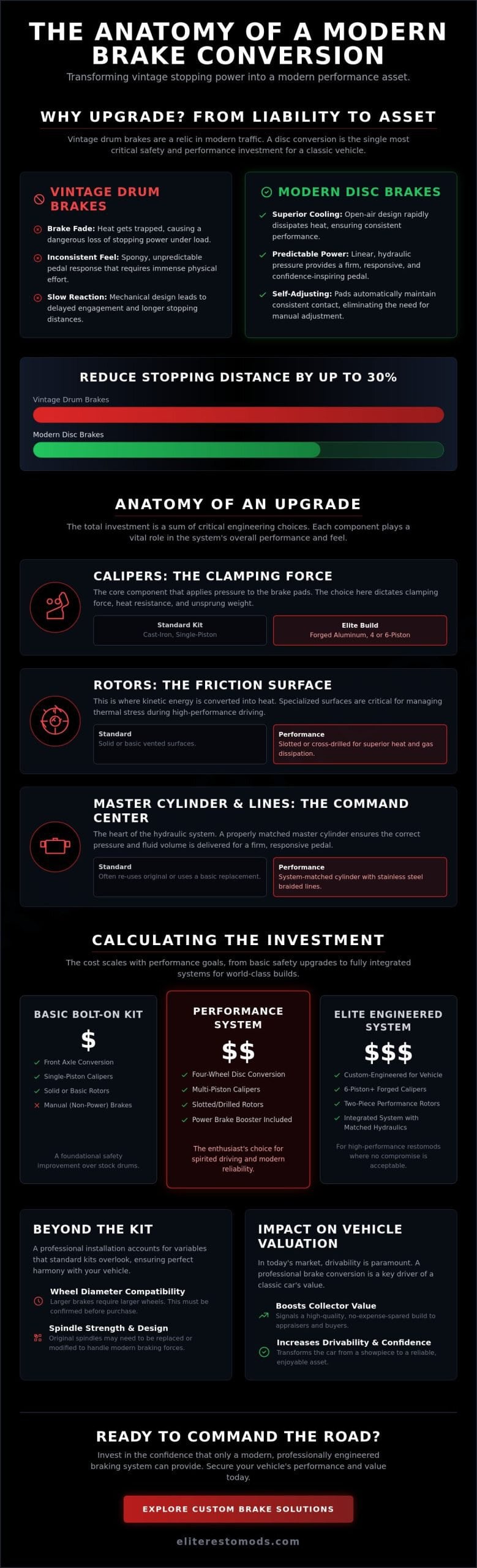
- Understand why transitioning from vintage drum technology to modern discs can reduce stopping distances by up to 30 percent, ensuring your vehicle is equipped for contemporary traffic safety.
- Explore the technical nuances of high-performance hardware, from forged multi-piston calipers to specialized rotor surfaces that effectively manage thermal stress during spirited driving.
- Evaluate the various tiers of classic car disc brake conversion cost, ranging from basic bolt-on kits to the comprehensive, engineered systems required for world-class custom builds.
- Identify critical secondary requirements, such as wheel diameter compatibility and spindle strength, that often dictate the final complexity and scope of a professional installation.
- Learn the difference between a simple component swap and a custom-engineered braking system designed to harmonize with your vehicle’s unique power and weight distribution.
The Price of Safety: Why Classic Car Disc Brake Conversions Are Essential
The era of the drum brake has ended. While original equipment served its purpose on the sparse highways of the mid-twentieth century, modern congestion demands a higher standard of performance. Driving a vintage asset with four-wheel drums often feels like a calculated risk rather than a joy. You press the pedal and wait for a response that feels spongy and uncertain. When evaluating the classic car disc brake conversion cost, it’s vital to remember that you’re investing in more than just metal. You’re buying the ability to reduce stopping distances by as much as 30 percent. This isn’t just a mechanical change. It’s a fundamental shift in how you experience your car. You move from a state of constant caution to one of absolute command.
To better understand the mechanical transformation involved in this upgrade, watch this detailed walkthrough:
Vintage Drums vs. Modern Discs
The mechanical disparity between these two systems centers on thermal management. Kinetic energy must go somewhere. In a drum system, it turns into heat that has no escape route, leading to the dreaded fading effect where the pedal goes to the floor but the car keeps moving. Discs are open to the atmosphere, allowing for rapid cooling and consistent friction. To truly grasp the engineering involved, it helps to understand how disc brakes work by clamping a rotor rather than pushing shoes outward against a drum. This transition offers several key advantages:
- Superior thermal dissipation through open-air rotor surfaces.
- Linear, predictable pressure from hydraulic piston calipers.
- Automatic pad adjustment that maintains consistent pedal travel.
Manual drums also require immense physical effort. A modern power disc conversion provides a refined, luxury feel that makes the car accessible and enjoyable for every journey. It creates a sense of reliability that drum brakes simply cannot match.
Impact on Vehicle Valuation
Collectors and enthusiasts in 2026 prioritize drivability above all else. An investment-grade restomod must do more than look beautiful; it must perform with the precision of a contemporary machine. A vehicle that cannot stop as fast as it accelerates is a liability, not an asset. When calculating the classic car disc brake conversion cost, consider the long-term return on your capital. Safety upgrades are a primary driver of classic car value in the current market. Professional appraisers and savvy buyers look for high-performance braking as a sign of a meticulous, no-expense-spared build. It signals that the vehicle was built to be utilized and enjoyed, not merely stored. You aren’t just buying parts. You’re securing the legacy and liquidity of your automotive investment. Confidence at high speeds is the ultimate luxury, and a modern braking system is the foundation of that experience.
Anatomy of an Upgrade: Components That Drive Conversion Costs
The true classic car disc brake conversion cost isn’t found on a single price tag; it’s the sum of several high-stakes engineering choices. A standard kit might provide the basic hardware, but a professional-grade installation requires a symphony of high-performance parts working in perfect unison. At the heart of this transformation are the calipers. While entry-level kits often utilize heavy cast-iron single-piston units, elite builds favor forged aluminum multi-piston calipers. These components offer superior clamping force and significant weight savings, reducing unsprung mass to improve overall handling. Choosing between a four-piston or a six-piston setup will dictate both the budget and the visceral feedback you feel through the pedal.
Beyond the calipers, the master cylinder serves as the command center for your entire hydraulic system. Transitioning from a primitive single-reservoir unit to a modern dual-circuit master cylinder is an essential safety upgrade that ensures you won’t lose all stopping power if one line fails. To achieve a modern, effortless feel, you must also consider the power booster. Vacuum-assisted boosters are common, but high-horsepower engines with aggressive camshafts often lack the necessary vacuum. In these instances, a hydroboost system, which utilizes power steering pressure, provides the relentless stopping force required for heavy-duty applications. This level of technical integration is what separates a simple part swap from a comprehensive mechanical overhaul.
The Friction Choice: Pads and Rotors
Rotors are the canvas upon which your braking performance is painted. Solid rotors are functional, but vented, slotted, or cross-drilled surfaces are necessary to manage the extreme heat generated during spirited driving. These specialized finishes prevent gas buildup between the pad and the rotor, ensuring a consistent bite every time you apply pressure. For those who value aesthetics as much as performance, zinc-plated rotors provide a clean, rust-free look that complements a set of bespoke wheels. Your choice of brake pads also influences the experience. Ceramic pads offer a quiet, low-dust solution for luxury cruising, while semi-metallic compounds provide the aggressive grip needed for high-speed performance. If you want to see how these components are curated for excellence, you can explore our custom build services to witness the transformation firsthand.
Hydraulics and Plumbing
The integrity of your hydraulic lines defines the precision of your pedal feel. Replacing aged rubber hoses with stainless steel braided lines eliminates the expansion common in older systems, resulting in a firm, communicative pedal. A modern proportioning valve is equally critical. This component allows for the fine-tuning of fluid pressure between the front and rear axles, preventing the rear wheels from locking up prematurely during hard stops. Finally, the pedal assembly itself may require modification. Adjusting the mechanical leverage ensures that the transition to power discs feels intuitive rather than binary. Every detail in this process contributes to the final classic car disc brake conversion cost, ensuring the result is a machine that stops with the same authority with which it accelerates.
Calculating the Total Investment: Parts, Labor, and Engineering
Budgeting for a mechanical transformation requires a holistic view of the machine. While many enthusiasts begin by browsing catalogs, the true classic car disc brake conversion cost is determined by the intersection of component quality and technical labor. An entry-level conversion typically centers on standard bolt-on kits. These packages provide the foundational hardware needed to replace aging drums with basic rotors and calipers. For a front-only swap, you should anticipate approximately 4 to 6 hours of labor. It’s a functional upgrade, but it represents only the beginning of what’s possible for a vintage asset.
Mid-tier performance systems elevate the experience by integrating respected brand-name components with professional calibration. These setups often feature larger rotors and multi-piston calipers that require precise alignment and specialized plumbing. When you move into elite professional systems, the scope expands significantly. A full four-wheel system with six-piston calipers and custom-bent stainless steel lines can require 12 to 20 hours of meticulous shop time. This level of investment ensures that every component is harmonized with the vehicle’s specific weight distribution and power output. You can find detailed breakdowns of modern disc brake conversion costs that highlight how budget-friendly options differ from pro-touring masterpieces.
Professional Shop Rates in 2026
The labor market for specialized restoration has evolved. General repair shops often lack the specific tooling and experience required to navigate vintage geometry and custom fitment. A professional builder understands that a 1960s spindle wasn’t designed for modern clamping forces. They provide a fully sorted installation that accounts for these discrepancies. While premium shop rates reflect this expertise, they also offer the peace of mind that comes with a system engineered for high-speed reliability. In 2026, the value of a master builder lies in their ability to anticipate mechanical conflicts before they occur.
The DIY vs. Professional Debate
The allure of a weekend project is strong, but the technical requirements for a safe installation are substantial. Beyond basic wrenches, you’ll need specialized flairing tools for hydraulic lines, vacuum bleeders for the master cylinder, and a lift to ensure proper clearance. There’s also the significant matter of liability. Many insurance providers for high-value vehicles look for professional certification or documented expert installation on safety-critical systems like brakes. We prioritize this level of scrutiny in our process to ensure that every vehicle we touch meets modern safety standards. Entrusting your stopping power to experts isn’t just about convenience; it’s about guaranteeing the integrity of your investment and your safety on the road.
Beyond the Kit: Hidden Expenses and Performance Variables
A precision machine is a delicate ecosystem. When you introduce modern stopping power, you inevitably stress the components surrounding it. The true classic car disc brake conversion cost often includes a series of cascading upgrades that many enthusiasts overlook during the initial planning phase. It’s rarely a matter of simply swapping parts; it’s an engineering recalibration. One of the most immediate hurdles is wheel compatibility. Your original 14-inch or 15-inch steel wheels were designed for the slim profile of drum brakes. They lack the internal clearance required for modern, high-performance calipers. This often necessitates a transition to larger diameter wheels, which fundamentally alters the vehicle’s stance and aesthetic profile.
Spindle integrity is another critical variable. Original hardware was never intended to withstand the aggressive clamping forces generated by a six-piston hydraulic system. Under heavy load, an aged spindle can flex or even fail, compromising both safety and performance. Integrating rear discs presents its own unique challenge: the parking brake. Most vintage vehicles utilize a mechanical cable-actuated system that isn’t natively compatible with modern calipers. Solving this requires custom bracketry or specialized calipers with integrated parking mechanisms, adding layers of complexity to the build process. These technical hurdles are why we recommend professional custom build services to ensure every variable is accounted for.
Wheel and Tire Integration
The move to larger rotors demands a larger canvas. Upgrading to 17-inch or 18-inch wheels provides the necessary clearance while allowing for the fitment of modern, high-grip radial tires. This combination is essential. Powerful brakes are only as effective as the rubber meeting the road. To maintain a period-correct soul, many owners opt for bespoke wheels that mimic classic designs but offer modern dimensions. This marriage of heritage and capability ensures the car remains a functional piece of art without looking out of place in a contemporary landscape.
Structural Reinforcement
Increased stopping power translates to increased torque on your suspension. The sudden deceleration can expose weaknesses in aged control arms and perished rubber bushings. A comprehensive brake upgrade is the ideal time to consider suspension upgrades to ensure the chassis can handle the new performance envelope. Replacing the steering knuckles and reinforcing the spindles provides a stable foundation for the hydraulic system. It’s a transformative journey that turns a nervous vintage cruiser into a confident, high-performance machine. If you’re ready to elevate your vehicle’s capabilities, explore our current inventory to see how we balance brute force with refined engineering.
The Elite Standard: Integrated Braking for High-Performance Restomods
Excellence in automotive curation begins with the ability to command momentum. At Elite Restomods, we view the braking system not as a peripheral upgrade, but as the structural foundation of every build. A vintage asset with modern horsepower is a masterpiece in motion; however, it requires a sophisticated anchor to ensure that power remains a source of joy rather than anxiety. We prioritize braking performance as the first chapter of our engineering narrative. This philosophy ensures that every vehicle we deliver strikes a deliberate balance between raw, visceral excitement and the refined safety of a contemporary luxury machine.
There is a profound distinction between a standard bolt-on kit and a custom-engineered braking system. While a basic kit might address the immediate need for discs, it often lacks the meticulous calibration required for a high-performance environment. When evaluating the classic car disc brake conversion cost, the investment should reflect a holistic approach to the vehicle’s dynamics. We analyze weight distribution, center of gravity, and intended use to curate a system that feels intuitive. Our rigorous testing protocols ensure that every component, from the master cylinder to the final bleeder screw, operates with absolute perfection. This level of professional sorting provides the peace of mind that allows you to enjoy your long-held dream with total confidence.
Curated Performance Systems
We believe in utilizing only the finest industry-standard hardware to achieve our elite standards. Through strategic partnerships with leaders like Wilwood and Baer, we integrate high-performance mechanical components that are as beautiful as they are functional. For our LS-swapped icons, we match the braking capacity to the relentless torque of a modern powertrain. This often involves oversized rotors and multi-piston forged calipers that provide immediate, fade-free response. Beyond the technical specifications, we offer bespoke aesthetic finishes. Whether it is a custom powder-coated caliper to match a unique paint code or a specific rotor finish to complement artisanal wheels, every detail is treated as a piece of functional art.
Your Journey to a Safer Classic
The transition from a traditional restoration to a modern restomod is a transformative journey. We act as world-class curators, guiding you toward the best braking path for your specific model and driving goals. Whether you are seeking a reliable weekend cruiser or a high-speed touring machine, we ensure the engineering meets the vision. Our commitment to excellence is visible throughout our sales and consignment inventory, where elite braking standards are a non-negotiable requirement for every featured vehicle. We invite you to explore our inventory of fully sorted restomods to experience the pinnacle of vintage design married to modern operational reliability. Your car should be utilized and enjoyed; we provide the engineering that makes it possible.
Securing Your Automotive Legacy
Upgrading your vintage machine is an act of both preservation and evolution. You’ve explored how transitioning from drum technology to modern discs provides a vital safety margin and how meticulous component selection dictates the final classic car disc brake conversion cost. It’s clear that true performance isn’t found in a simple box of parts; it’s the result of specialized classic car engineering expertise. By addressing hidden variables like spindle strength and hydraulic balance, you transform a beautiful relic into a reliable, high-performance asset. Every build deserves investment-grade performance standards that honor the vehicle’s history while embracing the precision of 2026 engineering.
We apply rigorous multi-point safety inspections to every vehicle we curate, ensuring your dream is as secure as it is exhilarating. Whether you’re seeking a bespoke build or a turn-key masterpiece, the right foundation is essential. View Our Inventory of Elite Certified Restomods to find a vehicle that stops with the same authority as it accelerates. Your journey toward a safer, more capable classic starts with the right partner. Enjoy the open road with the confidence you deserve.
Frequently Asked Questions
Is a front-only disc brake conversion enough for a classic car?
A front-only conversion is often the most impactful upgrade you can make for a vintage machine. Since the front wheels handle approximately 70 percent of the braking force, replacing tired drums with modern discs significantly reduces stopping distances. It’s a practical choice for casual cruisers, but high-performance restomods often require a four-wheel system to achieve the balanced, linear deceleration expected of a world-class build.
Will I need to buy new wheels if I switch to disc brakes?
New wheels are often a technical necessity when moving away from drum technology. Original 14-inch or 15-inch steel wheels frequently lack the internal clearance required to house modern, multi-piston calipers. Transitioning to 17-inch or 18-inch wheels allows for larger rotors and high-performance tires, which are essential for translating that new stopping power to the pavement. It’s a cascading upgrade that elevates both the safety and the stance of your vehicle.
How much does labor typically cost for a 4-wheel disc brake conversion?
Labor investment depends on the depth of the engineering required for your specific chassis. A professional 4-wheel installation typically requires between 12 and 20 hours of specialized shop time to ensure every line is flared perfectly and the system is fully calibrated. When calculating the classic car disc brake conversion cost, you must account for the premium rates of master builders who understand vintage geometry. Precision at this stage is what guarantees a firm, communicative pedal feel.
What is the difference between manual and power disc brakes?
The primary difference lies in the physical effort required to engage the system. Manual disc brakes rely solely on your leg strength and mechanical pedal leverage, which can feel heavy during aggressive driving. Power systems utilize a vacuum or hydraulic booster to multiply the pressure you apply. This results in a refined, effortless experience that brings the visceral excitement of a classic car into harmony with modern luxury standards.
Do I need to change my master cylinder when converting to discs?
A master cylinder swap is a fundamental safety requirement for any disc conversion. Drum-style master cylinders are designed for different fluid volumes and often include residual pressure valves that will cause disc brakes to drag and overheat. Upgrading to a modern dual-circuit master cylinder also provides a critical safety backup; it ensures that a single leak won’t result in a total loss of stopping power. It’s the hydraulic foundation of a reliable build.
How does a disc brake conversion affect the resale value of my classic car?
Modernizing your stopping power is a strategic investment in vehicle valuation. In the 2026 market, collectors prioritize drivability and safety over strict originalism for cars meant to be driven. A professionally sorted system signals to buyers that the car has been maintained with a no-expense-spared philosophy. While the classic car disc brake conversion cost is an upfront expenditure, it often pays dividends by making the vehicle more liquid and desirable to a broader audience of enthusiasts.
Can I keep my original spindles when installing a disc brake kit?
Whether you can retain your original spindles depends on the chosen system’s complexity. Many basic kits are designed to bolt onto factory spindles, but elite systems often require reinforced or dropped spindles to handle increased clamping forces. Original hardware can flex under the extreme torque of modern six-piston calipers. We often recommend upgraded spindles to ensure the steering geometry remains precise and the structural integrity of the front end is never in question.
Why is a proportioning valve necessary for a disc brake upgrade?
A proportioning valve is the hydraulic brain of your braking system. It regulates the fluid pressure sent to the rear wheels to prevent them from locking up before the front wheels during a hard stop. Without this precise calibration, the car can become unstable or swap ends under heavy braking. It allows a master builder to fine-tune the bias, ensuring the car remains flat and composed regardless of how much force you apply to the pedal.