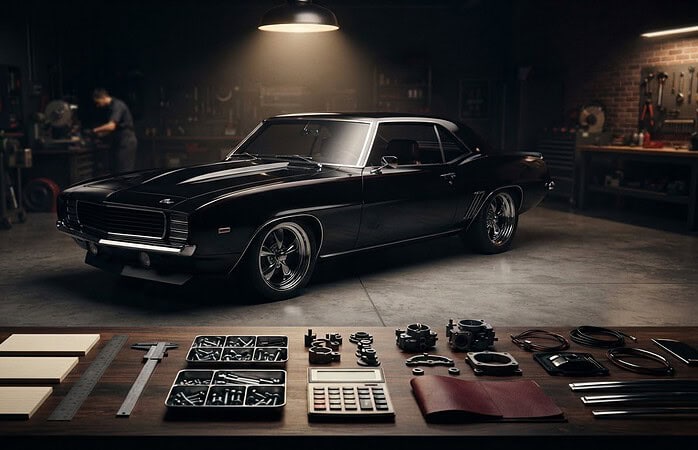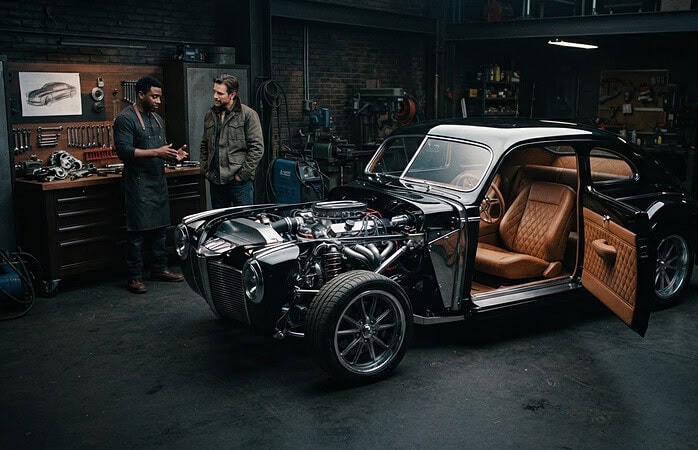

What if the primary obstacle to your dream garage isn’t the mechanical complexity of the build, but the rigid spreadsheets of a traditional bank? You’ve likely felt the frustration of trying to explain the value of a handcrafted chassis to a lender who only understands standard depreciation. Understanding how to get a loan for a custom car build requires moving beyond ordinary personal loans and toward asset-backed specialty financing. It’s a process of validating that your project is a bespoke piece of functional art rather than a simple machine.
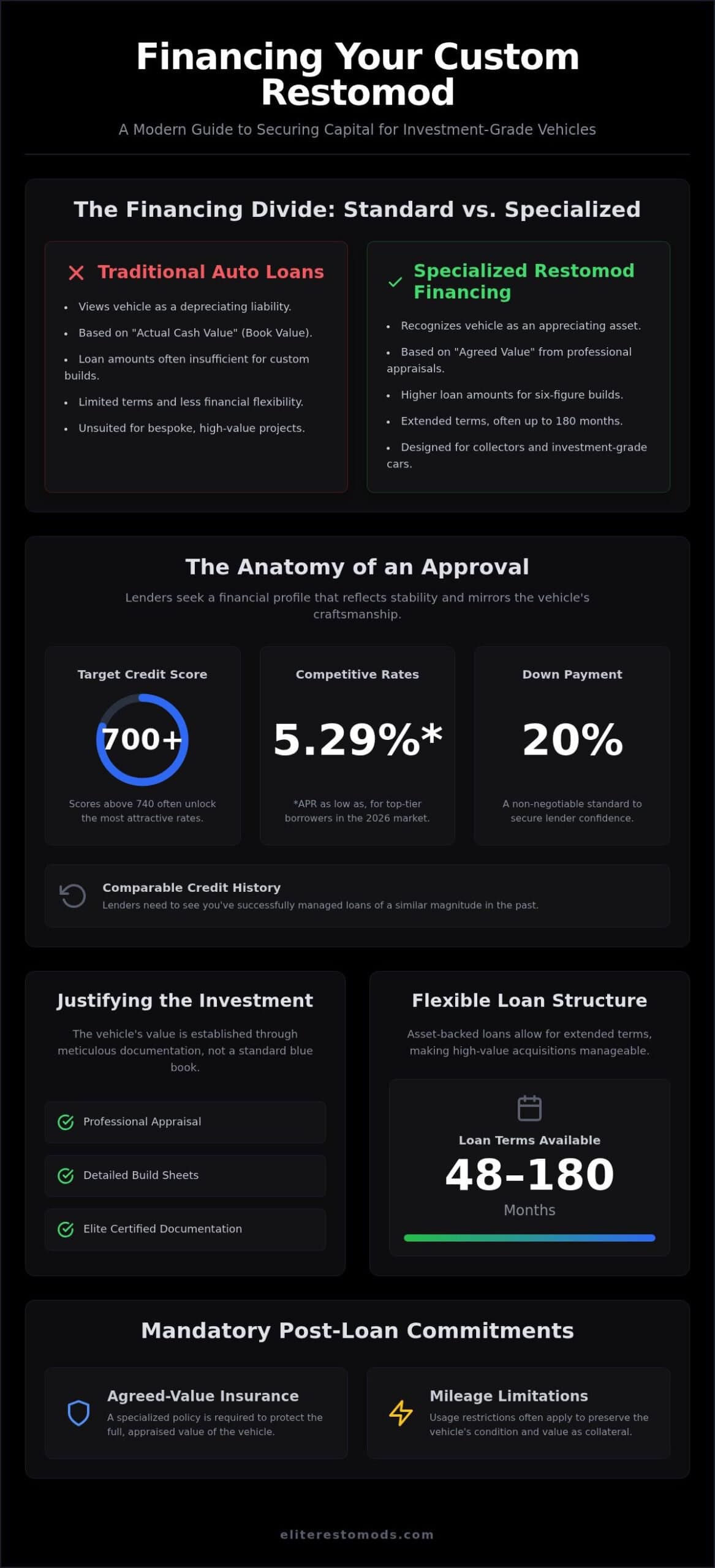
Securing high-value financing in 2026 demands a sophisticated approach to both your financial legacy and the vehicle’s mechanical pedigree. While specialty lenders may offer rates as low as 5.29% APR for those with credit scores above 700, the requirements for a 20% down payment and agreed-value insurance are non-negotiable standards. This guide masters the financial hurdles and asset-specific criteria needed to secure capital for investment-grade classic vehicles. We’ll explore the nuances of appraisals and debt-to-income ratios, providing a clear path to financing an Elite Certified Restomod that bridges the gap between a vintage dream and modern operational reliability.
Key Takeaways
- Understand the fundamental shift from standard auto loans to agreed-value financing, where the loan is based on the appraised worth of the asset rather than a depreciating book value.
- Identify the specific financial benchmarks required for high-end assets, including a target credit score of 700 or higher and a manageable debt-to-income ratio for luxury acquisitions.
- Learn how to get a loan for a custom car build by leveraging Elite Certified documentation to justify the investment-grade valuation of a restomod to specialized lenders.
- Recognize the mandatory operational requirements, such as securing a specialized agreed-value insurance policy and adhering to mileage limitations to protect the collateral.
- Navigate the transition from vehicle sourcing to final funding by utilizing professional financing referrals that understand the meticulous craftsmanship of a bespoke build.
Understanding the Distinct Nature of Classic Car Financing
Traditional lending is built on the cold reality of depreciation. A standard bank views a vehicle as a liability that loses value the moment it leaves the lot. For the collector, this mindset is a fundamental barrier. Understanding the Distinct Nature of Classic Car Financing requires a shift in perspective from consumer debt to asset management. When you pursue a high-end restomod, you aren’t just buying a car; you’re acquiring a bespoke piece of functional art. Specialized lenders recognize this distinction. They understand that a meticulously engineered build can appreciate, unlike a mass-produced daily driver.
Securing capital for these six-figure assets requires more than a standard credit application. It involves a dual-audit of your financial standing and the vehicle’s mechanical pedigree. Many enthusiasts wonder how to get a loan for a custom car build when traditional institutions offer so little. The answer lies in specialized firms that focus exclusively on the collector market. These institutions value the craftsmanship, the performance upgrades, and the historical soul of the machine. They don’t look at a blue book; they look at a build sheet.
Asset-Backed vs Unsecured Lending
Standard personal loans are often unsecured. They rely solely on your creditworthiness and usually cap out at amounts insufficient for a premium build. In contrast, specialized classic car loans are asset-backed. The vehicle itself serves as collateral. This structure allows for significantly lower interest rates, sometimes as low as 5.29% APR in the 2026 market. Because the lender holds a lien on an appreciating asset, they can offer extended terms ranging from 48 to 180 months. This flexibility is essential for managing the cash flow of a high-value acquisition. It transforms a massive capital outlay into a structured investment.
The Concept of Agreed Value
The most critical hurdle in collector financing is the valuation. Standard banks use Actual Cash Value, which is a death sentence for a custom build. Specialized lenders utilize Agreed Value. This is a predetermined amount established through professional appraisals and detailed build sheets. It protects your equity by ensuring the loan and insurance coverage reflect the true cost of the engineering and artisanal finishes. Professional documentation is the bridge here. For those looking at how to get a loan for a custom car build, providing a comprehensive history of the restoration is the only way to justify a valuation that exceeds original factory specs. This ensures that every dollar spent on performance and comfort is recognized as real-world value.
Financial Prerequisites: What Lenders Look for in a Borrower
Securing capital for a six figure restomod is an exercise in precision. It isn’t a standard transaction. Lenders for these assets operate with a different set of rules. They seek borrowers who treat their finances with the same meticulous care a master builder applies to a fuel injection system. To understand Financial Prerequisites: What Lenders Look for in the 2026 market, you must look beyond the basic credit application. You are presenting a financial legacy that justifies the acquisition of a high performance asset.
Specialized lenders view these loans as luxury investments. They require a profile that reflects stability and liquid strength. While a standard car loan might be approved on a whim, the process for a custom build is a deep dive into your fiscal history. It is a dual audit of your ability to pay and your history of managing similar high value liabilities. This scrutiny is the price of entry for the exclusive world of investment grade automotive art.
Credit Profile and FICO Requirements
A FICO score of 700 or higher is the baseline for competitive terms. Scores above 740 often unlock the most attractive rates, which have hovered around 5.29% APR for top tier borrowers. However, the score is just the beginning. Lenders prioritize “comparable credit” history. They want to see that you’ve successfully managed a loan of a similar magnitude in the past. If you’re seeking a six figure loan but your largest previous credit limit was a fraction of that, expect more rigorous questioning. They also monitor recent inquiries closely. Too many applications in a short window can signal financial distress, even for high net worth individuals.
Income Verification and DTI Ratios
Debt to income (DTI) ratios are a critical metric for secondary assets. Most specialized lenders prefer a DTI below 45% after accounting for the new vehicle payment. This ensures that your passion for a vintage silhouette doesn’t compromise your primary financial obligations. For self employed or high net worth borrowers, the documentation process is extensive. You should be prepared to provide two years of tax returns and proof of liquid reserves. Lenders often look for cash reserves that can cover several months of payments as a safety net. Understanding how to get a loan for a custom car build involves preparing these documents well in advance of your first inquiry. This preparation demonstrates the perfectionism and reliability that lenders value in the collector car market.
Beyond income, your housing history serves as a proxy for stability. Long term residence or significant home equity acts as a secondary layer of trust. When combined with a standard 20% down payment, these factors create a compelling case for approval. It turns a risky custom project into a calculated, asset backed investment.
Asset Qualification: Why Vehicle Valuation is the Ultimate Hurdle
Standard price guides are the enemy of the custom build. While a base-model Mustang might have a predictable value in a catalog, a restomod featuring a modern LS-swap and a bespoke chassis exists outside these generic frameworks. Lenders who rely on outdated price guides often cap financing at a fraction of the actual cost, which ignores the tens of thousands of dollars invested in performance engineering. Understanding how to get a loan for a custom car build requires moving past these basic tools. You must present the vehicle as a high-performance asset where the sum of the components far exceeds the original factory worth.
Specialized firms look for an Elite Certified status because it provides a documented quality assurance process. This certification acts as a bridge between the visceral excitement of the car and the logical needs of the underwriter. When a car is fully sorted and daily-driving capable, it represents a lower risk to the institution. Most specialty lenders in 2026 require a down payment of at least 20% for these assets, emphasizing the need for significant skin in the game. This down payment, combined with a professional appraisal, establishes a healthy loan-to-value ratio that protects your equity.
Appraising Modern Components in a Vintage Shell
The heart of a restomod’s value lies in its duality. A vintage shell paired with a modern powertrain creates a unique valuation challenge. Lenders must account for the brute force of high-performance mechanical components and the delicate luxury of artisanal interiors. A bill of sale is merely a starting point; the real value is proven through the technical specs of the fuel injection, the rigidity of the pro-touring suspension, and the reliability of modern hardware. This meticulous nature of the build process is what elevates a project from a simple machine to an investment-grade asset.
Provenance and Build Documentation
Documentation is the currency of the collector car world. A comprehensive build book is essential when Navigating the Approval Process for a six-figure loan. This book should include high-resolution professional photography of every stage, from the bare-metal restoration to the final aesthetic finishes. It serves as a developmental narrative for the lender. By highlighting the reputation of a master builder and the quality of parts used, you provide the systematic breakdown needed for a high-value appraisal. You can view examples of fully documented builds in our current inventory to see the level of detail lenders expect. This level of transparency builds the trust necessary to secure capital for a bespoke automotive dream.
Operational Constraints: Insurance and Usage Requirements
Securing capital for a high end restomod involves more than just proving your creditworthiness. It requires a commitment to stewardship. Lenders view these vehicles as appreciating assets, but that appreciation is contingent on the car remaining in investment grade condition. This is why operational constraints are a non negotiable part of the contract. When you research how to get a loan for a custom car build, you’ll find the institution is often more concerned with how the car is stored and used than its actual horsepower. They aren’t just financing a machine; they’re financing a bespoke piece of functional art that must be preserved.
Specialized lending institutions in 2026 have strict protocols to mitigate risk. These rules ensure that the collateral isn’t subjected to the wear and tear of a daily commuter. By enforcing these boundaries, lenders can offer the extended terms and lower rates that make six figure builds accessible. It is a partnership between the owner and the bank to maintain the vehicle’s pedigree over the life of the loan.
Agreed Value Insurance Mandates
Standard auto insurance is insufficient for a custom build. Lenders require an agreed value policy, which is a legally binding agreement on the vehicle’s worth in the event of a total loss. Unlike stated value policies that may still apply depreciation, agreed value protects every dollar of your equity. Lenders often mandate specific carriers that specialize in collector cars because these companies understand the nuances of artisanal finishes and high performance mechanical components. Protecting these assets also extends to where they reside. Many lenders look favorably on owners who utilize climate controlled car storage to prevent the environmental degradation of sensitive electronics and custom paintwork.
Usage Restrictions and Storage
The soul of a vintage asset is meant to be enjoyed, but not exhausted. Most specialty loans come with annual mileage limitations, typically ranging between 2,500 and 5,000 miles. This ensures the car remains a pleasure vehicle rather than a primary mode of transport. To enforce this, lenders often require proof of a “daily driver” for every licensed driver in the household. This other car rule is a cornerstone of collector financing. Additionally, the loan agreement will likely stipulate that the vehicle must be kept in a secure, enclosed structure. This level of protection is what allows these cars to bridge the gap between historical design and modern operational reliability. If you are ready to move from planning to acquisition, our team can guide you through specialized financing referrals that respect these operational needs.
Navigating the Approval Process for Elite Investment Vehicles
The acquisition of a world class restomod is a transformative journey. It begins with the initial spark of recognition and ends with the visceral roar of a modern engine in a vintage shell. Unlike generic auto loans that prioritize volume over value, the approval process for an elite asset is a systematic realization of your vision. Understanding how to get a loan for a custom car build requires patience and a commitment to perfectionism. You aren’t just transacting; you’re curating a legacy. This process is the bridge between a long held dream and a tangible, high performance reality.
The timeline for high end financing is governed by the need for accuracy. While some retail lenders claim to fund in an hour, a six figure investment requires a professional appraisal and a rigorous title search. These steps protect both the lender and your equity. This process typically takes several days to a week, ensuring every mechanical intricacy and aesthetic finish is correctly valued. It is a steady, purposeful flow designed to build trust and ensure the reliability of the asset you are bringing into the modern era.
Working with Specialized Lenders
Pre-approval is your most powerful tool before entering the showroom. It establishes your buying power and signals to the builder that you understand the elite nature of the asset. Utilizing dealership-referred financing partners offers a distinct advantage. These lenders are already familiar with the Elite Certified quality assurance process, which simplifies the appraisal stage. They recognize the value of a fully sorted, reliable build and the meticulous nature of the work involved. For a deeper dive into the technicalities of these partnerships, consult our classic car financing guide.
Closing the Deal and Vehicle Delivery
Finalizing the transaction involves coordinating with specialized escrow and title services. This ensures the historical provenance of the VIN is clear and the new lien is properly recorded. The final inspection is the moment of realization, where the Elite Certification is verified to match the build book. Once the funds are released, the transition to ownership is completed with enclosed vehicle transport. This final step preserves the artisanal interior and high performance finishes from the elements during transit. You can begin this journey today by exploring the meticulously documented assets in our inventory. Every detail has been overseen by a master builder to ensure perfection.
Realizing Your High Performance Reality
Transitioning from the dream of a vintage silhouette to the reality of a modern powerhouse requires a fusion of financial precision and mechanical pedigree. You’ve navigated the complexities of agreed-value appraisals and the necessity of specialized insurance mandates. These hurdles aren’t barriers; they’re the standards that protect your investment. Understanding how to get a loan for a custom car build is the final step in curating a vehicle that balances brute force with artisanal luxury.
Our Elite Certified quality assurance process provides the documented excellence that lenders demand, bridging the gap between your vision and their requirements. Through our specialized financing referral network, we connect you with partners who value these machines as investment-grade assets curated for long-term value. The journey from sourcing to the first visceral roar of the engine is a partnership in craftsmanship. It’s time to move beyond the spreadsheet and into the driver’s seat. Explore our finance-ready inventory of Elite Certified Restomods to begin your transformation today.
Frequently Asked Questions
What is the minimum credit score required for a classic car loan?
A credit score of 700 or higher is generally the baseline requirement for specialized collector car financing in 2026. While some lenders may consider lower scores, those above 720 typically secure the most competitive rates, such as the 5.29% APR offered by leading credit unions. Lenders prioritize financial stability to ensure that high-value assets are backed by borrowers with a proven history of managing significant credit obligations effectively.
Can I finance a restomod that has a modern engine swap?
Yes, you can finance a restomod with a modern engine swap through specialized lenders who understand the value of performance upgrades. Unlike traditional banks, these institutions recognize that an LS-swap or a modern fuel-injection system increases the vehicle’s reliability and market worth. Providing a detailed build sheet helps justify the valuation of these bespoke machines, treating the engine upgrade as a critical component of the asset’s overall investment-grade pedigree.
Do classic car loans require a larger down payment than standard loans?
Most specialty lenders require a down payment of at least 20% for classic car and restomod loans. This requirement is higher than standard auto loans because these vehicles are treated as luxury investments rather than depreciating daily transport. A significant down payment establishes a healthy loan-to-value ratio, protecting your equity while demonstrating the financial commitment necessary to maintain a high-performance asset in investment-grade condition throughout the term.
Can I use a classic car loan for a vehicle I intend to daily drive?
Collector car financing is generally not available for primary daily drivers. Lenders and insurance providers typically enforce a “no daily driver” rule, requiring proof that every licensed driver in your household has access to a modern, primary vehicle. This restriction is paired with annual mileage caps, often between 2,500 and 5,000 miles, to preserve the mechanical integrity and long-term value of the vintage asset as a pleasure vehicle.
How is the value of a custom restomod determined for a loan?
The value of a custom restomod is determined through a professional appraisal and a detailed review of the build documentation. Because these vehicles lack a standard book value, lenders rely on an agreed-value model that accounts for artisanal finishes and modern hardware. Understanding how to get a loan for a custom car build involves providing comprehensive build books and photography to justify a valuation that reflects the true cost of the engineering.
Are there age restrictions on the vehicles that can be financed?
Most specialized lenders classify a vehicle as a classic once it reaches 20 to 25 model years of age. For example, some credit unions require a car to be at least 20 years old to qualify for collector rates. However, high-quality restomods based on vintage shells are eligible regardless of their modern internal components. The focus remains on the historical soul of the machine and its potential for long-term appreciation as an asset.
Do I need to have a primary vehicle to qualify for collector car financing?
Yes, having a separate primary vehicle is a mandatory requirement for most collector car loan programs. Lenders need to ensure that the financed restomod is not subjected to the risks and wear of daily commuting. You will likely be asked to provide registration or insurance documentation for your primary transport. This policy allows lenders to offer the extended terms and lower interest rates associated with low-risk, pleasure-use luxury assets.
How long are the typical loan terms for a high-value classic car?
Specialized lenders offer extended terms for high-value classic cars, typically ranging from 48 to 120 months. Some institutions, like Woodside Credit, even offer terms up to 180 months for six-figure assets. These longer durations are designed to make the acquisition of a bespoke piece of functional art more manageable, treating the loan as a structured investment in an asset that is expected to maintain or increase its value over time.