
Your residential garage might be the pride of your home, but to a specialty underwriter, it could be the single biggest obstacle between you and a total loss payout. You’ve spent years sourcing the perfect restomod, obsessing over every mechanical detail and hand-stitched leather finish. It’s more than a machine; it’s a functional piece of art. You likely already suspect that standard insurance policies fail these assets by offering only actual cash value. Meeting the specific collector car storage insurance requirements is the only way to bridge the gap between a basic policy and the premium security your investment deserves.
Securing the ultimate protection requires more than just a locked door. This guide reveals the precise storage standards that elite insurers demand to qualify your vehicle for agreed value coverage and maximum ROI. We’ll explore the technicalities of climate control, professional-grade security, and the mechanical preservation steps needed to ensure your policy remains bulletproof through 2026. From fire suppression to humidity levels, you’ll discover how professional storage transforms from a luxury into a strategic insurance asset and a necessary extension of the vehicle’s preservation journey.
Key Takeaways
- Understand the fundamental shift from standard actual cash value to agreed value policies and why underwriter approval begins with the storage environment.
- Master the specific collector car storage insurance requirements that mandate fully enclosed, permanent structures to mitigate theft and environmental risks.
- Evaluate the critical differences between residential garages and professional facilities, focusing on how professional oversight eliminates common hazards like household chemical exposure.
- Discover the role of climate control in preserving both mechanical integrity and aesthetic finishes to ensure full compliance with modern underwriting guidelines.
- Streamline your path to policy approval by utilizing professional storage solutions that satisfy the rigorous standards of specialty insurance curators.
Understanding the Connection Between Storage and Collector Car Insurance Eligibility
Underwriting a high-performance machine requires a fundamental shift in perspective. For the owner of an Elite Certified Restomod, the vehicle is a bespoke asset, not a commuter tool. Standard insurance providers view automobiles through the lens of utility and depreciation. Specialty insurers, however, view them as investment-grade art. This distinction is precisely why collector car storage insurance requirements exist. Storage acts as the primary gatekeeper for policy approval. It serves as physical proof that the vehicle is removed from the chaotic risks of daily traffic and environmental exposure. It’s the difference between a machine that is used and a machine that is curated.
Why Standard Insurance Fails the Investment Grade Vehicle
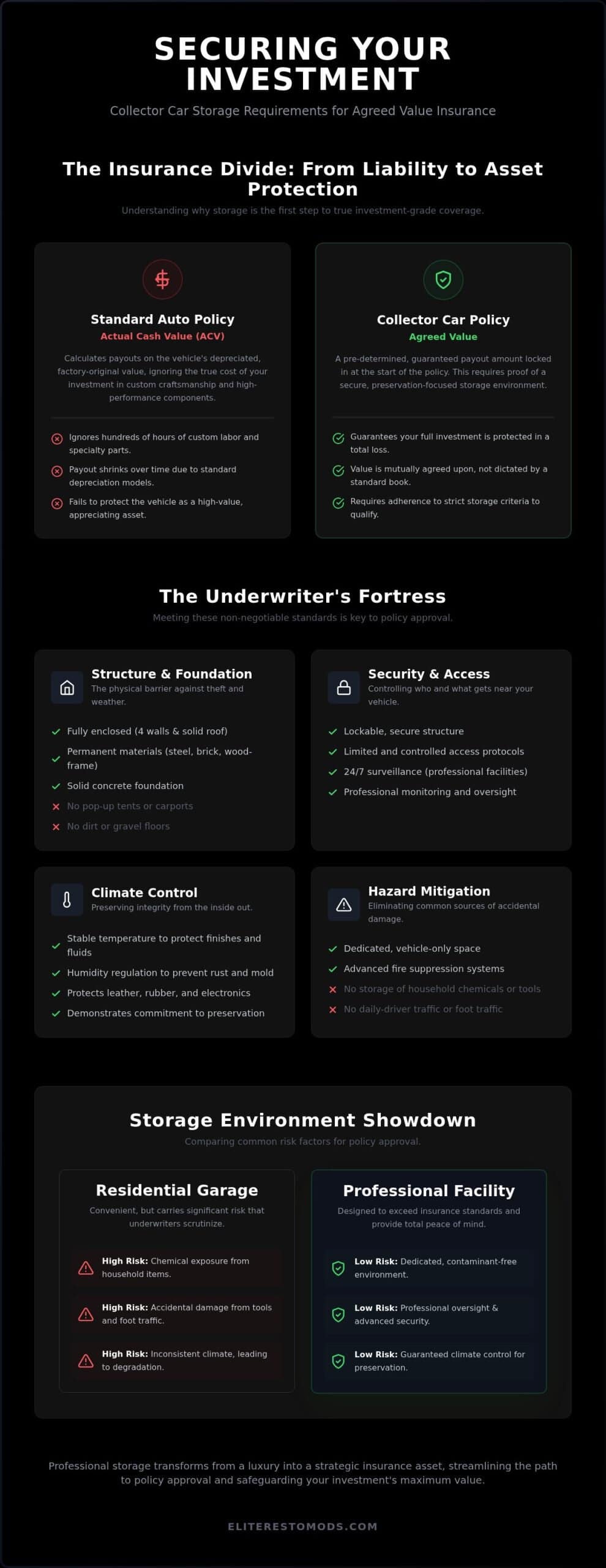
Standard auto policies typically operate on Actual Cash Value. This model is disastrous for high-end builds. In a total loss scenario, a standard carrier calculates a payout based on the depreciated value of a factory-original model. They rarely account for the hundreds of hours of artisanal craftsmanship or the high-performance mechanical components under the hood. Specialty insurance relies on Agreed Value. This is a guaranteed payout amount determined by the owner and the insurer at the start of the policy. To grant this, underwriters must be certain the vehicle is sheltered in a dedicated, secure environment. According to definitions often referenced by organizations like the Classic Car Club of America, these vehicles possess historical and aesthetic significance that transcends mere transport. Storage validates that the car is being preserved rather than consumed by the road.
The Underwriter Perspective on Risk and Environment
When an underwriter reviews an application, they are searching for a fortress. They look for a fully enclosed, lockable structure that separates the asset from the elements. A driveway or a soft-sided carport is an immediate disqualifier for premium coverage. Underwriters analyze the immediate storage structure because it is the most controllable variable in the risk equation. A professional facility or a dedicated private garage reduces the frequency of claims related to theft, vandalism, and accidental damage. For many enthusiasts, utilizing professional Climate-Controlled Storage is the most efficient way to satisfy collector car storage insurance requirements. It demonstrates a commitment to perfectionism that standard residential spaces, often cluttered with household chemicals and tools, simply cannot match. This level of environmental control provides the transparency and reliability that modern underwriters demand for high-limit policies.
The Essential Secure Storage Criteria Required by Specialty Insurers
A secure facility is the baseline, but the technical definition of security varies wildly between a standard residential garage and an underwriter’s checklist. For an investment-grade asset, secure is a measurable standard of engineering. It requires a fully enclosed structure with four permanent walls and a solid roof. This is a non-negotiable component of collector car storage insurance requirements. Specialty providers need to know that your vehicle is physically isolated from the outside world. They aren’t just looking for a roof; they’re looking for a fortress that mitigates every conceivable risk from theft to environmental degradation.
Physical Structure and Foundation Requirements
Insurers demand permanent building materials. This means steel, brick, or wood-framed structures that can withstand regional weather events. Temporary solutions like pop-up tents or soft-sided shelters are immediate red flags. They offer no resistance to theft and even less protection against falling debris or high winds. Underwriters also look closely at the floor. A concrete foundation is the preferred standard. Dirt or gravel floors are often excluded because they allow moisture to rise directly into the chassis, leading to the very corrosion that agreed value policies aim to avoid. A solid slab acts as a barrier, keeping the underside of your vehicle as pristine as the paintwork.
Locking Systems and Access Control Standards
A lock is only as good as the protocol behind it. High-value assets require deadbolts, reinforced garage doors, and restricted access. If you are researching the Best Classic Car Insurance Companies, you’ll find that many mandate the vehicle be kept in a locked, private space. Shared storage facilities are acceptable only if they feature individual units or 24/7 professional monitoring. Alarm systems that tie directly to local authorities provide the highest level of risk mitigation. This level of oversight often translates into lower premiums or higher coverage limits because it removes the variable of human error. It’s about creating a controlled environment where the soul of the machine is never left to chance.
Underwriting is a data-driven process. You’ll likely be asked for site photos showing the structure, the locking mechanisms, and the surrounding environment. Providing a detailed facility description can expedite the approval of your policy while satisfying all collector car storage insurance requirements. For collectors who want to bypass the technical hurdles of residential compliance, utilizing professional Climate-Controlled Storage ensures every requirement is met to master-builder standards. This approach frames your storage choice as a proactive step in the vehicle’s preservation journey, making the insurance approval process a simple formality rather than a technical battle.
Comparing Professional Facility Standards vs Residential Garage Requirements
A residential garage is often a multi-functional space where everyday life collides with high-value engineering. While convenient, these spaces carry a significantly higher risk profile in the eyes of an underwriter. Professional facilities, by contrast, are dedicated sanctuaries designed for one purpose: the preservation of automotive art. Understanding the nuances between these two environments is critical for satisfying collector car storage insurance requirements without compromising on your vehicle’s condition. Underwriters see the home garage as a variable; they see the professional facility as a constant.
Navigating the Risks of Shared Residential Spaces
The typical home garage is a high-traffic zone. It houses lawnmowers, bicycles, and heavy-duty shelving units. Each of these represents a potential claim for accidental damage. A falling ladder or a stray bicycle handle can instantly ruin a bespoke paint finish. Beyond physical impacts, the proximity to household chemicals creates a corrosive atmosphere. Fertilizers, pool supplies, and paint thinners release vapors that can tarnish chrome and degrade artisanal leather over time. Insurers are wary of these non-automotive risks. If you choose home storage, you must isolate the vehicle. Use dedicated bays, floor mats to prevent moisture wicking, and physical barriers to restrict family traffic. Underwriters often demand photos of these precautions to verify that the vehicle is not being treated as a daily utility.
The Advantages of Professional Curated Storage
Professional storage eliminates the variables of residential chaos. These facilities operate as controlled ecosystems. They offer more than just a locked door; they provide a comprehensive maintenance protocol. This includes consistent battery tending, tire pressure monitoring, and regular fluid inspections. Verifiable maintenance logs provide a paper trail of care that underwriters value. They prove the vehicle remains in a fully sorted state. This level of detail aligns perfectly with the Elite Restomods philosophy of treating every car as a functional masterpiece. Security is another tier entirely. Professional sites utilize 24/7 monitoring and advanced fire suppression systems that far exceed residential standards. Industrial-grade protocols mitigate the risk of theft and vandalism, which often leads to more favorable policy terms. It transforms the vehicle’s storage from a passive act into an active preservation journey.
Mitigating Environmental Risks to Maintain Policy Compliance
Environmental stability isn’t just about comfort; it’s about the financial integrity of your asset. While earlier sections focused on the physical fortress, underwriters also scrutinize the invisible forces that degrade a vehicle over time. Fluctuations in temperature and humidity cause metal to sweat and artisanal materials to contract. This micro-deterioration is a silent killer of appraisal value. Meeting collector car storage insurance requirements often means proving you’ve mitigated these atmospheric risks. An insurer’s willingness to maintain an agreed value policy depends on the vehicle’s condition remaining static. If the chrome begins to pit or the custom leather starts to crack, your next valuation could plummet, leaving your investment under-protected.
Humidity Control and Corrosion Prevention
Rust is a chemical reaction that doesn’t require a rainstorm to begin. High humidity levels, specifically anything above 60 percent, create a breeding ground for oxidation on classic metal and high-performance components. Stable humidity protects the intricate mechanical work and aesthetic finishes that define a restomod. It prevents the moisture wicking that ruins custom leather interiors and causes wood-grain accents to warp. Insurers view climate-controlled environments as significantly lower risk for long-term claims. They know that a vehicle kept in a steady 50 percent humidity environment won’t suffer from the hidden corrosion that often leads to catastrophic mechanical failure or expensive aesthetic restoration.
Pest Management and Fire Safety Protocols
A single rodent can cause thousands of dollars in damage in a single night. They are notoriously drawn to the soy-based insulation found in modern wiring harnesses, a common feature in elite restomods. Professional facilities implement rigorous pest management protocols that go far beyond a few traps in a corner. These sites are sealed and monitored to ensure no biological threats reach your upholstery or electronics. Fire safety is the final, critical pillar of compliance. While a residential garage might have a single smoke detector, professional facilities utilize advanced fire suppression systems. These systems are designed to extinguish threats without the water damage associated with traditional sprinklers. This level of sophisticated protection ensures your vehicle maintains its investment-grade status even in the face of an emergency.
Protecting a bespoke machine requires a partner who understands the soul of the asset. You don’t have to manage these technicalities alone. Secure your vehicle’s future and satisfy every underwriter’s demand by choosing Climate-Controlled Storage that meets the highest industry standards. This proactive approach ensures your restoration journey continues without the setbacks of environmental neglect.
Simplifying Insurance Approval with Professional Storage Solutions
Professional storage acts as the ultimate lubricant for the insurance approval process. It eliminates the primary hurdle that stalls most specialty applications: the unverifiable residential environment. When you choose a professional facility, you are presenting the underwriter with a standardized, low-risk profile that satisfies every collector car storage insurance requirement by default. This isn’t just a parking space. It is a curated environment maintained to master-builder standards. It provides a level of peace of mind that home garages, regardless of their sophistication, simply cannot match. You aren’t just storing a machine; you are protecting a bespoke investment.
At Elite Restomods, we understand that an investment-grade vehicle must exist in a state of constant readiness. Our Climate-Controlled Storage is more than a shelter; it is an active management program. There is a powerful synergy between secure storage, Classic Car Financing, and long-term asset management. A vehicle that is professionally stored is easier to finance and simpler to insure. This creates a streamlined ownership experience that allows you to focus on the visceral thrill of the drive rather than the technicalities of risk mitigation. It ensures the soul of the machine remains as potent as the day it left the shop.
The Role of Documentation in Policy Maintenance
A policy is only as strong as the evidence supporting it. Professional storage receipts serve as irrefutable proof of compliance for insurers. They create a digital paper trail that documents the vehicle’s environment every day of the year. This historical record is invaluable during a claim or a policy renewal. It also supports future resale value. A discerning buyer will pay a premium for a vehicle with a documented history of professional curation. They want to know the machine has been protected from the micro-deterioration caused by unstable environments. This documentation transforms your storage choice into a verifiable asset.
Transitioning Your Vehicle to a Secure Environment
Moving your asset from a residential space to a professional facility should be a seamless, purposeful transition. Begin with a comprehensive inspection to document the vehicle’s current state. Ensure all maintenance logs are updated and digitized. The logistics of the move are equally critical for maintaining policy integrity. Utilizing Enclosed Vehicle Transport is the only way to maintain the vehicle’s pristine condition during the journey. This eliminates the risk of road debris or weather exposure during the move. We invite you to explore the full suite of services at Elite Restomods, where we treat your vehicle as a bespoke piece of functional art. From initial sourcing to professional preservation, we are the bridge between your automotive dream and a tangible, high-performance reality.
Securing Your Automotive Legacy
Protecting a high-performance restomod involves more than just a locked door. It requires a controlled ecosystem that satisfies every underwriter’s demand. We’ve established how physical structure, foundation quality, and 24/7 monitoring form the backbone of modern collector car storage insurance requirements. By transitioning from a multi-purpose residential garage to a professional sanctuary, you move beyond basic coverage and into the realm of total asset protection. This strategic shift ensures your vehicle qualifies for agreed value policies that reflect its true artisanal worth and investment potential.
Elite Restomods provides a storage environment where nostalgia meets modern engineering. Our climate-controlled environments are designed for preservation, featuring maintenance checks and battery tending included with storage subscriptions to keep your vehicle fully sorted. We understand the mechanical intricacies that specialty insurers must protect because we are master builders who live and breathe these projects. It’s time to simplify your ownership experience and ensure your vehicle remains a tangible, high-performance reality. Explore Secure Storage and Elite Services at Elite Restomods and give your investment the sanctuary it truly deserves.
Frequently Asked Questions
What is the most important storage requirement for classic car insurance?
The vehicle must be kept in a fully enclosed, locked, and permanent structure. Open carports or street parking don’t qualify for specialty coverage. This is the foundation of meeting collector car storage insurance requirements. It proves the asset is removed from daily-use risks and environmental exposure. Insurers prioritize this because it mitigates theft and vandalism. Without a secure structure, you’re unlikely to secure an agreed value policy for your investment.
Can I get collector car insurance if I store my vehicle in a driveway?
No, specialty insurers generally require the vehicle to be stored in a secure, weather-protected structure. Storing an investment-grade restomod in a driveway or under a carport exposes it to uncontrolled risks that standard underwriters won’t accept for agreed value policies. For those without a private garage, professional facilities offer a reliable path to policy eligibility and long-term preservation. It’s about demonstrating that the vehicle is a curated asset.
Does my storage facility need to be climate-controlled to qualify for a policy?
While not always a hard requirement for every policy, climate control is strongly recommended and often required for high-value restomods. It protects the vehicle’s appraisal value by preventing micro-deterioration of artisanal finishes and mechanical components. Insurers view climate-controlled environments as lower risk. This proactive measure ensures your asset remains in a fully sorted state, supporting the vehicle’s long-term investment journey and maintaining its investment-grade status through 2026.
Will storing my car in a professional facility lower my insurance premiums?
Yes, many insurers offer premium discounts for vehicles stored in professional facilities with 24/7 monitoring and advanced security. These environments provide a level of risk mitigation that residential garages can’t match. By satisfying the most stringent collector car storage insurance requirements, you demonstrate a commitment to perfectionism that underwriters reward with more favorable terms and higher coverage limits. It transforms your storage choice into a strategic financial asset.
What does an insurer consider a secure enclosed structure?
An insurer defines a secure structure as one with four permanent walls, a solid roof, and a lockable entrance. It must be a permanent building made of materials like steel, brick, or wood. Temporary structures, such as pop-up tents or soft-sided shelters, are excluded. The structure should also have a solid foundation, preferably concrete, to prevent moisture from rising into the chassis and causing the corrosion that specialty policies aim to avoid.
Are there specific fire safety requirements for collector car storage?
Professional facilities are often required to have industrial-grade fire suppression systems and smoke detection tied to local authorities. In residential settings, underwriters look for basic fire protection measures and the absence of hazardous materials near the vehicle. Choosing a facility with specialized suppression ensures that an emergency doesn’t result in the water damage often associated with traditional sprinkler systems, preserving the integrity of the build and its custom interior.
How do I prove my storage meets insurance requirements during a claim?
Documentation is the primary tool for proof. You should maintain a digital paper trail that includes site photos of the structure, locking mechanisms, and security features. If you use a professional facility, your monthly storage receipts and maintenance logs serve as irrefutable evidence of compliance. This transparency builds trust with the underwriter and ensures a smoother claims process. It proves you’ve followed every protocol required to protect your asset.
Can I store multiple collector cars in the same facility under one policy?
Yes, most specialty insurers allow multiple vehicles to be covered under a single policy as long as the facility meets the required security standards. Each vehicle must still satisfy the individual storage criteria to remain eligible for agreed value coverage. Storing a collection in a professional, climate-controlled environment simplifies management and ensures every machine is kept in a state of constant readiness, ready for the visceral thrill of the drive.