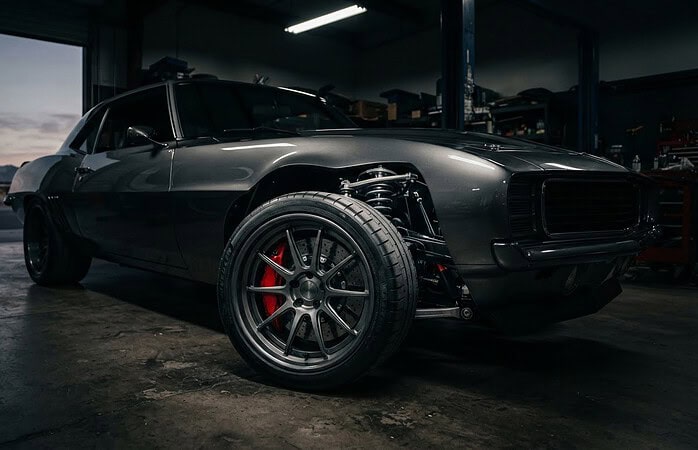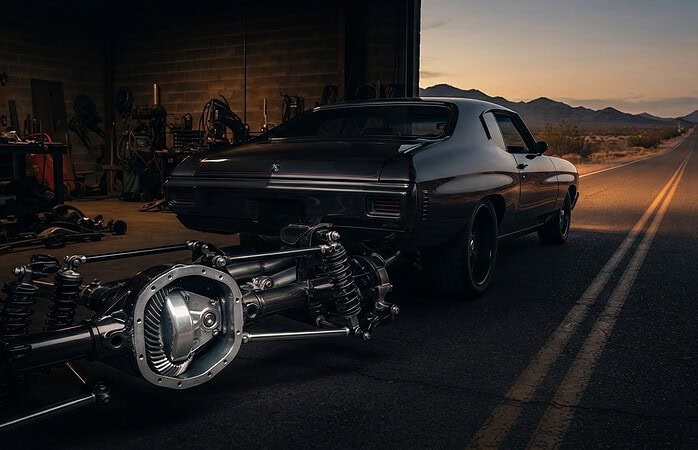

What if your 1969 fastback could out-corner a 2024 Porsche 911 while maintaining the raw soul of American iron? Most enthusiasts accept that vintage muscle comes with “boaty” steering and a terrifying four inches of play at 70 MPH. It’s a common compromise, but it’s no longer a necessary one. By integrating meticulous pro touring suspension upgrades, you can bridge the gap between 1960s aesthetics and 21st-century physics. You deserve a machine that feels as sharp as it looks, replacing vague handling with the surgical precision of a bespoke build.
We understand the anxiety of investing in mismatched parts that ruin your ride quality. This 2026 guide provides the technical roadmap to master your chassis geometry and achieve 1.0g of lateral grip. You’ll learn how to select high-performance coilovers and independent rear suspension systems that offer both track-ready aggression and daily-driver comfort. We are moving beyond simple bolt-ons to explore the engineering that grants your classic icon unrivaled stability and a significant boost in resale value.
Key Takeaways
- Identify the critical transition from the “frightening float” of vintage chassis design to the razor-sharp precision required for modern supercar handling.
- Discover how a synergistic approach to pro touring suspension upgrades—integrating front subframes and rear 4-link systems—creates a cohesive performance machine.
- Learn why the most important phrase in the restomod lexicon is “fully sorted,” emphasizing the art of chassis geometry over simple bolt-on parts.
- Master the balance between aggressive track performance and supple street cruising by tailoring your suspension choices to your specific build story.
- Understand how integrating elite-level suspension components elevates a vintage vehicle into an investment-grade restomod with unrivaled resale value.
The Evolution of Handling: Why Vintage Suspension Fails the Modern Driver
Every enthusiast remembers the first time they sat behind the wheel of an iconic 1960s muscle car. The smell of unburned fuel and the visceral shake of a high-lift cam create an intoxicating cocktail of American history. It’s a nostalgic roar that promises raw power. However, for many drivers, that excitement quickly turns into a frightening float once the car reaches highway speeds. The reality is that vintage chassis design was never intended to handle the speeds or the traffic conditions of the twenty-first century.
The Pro-Touring movement emerged to bridge this gap between classic aesthetics and modern performance. It isn’t just about making a car look aggressive; it’s a holistic engineering philosophy. By integrating pro touring suspension upgrades, builders can transform a vehicle that once felt like a boat into a precision instrument. This approach replaces 60-year-old compromises with bespoke engineering designed for the curves of a mountain road or the rigors of an autocross track.
To better understand this concept and see these components in action, watch this helpful video:
The Limitations of 1960s Automotive Engineering
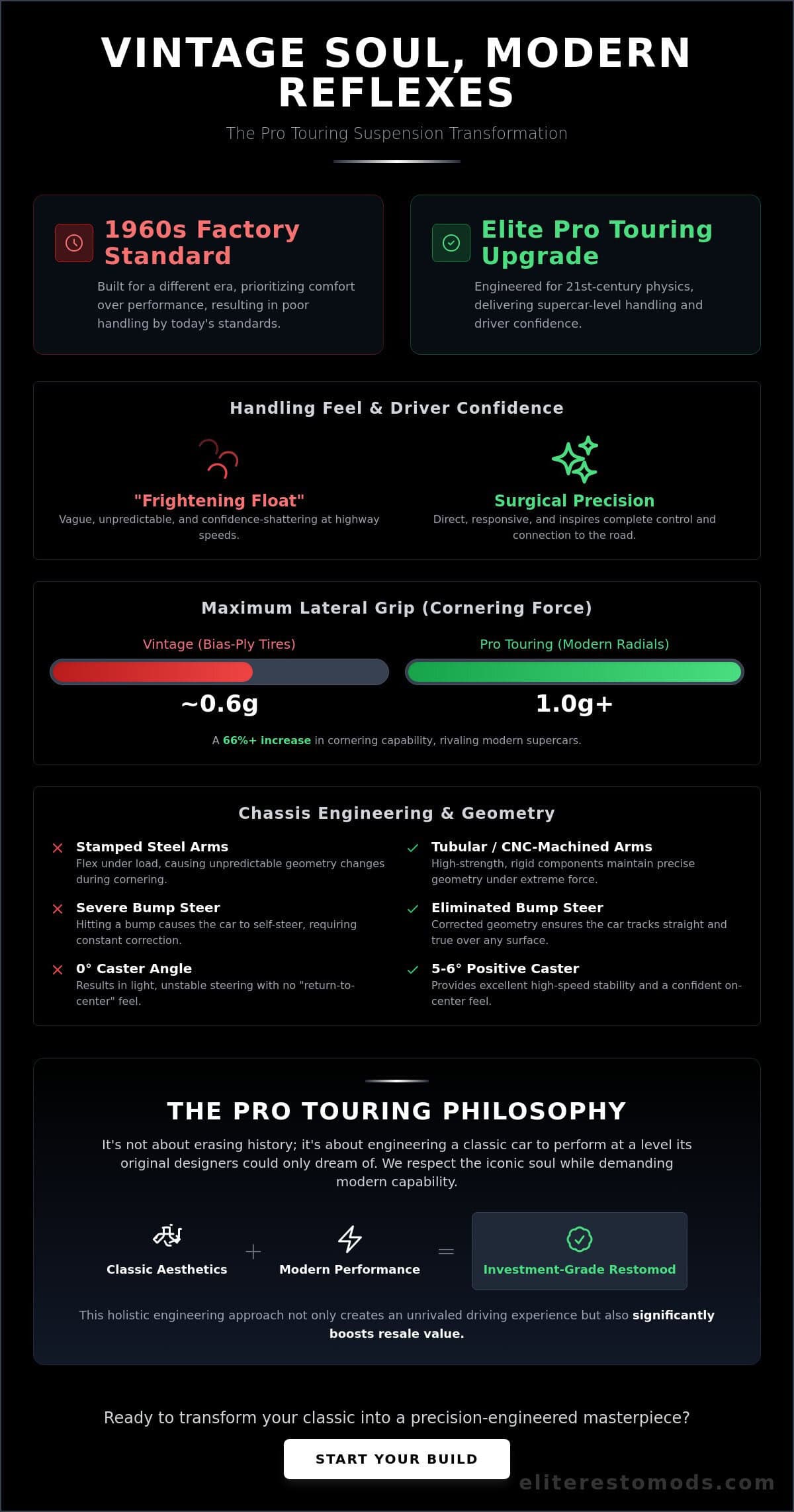
The factory suspension on a 1967 Mustang or a 1969 Camaro relied on stamped-steel control arms. These components were cheap to mass-produce but lacked structural rigidity. Under heavy cornering loads, these arms actually flex, changing the car’s geometry exactly when you need it to stay stable. Most vintage cars also suffer from severe bump steer. This phenomenon occurs when the tie rods and control arms travel in different arcs, causing the wheels to steer themselves when hitting a dip in the road. At 70 mph, a simple pothole can cause the car to dart half a lane wide, shattering driver confidence.
Furthermore, 1960s alignment logic was built for bias-ply tires. These tires were designed to slip and had very soft sidewalls. A factory service manual from 1965 might call for 0 degrees of caster; a setting that makes the steering feel light but provides no “return-to-center” stability. Modern radial tires, like a Michelin Pilot Sport 4S, offer nearly 40% more lateral grip than vintage rubber. When you apply 1.0g of cornering force to a chassis designed for 0.6g, the factory bushings compress and the geometry collapses. The car doesn’t just lean; it becomes unpredictable.
The Pro Touring Philosophy: Beyond Restoration
There’s a fundamental difference between a standard restoration and a Pro-Touring build. A restoration seeks to preserve the past, often down to the original, inferior rubber bushings and drum brakes. A Pro-Touring build respects the soul of the machine but demands modern capability. The goal is a vehicle meant to be driven across state lines, not just rolled on and off a trailer for a car show. It’s about achieving turn-key reliability and supercar-level handling without sacrificing the iconic silhouette of a classic. You can learn more about these distinctions in our guide on What is a Restomod vs. a Restoration?
Modern pro touring suspension upgrades utilize CNC-machined aluminum, high-strength tubular steel, and adjustable coilover shocks. These parts allow for precise alignment settings, such as 5 or 6 degrees of positive caster, which provides the high-speed stability of a modern luxury sedan. This “Then vs. Now” duality ensures that while the car looks like a piece of functional art from 1969, it performs with the poise of a 2026 performance machine. It’s the ultimate marriage of brute force and refined comfort.
The Anatomy of Performance: Key Pro Touring Suspension Components
Building a world-class restomod requires more than just bolting on shiny parts. It demands a holistic approach where every component works in perfect harmony. A truly sorted machine relies on the synergy between a precision-engineered front subframe and a sophisticated rear 4-link system. This foundation is what allows a vintage chassis to handle the massive torque of modern classic car engine swaps without twisting or losing composure. High-end brands like Detroit Speed and Wilwood have redefined these boundaries, turning 60-year-old steel into a bespoke piece of functional art. When you invest in pro touring suspension upgrades, you aren’t just buying parts; you’re engineering a new personality for your car.
Coilovers and Adjustable Dampening
The days of bouncy leaf springs and primitive shocks are over. Modern pro touring builds utilize sophisticated coilover setups that offer total control over ride height and corner balancing. Single adjustable shocks allow you to tune the rebound, while double adjustable units provide independent control over both compression and rebound. This level of precision is vital for the luxury gearhead who demands a car that remains supple on broken pavement but stays flat through a 1.0g corner. Selecting the correct spring rate is a meticulous process, ensuring the vehicle feels planted rather than punishing. Projects like the Week 2 Wicked 1967 Nova demonstrate how these systems transform a car’s center of gravity and weight transfer characteristics instantly.
Tubular Control Arms and Spindles
Stock stamped-steel arms were never designed for modern radial tires or high-speed cornering. Tubular control arms, often crafted from high-strength DOM steel, offer a superior strength-to-weight ratio that reduces unsprung mass. This allows the suspension to react faster to road imperfections. When paired with revised spindles, these pro touring suspension upgrades improve the camber gain during hard cornering. This means the tire’s contact patch remains flat against the asphalt even as the chassis leans, providing unrivaled grip. These components are the skeletal structure of performance, finished in show-quality powder coat to match their mechanical excellence.
Rack and Pinion Steering Conversions
Vintage steering boxes are notoriously vague, often feeling like a suggestion rather than a command. Swapping to a modern rack and pinion system provides the tactile feedback and “on-center” feel required for high-performance driving. This conversion eliminates the “dead spot” in the middle of the wheel’s travel, giving the driver total confidence at triple-digit speeds. The steering ratio defines the number of degrees the steering wheel must turn to move the wheels one degree, with a quick 12:1 ratio drastically reducing the effort needed for rapid direction changes. It’s the final touch in creating a telepathic connection between the driver and the road. You can explore how these systems integrate into a complete build by viewing our custom restoration services to see the level of detail we bring to every chassis.
Beyond the Bolt-On: Geometry and the Art of the Fully Sorted Chassis
Buying a catalog of high-end parts isn’t the same as building a world-class machine. This is the primary misconception in the restomod world. Many enthusiasts believe that simply installing pro touring suspension upgrades guarantees modern handling. It doesn’t. A collection of expensive components without a cohesive plan is just a pile of metal. True performance is found in a “fully sorted” chassis. This phrase represents the pinnacle of automotive engineering, where every bushing, spring rate, and shock valving works in perfect harmony. It’s the difference between a car that feels nervous at 60 mph and one that feels planted at 130 mph.
The chassis is the foundation of every bespoke build. If the foundation is weak, the rest of the car suffers. Achieving a fully sorted status requires professional corner scaling and precision alignment. We weigh each corner of the vehicle to achieve a balanced weight distribution, often aiming for a 50/50 or 52/48 bias. This ensures the car behaves predictably during aggressive weight transfers. Even seasoned professionals spend dozens of hours dialing in these settings, as seen in the Super Chevy Week to Wicked series, where a 1969 Camaro is transformed through meticulous adjustment rather than just part swapping.
Understanding Suspension Geometry
Geometry is the invisible science that dictates how a car moves. Roll centers define the imaginary point around which the body pivots during a turn. If the roll center is too low, the car leans excessively. Anti-dive and anti-squat settings control how the chassis reacts to braking and acceleration. Proper anti-dive keeps the nose level under heavy braking, maintaining tire contact. Without a master builder’s vision during the build process, even the best pro touring suspension upgrades can result in poor “bump steer” or snap oversteer. Precision is mandatory. We calculate these points to ensure the tires stay flat against the pavement, maximizing the mechanical grip of modern rubber.
Rigidity: The Role of Subframe Connectors and Roll Cages
A 1960s unibody was never designed for the lateral loads of modern 200-treadwear tires. Without reinforcement, a classic chassis can flex up to 0.5 inches during high-G cornering. This flex acts as an uncontrolled spring, making the suspension’s job impossible. We eliminate this through structural engineering:
- Subframe Connectors: These bridge the front and rear clips, turning two separate pieces into a rigid unit.
- Roll Cages: A well-integrated 6-point cage can provide a 300 percent increase in torsional rigidity.
- X-Bracing: This prevents the “twisting” motion common in high-horsepower muscle cars.
The result is an unrivaled feel of solidity. The car doesn’t groan or rattle when pushed. It responds instantly to driver input. By balancing this rigidity with modern acoustic damping, we create a chassis that offers track-day precision without sacrificing the comfort required for a cross-country tour. It’s the marriage of brute strength and refined composure.
Street vs. Track: Tailoring Your Suspension Upgrades to Your Build Story
Every iconic build begins with a narrative. Your “Build Story” dictates whether your vehicle becomes a long-distance cruiser or a corner-carving predator. A common misconception suggests that pro touring suspension upgrades are reserved strictly for the racetrack. This isn’t the case. Pro Touring is about balance. It’s the art of erasing the fifty-year gap between vintage aesthetics and modern performance. When you plan a restomod build, the suspension serves as the foundation of your driving experience. It determines how the car speaks to you through the steering wheel and the seat.
The “Daily Driver” Setup
Comfort is king for the open road. If your goal is to cruise the coast or attend national shows, you must prioritize the reduction of Noise, Vibration, and Harshness (NVH). Traditional rubber bushings offer superior damping. However, modern poly-graphite options provide a 20% increase in stiffness without the annoying squeaks of older materials. Avoid solid rod ends here. They transfer every pebble directly into the chassis. Maintain a ride height of at least 5 inches. This ensures your bespoke chin spoiler survives real-world speed bumps and driveway inclines while maintaining a sleek, aggressive stance.
The “Weekend Warrior” Track Setup
For those who crave the roar of the engine at wide-open throttle, the requirements shift toward maximum mechanical grip. An Independent Rear Suspension (IRS) is the ultimate upgrade. It allows each wheel to react to the pavement independently, which drastically improves stability during high-speed cornering. You’ll need 1.25-inch hollow sway bars to minimize body roll and aggressive alignment specs that favor turn-in response. This level of performance demands equal stopping power. Integrating high-performance Wilwood brakes into your pro touring suspension upgrades ensures you can dive deep into corners with total confidence.
Your vision deserves a chassis that can keep up. Whether you want a supple ride or a track-ready beast, the right components transform a vintage car into a modern masterpiece. Perfection is found in the details of the geometry. Every shim and bolt matters when you’re chasing automotive excellence. Ready to define your drive? Explore our bespoke suspension services today.
The Elite Standard: Integrating Modern Suspension into Investment-Grade Restomods
A world-class restomod is more than a vintage shell with a high-horsepower crate engine. It’s a cohesive, engineered machine where every component communicates. High-quality pro touring suspension upgrades do more than just shave seconds off a lap time. They define the vehicle’s market position. Recent data from 2025 collector car auctions reveals that restomods equipped with modern, fully independent suspension systems command a 25% to 40% premium over builds using modified factory hardware. The market rewards precision. Investors and enthusiasts alike seek vehicles that offer the visceral thrill of 1969 with the composure of 2026.
Every vehicle that leaves our facility undergoes the “Elite Certified” validation process. This isn’t a simple visual inspection. It’s a rigorous testing protocol that includes 150 miles of mixed-environment road testing and specific chassis tuning. We verify geometry, eliminate bump steer, and ensure high-speed stability. We don’t just build cars. We curate driving experiences that are predictable, safe, and exhilarating. You get a turn-key reality where the mechanical gremlins of the past are replaced by modern reliability.
The Value of Professional Engineering
Investment-grade status requires a departure from the “parts catalog” mentality. It’s about how those parts work in unison. A professionally sorted suspension provides the peace of mind required to actually drive the car. When you’re pushing 600 horsepower through the rear wheels, you need to know the chassis won’t flex and the tires will stay planted. For those looking to secure a high-end build without compromise, we offer insights through our classic car financing options. This ensures your capital is as well-managed as your cornering speeds.
Commissioning Your Build
Every icon is unique. A 1969 Camaro destined for the autocross circuit needs a different setup than a 1970 Chevelle built for cross-country touring. We curate your pro touring suspension upgrades to match your specific driving profile. This bespoke approach transforms a machine into functional art. It’s the difference between a car that looks fast and one that feels unstoppable. The goal is simple. A classic car should roar like a beast but handle like a dream.
Ready to experience the elite standard of modern performance? View our current inventory to find your next investment-grade icon.
Command the Road with Modern Precision
The road ahead demands more than just vintage aesthetics. It requires a chassis that can handle the raw torque of a modern powerplant while maintaining the poise of a contemporary supercar. You’ve seen how 2026-standard engineering transforms 1960s geometry from a wandering liability into a precision instrument. High-performance pro touring suspension upgrades bridge this gap; they replace outdated leaf springs and steering boxes with sophisticated coilover systems and multi-link rear ends. This isn’t just about speed. It’s about the confidence to carve corners with absolute predictability.
At Elite Restomods, we don’t just build cars. We create bespoke functional art. Every vehicle in our collection undergoes our rigorous Elite Certified Quality Assurance process to ensure turn-key reliability for your daily commute or a cross-country rally. We’ve mastered the balance between the visceral roar of American muscle and the refined grace of modern handling. Your dream car shouldn’t just sit in a garage. It belongs on the open pavement.
Explore our inventory of fully sorted Pro Touring restomods and experience the perfect marriage of then and now. The keys to your next adventure are waiting.
Frequently Asked Questions
Is a Pro Touring suspension upgrade worth the investment for a street car?
Absolutely. A Pro Touring suspension upgrade is the definitive choice for enthusiasts who want to drive their icons rather than just trailer them. While vintage setups offer a floaty, 1960s feel, modern geometry provides a 30 percent increase in cornering stability. You’ll gain the confidence to navigate canyon roads with the precision of a 2026 sports car while maintaining the soul of a classic muscle car.
Can I install a Pro Touring suspension kit myself or do I need a master builder?
You can install basic bolt-on kits in a home garage, but achieving peak performance often requires a master builder’s touch. Complex systems like a triangulated 4-link require precise welding and 100 percent accurate pinion angle adjustments. Professionals utilize laser alignment tools and corner weighting scales to ensure your bespoke machine handles as flawlessly as it looks, bridging the gap between raw power and refined control.
How much does a full Pro Touring suspension upgrade cost for a classic Camaro or Mustang?
Total investment varies based on the level of engineering and track capability required. Industry data from 2025 indicates that comprehensive
pro touring suspension upgrades
for F-body Camaros or classic Mustangs typically range from 8,000 to 25,000 dollars for high-end hardware. This investment covers everything from tubular control arms to sophisticated coilover systems that transform a vintage chassis into a modern performance beast.
What is the difference between a 4-link and a leaf spring suspension?
A 4-link system replaces antiquated leaf spring technology to eliminate wheel hop and axle wrap entirely. Leaf springs rely on 19th-century designs that flex under heavy loads. By contrast, a 4-link uses dedicated arms to locate the axle, allowing for a 40 percent improvement in rear-end articulation and grip. It’s the essential difference between fighting your car’s weight and commanding its every movement on the asphalt.
Will a Pro Touring suspension lower my car too much for daily driving?
Modern systems won’t compromise your daily drivability because they offer 2 to 3 inches of ride height adjustability. You can dial in a low, aggressive stance for the show floor and then raise it for real-world road obstacles like speed bumps. High-quality coilovers from 2026 brands feature 24-position dampening clicks, allowing you to soften the ride for city streets or stiffen it for the track.
Do I need to upgrade my brakes and wheels when installing a Pro Touring suspension?
You must upgrade your wheels and brakes to realize the full potential of your new suspension geometry. Most Pro Touring spindles require 17-inch or larger wheels to clear high-performance 6-piston Wilwood or Brembo calipers. Upgrading to 14-inch rotors provides the stopping power needed to match your car’s increased cornering speeds, ensuring that safety and performance are perfectly balanced in your build.
How does an Independent Rear Suspension (IRS) compare to a solid axle 4-link?
Independent Rear Suspension (IRS) offers unrivaled ride quality and mid-corner composure on uneven pavement. While a solid axle 4-link is legendary for its 1,000-plus horsepower durability, an IRS allows each wheel to react independently to road imperfections. This reduces unsprung weight by approximately 15 percent, resulting in a more refined, European-inspired handling characteristic for your American muscle icon.
What are the best brands for Pro Touring suspension components in 2026?
The 2026 market is led by industry titans like Detroit Speed, Ridetech, and Roadster Shop. These manufacturers are the gold standard for
pro touring suspension upgrades
, providing meticulously engineered components that fit with factory-like precision. Their latest catalogs feature advanced valving and lightweight alloys that transform iconic silhouettes into modern performance masterpieces, ensuring your car remains a benchmark of automotive excellence.