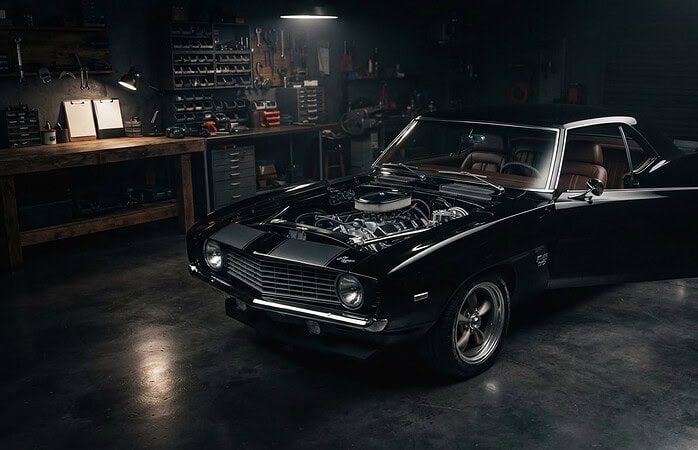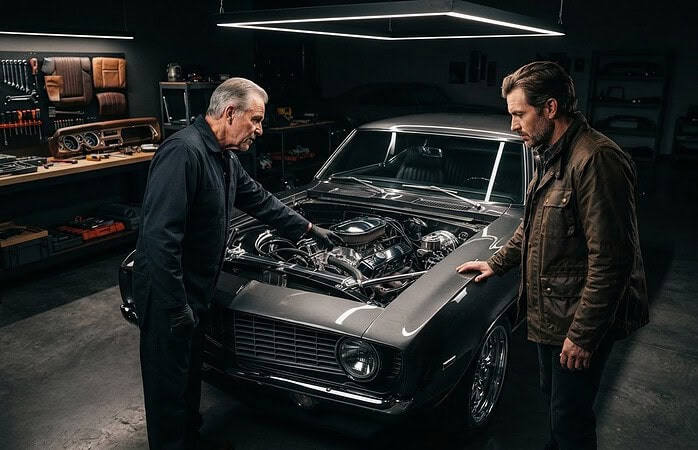

What if the greatest threat to your vintage investment isn’t a market downturn, but the simple fear of actually turning the key? You’ve likely felt that familiar hesitation. You want to experience the soul of a 1966 GTO, yet the prospect of mechanical failure or the lack of modern safety features keeps the machine confined to the garage. Understanding the balance of restoration vs restomod value is essential for any collector seeking a vehicle that functions as a bespoke piece of functional art. You deserve the raw, visceral thrill of the open road without the anxiety of a breakdown.
This guide helps you decide between preserving a moment in time or engineering a new one for the 2026 market. We’ll examine how current auction trends prioritize usability and how specific modifications impact your long-term financial satisfaction. From the meticulous precision of a concours-level build to the brute force of a certified restomod, we’ll provide the clarity needed to choose your perfect driving experience.
Key Takeaways
- Understand the fundamental choice between maintaining a car as a historical artifact or evolving it into a bespoke piece of functional art.
- Evaluate how restoration vs restomod value is influenced by the rising demand for usability and modern performance in the current collector landscape.
- Identify the critical mechanical upgrades, from modern powertrain swaps to advanced chassis stiffening, that bridge the gap between 1960s soul and 2026 reliability.
- Discover the benefits of a fully sorted, investment-grade build that eliminates the common mechanical failures associated with traditional vintage ownership.
Defining the Divide: The Core Philosophy of Restomod vs Restoration
The choice between a factory-perfect preservation and a high-performance reimagining isn’t just a mechanical decision. It’s a statement of intent. For decades, the collector car market focused on the “time capsule” effect, where every nut and bolt mirrored the original assembly line. However, the 2026 market reflects a profound shift in priorities. Owners are no longer content with static displays. They crave the visceral roar of a vintage engine paired with the unwavering reliability of modern fuel injection. This evolution has sparked a deep debate regarding restoration vs restomod value, as collectors weigh the prestige of history against the thrill of modern capability.
Understanding The Core Philosophy of Restomod vs Restoration requires looking beyond the sheet metal. One path honors the past through strict adherence to manufacturing standards. The other path treats the vehicle as a canvas for bespoke functional art. This divide is driven by a desire for a machine that starts every time, stops on a dime, and maintains its composure in modern highway traffic. The emotional hook is powerful. You want the nostalgia of that iconic silhouette, but you refuse to sacrifice the confidence of modern engineering.
What is a Traditional Restoration?
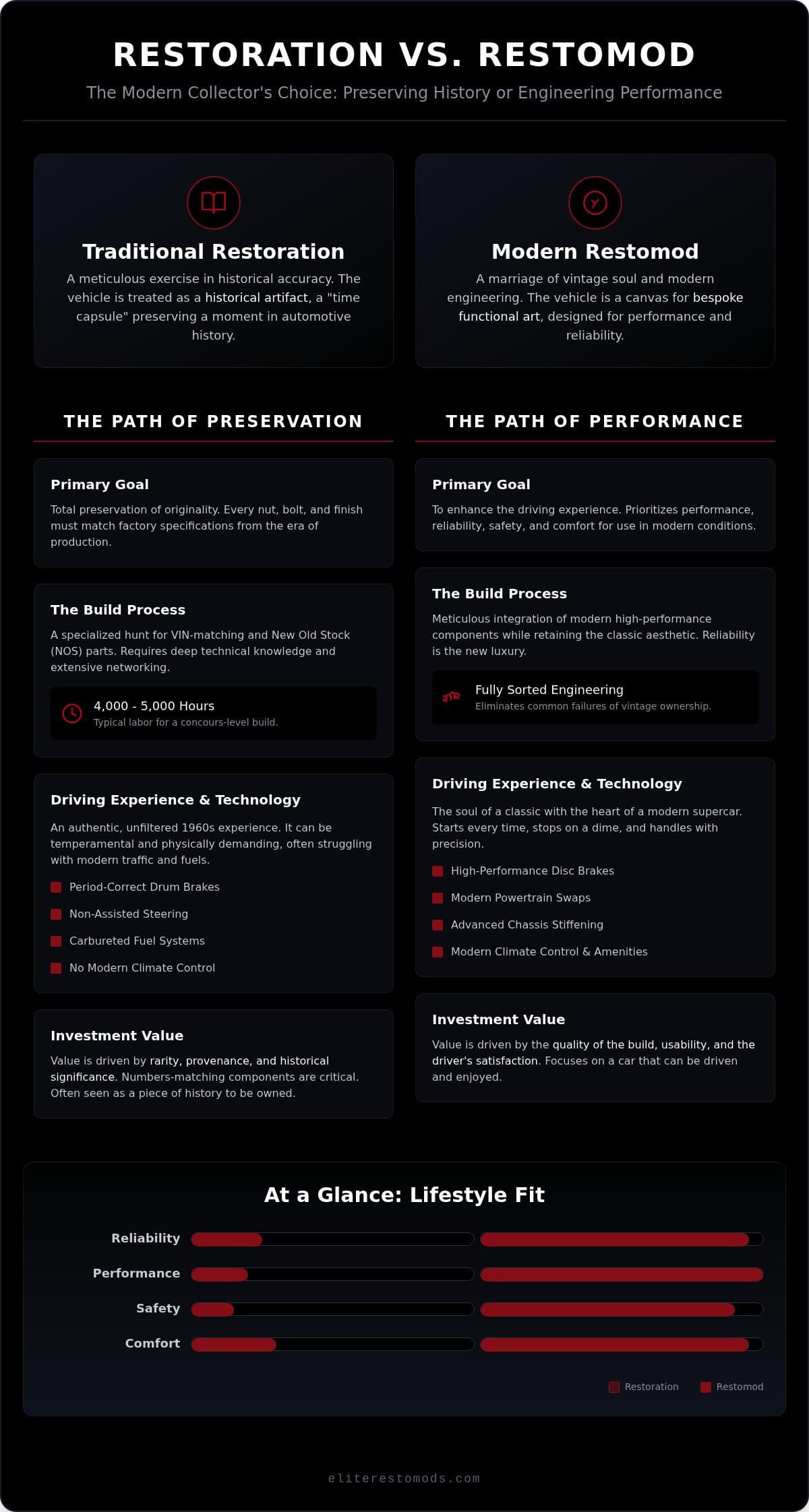
A traditional restoration is an exercise in historical accuracy. It demands a relentless pursuit of VIN-matching components and period-correct finishes. The goal is total preservation. Every detail, from the bias-ply tires to the single-stage paint, must reflect the era of production. A professional concours-level restoration now typically requires 4,000 to 5,000 hours of labor to achieve perfection. While these cars are breathtaking to behold, they carry the inherent limitations of 1960s technology. They are delicate. They are temperamental. For the purist, the value lies in the absolute authenticity of the experience, even if that means compromising on modern safety and climate control.
What Defines a Modern Restomod?
The modern restomod is a marriage of brute force and refined comfort. It keeps the iconic silhouette of a classic but replaces the aging skeleton with contemporary engineering. This isn’t just a simple parts swap. It’s a meticulous build process that integrates high-performance mechanical components into a vintage frame. A restomod prioritizes the driver’s relationship with the machine. It offers the soul of a classic with the heart of a modern supercar. Reliability is the new luxury. By focusing on performance, safety, and daily drivability, the restomod offers a different perspective on restoration vs restomod value, catering to those who believe cars are meant to be driven and enjoyed, not just displayed.
The Art of Concours Restoration: Preserving Automotive History
The pursuit of a concours-level restoration is a journey into the soul of the past. It’s a commitment to total historical accuracy. Every component must be as it was when the vehicle first rolled off the assembly line. This path appeals to the curator who views the automobile as a historical artifact. However, this dedication to purity often creates a “trailer queen” scenario. The car becomes too precious to drive. Its mechanical systems, designed over half a century ago, struggle with modern fuels and traffic speeds. This creates a unique tension when evaluating restoration vs restomod value for the modern collector.
The Technical Rigor of Factory-Correct Builds
Sourcing New Old Stock (NOS) parts is a specialized hunt. It requires years of networking and deep technical knowledge. A true restoration demands period-correct paint chemistry and specific interior stitching patterns. You aren’t just fixing a car; you’re preserving a legacy. But this legacy comes with limitations. Drum brakes and non-assisted steering require a physical effort that modern drivers often find jarring. Carburetors demand constant tuning. These systems were never intended for the stop-and-go reality of 2026. Maintaining these machines is a labor of love, but the lack of safety features and climate control often keeps them off the road. The buyer of a traditional restoration is often motivated by a desire to own a piece of history that remains unchanged. They are comfortable with the maintenance schedules of the 1960s. They enjoy the ritual of the cold start and the distinct smell of unburnt fuel.
Investment Value in the Traditional Market
Provenance is king in the traditional market. A numbers-matching engine and original documentation can drive prices to incredible heights. For instance, a factory-stock 1969 Chevrolet Camaro RS/SS sold for $143,000 at a 2026 Mecum auction. In these cases, the financial satisfaction comes from rarity. If you own a limited-production icon, keeping it original is often the objectively better financial choice. The traditional market values the “as-delivered” state above all else. It prioritizes the vehicle as a time capsule rather than a functional tool. Even with the 2026 market correction leading to more sustainable pricing, high-end preservation remains a staple of elite auctions. While we appreciate the discipline of preservation, we believe the ultimate value lies in a machine you can actually use. You can explore our current inventory of vehicles that balance this heritage with modern capability.
The Restomod Revolution: Modern Engineering Meets Vintage Soul
The restomod revolution isn’t merely about speed. It’s about the complete transformation of the driving experience. While a traditional restoration freezes a vehicle in time, a restomod liberates it. By integrating contemporary engineering into a classic silhouette, we create a machine that thrives in modern traffic. This shift is a primary driver of restoration vs restomod value in 2026, as buyers increasingly prioritize usability over strict originality. A vehicle that sits in a garage is a relic; a vehicle that conquers the highway is an asset. This approach treats every project as a bespoke piece of functional art, where the beauty of the past meets the precision of the future.
The Alchemy of High-Performance Swaps
The heart of this transformation is the powertrain. Swapping a temperamental, carbureted engine for a modern LS or Coyote V8 changes the very soul of the car. Electronic fuel injection (EFI) provides turn-key reliability. No more pumping the pedal or fearing a stall at a stoplight. Modern transmissions offer crisp, precise shifts that a vintage gearbox simply cannot match. The modern restomod powertrain serves as the definitive bridge between 1960s heritage and 2026 high-performance standards. This mechanical synergy creates a visceral excitement that is both nostalgic and exhilarating. You get the raw power you remember, but with the efficiency and cooling capacity required for long-distance summer cruises.
Modern Creature Comforts in a Classic Body
Luxury is defined by comfort. Traditional classics are often loud, hot, and physically demanding to drive. We solve this through meticulous interior engineering. High-output air conditioning systems provide a sanctuary from the summer heat. Premium sound systems are integrated seamlessly, maintaining the vintage aesthetic while delivering modern acoustic clarity. We use advanced insulation and sound-deadening materials to create a refined cabin environment. This allows the driver to focus on the road, not the rattle. Every touchpoint is reconsidered. Custom driving positions and ergonomic seating ensure that long-distance journeys are a pleasure, not a chore. The result is a cabin that feels as premium as a modern luxury sedan but looks like a 1960s masterpiece.
True performance requires control. We upgrade the skeleton of the car with modern suspension systems and chassis stiffening. Rack-and-pinion steering provides the precision needed for confident cornering. High-performance disc brakes ensure you can stop as quickly as you can accelerate. These aren’t just upgrades; they are essential safety features for the 2026 driving environment. By following a meticulous build process, we ensure that the restoration vs restomod value remains high for those who demand excellence in both form and function. Reliability is no longer an afterthought. It is the foundation of the build.
Performance, Reliability, and Value: Which Path Fits Your Lifestyle?
Choosing between these two paths requires an honest assessment of how you intend to spend your time. A vintage engine is a temperamental partner. It requires constant adjustment of the points, timing, and carburation. In contrast, a modern crate motor offers a turn-key experience. This reliability is a cornerstone of restoration vs restomod value for the active driver. If your goal is to participate in the 2026 market, you must consider that restomod builds currently lead the service type segment, accounting for an estimated 39.5 percent of the market. This dominance is driven by a desire for a machine that survives the commute as easily as it wins at the show. The machine is a tool. The tool must work.
The cost-to-value ratio for long-term ownership often favors the restomod for those who actually drive their cars. Maintenance on a factory-spec 1960s vehicle is a continuous cycle of specialized care. Parts are becoming harder to source. Mechanics who understand vintage distributors are a disappearing breed. A restomod utilizes industry-standard hardware. It can be serviced at high-end performance shops nationwide. You spend less time on the lift and more time on the road. This operational efficiency is a key factor when weighing restoration vs restomod value in a world that values time as much as capital.
The Daily Driving Reality
Original cooling systems were engineered for a different era. They struggle in the intense heat of a modern July. A classic radiator often fails when trapped in gridlock; a modern aluminum unit with electric fans keeps the needle steady. This confidence extends to the chassis. An independent rear suspension transforms a rigid, leaf-sprung muscle car into a precise instrument. It absorbs the imperfections of modern asphalt. It provides the grip needed for emergency maneuvers. Modern disc brakes offer a bite that drum brakes simply cannot replicate. You aren’t just driving; you’re commanding. The visceral roar remains, but the fear of mechanical failure is gone.
Financial Considerations and Resale Appeal in 2026
The buyer pool for classic assets is changing. Younger collectors in their peak earning years prioritize cultural relevance and usability. They want a car that starts every time. Because of this, a fully sorted restomod often holds its price better in a volatile market. The investment is protected by the quality of the components and the transparency of the build history. Documentation is the currency of the high-end market. To understand how to leverage these assets, you can review our classic car financing the 2026 guide to funding your investment grade restomod. This provides a clear roadmap for securing a high-performance asset. If you’re ready to transition from a project to a finished masterpiece, explore our custom build services.
The Elite Certified Approach: Why Fully Sorted Restomods Are the Modern Standard
The classic car world is often a landscape of unfinished dreams. Countless projects stall in the transition from vision to mechanical reality, leaving owners with beautiful shells that lack operational soul. We believe the true restoration vs restomod value lies in the “fully sorted” philosophy. This means every system, from the electrical loom to the fuel mapping, is engineered to perform without hesitation. Reliability is not a luxury; it is the modern standard. By addressing the gap between a vintage silhouette and modern performance, we transform the classic car from a temperamental relic into a dependable high-performance asset.
Our rigorous quality assurance process ensures that the machine is ready for the road from the moment it leaves the shop. We act as the bridge between your long-held aspirations and a tangible, visceral reality. This is not a simple transaction. It’s a transformative journey. You are participating in the creation of a bespoke piece of functional art that honors its heritage while embracing the future. In the 2026 market, where restomod builds account for nearly 40 percent of the service segment, the distinction between a project and a certified masterpiece is what secures long-term financial satisfaction.
The Meticulous Nature of the Elite Build Process
Every project begins with a complete, bare-metal stripping of the donor vehicle. This allows us to inspect every weld and reinforce the chassis for the brute force of a modern powertrain. We don’t just bolt on parts. We perform precise mechanical calibrations to ensure every component works in harmony. From the custom-stitched artisanal interiors to the mirror-finish engine bays, we treat every detail with perfectionism. This systematic approach eliminates the gremlins that plague traditional builds. You can explore the systematic breakdown of our technical work to see how we maintain this level of excellence through every phase of the build.
Your Next Step Toward Automotive Excellence
Realizing your dream requires a partner who understands the intricacies of vintage sourcing and modern engineering. Whether you have a specific model in mind or need us to find the perfect donor car, our custom build services provide a clear path to ownership. We handle the technical complexities so you can focus on the driving experience. For those who want to begin their journey immediately, we offer a selection of ready-to-drive, investment-grade vehicles. You can view our current inventory of certified high-performance classic cars to find the machine that speaks to your soul. The road is calling. It’s time to answer with a car that performs as beautifully as it looks.
Securing Your Legacy on the Open Road
The decision to preserve history or reinvent it is a personal journey that defines your legacy as a collector. As the 2026 market continues to prioritize usability and modern performance, understanding the nuances of restoration vs restomod value becomes the key to long-term satisfaction. You’ve seen how a concours restoration serves as a breathtaking time capsule, while a restomod offers the brute force and refined comfort required for the modern highway. The ultimate investment is one that you can actually enjoy without the fear of mechanical failure or outdated safety standards.
We are dedicated to bridging the gap between your long-held dream and a tangible reality. Through our meticulous investment-grade vehicle sourcing and the rigorous Elite Certified quality assurance process, we ensure every machine is a bespoke piece of functional art. Whether you crave the soul of the 1960s or the precision of contemporary engineering, your next chapter starts with a vehicle that is truly fully sorted. With nationwide enclosed transport available, your masterpiece is closer than you think.
Explore Our Inventory of Fully Sorted Elite Certified Restomods
Frequently Asked Questions
Does a restomod decrease the value of a classic car?
Value depends entirely on the rarity and provenance of the donor vehicle. For mass-produced muscle cars, a high-quality build often increases market appeal and liquidity because modern buyers prioritize drivability. However, for a one-of-one survivor with historical significance, maintaining original factory specifications is usually the better path. Understanding the balance of restoration vs restomod value requires evaluating whether the car is a historical artifact or a candidate for modern performance.
Is a restomod easier to drive than a traditional restoration?
A restomod is significantly easier to operate because it utilizes contemporary mechanical systems designed for modern infrastructure. Features like rack-and-pinion power steering, power-assisted disc brakes, and modern automatic transmissions remove the physical strain associated with vintage hardware. You gain the ability to navigate stop-and-go traffic with the same effort as a current luxury sedan, enjoying the soul of the 1960s without the mechanical struggle.
What is the difference between pro-touring and a restomod?
Pro-touring is a specific subset of the restomod movement that prioritizes track-ready handling and high-speed performance above all else. While a standard restomod might focus on luxury interiors and modern climate control for comfortable cruising, a pro-touring build emphasizes aggressive suspension geometry, massive brakes, and extreme weight reduction. It’s a machine built to excel on a road course while maintaining its classic silhouette.
Can any classic car be converted into a restomod?
Most classic cars can undergo a modern transformation, though models with high aftermarket support like the Mustang or Camaro are the most common candidates. Sourcing components for obscure or rare models requires bespoke engineering and extensive custom fabrication. We recommend starting with a donor vehicle that has a robust frame capable of handling the increased horsepower and torque of a modern high-performance powertrain.
How much does a professional restomod build typically cost?
Professional restomod builds involve a significant investment in both high-performance hardware and specialized labor. Total costs are determined by the depth of customization, ranging from basic powertrain swaps to full frame-off transformations involving thousands of artisanal labor hours. You should expect the investment to reflect the status of the vehicle as a bespoke piece of functional art, with labor rates for specialists reflecting the meticulous nature of the work.
Is a restomod more reliable for daily use than an original classic?
Reliability is the primary advantage of the restomod philosophy. By replacing temperamental carburetors with electronic fuel injection and upgrading to modern cooling systems, you eliminate the common cold-start and overheating issues of the past. These vehicles are engineered to be utilized and enjoyed on a daily basis, providing the turn-key confidence that a factory-stock 1960s engine simply cannot match in a modern driving environment.
What are the most popular engines for a modern restomod swap?
The GM LS-series remains a dominant choice due to its compact size and massive power potential. Ford enthusiasts frequently opt for the 5.0L Coyote crate motor for its high-revving overhead cam design and modern efficiency. These powerplants provide the perfect balance of brute force and operational reliability that defines the restoration vs restomod value proposition, ensuring your classic has the heart of a modern supercar.
Do I need special insurance for a restomod vehicle?
Standard auto insurance is insufficient for a high-value custom build. You need an Agreed Value policy that recognizes the specific investment in modern components and artisanal craftsmanship. This ensures that your financial interests are fully protected in the event of a total loss, reflecting the true replacement cost of a bespoke machine rather than just the book value of a standard vintage car.