

A dealer’s direct offer may be quicker, but it can mean accepting less than you hope to earn. With consignment, the dealer markets and sells your car while you generally retain ownership until the sale. To understand what to expect from a consignment dealer, focus on the fees, agreed sale terms, and how the car will be presented to buyers.
It’s reasonable to want a strong return and a straightforward process. Consignment can provide professional marketing and sales support, while a private sale gives you more direct control and selling to a dealer offers a simpler transaction. Each route involves a different balance of effort, timing, and proceeds.
This guide explains how consignment works, how dealers may charge and market a vehicle, and how the options compare. You’ll be better equipped to decide which route fits your car, priorities, and preferred selling experience.
Key Takeaways
- Understand how ownership, title transfer, liens, and sale paperwork can shape a consignment agreement.
- Compare commission and flat-fee structures by calculating how each affects your net proceeds.
- Weigh the convenience of dealer marketing against the control and effort involved in a private sale.
- Review the agreed price, agreement duration, and payout terms before consigning your vehicle.
- For a classic car, consider whether a specialist consignment program or a direct dealer offer better fits your goals.
How do Auto Consignment Service Providers or Used Car Dealerships Work?
A consignment agreement sets the asking price, sale terms, and who handles each step. Before leaving your vehicle with a partner like Elite Restomods, understand the paperwork, storage arrangements, advertising plan, and what happens if it remains unsold.
Vehicle Paperwork and Lien Payoff
With consignment, you generally keep ownership and insurance until the vehicle sells, then sign over the title. The dealer may manage ownership-change paperwork, while registration documents help identify the vehicle and its current record. If a loan remains, the dealer may pay it off and obtain the title and lien release. Across most regions, sellers are strongly advised not to sign over the title before the final sale is completed.
Pricing and Accepted Vehicle Condition
You and the dealer agree on the selling price, taking into account the vehicle’s condition, equipment, history, and likely buyer demand. Specialty vehicles and high-end collector cars are common consignment candidates. Dealers assess whether a vehicle suits their inventory focus and condition standards; a carefully maintained collector car from Elite Restomods may be a better fit for a specialist than a high-mileage daily driver.
Options for Unsold Vehicles
If the vehicle doesn’t sell, the agreement determines the next step. You may be able to revise the asking price, extend the listing period, or end the arrangement and reclaim the vehicle. Consignment agreements commonly run for 60-90 days, and sellers may generally cancel at any time. Read the contract’s notice, vehicle-return, and fee terms before signing.
Evaluating a Local Consignment Dealer
Look for an auto consignor operating as a licensed, bonded, and insured used-vehicle dealer approved by a state department of motor vehicles. Review the written agreement for the price, duration, advertising responsibilities, insurance coverage, and process for returning an unsold vehicle. Ask for clear explanations of title handling and lien payoff, then compare the terms of the dealers you’re considering.
Ask where the vehicle will be stored and how it will be shown. During consignment, sellers usually keep full insurance coverage, while the dealer also carries insurance for consigned vehicles. Request a specific marketing plan covering listing channels, photographs, the vehicle description, and how buyer inquiries are handled. Dealers may advertise through their own inventory pages and vehicle-listing sites.
| Option | Ownership before sale | Marketing | If it doesn’t sell |
|---|---|---|---|
| Consignment | Usually remains with seller | Dealer handles listing | Follow agreement terms |
| Private sale | Seller retains vehicle | Seller manages advertising | Seller relists or changes approach |
| Dealer purchase | Transfers to dealer | Dealer resells vehicle | Sale is completed upfront |
Choose by weighing your preferred level of control, paperwork support, storage arrangements, and responsibility for advertising.
Consignment dealer fee and commission models
Compare the agreement’s charges with the amount you expect to receive after the sale. Separate the vehicle’s selling price from every fee deducted before your net payout.
Customer Net and Commission Structure
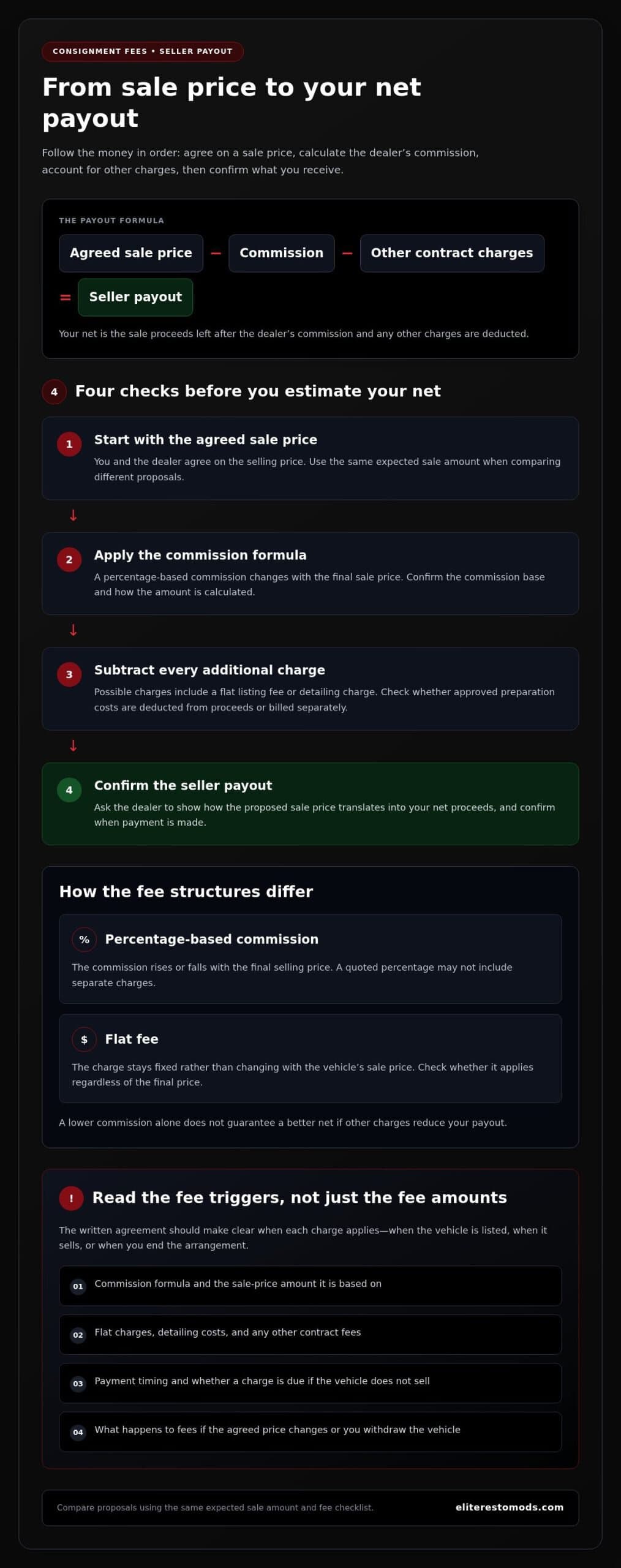
Your net is the sale proceeds remaining after the dealer’s commission and any other contract charges are deducted. For example, if the agreement lists a commission and a separate detailing charge, account for both before estimating your payout. A percentage-based commission changes with the final sale price; a flat fee stays fixed, so each structure affects your net differently.
Dealer Commissions and Fees
Dealers may charge a commission, a flat listing fee, or a detailing charge in addition to commission. The agreement should identify each charge and explain when it applies, such as only after a completed sale. A percentage-based commission rises or falls with the selling price, unlike a flat fee, so the final payout depends on the negotiated sale amount.
Commission rates vary across the market, so compare how they’re calculated rather than relying on a headline rate alone. A quoted percentage may not include separate charges, while a flat fee may apply regardless of the vehicle’s sale price. Use the written agreement to identify the commission base, every additional charge, and whether fees are due if the vehicle doesn’t sell.
Before signing, map out the money in order: agreed sale price, commission calculation, additional fees, then seller payout. This makes competing proposals easier to compare. If one dealer calculates commission on the full sale price and another lists a fixed charge, compare the deductions against the same expected sale amount.
Ask the dealer to show how a proposed sale price translates into your net proceeds. A clear example in the agreement or sales discussion can reveal charges that are easy to miss in a short quote. Confirm whether approved preparation costs, such as detailing, are deducted from proceeds or billed separately.
Review fee triggers as carefully as fee amounts. The contract should explain whether a charge applies when the vehicle is listed, when it sells, or when you end the arrangement. These distinctions matter if the car remains unsold, the agreed price changes, or you withdraw it before a buyer completes the purchase.
Compare each offer using the same checklist: commission formula, flat charges, detailing costs, payment timing, and terms for an unsold vehicle. Then weigh the projected net against the dealer’s stated marketing and sale responsibilities. A lower commission alone doesn’t guarantee better value if other charges reduce your payout.
Why Choose Consignment Over Lowball Offers or Private Sale?
Consignment sits between a quick dealer purchase and a private sale: it trades some proceeds for help managing the sale.
Consignment Versus Trade-Ins
A trade-in combines selling your current vehicle with buying another one, often in a single transaction. That convenience can come with a lower offer: estimates put dealer purchase offers about 10% below retail value.
Consignment keeps the vehicle on the market while a dealer handles the sale, rather than transferring ownership upfront. Estimates suggest sellers may receive about 5-6% more through consignment than by selling directly to a dealer. Compare the expected net proceeds, the time you can wait, and whether you want to replace your vehicle immediately.
A trade-in may suit a seller who wants a straightforward transaction alongside a new purchase. Consignment may better fit an owner prepared to wait for a buyer in exchange for a potentially higher return. Compare offers using the same vehicle condition and retail estimate, then account for consignment fees before deciding.
Consignment Versus Private Sale
A private sale puts you in charge of setting the asking price, writing listings, answering inquiries, arranging viewings, and negotiating. It can return more because there’s no consignment commission, but the work stays with you. Estimates indicate private sellers may spend about 33% more time selling, or roughly 15 additional days compared with dealer or consignment sales.
Consignment shifts much of that marketing and buyer communication to the dealer, while the seller pays the agreed fee. Estimates suggest a private sale can yield about 3% more than consignment, but pricing accuracy matters: ineffective private-sale pricing may reduce a vehicle’s sale value by about 2.5%. A strong asking price and responsive handling of buyers can influence the result.
Private selling also means managing appointments and assessing buyer interest yourself. For example, a seller listing a classic car must prepare its description, photographs, and service history, then coordinate each viewing. Consignment can reduce that workload, though the agreement determines what marketing and sales support the dealer provides.
Choose private selling if control and direct buyer contact matter most and you can handle the listing work. Consider consignment if you value dealer-managed marketing and accept a fee in exchange. Choose a trade-in when completing the sale as part of another vehicle purchase is the priority.
Dealer marketing and sale services
A consignment dealer combines vehicle merchandising with buyer communication and sale coordination. The agreement should clarify which tasks the dealer handles and how payment follows the completed sale.
Marketing starts with presenting the vehicle accurately. A dealer may photograph its exterior and interior, document its features, and prepare a listing for inventory pages or vehicle-listing sites. Clear details about condition, equipment, and service history help buyers assess the car before arranging a viewing. Ask which platforms the dealer uses and who responds to buyer inquiries.
Advertising is only one step. The dealer also coordinates buyer interest, viewings, and offers, while the agreement defines your authority over price changes. For example, it should make clear whether the dealer can accept an offer below the agreed asking price. Defined approval steps reduce confusion when an interested buyer wants to move quickly.
Sale Timelines
Marketing timelines differ from payment timelines: a listing can attract buyers well before a transaction closes. Consignment agents are estimated to sell vehicles in about 45 days on average, while a consigned sale may take 2-6 weeks depending on demand, condition, and asking price. Agreements commonly run for 60-90 days, giving the listing a defined sales window.
Use that window to review buyer activity and listing performance with the dealer. If inquiries remain limited, discuss whether the photographs, description, or asking price need adjustment. The agreement should explain whether changes require your approval and what happens when its term ends. A defined review process helps you respond to market feedback without making rushed decisions.
Payment After the Sale
Payment follows the sale and the dealer receiving funds. Sellers usually receive the agreed payout within 24-48 hours after the dealer is funded. In Washington, the Washington State Legislature requires a dealer to pay the consigning seller within 10 days of delivery of the title to the purchaser. These timelines use different triggers, so identify the trigger stated in your agreement.
Before the vehicle is listed, confirm how the dealer will report the final sale price, deductions, and payout. The written agreement should explain what documentation you receive and how payment is delivered. In Washington, guidance says dealers must immediately provide the seller with a copy of the purchase order used to complete the sale. Keep that document with the title and sale records.
Ask the dealer to outline each handoff: buyer offer, your approval where required, completed sale, title delivery, and seller payment. For example, note when the dealer considers itself funded, because the usual 24-48-hour payout estimate begins then. A clear sequence helps you track the transaction and reduces the hassle of following up over missing paperwork or unclear timing.
Consignment compared with dealer sales
The central difference is ownership during the sale. In a dealer purchase, the dealer buys the vehicle; in consignment, the dealer markets it for you.
That distinction changes the transaction’s risk and payout. A dealer buying a car pays you directly, then bears the risk of reselling it at a profit. A consignment dealer sells the vehicle without taking on the market risk of owning it. You typically wait for a buyer and pay the agreed commission or fees from the sale proceeds.
For a direct dealer sale, compare the offer with your priorities: speed, certainty, and fewer steps. Once you accept, the dealer becomes responsible for resale, including how to price and present the vehicle. You give up the chance to benefit if a later buyer pays more, but you also avoid managing a listing or waiting for retail demand.
With consignment, you remain connected to the final sale price. Before signing, write down the agreed asking price, the lowest amount the dealer may accept, and whether you approve offers below that threshold. The agreement should also show how commission and other charges affect your net. These terms make the potential payout easier to compare with a direct purchase offer.
Consider a classic vehicle with a narrow audience. A dealer may have the buyer network and merchandising approach to present its condition, provenance, and distinctive details. Consignment can give that vehicle access to retail buyers while you retain the sale proceeds, less agreed charges. A direct dealer purchase instead exchanges that potential retail exposure for an immediate transaction.
Make a fair comparison using the same vehicle and condition, not just two headline amounts. Set out each route’s expected net, who handles buyer questions, who approves price changes, and what happens if the vehicle remains unsold. A direct offer is easier to evaluate when the dealer states the purchase amount clearly. A consignment proposal is easier to assess when its commission formula and sale authority are equally clear.
Choose a dealer purchase when certainty and a completed sale matter more than managing the retail outcome. Choose consignment when you can wait for a buyer and value dealer-led marketing enough to accept the commission structure. Neither route automatically produces a better result; vehicle demand, condition, pricing, and contract terms shape the comparison.
If you’re considering consigning a classic car, review the consignment program details alongside the agreement’s sale terms.
Elite Restomods: Elite Certified Restomods
Elite Restomods offers a Consignment Program for owners seeking a specialist route to market for a classic vehicle. If you’re weighing consignment against a direct dealer sale, this is a natural next step when the car’s character and presentation matter to the sale.
For those drawn to classic design with modern capability, Elite Certified Restomods offer a curated path to a finished restomod. Custom Build Services suit owners planning a tailored vehicle, while Climate-Controlled Storage provides a dedicated option for vehicle care. Each offering serves a different point in the classic-car journey, from selling to building or storing.
Contact Elite Restomods to discuss which direction best fits your vehicle and plans.
Choose the Next Move for Your Classic
Start by deciding what you want the car to do for you. Is your priority a clean transition, a carefully managed sale, or shaping a vehicle around a long-held vision? Your answer can guide whether to sell now, keep the car, or explore a new direction.
Before deciding, write down your priorities and the details that matter most: the vehicle’s story, its current condition, and what you’d like to happen next. Knowing what to expect from a consignment dealer gives you a stronger starting point for a focused conversation, but the right path should still fit your goals for the car.
Elite Restomods can help you consider the possibilities for your vehicle, whether you’re exploring a sale or imagining a bespoke build. Contact Elite Restomods to discuss your car and take the next step with clarity.
Frequently Asked Questions
What is Car Consignment?
Car consignment is an arrangement where an owner places a vehicle with a dealer to market and sell on the owner’s behalf. The owner and dealer agree on sale terms, including the asking price and compensation structure. For a classic vehicle with distinctive options or provenance, this approach can put the car in front of buyers already interested in that market. Knowing what to expect from a consignment dealer starts with understanding that the written agreement governs the arrangement.
What if my car doesn’t sell?
If the vehicle remains unsold, follow the agreement’s end-of-term process. It may allow you to extend the listing, adjust the asking price, or retrieve the car. For example, if listing views are strong but buyers aren’t booking viewings, revised photographs or a clearer description may help. Before changing the terms, review any listing or preparation charges and follow the contract’s instructions for ending the arrangement.
How does consignment selling work?
The process starts with an assessment of the vehicle and a written agreement defining the sale terms. The dealer then presents the car to prospective buyers and coordinates interest. If a buyer makes an offer, your approval rights depend on the agreement. After the sale, title transfer and payout follow the transaction paperwork. Keep copies of the signed agreement and vehicle records together for reference.
What does a consignment dealer do?
A consignment dealer represents the vehicle for sale, helping prepare its presentation and connect it with prospective buyers. Depending on the agreement, the dealer may coordinate viewings, handle buyer questions, and assist with sale paperwork. For a collector car, accurate descriptions of equipment, condition, and documented history help buyers understand what they’re considering. The contract defines the dealer’s authority and responsibilities.
What commission percentage do consignment dealers charge?
Commission structures vary. Car consignment dealers commonly charge a percentage of the final sale price, and some also use a flat fee. Other arrangements combine a detailing charge with commission. Compare the calculation method and all separate charges, not just the percentage: a percentage changes with the final sale price, while a flat charge does not. The signed agreement should explain how each amount affects your payout.
What fees and expenses should sellers expect?
Possible charges include the dealer’s commission, a flat listing fee, or detailing costs. Whether preparation work is billed separately or deducted from sale proceeds depends on the agreement. Ask for every charge to be identified in writing, along with when it becomes due and whether it applies if the vehicle doesn’t sell. This helps you compare projected net proceeds without overlooking a separate expense.
How long does it usually take to sell an item on consignment?
The time it takes to find a buyer depends on demand, condition, and asking price. A sought-after model with clear records may draw interest differently from a car needing substantial preparation or priced above buyer expectations. Distinguish the listing period in the agreement from the time required to complete a sale. Review buyer activity with the dealer before deciding whether to revise the listing.
When and how does the seller get paid?
You’re paid after the sale is completed and the dealer receives the buyer’s funds. The agreement should explain how the payout is calculated, which charges are deducted, and what records document the transaction. Keep the purchase paperwork and payout statement so you can reconcile the final proceeds with the agreed terms. If the vehicle has a lien, confirm how its payoff affects the amount due to you.