
The buyer generally pays sales tax on a consigned car, but the dealer handling the sale may be responsible for collecting and remitting it. To understand how consignment sales tax works for cars, separate the tax on the vehicle’s sale from the commission deducted from the seller’s proceeds. State and local rules, as well as where the buyer takes delivery or registers the car, can affect how the tax is handled.
It’s easy to assume that because an individual owns the car, the transaction works like a private sale. In a consignment, a dealer typically manages the sale on the owner’s behalf, so the dealer’s role in collecting tax may differ from that in a direct owner-to-buyer transaction.
This article explains what consignment means, who may collect and remit sales tax, and how state and local rules shape the transaction. It also explains why the tax amount and the seller’s take-home proceeds are separate parts of the deal, so you can understand the figures before a classic car changes hands.
Key Takeaways
- Understand how a consignment dealer’s role differs from a private seller’s, and how that affects the sale.
- Learn who generally collects and remits tax, and why the dealer’s commission is separate from the vehicle’s taxable sale.
- See how the buyer’s location and state-specific rules shape the tax due, including Texas’s private-sale valuation rule.
- Find out when Elite Restomods’ Consignment Program can help bring a classic car to market.
What is a consignment sale?
A car consignment sale lets a dealer market and sell a vehicle owned by someone else. The dealer typically manages buyer interactions, sale paperwork, and the transfer of funds, then deducts the agreed commission from the owner’s proceeds. The buyer’s sales tax is separate from that commission. For Minnesota sales, the applicable rate is based on where the customer receives the vehicle, typically at the dealership or a delivery address. Local sales or use tax may also apply when the seller operates in or sells into a taxing area. A state rate alone may not show the full charge.
Some vehicle transactions follow distinct rules. In Minnesota, when a financial institution sells a repossessed motor vehicle, sales tax isn’t collected or reported at the sale; the purchaser reports motor vehicle sales tax when registering it. California generally exempts a sale to an out-of-state purchaser from sales tax and DMV fees when the seller has proof that delivery occurred outside California. Delivery location and supporting records matter. An out-of-state buyer who takes delivery in California may not meet that condition.
Family transfers, gifts, and inherited vehicles aren’t automatically treated like ordinary retail sales. Their tax treatment depends on state rules for the transfer and registration. A title change within a family, a gift with no sale price, and a vehicle received through an estate may involve different documentation or tax treatment. The relationship between the parties alone doesn’t prove that a transaction is exempt.
Private-sale thresholds usually concern dealer licensing, not whether a particular sale is taxable. U.S. states generally set the annual number of vehicles an individual may sell before needing a dealer license at somewhere from two to about five or six vehicles per year. Selling below a licensing threshold doesn’t automatically exempt the buyer from tax. In most states, a private-sale buyer pays applicable tax when titling or registering the vehicle. This distinction clarifies how consignment sales tax works for cars: dealer involvement changes who may collect tax, while state transaction rules determine how it’s assessed.
Retail sales tax collection and remittance
In a consignment sale, the dealer’s role can determine who collects tax and reports the transaction. The buyer’s title transfer and registration connect the sale paperwork to the tax due.
Collecting and Reporting Sales Tax
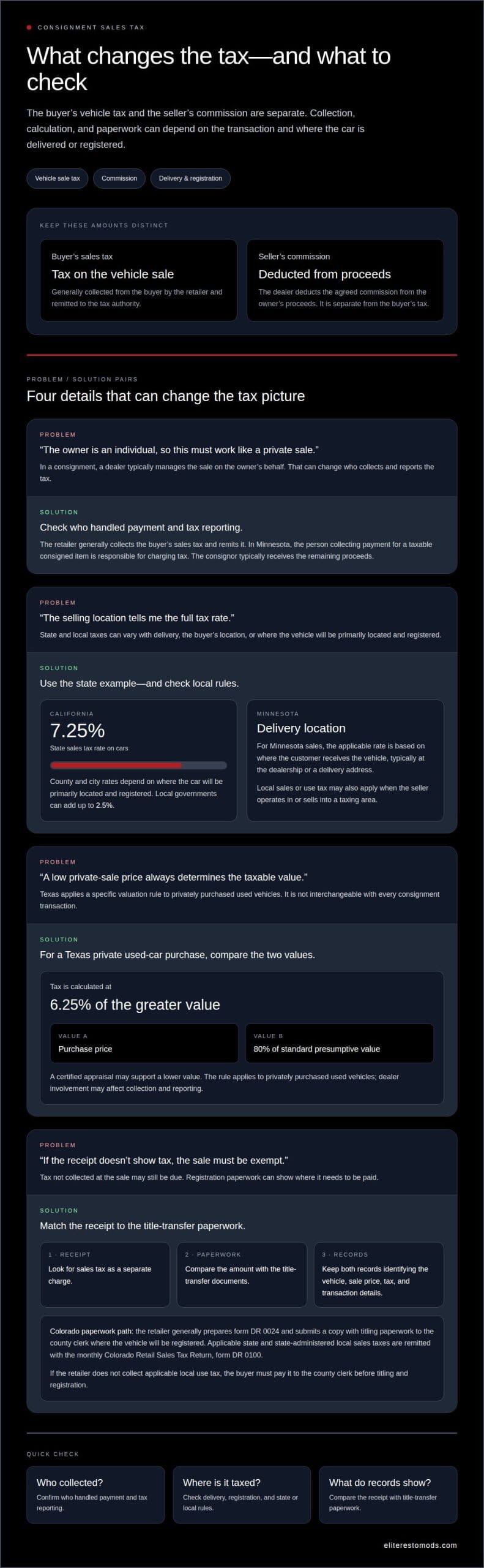
For a consigned car, the retailer generally collects sales tax from the buyer and remits it to the tax authority; the consignor typically receives the remaining proceeds. In Minnesota, the person collecting payment for a taxable consigned item is responsible for charging tax. This matters because the owner’s commission and the buyer’s tax are separate parts of the transaction.
Colorado illustrates the paperwork path. A retailer generally prepares a Standard Sales Tax Receipt for Vehicle Sales, form DR 0024, and submits a copy with titling paperwork to the county clerk where the vehicle will be registered. Applicable state and state-administered local sales taxes are remitted with the monthly Colorado Retail Sales Tax Return, form DR 0100. If the retailer doesn’t collect applicable local use tax, the buyer must pay it to the county clerk before titling and registration.
If the responsible seller fails to collect or remit tax, the unpaid amount may still be due, and state rules determine any additional consequences. There’s no single penalty amount that applies across every state; the transaction’s location and applicable tax law govern.
Verifying Tax Collection
Buyers can verify tax collection by reviewing the retail sale documents and checking whether sales tax appears as a separate charge. Compare the receipt with the amount shown in the title-transfer paperwork, and keep both records. The documents should clearly identify the vehicle, sale price, tax collected, and transaction details so the payment can be traced.
Registration determines where the vehicle is recorded and can affect which tax obligations remain. In Colorado, a county clerk receives the vehicle sales tax receipt with the titling paperwork; local use tax not collected at sale must be paid before title and registration. If the documents show no tax collection, establish whether tax is due at registration rather than assuming the transaction is exempt.
State and local sales and use taxes
A vehicle’s tax can combine state sales tax with local taxes, so the buyer’s registration location matters. California’s state sales tax rate on cars is 7.25 percent, while county and city rates depend on where the vehicle will be primarily located and registered. Local governments can add up to 2.5 percent. A car registered in one California county may therefore face a different combined rate from one registered elsewhere. The selling location alone doesn’t explain the complete tax calculation.
Texas applies a separate valuation rule to private used-car purchases. According to the Texas Comptroller of Public Accounts, Texas taxes a privately purchased used vehicle at 6.25 percent of the greater of its purchase price or 80 percent of its standard presumptive value, unless a certified appraisal supports a lower value. Texas uses 80 percent of a vehicle’s standard presumptive value as part of that private-sale tax valuation rule. This matters when a stated resale price falls below the value used in the state’s calculation.
A consignment transaction and a private sale aren’t interchangeable under every tax rule. The Texas valuation rule specifically concerns privately purchased used vehicles; dealer involvement may affect collection and reporting, while the buyer’s state still determines applicable tax obligations. Most states give buyers credit for vehicle tax paid to another state, but rules differ, and a few states don’t provide that credit. When moving a car across state lines, distinguish tax already paid from tax due where the car will be registered.
To understand how consignment sales tax works for cars across state lines, trace the transaction’s location and type. Identify whether the car is sold through a retailer or directly by its owner, where delivery occurs, and where the buyer will register it. Then compare the documented sale price with any state-specific valuation rule. These details help clarify which state and local tax rates apply, whether previously paid tax receives credit, and whether additional use tax may be due. Each state’s revenue department or tax authority administers its vehicle transaction rules.
Consignment sales
A consignment contract sets out how a dealer markets a car, handles offers, and pays the owner. It should specify the selling price or pricing authority, commission, any additional fees, and the arrangement’s duration. The dealer may inspect the vehicle, assess its market value, and recommend a retail price. Clear terms explain what happens when the buyer’s payment arrives and how the owner’s proceeds are calculated.
Washington’s example illustrates the distinction between tax and seller proceeds. Sales tax is generally collected on the final selling price, not on the owner’s net proceeds after commission.
In that Washington example, the retail sales tax rate is 8.0 percent, so the buyer’s tax on the $4,000 sale is $320. The example also lists $8.23 in Service B&O tax, making Dealer A’s remittance to the Department of Revenue $328.23. These figures describe that transaction, not a universal consignment tax rate. State rules determine which taxes apply and who must collect them.
For a seller, the takeaway is to separate three figures in the contract and closing records: the vehicle’s selling price, tax collected from the buyer, and deductions from the owner’s proceeds. A clear record should include the car’s sale date and price, along with the commission and any fee. Washington’s consignment guidance cites WAC 458-20-159 and WAC 458-20-221. To arrange a sale through Elite Restomods’ Consignment Program, discuss consigning your vehicle.
Elite Restomods: Consignment Program
Elite Restomods’ Consignment Program is a natural next step when you’re ready to sell a classic car through a dealership rather than manage a private sale. With the tax framework in mind, the key is keeping the sale terms clear: the vehicle’s selling price, the agreed commission, any deductions, and how the transaction is documented. Those figures help distinguish the buyer’s tax from the seller’s proceeds.
If your car is a considered asset with a distinct history and specification, consignment can give its sale a structured path. Elite Restomods also offers Climate-Controlled Storage for owners considering how to care for a vehicle while plans take shape. Share your car’s details with Elite Restomods to discuss whether its Consignment Program fits your goals.
Plan the Next Chapter for Your Car
Understanding how consignment sales tax works for cars can help you approach a sale with sharper questions and a clearer picture of the transaction. Your next decision goes beyond paperwork: consider whether selling your current vehicle, finding a different classic, or developing a custom build best fits your plans.
Elite Restomods offers a Consignment Program for owners preparing to sell, along with Elite Certified Restomods and Custom Build Services for those considering what comes next. Each path begins with the vehicle and the vision behind it. A classic can move into new hands, become the foundation for a bespoke build, or make room for another carefully chosen machine.
For a conversation about selling your vehicle or exploring a future build, contact Elite Restomods. Take the next step with clarity, and keep the road ahead open to possibility.
Frequently Asked Questions
What is taxable and non-taxable?
Taxability depends on the charge and the state. California treats the vehicle’s selling price, installed accessories not included in that price, and the document preparation service fee as taxable. California DMV license and registration fees and the State Smog Certificate fee are nontaxable. A line-item breakdown helps distinguish the vehicle’s taxable price from separately listed fees and charges.
How is sales tax handled when selling a car on consignment?
The retailer generally collects tax from the buyer and remits it to the relevant tax authority. In Minnesota, the person collecting payment for a taxable consigned item is responsible for charging tax. Keep the buyer’s receipt, sale record, and seller’s payout statement together. This makes it easier to distinguish tax collected from the amount paid to the vehicle owner.
Is sales tax calculated on the car’s full selling price or the consignment fee?
Generally, tax applies to the car’s final selling price, not just the dealer’s consignment fee. The commission is a deduction used to calculate the owner’s proceeds; it doesn’t automatically reduce the vehicle’s taxable price. For example, if a contract lists the sale price and the dealer’s commission separately, those figures serve different purposes. State rules determine the precise taxable base.
How do state sales tax rates and local taxes apply to consignment car sales?
The applicable rate depends on state rules and may include local taxes. Minnesota determines the rate based on where the customer receives the vehicle, while California bases vehicle tax rates on where the car will be primarily located and registered. If the buyer takes delivery at one address and registers the vehicle elsewhere, distinguish those locations because state rules use them differently.
Do sales tax rules differ for dealer consignment and private-party consignment?
Yes. In a dealer-handled consignment, the retailer generally collects and remits tax on the sale. In most private sales, the individual seller doesn’t collect or remit sales tax; the buyer typically reports and pays it when titling or registering the vehicle. The seller’s licensing status and the transaction structure matter, but a private-sale licensing threshold alone doesn’t determine whether the buyer owes tax.
What sales tax exemptions apply to consignment car sales, such as trade-ins or family transfers?
Exemptions depend on state law and the transaction. California doesn’t subtract a trade-in’s value from the taxable vehicle price, so a trade-in doesn’t reduce the taxable amount there. Family gifts and inherited vehicles may follow different transfer rules from retail sales, but a family relationship alone doesn’t establish an exemption. The transfer documents and state registration rules determine the applicable treatment.