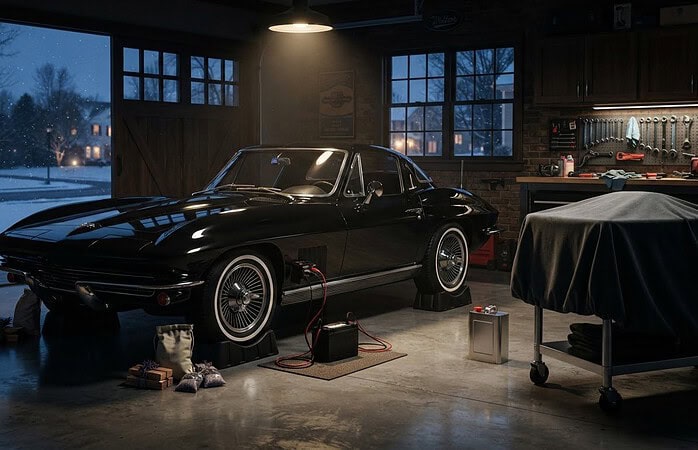

Before choosing a storage unit, check that its dimensions and access suit your vehicle. For winter car storage, a 10-by-20-foot unit is the most common size for a car, though the right fit depends on the vehicle. Covered and indoor storage offer different levels of enclosure, so the best choice depends on how you plan to protect and access your car.
Choosing winter car storage with Elite Restomods is about more than finding an empty spot. Compare the space, vehicle access, and the practical differences between covered and indoor storage.
This guide explains how to assess whether a unit can accommodate your car, what to consider when comparing storage types and locations, and how to prepare your vehicle for a winter stay. The aim is a clear, confident choice that keeps your car ready for the season ahead.
Key Takeaways
- Compare outdoor, covered, and indoor spaces by how much shelter your vehicle needs for winter.
- Use your car’s full dimensions, including mirrors and accessories, to narrow down suitable unit options.
- Consider how drive-up access affects loading, parking, and reaching your vehicle during storage.
- Vehicle size and type can shape which nearby storage options are practical.
- For a prized classic, learn how climate-controlled storage from Elite Restomods fits into a seasonal care plan.
Outdoor, covered, and indoor storage
A car can fit in a storage unit when the space accommodates its dimensions and vehicle access. For winter car storage in Boyne City, compare how each option shields the vehicle from snow, moisture, and temperature swings.
Indoor boat storage offers more weather protection than outdoor storage, which may require a cover or shrink wrap. The same basic comparison helps car owners weigh exposure against enclosure.
For a practical look at winter vehicle protection, watch this AutoGuide.com video:
Heated and cold indoor pricing
Heated and cold indoor storage differ in temperature management, not simply in being enclosed. Costs can depend on heat, unit dimensions, access, and storage duration. Compare what each space includes, such as climate control, rather than treating all indoor units as equivalent. For a cherished classic, temperature management may matter more than choosing the lowest-priced enclosed space.
Indoor storage services
Indoor storage keeps a vehicle inside an enclosed building, reducing direct exposure to snow, wind, and precipitation. The space may be heated or cold, and access arrangements can vary. Review the terms for the assigned space, access conditions, and included services. These details distinguish basic indoor parking from climate-controlled storage.
Storage agreements also set out insurance, registration, and payment requirements. Check whether proof of insurance or current registration is required, along with payment methods and due dates. Comprehensive coverage protects against storage damage but does not include liability coverage.
For boats, indoor storage offers more protection from the weather, while outdoor storage may call for a cover or shrink wrap. Boat owners should prepare the vessel separately: winterize and clean it, drain fluids, and remove valuables before storage.
Winter storage preparation and protection
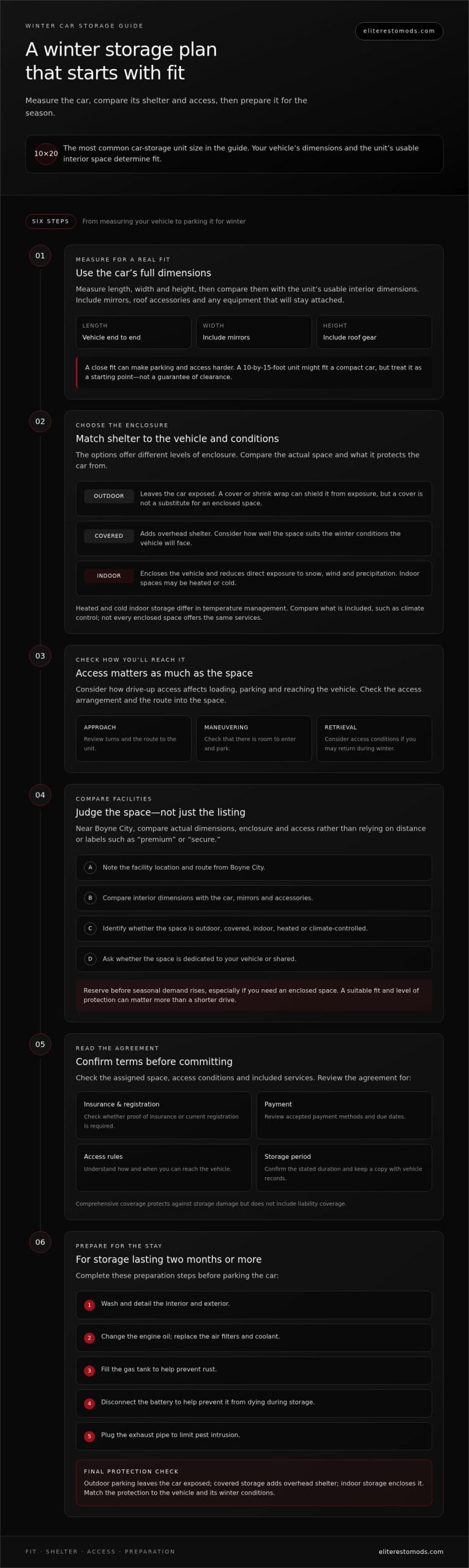
For storage lasting two months or more, prepare the car before parking it. Wash and detail the interior and exterior, change the engine oil, replace the air filters and coolant, and fill the gas tank to help prevent rust. Disconnecting the battery can help prevent it from dying during storage.
To limit pest intrusion, plug the exhaust pipe before storing the vehicle. A cover or shrink wrap can shield an outdoor car from exposure, while indoor storage offers more protection from the elements. These steps address moisture, rodents, and cold-weather exposure, but a cover is not a substitute for an enclosed space.
Consider the storage environment alongside your preparation: outdoor parking leaves the car exposed, a covered space adds overhead shelter, and indoor storage encloses it. Match the protection to the vehicle and the conditions it will face over winter.
Car storage facilities near Boyne City
Yes, winter car storage options are available near Boyne City. Reserve before seasonal demand rises, especially if you need an enclosed space, since the right unit depends on vehicle dimensions and storage type.
Compare the actual space, not just its distance from you or a facility’s general description. Outdoor parking, a covered space, and an indoor unit provide different levels of shelter. For a classic car, an enclosed facility may be worth the extra drive if it better suits the vehicle’s needs.
Use the same checklist for each storage facility you consider:
- Record the facility’s location and the route you would take from Boyne City.
- Compare the unit’s interior dimensions with your car, including mirrors and accessories.
- Identify whether the space is outdoor, covered, indoor, heated, or climate-controlled.
- Review the access arrangement and storage agreement before reserving.
- Ask whether the quoted space is dedicated to your vehicle or shared.
These details make comparisons more useful than a map result alone. A nearby facility may not suit a low-clearance car or a vehicle that needs enclosed storage. Consider the access route, including turns, approach, and room to maneuver, before choosing a space.
Review each facility’s listing or contact it for location, unit types, and reservation details. Then compare the answers side by side. Facilities may describe spaces differently, so focus on the actual enclosure and dimensions rather than labels such as “premium” or “secure.” This helps you choose based on the car, not an appealing name.
Timing matters. Reserve before winter demand builds, rather than waiting until snow is already affecting your plans. If you need a particular indoor arrangement, flexibility on location or storage type can make the search easier. Have your vehicle’s length, width, height, and storage preference ready when you begin comparing Boyne City options.
Distance also affects how you’ll use the space. If you expect to retrieve the car during winter, consider the route in changing weather and the facility’s access conditions. If it will stay stored until spring, prioritize suitable shelter and a space that fits comfortably. A short drive is useful, but it should not outweigh fit and protection.
Before committing, read the agreement for payment timing, insurance requirements, access rules, and the stated storage period. These terms affect your experience as much as location. Keep a copy with your vehicle records so the arrangement is clear when you return for the car.
Choosing a storage unit size
A 10-by-20-foot unit is the most common size for car storage, but the label alone doesn’t confirm fit. Measure your vehicle’s length, width, and height, then compare those figures with the unit’s usable interior dimensions. Include mirrors, roof accessories, and any equipment that stays attached during winter. A close fit can complicate parking and access.
Compact cars might fit in a 10-by-15-foot unit. Treat that size as a starting point, not a guarantee of comfortable clearance. Measure the car at its widest point and account for the space needed to enter and exit. If you plan to keep boxes or a battery tender beside the vehicle, include their footprint in your layout rather than assuming the car alone is the only consideration.
Larger trucks, vans, and SUVs may need a 10-by-30-foot unit. Compare the vehicle’s full length with the unit’s interior length, especially if it has a long bed, rear-mounted spare, or attached accessories. Width matters too: mirrors can extend beyond the body, while a wide SUV may leave little room to open a door in a tight space.
Ceiling height matters alongside floor dimensions. Storage units have 8-foot ceilings, so check the height of roof racks, raised accessories, or other equipment before choosing a unit. Also compare the entrance opening with the vehicle’s height and width. Interior measurements won’t help if the car can’t pass through the doorway or maneuver into position.
Use this measurement sequence before selecting a space:
- Measure the vehicle’s overall length, width, and height, including attached accessories.
- Compare each measurement with the unit’s interior dimensions and entrance opening.
- Sketch the car’s position and include any stored equipment in the floor plan.
- Consider how the vehicle will turn and align with the entrance when driven inside.
- Choose a larger option if the measured fit leaves no practical room for access.
A 10-by-20-foot space may suit a standard car, while a compact model could fit in 10-by-15 feet. A truck with a long bed may call for 10-by-30 feet. These examples are useful comparisons, not substitutes for measuring the specific vehicle and space. Vehicle shape, mirrors, and accessories affect the real footprint.
For a classic car, plan its parking position before moving it into storage. Check the doorway, ceiling, and interior dimensions as one complete route, then allow enough room to park without contacting walls or stored items. The right unit fits the vehicle and allows safe, practical access throughout winter.
Drive-up access for car storage
Drive-up access lets you bring a vehicle directly to a storage-unit entrance. Assess the entire route, not just the space. A unit may fit your car, but a tight turn or narrow approach can make entry difficult. Trace the route from the facility entrance to the unit, noting turns, gates, and changes in surface.
Think through the arrival step by step. Can you approach the unit without a sharp turn? Is there room to align the car with the doorway? Can you pull forward or reverse safely if the first approach does not work? These details matter for a long vehicle, a wide classic, or a car with limited ground clearance.
Check the entrance as carefully as the unit interior. Compare the vehicle’s height and width with the doorway, accounting for mirrors and attached accessories. A roof rack, for example, may affect clearance even when the car itself fits. Floor dimensions alone do not tell you whether the vehicle can pass through the entrance or line up with the door.
Surface and slope also affect access. Look for uneven pavement, a steep approach, or a threshold that could challenge a low-profile vehicle. In winter, consider how snow and ice might affect the route from the facility entrance. A direct path is useful only if you can maneuver along it and position the car without scraping its underside or bodywork.
Before reserving, use a short access checklist:
- Compare your car’s dimensions with the entrance opening and interior space.
- Review every turn between the facility entrance and the assigned unit.
- Consider the vehicle’s ground clearance at thresholds and sloped approaches.
- Identify how you’ll position the car for entry and later removal.
- Read the access terms for gates, opening hours, and vehicle movement.
Drive-up access is useful when you plan to move the car into storage yourself or retrieve it during winter. For example, a collector planning to bring a classic car out before spring should consider both arrival and departure. The return route matters as much as parking day, especially if other vehicles or obstacles could restrict maneuvering.
Access and protection are separate decisions. A drive-up unit can simplify parking, while indoor or climate-controlled storage addresses the storage environment. Choose based on the vehicle’s dimensions, the route to the door, and the level of shelter you want. Assessing all three factors turns “drive-up” from a label into a practical fit check.
What are the size limits and vehicle types accepted for winter storage near Boyne City?
Storage limits depend on the unit’s interior dimensions, doorway, and access route. A 10-by-20-foot unit is the most common car-storage size; compact cars might fit in 10-by-15 feet, while larger trucks, vans, and SUVs may need 10-by-30 feet. These dimensions offer useful benchmarks, but the vehicle’s measurements determine fit.
Facilities may accept different vehicle types, but the specific car must fit and enter its assigned space. Start by identifying the vehicle: sedan, coupe, pickup, van, SUV, or classic car. Then record its length, width, and height, including accessories that change its profile, such as a roof rack or rear-mounted spare.
Measure the doorway as well as the storage area. A vehicle can fit within the unit yet fail to pass through its entrance. Check mirrors, roof equipment, and vehicle height against the opening. Storage units have 8-foot ceilings, so confirm that the vehicle and attached accessories clear both the entrance and interior ceiling.
Use this fit checklist for a car, truck, van, or SUV:
- Measure the vehicle at its widest and tallest points, including accessories.
- Compare those measurements with the unit’s entrance and interior dimensions.
- Account for the space needed to park and open doors safely.
- Consider whether a long bed, extended body, or low clearance affects entry.
- Match the vehicle type and dimensions to the facility’s stated limits.
A vintage coupe may have a different footprint from a modern SUV, even if both are passenger vehicles. A pickup’s bed length and a van’s overall height can affect which unit works. For a modified classic, include custom bumpers, wide tires, or raised suspension in your measurements. A model name alone is not enough to select a space.
Ask for the dimensions of the assigned unit and entrance, then compare them with your measurements. If vehicle specifications differ by trim or configuration, use the larger measurement. This helps avoid choosing a unit based on a generic category when a roofline, wheelbase, or accessory determines the fit.
Match the space to the vehicle before arranging transport. If the car needs an enclosed environment, explore vehicle storage services as one option. A measured fit, clear entrance, and suitable storage type make a stronger plan than relying on a broad “car storage” label.
Elite Restomods: Elite Certified Restomods
Elite Restomods offers Elite Certified Restomods and climate-controlled storage for owners considering winter protection for a valued vehicle. If an enclosed, temperature-managed environment better suits your car than a standard unit, climate-controlled storage is an option to consider.
Storage is one part of a vehicle’s longer story. Owners planning a transformation can explore Custom Build Services, while those considering a sale can learn about the Consignment Program. Each supports a different goal, from protecting a car through winter to shaping its next chapter.
The right next step depends on whether you need seasonal storage, a custom build, or support with a future sale. Visit Elite Restomods to explore the option that fits your plans.
Plan the Next Chapter for Your Car
Winter storage can be more than a seasonal pause. It can create space to consider what you want the car’s next chapter to look like, whether that means preserving its character, refining its performance, or finding it a new home. For owners weighing winter car storage in Boyne City, that wider perspective can help connect today’s storage decision with longer-term plans.
Elite Restomods offers Elite Certified Restomods, Custom Build Services, and a Consignment Program for different stages of classic-car ownership. These options support distinct goals: enjoying a carefully developed restomod, commissioning a build, or preparing a vehicle for consignment.
Explore the possibilities at your own pace, then contact Elite Restomods to discuss your plans. A thoughtful next step can keep your car’s story moving forward.
Frequently Asked Questions
Can you store a car in a storage unit in Boyne City, MI?
Yes, you can store a car in a unit if the facility permits vehicle storage and the space accommodates it. Confirm that the agreement covers vehicles, not just household goods. For example, a classic coupe with a low front spoiler may need a clear approach and careful entry. Keep the vehicle’s measurements handy when comparing spaces and terms.
What winter car storage options are available in Boyne City, Michigan?
Options include outdoor parking, covered spaces, and enclosed indoor units. Elite Restomods also offers climate-controlled storage. Choose based on how often you expect to access the car and the level of shelter you want. A vehicle left untouched until spring has different practical needs from one you plan to retrieve during winter. Consider how you will use it alongside the storage environment.
What are the monthly prices for indoor, outdoor, and covered vehicle storage near Boyne City?
Monthly costs vary with storage type, location, access, and availability. For a useful comparison, separate the base space from any additional temperature management or access arrangements. Compare options for the same storage period and vehicle rather than treating outdoor parking and an enclosed unit as equivalent. There is no single rate that applies to every storage arrangement.
Which Boyne City storage facilities offer heated or climate-controlled vehicle storage?
Elite Restomods offers Climate-Controlled Storage. Heated and climate-controlled describe different conditions, so consider the actual environment rather than assuming the terms mean the same thing. An owner storing a restored vehicle, for example, may prioritize a managed indoor environment over basic covered parking. Consider the car’s condition, storage duration, and access needs when deciding whether this option suits it.
What are the pros and cons of indoor versus outdoor winter car storage in Boyne City?
Indoor storage provides an enclosed setting, while outdoor parking exposes the car more directly to winter weather. The added shelter can matter for a vehicle with a delicate finish or carefully restored interior. Outdoor parking may suit owners who prioritize a simple arrangement, but using a vehicle cover adds a preparation step. Balance shelter needs with access, budget, and how you plan to use the car.
Are there local vehicle storage options in nearby Petoskey, Charlevoix, or Boyne Falls?
Include Petoskey, Charlevoix, and Boyne Falls as separate areas when comparing nearby storage choices. A wider search radius can help if the closest option doesn’t match your vehicle or preferred storage type. Compare each location’s drive time from where the car is kept, access arrangements, and agreement terms. For a vehicle moved by enclosed transport, distance may factor differently than for a car you’ll drive yourself.
What insurance, registration, and payment requirements do local storage facilities have?
Requirements vary by agreement. Check whether proof of insurance and current registration are required, along with accepted payment methods and due dates. Comprehensive coverage protects against storage damage but does not include liability coverage.