
The most expensive mistake in the collector car market isn’t buying a bad car; it’s paying for a masterpiece and receiving an unfinished prototype. While the Hagerty Market Index reached 171.04 in early 2026, marking a 6% price correction, assets that meet rigorous investment grade restomod standards continue to defy the dip. You’ve likely felt that visceral pull toward a vintage silhouette, only to be stalled by the fear of hidden mechanical failures or modern electronics that don’t quite communicate with their analog hosts. It’s a valid anxiety. Paying a premium for a car that isn’t fully sorted is a risk no serious collector should take.
We understand that a truly exceptional build is more than just a list of expensive parts; it’s the seamless marriage of heritage and modern reliability. In this guide, you’ll master the art of evaluating high-performance builds with our professional-grade restomod inspection framework. We provide a systematic audit of modern powertrains, artisanal interiors, and the critical integration points that separate a world-class asset from an amateur money pit. By the end, you’ll have the confidence to distinguish between a collection of hardware and a bespoke piece of functional art.
Key Takeaways
- Identify the hallmarks of professional engineering by understanding how investment grade restomod standards prioritize the seamless integration of modern components over a simple parts list.
- Conduct a rigorous structural audit of the chassis and bodywork to ensure the vehicle’s foundation can handle the brute force of contemporary high-performance powertrains.
- Evaluate the precision of the mechanical assembly by inspecting for meticulous wire tucking and cooling systems engineered for modern reliability.
- Verify the vehicle’s road manners by scrutinizing the transition to independent suspension and modern power braking systems that define a truly sorted build.
- Secure your asset’s future value by validating the comprehensive build book and professional documentation required for elite-level appreciation and insurance.
Defining Investment Grade Restomod Standards in 2026
The 2026 collector car market demands a new level of scrutiny. Traditional automotive restoration standards often focus on numbers-matching originality, but a restomod is a different animal. It is a bespoke piece of functional art. It fuses 1960s soul with 2020s adrenaline. To identify a true masterpiece, you need investment grade restomod standards that look past the paint and deep into the mechanical marriage of disparate eras.
To better understand this concept, watch this helpful video:
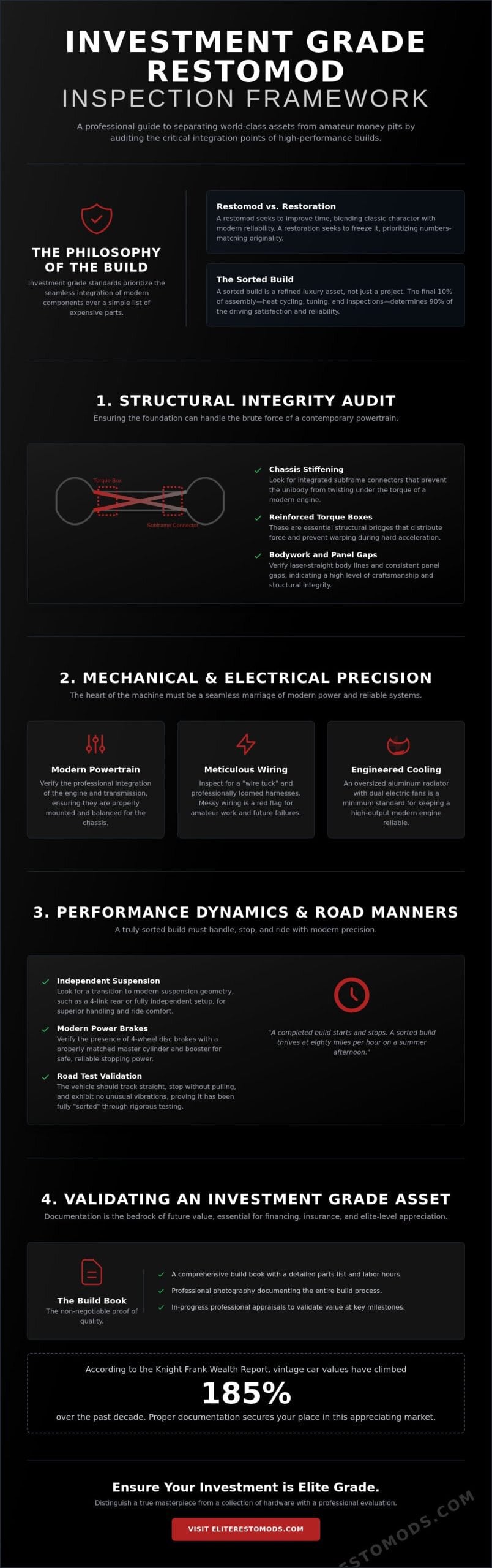
While the Knight Frank Wealth Report shows vintage car values have climbed 185% over the past decade, the recent 6% market dip in early 2026 has separated the pretenders from the performers. Documentation is the bedrock of value in this climate. A detailed build sheet and professional appraisals during the construction process are no longer optional. They are essential for securing financing and achieving a valuation that reflects the true cost of elite craftsmanship. You aren’t just buying a car; you’re buying thousands of hours of custom engineering. If the integration of modern electronics and high-performance hardware isn’t seamless, the investment potential vanishes.
True excellence is found in the developmental narrative of the build. It’s a transformative journey where every weld and wire serves a purpose. High-net-worth individuals are increasingly financing these builds to preserve liquid capital, treating these vehicles as stable, usable assets rather than static museum pieces. This shift toward drivability means the inspection must focus on how the car handles the brute force of a modern powertrain while maintaining its historical dignity.
The Philosophy of the Fully Sorted Build
A “completed” build is a car that starts and stops. A “sorted” build is a car that thrives at eighty miles per hour on a summer afternoon. The final ten percent of the assembly process determines ninety percent of your driving satisfaction. This phase involves heat cycling, nut-and-bolt inspections, and electronic tuning. Rigorous quality assurance ensures that the power of a modern crate engine doesn’t overwhelm the vintage frame. It’s the difference between a project and a refined luxury asset.
Restomod vs Restoration: Divergent Inspection Paths
A pure restoration seeks to freeze time. A restomod seeks to improve it. When you evaluate these vehicles, you must identify the builder’s core intent. Is it a pro-touring monster designed for the track or a refined cruiser for coastal drives? Each path requires a different set of mechanical priorities. For a deeper look at these distinctions, you can explore our guide on What is a Restomod vs. a Restoration? to understand how modern reliability intersects with classic character. This distinction is vital as legislative shifts like California’s SB 1392 potentially ease emissions for 1981 models, making operational reliability even more valuable.
Structural Integrity: Auditing the Chassis and Body
The soul of a classic car resides in its silhouette, but its future depends on the steel beneath. When you evaluate a build against investment grade restomod standards, the first point of failure is often the most overlooked: structural rigidity. A vintage unibody was designed for the bias-ply tires and modest horsepower of a bygone era. Today, the introduction of a modern LS or Coyote engine demands a foundation that can handle brute force without buckling. You must look beyond the gleaming exterior to ensure the bones of the machine have been properly prepared for their new life.
Chassis Stiffening for Modern Power
High-torque modern engines can exert forces that literally twist vintage sheet metal. You must look for integrated subframe connectors and reinforced torque boxes. These are not merely optional accessories. They are the essential structural bridges that prevent the car from warping under hard acceleration. In the most elite builds, you may find a full aftermarket chassis or a custom front clip that replaces the original suspension geometry entirely. Look closely for signs of frame twist, such as stress fractures near the base of the A-pillars or doors that no longer latch with a crisp, mechanical click. A vehicle that hasn’t been stiffened is a liability, not an investment. You can see how we approach these structural foundations by exploring our meticulous build process.
The Art of the Finish: Paint and Body
A master builder treats the body as a canvas for functional art. This requires inspecting the finish under professional-grade lighting to reveal waves or ripples that are invisible in natural light. High-end custom finishes should possess a depth and clarity that makes the paint look “wet” even when dry. Scrutinize the panel gaps with a critical eye. Uniform spacing across the hood, doors, and trunk lids serves as a proxy for frame straightness and precision assembly. If the gaps are uneven, it often indicates a frame that was never properly squared on a jig.
- Inspect the depth of the clear coat for a mirror-like finish without “orange peel” texture.
- Verify that the weatherstripping and glass fitment are tight and flush to prevent wind noise at high speeds.
- Audit the underside for clean, deliberate welds and high-quality epoxy coatings that protect against hidden rust.
The underside of the car should be as clean as the top. Avoid builds where fresh undercoating appears to be hiding old metal or poor repairs. A truly investment-grade asset displays its mechanical integrity proudly, with powder-coated components and organized plumbing that reflect a commitment to perfectionism. Every detail, from the door alignment to the coating on the floor pans, tells the story of the build’s quality. If the builder cut corners on the metalwork, they likely cut corners on the engineering you can’t see.
The Heart of the Machine: Powertrain and Electrical Systems
Open the hood of a world-class build and you should witness a gallery of mechanical excellence. The visceral power of a modern powertrain meets the refined logic of contemporary electronics in a display of functional art. Adhering to investment grade restomod standards requires more than just dropping a crate engine into an old bay. It demands a level of integration where every hose, fitting, and fastener serves both performance and aesthetic. The engine bay is the most scrutinized area of any high-end build, and it’s where the distinction between a professional masterpiece and an amateur project becomes undeniable.
A professional shop-installed LS swap can range from $20,000 to $30,000 for a complete package using new components. At this level, you aren’t just paying for the hardware; you’re paying for the meticulous plumbing and wire tucking that ensures reliability. Every fluid line should be routed with purpose, utilizing high-end AN fittings and braided stainless steel hoses. This systematic approach prevents the mechanical clutter that often plagues lesser builds, creating a clean environment that allows the high-performance components to take center stage.
Modern Electrical Architecture in Vintage Steel
The greatest weakness of many custom builds is the electrical system. Spaghetti wiring is a red flag that signals potential failure. Elite builds utilize modern fuse blocks and dedicated wiring harnesses that replace the brittle, decades-old original looms. The Engine Control Unit (ECU) must be mounted in a protected, ventilated area away from extreme engine heat. While a basic mail-in ECU tune for an LS engine costs approximately $400, investment-grade assets typically feature bespoke dyno-tuning. This ensures that modern amenities, such as digital gauges and LED lighting systems, operate with the seamless reliability of a contemporary luxury vehicle.
Fuel and Cooling: The Lifeblood of Reliability
Modern high-performance engines generate significant thermal loads that vintage cooling systems cannot handle. A professional-grade build features a high-capacity aluminum radiator paired with thermostatically controlled electric fans designed for modern traffic conditions. The fuel system must also evolve. Transitioning to electronic fuel injection requires high-pressure electric pumps and stainless steel fuel lines capable of handling modern ethanol-blended fuels. Look for proper ventilation and heat shielding around the custom exhaust. This protects the fuel tank and prevents heat soak from compromising the artisanal interior finishes we’ll discuss in the following sections.
Finally, the drivetrain integration must be flawless. A vibration-free driving experience is the signature of a master builder. This requires auditing the transmission tunnel for proper clearance and verifying that the driveshaft angles are mathematically synchronized with the new suspension geometry. If the builder hasn’t accounted for these angles, the car will never feel truly sorted at highway speeds. A machine that looks fast must also feel refined, proving that brute force and luxury craftsmanship can coexist in a single, investment-grade package.
Performance Dynamics: Suspension, Brakes, and Road Manners
Brute force is a liability without precision control. While the powertrain provides the visceral heart of the machine, the suspension and braking systems provide its poise. To meet investment grade restomod standards, a build must navigate modern roads with the confidence of a contemporary supercar while retaining its historical silhouette. This is where the engineering of the marriage between old and new truly shows its strength. A car that wanders at highway speeds or dives under braking isn’t a finished asset; it’s a project in disguise.
Modern Geometry and Suspension Tuning
Stock suspension geometry from the mid-twentieth century was never intended to manage the lateral loads of modern high-performance tires. Elite builds often utilize complete subframe replacements or sophisticated coilover conversions from industry leaders like Ridetech or Detroit Speed. You must verify that the ride height allows for full suspension travel without the tires contacting the inner fenders under full compression. For a street-driven masterpiece, the choice of bushings is critical. While rod ends offer maximum precision for the track, high-quality polyurethane or rubber bushings provide the refined comfort expected of a luxury asset. Look for independent rear suspension (IRS) setups in top-tier builds, as these offer a level of road-holding that traditional live axles simply cannot match.
Stopping Power: The Brake System Audit
In 2026, four-wheel disc brakes are the non-negotiable standard for any high-performance build. A vintage drum setup has no place in a vehicle with a modern crate engine. Inspect the master cylinder for professional execution and look for a proportioning valve. This component is vital for balancing the braking force between the front and rear axles, ensuring the car remains stable under heavy deceleration. The parking brake integration is another hallmark of a fully sorted build. Many amateur projects overlook this detail, but a functional, well-integrated emergency brake is a sign of a builder who understands the value of completeness. Scrutinize the line routing for clean, secure paths that avoid moving suspension components or heat sources.
The steering rack integration must be seamless. Modern power steering pumps need to be compatible with the steering box or, ideally, a modern rack-and-pinion conversion. If the steering feel is vague or the pump whines under load, the integration is flawed. This mechanical harmony is what separates a collection of parts from a bespoke piece of functional art.
The final test is the road audit. A truly investment-grade car tracks straight and absorbs road imperfections without rattles or vibrations. Any cowl shake or steering wheel oscillation indicates that the structural reinforcements discussed earlier were insufficient or the suspension geometry is out of alignment. If you’re ready to experience a build that has already been perfected to these rigorous levels, you can browse our current inventory of elite certified restomods. Every vehicle we source must pass this dynamic audit before it earns its place in our collection.
The Elite Standard: Validating an Investment-Grade Asset
Excellence in the restomod world is not an accident; it is the result of a systematic, uncompromising methodology. After auditing the chassis, the powertrain, and the performance dynamics, the final step is to validate the vehicle as a legitimate financial asset. In an era where vintage car values have climbed by 185% over the past decade according to the Knight Frank Wealth Report, the distinction between a hobbyist project and a professional build is worth six figures. Adhering to investment grade restomod standards ensures the vehicle remains a tangible, high-performance reality rather than a depreciating liability.
Documentation and Provenance
A world-class build is accompanied by its biography. This usually takes the form of a comprehensive build binder. This documentation should contain every receipt, wiring diagram, and component manual used during the transformation. It provides the provenance that lenders and insurance companies require for high-value appraisals. You must verify the warranties for modern crate engines and transmissions, as these documents prove the hardware is new rather than salvaged. A build book is more than just paper; it is a testament to the meticulous nature of the construction. You can see these documentation standards in practice by viewing our Elite Certified Restomods, where every vehicle is backed by a transparent history of its developmental journey.
The Value of Professional Sorting
There is a profound difference between a garage build and a professional shop build. A garage build often ends when the car looks finished. A professional build only begins its final phase once the car is assembled. This is the “sorting” period. It involves hundreds of miles of real-world testing to identify harmonic vibrations, heat soak issues, or minor electrical gremlins that only appear under load. The Elite QA Process is designed to simplify the ownership experience by handling this grueling developmental phase before the keys ever reach your hand. Our mission is to bridge the gap between a client’s long-held dream and a reliable, high-performance reality.
Before finalizing any purchase, run through a final checklist. Is the air conditioning blowing ice cold after thirty minutes of idling? Do the digital gauges communicate perfectly with the ECU? Does the car track straight with zero input at highway speeds? If the answer to any of these is “no,” the car is a showroom piece, not a road-ready asset. A truly investment-grade vehicle is meant to be utilized and enjoyed, not just displayed. When you invest in a build that has been professionally sorted and documented, you aren’t just buying a car; you’re securing a piece of functional art that is engineered to endure for the next fifty years.
Secure Your Automotive Legacy
The transition from a vintage shell to a high-performance masterpiece is a journey defined by precision. You now have the framework to evaluate structural rigidity, electrical integration, and dynamic road manners with the eye of a master builder. Identifying a vehicle that meets investment grade restomod standards is about more than just checking a list. It’s about recognizing the seamless marriage of brute force and refined comfort. Every weld, wire, and bolt should reflect a commitment to perfectionism that ensures your asset remains reliable for decades to come.
Our master builders bring decades of restomod experience to every project, ensuring that the soul of the classic era is preserved through modern engineering. Every vehicle undergoes our rigorous Elite QA Process to guarantee it is truly sorted for the road, not just the showroom floor. With specialized financing and enclosed transport available, the path to ownership is as refined as the builds themselves. Explore our current inventory of fully sorted, Elite Certified Restomods and find the bespoke piece of functional art you’ve been dreaming of. Your next great drive is waiting.
Frequently Asked Questions
What is the most important thing to look for when inspecting a restomod?
The most important factor is the quality of the integration between the vintage chassis and modern components. You aren’t just looking for a list of high-end parts; you are looking for how those parts communicate. A professionally sorted build will have seamless transitions between electronic systems and mechanical hardware. If the car feels like a cohesive unit rather than a collection of aftermarket accessories, it likely meets the highest investment grade restomod standards.
How do I verify the quality of a modern engine swap in an old car?
Verifying a modern engine swap requires a deep dive into the plumbing and electrical execution. Look for clean wire tucking and the use of high-pressure fuel lines and AN fittings that can handle contemporary fuel injection. A shop-installed swap using a new crate engine often starts at a minimum of $20,000, and the quality should reflect that premium. Check for a dedicated ECU mounting location that is protected from both moisture and excessive engine bay heat.
Should I hire a regular mechanic for a restomod pre-purchase inspection?
You should avoid hiring a general mechanic for a restomod inspection because they often lack the specialized knowledge required to audit custom engineering. A standard technician is trained to look for OEM specifications, but a restomod is a bespoke creation. You need an expert who understands how a modern suspension geometry should be integrated into a vintage frame. This specialist can identify if the builder utilized proper investment grade restomod standards during the assembly.
What are the red flags of a poorly built restomod?
Red flags include spaghetti wiring under the dashboard and uneven panel gaps that suggest a twisted frame. Another warning sign is the absence of a comprehensive build book or receipts for the major mechanical components. If the car exhibits excessive rattles or a vague steering feel during the test drive, it indicates that the sorting process was never completed. These flaws often hide a project car that was rushed to the showroom floor without proper testing.
How does modern wiring affect the value of a classic car?
Modern wiring significantly increases the value and reliability of a classic car by eliminating the fire risks associated with brittle original looms. A complete aftermarket harness with a modern fuse block ensures that high-draw amenities like electric fans and LED lighting operate without failure. This electrical architecture is a foundational requirement for any vehicle intended for frequent use. It transforms a fragile antique into a dependable asset that commands a higher market premium.
Can I daily drive a restomod if it passes this checklist?
Yes, a restomod that passes this rigorous checklist is designed for the reliability of a daily driver. Unlike traditional restorations that are often delicate, restomods prioritize modern cooling, braking, and fuel systems that thrive in contemporary traffic conditions. These vehicles are engineered to be utilized and enjoyed, not just stored in climate-controlled environments. Passing this audit proves the machine has the mechanical stamina to handle regular operation without the constant maintenance required by original vintage hardware.
Why is chassis stiffening so critical for restomods?
Chassis stiffening is critical because vintage frames were never designed to manage the massive torque of modern engines. Without subframe connectors or torque box reinforcements, a high-performance engine can literally twist the body, leading to cracked paint and misaligned doors. Stiffening the foundation allows the suspension to work as intended, providing the precise handling and road manners expected of a world-class build. It is the invisible backbone that ensures the car remains structurally sound under brute force.
What paperwork should accompany a high-end restomod sale?
A high-end sale must be accompanied by a comprehensive build book that documents the entire transformation process. This binder should include detailed receipts for the crate engine and transmission, wiring diagrams for custom electrical work, and a history of the metalwork performed. Additionally, a professional appraisal is essential for establishing the replacement value for insurance purposes. Proper documentation provides the provenance that justifies the premium price of an elite-level restomod asset and protects your long-term investment.