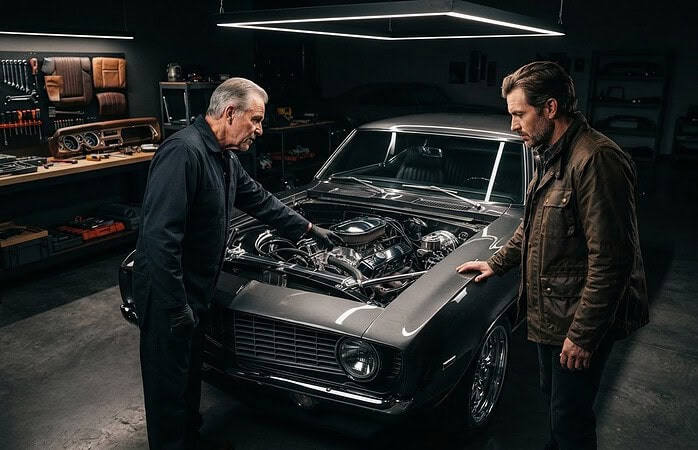

The most profitable automotive assets in 2026 aren’t the ones hidden under silk covers in a vault; they’re the ones built to be driven. While the broader collector market saw a 6 percent price dip in early 2026, the demand for high-performance, usable heritage remains resilient. You likely feel the tension between the visceral pull of a vintage silhouette and the legitimate fear of overpaying for a build that’s more hobbyist than high-end. It’s a valid concern. Calculating the restomod return on investment today requires a sophisticated understanding of how modern engineering increases a vehicle’s longevity and desirability.
This guide provides the framework you need to evaluate investment-grade builds that balance artisanal finishes with modern mechanical performance. We’ll explore why muscle cars account for over 31 percent of the market and how a flight to quality is redefining value for 2026. You’ll gain the confidence to acquire a bespoke machine that serves as both a functional piece of art and a strategic financial asset. From analyzing build histories to understanding the shift toward mechanical excellence, we’re outlining the path to owning a classic that performs as flawlessly as it looks.
Key Takeaways
- Learn to distinguish between hobbyist builds and professional-grade assets that fuse classic silhouettes with precision engineering.
- Understand why reliability is the ultimate driver of value, transforming a static display piece into a high-performance machine you can actually use.
- Discover the specific mechanical criteria and documentation required to maximize your restomod return on investment in the 2026 market.
- Evaluate the financial advantages of bespoke restomods over traditional factory restorations when targeting uncapped appreciation potential.
- Identify the rigorous certification and climate-controlled storage standards necessary to protect the structural and mechanical integrity of your automotive portfolio.
Redefining the Restomod Return on Investment Landscape
High-end car collecting has evolved. Investors no longer seek static museum pieces that require a trailer for every outing. Instead, the focus has turned toward the restomod car investment, which we define as the strategic acquisition of classic vehicle aesthetics paired with contemporary engineering. By analyzing the restomod return on investment, collectors are securing assets that offer both emotional and financial dividends. This evolution recognizes that the true value of a vehicle lies in its ability to be experienced. By defining resto-modification as a bridge between heritage and modern capability, the market is shifting toward usable assets that don’t just sit in a garage.
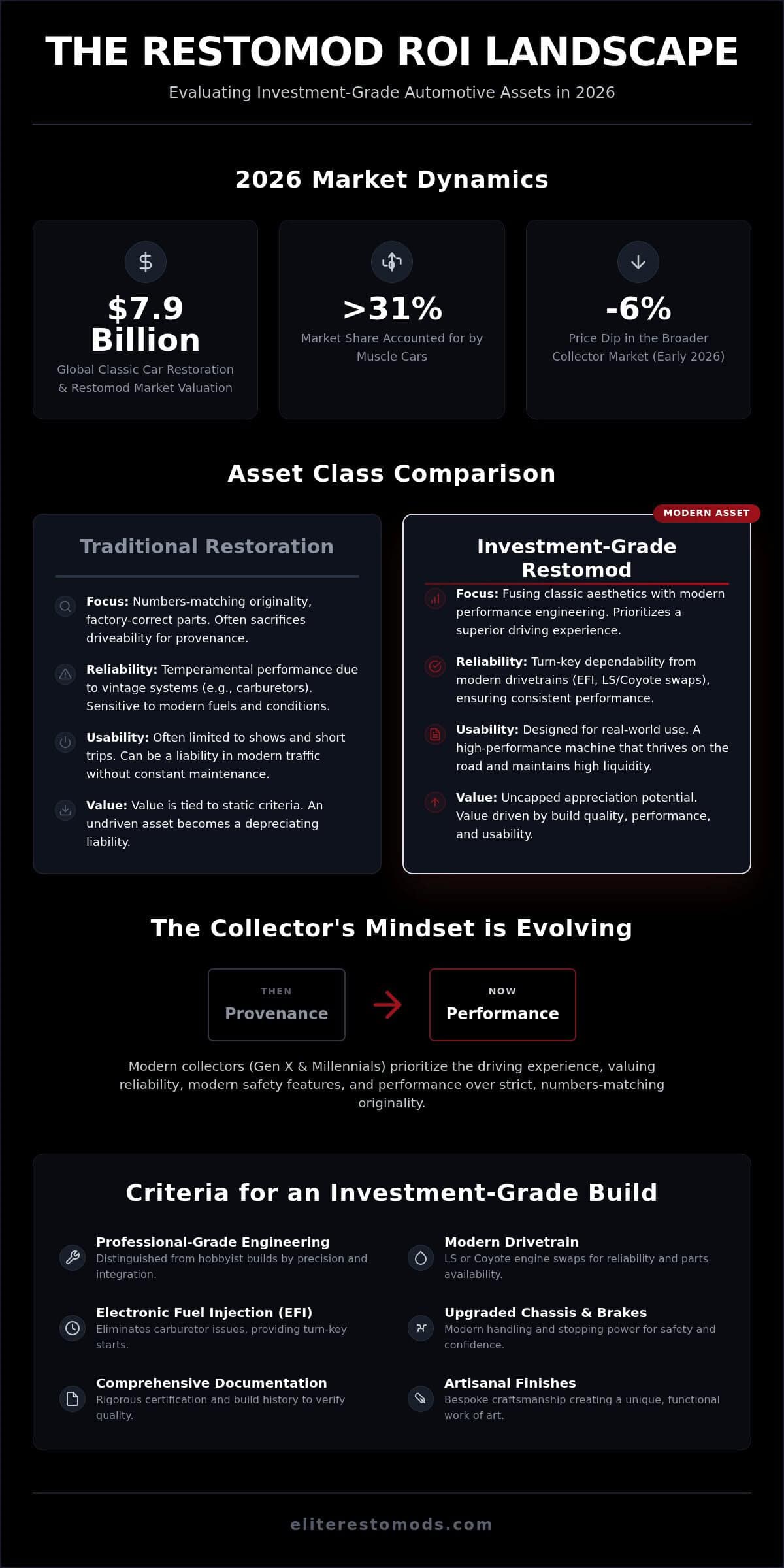
In 2026, the global classic car restoration and restomod services market reached a valuation of $7.9 billion. This isn’t just a hobbyist’s playground anymore; it’s a recognized alternative asset class. Mechanical reliability is the primary driver of this growth. A vehicle that starts every time and handles with modern predictability maintains a level of liquidity that traditional, temperamental classics simply can’t match. Buyers now prioritize machines that can thrive in real-world traffic, utilizing modern fuel standards and infrastructure without the constant threat of a mechanical failure.
The Evolution of the Collector Market
Historically, the market obsessed over numbers-matching originality. Every bolt had to be factory-correct, even if it meant the car was miserable to drive. Today, a demographic shift is occurring. Gen X and Millennial collectors are entering the market with a different set of priorities. They value performance over provenance. They want the silhouette of a 1969 muscle car but the stopping power of modern ceramic brakes. This flight to quality means that a professionally built restomod often commands a higher price than an original restoration because it solves the inherent flaws of the vintage platform.
Restomods as Functional Art
A high-quality restomod is more than a car. It’s a bespoke piece of functional art. Every build represents a meticulous intersection of artisanal craftsmanship and high-performance mechanical engineering. While mass-produced luxury vehicles depreciate the moment they leave the lot, a unique, hand-crafted asset often appreciates as its rarity and build quality become recognized. There is a deep psychological appeal in reliving a classic era of design while enjoying the confidence of modern safety features and climate control. This duality ensures that the restomod return on investment remains strong as collectors look for exclusivity that modern showrooms cannot provide. You can view examples of these investment-grade builds in our inventory to see how heritage and performance collide.
The Financial Logic of Usability and Reliability
An automotive asset that requires a specialized technician for every weekend excursion is not an investment; it is a burden. In the current landscape, the math is simple. An asset that remains on a lift is a depreciating liability. The restomod return on investment is fundamentally tied to the frequency of its operation. A vehicle that cannot be driven reliably in modern traffic is a liability that limits its own secondary market. Investors now seek fully sorted vehicles that require zero immediate intervention, recognizing that “uptime” is the ultimate luxury. This shift toward usability is why the booming restomod market continues to outpace traditional restoration sectors. Reliability preserves value by eliminating the unpredictable maintenance costs that plague original classics.
Resale speed in the secondary market is directly correlated with a vehicle’s mechanical reputation. A restomod equipped with a modern drivetrain, such as an LS swap or a Coyote engine, offers a level of financial predictability that vintage hardware cannot match. These components are supported by a vast network of parts and expertise, ensuring that the asset remains on the road rather than in the shop. Our Elite Certified quality assurance process is designed to verify this level of operational excellence before a vehicle ever reaches a client’s collection.
Eliminating Mechanical Liability
Traditional carburetor systems are temperamental. They struggle with modern fuel blends and altitude changes, often leading to fouled plugs or starting issues. Modern electronic fuel injection (EFI) eliminates these variables, providing turn-key reliability in any environment. Upgraded cooling systems and modern electrical looms prevent the catastrophic overheating and wiring failures that can devalue a vintage asset overnight. By utilizing widely available performance parts, owners reduce the long-term cost of ownership while ensuring the vehicle remains serviceable for decades to come. This transition from fragile vintage tech to robust modern hardware is the cornerstone of a sound automotive portfolio.
The Premium on Daily Drivability
The 2026 market places a significant premium on comfort and safety. A classic silhouette loses its appeal if the cabin is sweltering or the brakes feel inadequate in modern traffic. Integrated climate control, power-assisted steering, and multi-piston disc brakes are no longer optional upgrades; they are essential for asset desirability. These features allow an owner to utilize the car for more than just a drive around the block. When a vehicle can handle a cross-country tour as easily as a local show, its perceived and actual market value increases. Usability creates demand, and demand drives the restomod return on investment.
Market Dynamics of Restomod vs Original Restoration
Traditional factory restorations often operate within a rigid financial corridor. For an original example, the valuation is strictly tethered to its build sheet, production numbers, and historical correctness. Once a vehicle reaches a concours level of restoration, its appreciation potential is limited by the most recent sale of an identical model. Elite Certified Restomods break this cycle by being valued as unique commissions rather than mass-produced commodities. This distinction is vital when calculating your restomod return on investment. While the broader collector market experienced a 6 percent price dip in early 2026, high-quality, professionally built assets remained resilient. Investors are increasingly prioritizing whole-asset ownership over fractional equity platforms because physical possession offers a utility dividend that digital shares cannot match.
Realizing the maximum value of an automotive asset requires more than just a high-quality build; it requires a strategic path to market. Professional consignment services play a critical role here. By positioning a vehicle within a curated ecosystem, owners can tap into a national network of qualified buyers who understand the premium associated with modern performance. This approach ensures that the bespoke nature of the build is reflected in the final sale price, rather than being compared to hobbyist-level projects found on public auction sites.
Value Retention and Appreciation Trends
Data from early 2026 confirms that restomod builds now command a 39.5 percent share of the restoration and services market. Muscle cars remain the dominant force, accounting for over 31 percent of this sector. During record-breaking national auctions in January 2026, which saw total sales reach $445 million, the most aggressive bidding frequently centered on pro-touring builds. These vehicles offer a level of performance that original examples simply cannot reach. This trend is especially evident in vintage SUVs and 1980s-era platforms, where the marriage of nostalgic design and modern drivability creates a high-demand scenario that drives appreciation.
The Role of Builder Pedigree
In the world of high-end automotive assets, reputation is the ultimate currency. A build from a world-class curator carries significantly more weight in an appraisal than a private, undocumented project. Documentation is the bridge between a car and its value. Every receipt, engineering choice, and test mile must be recorded to justify a premium resale price. You can see how these standards are applied by reviewing the meticulous quality assurance process we employ. By adhering to a rigorous certification standard, investors protect their capital against the mechanical uncertainties that often plague unverified builds. A documented pedigree transforms a machine into a verified financial asset, providing the transparency required to maximize your restomod return on investment during a future exit.
Criteria for an Investment-Grade Restomod Build
True value in a bespoke build is found at the intersection of raw power and refined detail. To secure a predictable restomod return on investment, an investor must look beyond a fresh coat of paint. A professional-grade asset is defined by its mechanical cohesion. It’s the difference between a project car and a piece of functional art. Every component, from the structural bracing to the wiring loom, must be executed with a level of perfectionism that ensures long-term reliability. When you’re evaluating an asset, the quality of the hidden components often dictates the eventual resale value. High-end builds command premium valuations because of the meticulous engineering required to meet investment-grade standards.
The Mechanical Foundation
The soul of a restomod is its drivetrain, but the foundation is its chassis. An investment-grade build begins with a laser-straight body and a reinforced frame capable of handling modern torque levels. While modern powerplants are essential, they must be paired with a comprehensive pro touring suspension system to be considered a top-tier asset. This involves a complete redesign using independent rear suspensions and coil-over shocks rather than simple bolt-on upgrades. Safety and value are further solidified through high-performance braking systems, such as six-piston calipers and oversized rotors, which provide the stopping power necessary for modern traffic conditions. These components transform a vintage silhouette into a machine with contemporary handling dynamics.
Aesthetic and Interior Excellence
The visual impact of a high-end restomod should be immediate and visceral. Paint work must be flawless, with a deep, mirror-like finish that shows no signs of orange peel or imperfections. Body gaps must be uniform across the entire vehicle, signaling a level of craftsmanship that exceeds original factory standards. Inside the cabin, the goal is to maintain the nostalgia of the classic era while providing the comfort of a modern luxury sedan. This duality is achieved through:
- Artisanal leather upholstery using premium, automotive-grade hides.
- Integrated climate control systems that are hidden behind vintage-style controls.
- Modern sound systems with Bluetooth connectivity that don’t disrupt the period-correct dashboard aesthetic.
- Digital or analog gauges that provide precise mechanical data while retaining a classic font and layout.
The most successful builds treat technology as a silent partner. It enhances the experience without shouting for attention. When modern luxury is woven seamlessly into a vintage silhouette, the asset becomes timeless. You can explore our custom build services to see how we engineer these rigorous standards into every vehicle we curate.
Securing Your Asset with Elite Certified Standards
Acquiring a high-performance machine is only the first stage of a successful automotive strategy. Stewardship is where the true value is preserved and grown. In a market where quality dictates liquidity, the Elite Certified Restomods program serves as a critical safeguard for the modern investor. It eliminates the ambiguity often found in private sales by providing a verified, documented standard of excellence. Protecting your restomod return on investment requires a commitment to professional oversight that extends far beyond the initial purchase. From specialized financing to climate-controlled environments, every element of our ecosystem is designed to maintain the vehicle’s functional and financial integrity.
The Elite Certified Advantage
Every vehicle in our collection undergoes a rigorous, multi-point quality assurance process. This isn’t a surface-level inspection; it’s a deep mechanical and aesthetic audit. We verify the structural integrity of the frame, the precision of the modern drivetrain, and the artisanal finish of the interior. This process ensures that every car is fully sorted and ready for immediate, reliable use. For the investor, this means the asset can be enjoyed on the road without the fear of immediate mechanical failure or hidden liabilities. You can view our current selection of Elite Certified Restomods to see the results of this uncompromising standard. This level of certification transforms a vehicle from a hobbyist project into a verified financial asset.
Comprehensive Ownership Support
Maintaining an investment-grade vehicle requires specialized infrastructure. Climate-controlled storage is essential for protecting sensitive modern electronics and high-end finishes from environmental degradation. It’s not just about a roof over the car; it’s about precision humidity and temperature management that preserves the artisanal interiors and custom paint. These facilities act as a secure vault for your automotive wealth. When the vehicle needs to move, enclosed vehicle transport ensures it arrives in pristine condition, shielded from road debris and harsh weather. This preservation of condition is vital for a long-term restomod return on investment.
Strategic capital management is also a key component of a sophisticated portfolio. Classic car financing allows investors to leverage their capital effectively, making the acquisition of a high-value asset more flexible and strategic. When the time comes to rotate your collection, our professional consignment program provides the necessary path to liquidity, connecting your asset with a global audience of qualified collectors who recognize the Elite Certified standard. Whether you want to acquire a finished piece from our showroom or consult with experts to commission a bespoke asset, our team provides the expert guidance needed to navigate the 2026 market with absolute confidence.
Driving the Future of Automotive Capital
The transition from static preservation to high-performance utility has fundamentally changed how we evaluate automotive assets. By prioritizing mechanical excellence and modern reliability, collectors are securing machines that offer both a visceral driving experience and a resilient restomod return on investment. The 2026 market rewards the flight to quality. It favors vehicles that have undergone a rigorous Elite Certified quality assurance process. These aren’t just cars; they’re bespoke financial instruments that bridge the gap between heritage design and contemporary engineering. Meticulous build documentation and professional stewardship have replaced simple provenance as the ultimate indicators of value.
To begin your journey, explore our current inventory of investment-grade Elite Certified Restomods. We support every acquisition with nationwide enclosed transport and specialized classic car financing partnerships to ensure your portfolio is as mobile as it is valuable. It’s time to own a piece of history that performs with the precision of tomorrow. Your vision of a high-performance reality is ready to be driven.
Frequently Asked Questions
Is a restomod return on investment better than a traditional classic?
A restomod return on investment often outperforms traditional factory restorations because it addresses the mechanical liabilities that limit a vintage car’s market. While an original vehicle is tied to production numbers, a bespoke build is valued for its unique engineering and daily drivability. This usability creates a broader pool of buyers who want the aesthetic of the past without the unreliability of heritage hardware. Usability is the primary driver of appreciation in 2026.
How do I verify the quality of a restomod build before purchasing?
Verification requires a deep dive into the build’s documentation and engineering pedigree. You should prioritize vehicles that have undergone a rigorous certification process to ensure they are fully sorted. An investment-grade build must include a comprehensive history of the components used, such as the engine, transmission, and suspension. This transparency eliminates the risks associated with hobbyist-level projects and confirms the vehicle’s status as a verified financial asset.
What are the most popular models for restomod car investment in 2026?
Muscle cars remain the dominant force in the 2026 market, accounting for over 31 percent of total acquisitions. Vintage SUVs like the Chevrolet K5 Blazer and Ford Bronco are also seeing significant demand due to their versatility and iconic design. Additionally, there is a growing interest in platforms from the 1980s and 1990s as younger collectors enter the space. These models offer the best balance of nostalgia and modern performance.
Will a restomod hold its value if I drive it regularly?
Regular use can actually preserve value by keeping mechanical systems operational and preventing the seal failures common in static displays. Modern drivetrains are designed for consistent operation, meaning a well-maintained, driven restomod is often more desirable than one that has sat idle. The 2026 market prioritizes mechanical excellence. As long as the vehicle is protected from environmental damage, its usability remains a key driver of its overall market appreciation.
How does classic car financing work for high-value restomods?
Financing for high-value assets works through specialized lenders who understand the unique appraisal metrics of bespoke builds. Unlike standard auto loans, these programs offer flexible terms that reflect the vehicle’s status as a growing financial asset. By leveraging specialized classic car financing, investors can manage their capital more effectively while securing a high-performance machine. This strategic approach allows for the acquisition of elite-tier builds without liquidating other parts of a portfolio.
What is the difference between a pro touring build and a standard restomod?
A pro touring build is a specialized subset of restomodding that prioritizes track-level performance and handling. While a standard restomod might focus on a modern engine and air conditioning for street comfort, pro touring requires advanced suspension geometry and multi-piston braking systems. These vehicles are engineered to out-handle modern sports cars while retaining their classic silhouette. This focus on extreme mechanical capability often places pro touring builds at the top of the valuation scale.
How can I sell my restomod for the highest possible price?
Utilizing a professional consignment program is the most effective way to realize the maximum value of your asset. This approach places your vehicle in a curated environment where it is presented to a global network of qualified collectors. High-quality marketing and a documented build history are essential for justifying a premium price. By avoiding the volatility of public auction sites, you ensure that your investment is recognized for its artisanal craftsmanship and mechanical precision.
Why is climate-controlled storage necessary for an investment-grade vehicle?
Precision storage is vital for protecting the complex electronics and delicate finishes found in high-end builds. Climate-controlled environments manage humidity and temperature to prevent the degradation of premium leather interiors and custom paint work. Without these safeguards, the structural and aesthetic integrity of the vehicle can suffer over time. Secure storage acts as a protective vault, ensuring that your restomod car investment remains in showroom condition for years to come.