
A vintage masterpiece should be a sanctuary, not an endurance test. Why let a mid-July heatwave transform your prized fastback into a leather-lined sauna? You’ve likely felt the hesitation that comes with modifying a legend, fearing that a subpar installation might mar a pristine dashboard or cause your engine to boil over in traffic. It’s a common crossroads for the discerning collector. To make an informed decision, you must understand the true classic car air conditioning upgrade cost, which involves looking beyond the price of a basic compressor to the synergy of modern thermal management and period-correct aesthetics.
This guide clarifies the investment required to achieve ice-cold reliability without compromising the soul of your vehicle. We’ll explore the latest 2026 EPA regulations regarding refrigerant management, essential technical hardware requirements, and the professional labor standards that turn a simple installation into a value-adding restomod transformation. From high-efficiency rotary compressors to the necessity of high-output cooling systems, discover how to bridge the gap between golden-era design and modern, effortless comfort. Your journey toward a fully sorted, climate-controlled masterpiece begins with understanding the mechanical intricacies of the modern era.
Key Takeaways
- Understand how integrating modern climate control transforms a vintage asset into a high-performance restomod, significantly increasing both drivability and market valuation.
- Evaluate the total classic car air conditioning upgrade cost by accounting for advanced rotary compressor technology and high-efficiency condensers rather than just the base kit price.
- Identify the critical electrical requirements, such as high-output alternators, needed to support modern blower motors and ensure long-term system reliability.
- Compare the streamlined installation of model-specific kits against the bespoke engineering required for custom climate integration in unique or modified builds.
- Discover the importance of professional calibration to achieve a clean, factory-appearing finish that preserves the aesthetic integrity of your vintage interior.
The Value of Climate Control in the Modern Restomod Era
A vintage masterpiece should be an extension of the driver’s lifestyle, not a seasonal burden. The psychological shift in the collector market is undeniable. Enthusiasts no longer settle for “weekend cruisers” that languish in the garage during the peak of summer. They demand vehicles that offer the raw, visceral excitement of the past alongside the refined reliability of the present. Integrating modern climate control is the bridge between these two worlds. It removes the physical limitations of vintage technology, allowing the soul of the machine to shine through in any weather. When calculating the classic car air conditioning upgrade cost, it is essential to view the expense as a foundational investment in the vehicle’s utility and long-term market appeal.
The evolution of Automotive air conditioning has moved from a bulky, parasitic luxury to a streamlined, high-performance necessity. Modern systems are designed to be nearly invisible, tucked behind the firewall to preserve the clean lines of a period-correct engine bay. This transition from archaic piston compressors to efficient rotary units mirrors the broader restomod philosophy: preserve the heritage, but perfect the performance. By choosing a sophisticated climate solution, you transform a beautiful static object into a functional piece of art that is ready for the open road at a moment’s notice.
Drivability as a Metric of Vehicle Value
An undriveable car is a stagnant asset. If a heatwave makes the cabin unbearable, the vehicle remains hidden, losing the visibility and engagement that drive valuation in the collector community. High-performance engine builds and modern suspension geometries lose their impact if the driver is too fatigued by cabin heat to enjoy them. A modern HVAC system aligns the interior environment with the mechanical capabilities of the car. It enables long-distance touring and cross-country rallies, ensuring that the vehicle is utilized as intended. This level of readiness is a hallmark of the meticulous build process required for investment-grade assets.
The Aesthetic Integrity of Professional Integration
True luxury is found in the details. While universal hang-on units might provide cooling, they often mar the artisanal beauty of a classic dashboard with cheap plastics and exposed hoses. Professional integration focuses on bespoke craftsmanship. It utilizes the original factory controls to operate modern electronic actuators, maintaining a seamless visual narrative. This approach ensures that the classic car air conditioning upgrade cost reflects a commitment to quality rather than a compromise. For the discerning collector, the goal is a cabin that feels factory-original but performs with the effortless confidence of a contemporary supercar.
Decoding the Components: What Drives Upgrade Costs?
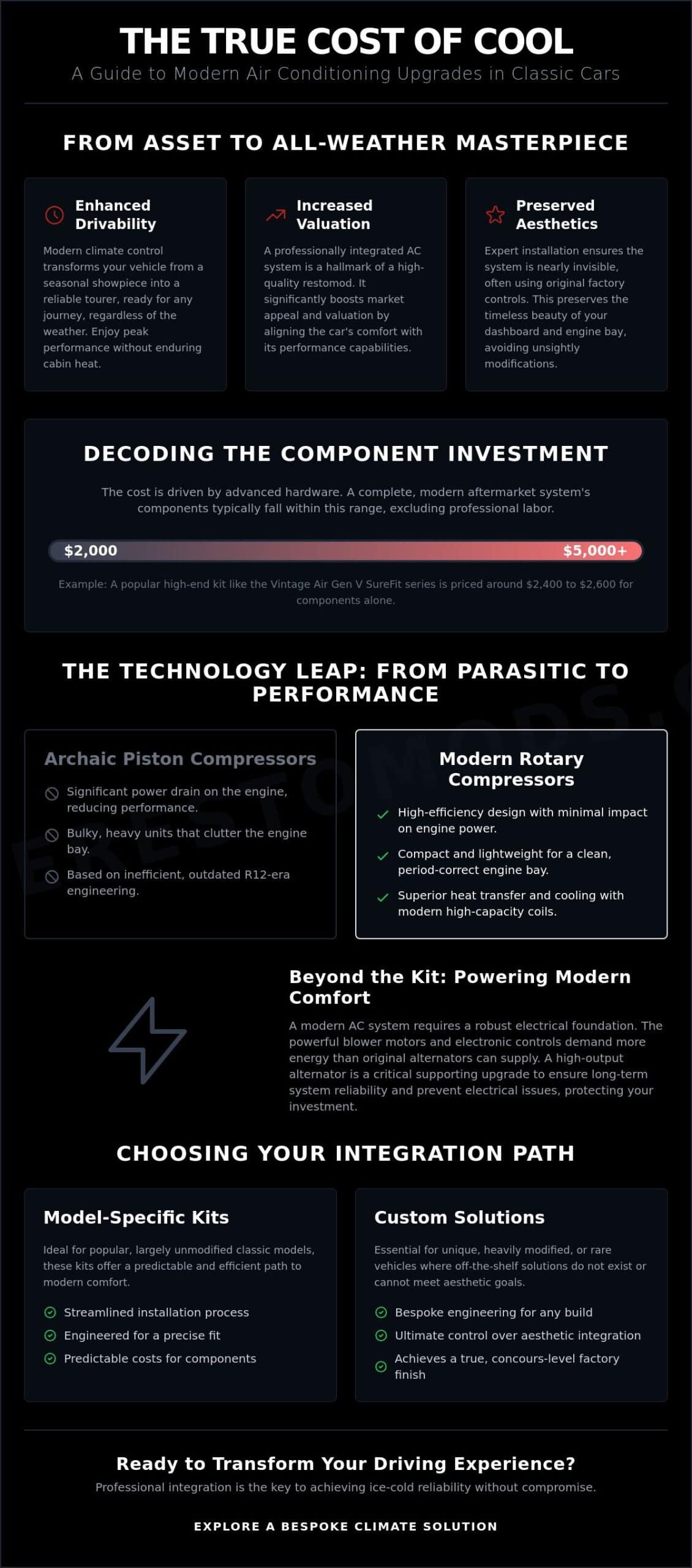
Building a climate-controlled sanctuary within a vintage chassis requires more than a simple kit purchase. It is a meticulous assembly of high-performance hardware. When evaluating the classic car air conditioning upgrade cost, the total investment is dictated by the sophistication of the hardware chosen and the complexity of its integration. A complete aftermarket system generally ranges from $2,000 to $5,000 for the components alone. This price reflects the shift from archaic, parasitic machinery to the refined efficiency of modern thermal management. Every fitting, hose, and bracket serves as a critical link in a chain designed to withstand the rigors of high-performance driving while maintaining a serene cabin environment.
The decision often begins with whether you are restoring the original factory air system or opting for a total modernization. While restoration preserves historical accuracy, it often leaves you tethered to the limitations of R12-era engineering. Modern kits, such as the Vintage Air Gen V SureFit series priced around $2,400 to $2,600, offer a complete departure from the past. These systems utilize multi-mount evaporator designs and high-capacity coils that provide superior heat transfer in a fraction of the space. Our custom build services prioritize these modern internals to ensure that the visceral thrill of the engine is never overshadowed by an overheating cabin.
Compressors and Mounting Hardware
The compressor is the heart of the system. Modern Sanden-style rotary units have replaced the cumbersome piston designs of yesteryear. They are lightweight. They are exceptionally smooth. Because they require significantly less horsepower to operate, they don’t sap the life from your small-block V8 during spirited acceleration. However, the cost increases when dealing with specialized engine architectures. Custom-machined brackets and serpentine drive conversions are often necessary to ensure perfect pulley alignment. These precision-engineered mounting solutions prevent belt slippage and vibration, protecting both the compressor and the engine’s crank snout from premature wear.
Evaporator Units and Cabin Controls
Interior comfort is won or lost at the evaporator. High-end modules from brands like Restomod Air range from $1,299 to $1,499 and represent the pinnacle of cabin cooling technology. The placement of these units, whether tucked behind the dash for a factory look or mounted as a custom centerpiece, significantly impacts labor requirements. Modern “Smart Series” electronics have replaced old-fashioned cable-driven slides with precise digital actuators. This allows for infinite adjustment of airflow and temperature. Achieving this level of refinement requires custom ductwork and artisanal vent integration, ensuring that the ice-cold air reaches the driver without disrupting the vehicle’s period-correct aesthetic.
Beyond the Kit: Essential Mechanical Support Upgrades
A high-end climate control system is more than a simple box of parts. It is a mechanical ecosystem that places significant demands on your vehicle’s aging infrastructure. Many enthusiasts focus solely on the purchase price of a kit, yet the true classic car air conditioning upgrade cost often hinges on the necessary support systems. A “bolt-on” installation that ignores the electrical and thermal realities of vintage steel is a recipe for roadside failure. To achieve the reliability of a modern luxury vehicle, we must look beyond the evaporator and address the foundational components that keep the system running under the most demanding conditions.
Modern engineering requires modern power. Integrating these systems into an unrestored platform often reveals the fragility of period-correct hardware. This is why our meticulous build process treats the climate system as an integrated mechanical upgrade rather than an isolated accessory. From the firewall forward, every component must be calibrated to handle the increased load of contemporary thermal management hardware.
Electrical Architecture and Power Delivery
The original electrical systems in vintage machines were never designed for the amperage draw of a modern high-performance blower motor and high-CFM electric fans. A standard 1960s alternator, often producing a meager 37 to 55 amps, will struggle to maintain battery voltage when the AC is engaged at idle. Upgrading to a 100+ amp alternator is a non-negotiable requirement. This ensures consistent power delivery to the blower motor and prevents the dimming lights or stumbling idle that plague lesser builds. Furthermore, the use of dedicated relay circuits protects your original wiring harness from heat and voltage spikes, ensuring long-term operational integrity.
Engine Cooling and Thermal Management
Thermal management is a game of exchange. The AC condenser is a secondary heat exchanger typically mounted directly in front of the radiator. It sheds heat from the cabin into the air path of the engine. This adds a substantial thermal load to the cooling system. To compensate, high-performance builds require high-efficiency aluminum radiators paired with precision-engineered electric fan shrouds. These fans must pull enough air to cool both the engine and the condenser simultaneously, even in stationary traffic. To keep that cold air where it belongs, we also incorporate advanced thermal insulation and sound deadening throughout the cabin floor and doors. This artisanal attention to detail ensures that your interior remains a sanctuary of refined comfort, regardless of the visceral heat radiating from the pavement below.
Comparing Systems: Model-Specific Kits vs. Custom Solutions
Choosing the right architecture for your climate control is a pivotal moment in any restoration journey. It’s the point where engineering meets personal vision. For many popular muscle cars, the path is well-defined through model-specific kits. These “Perfect Fit” systems are meticulously engineered to utilize existing dashboard openings and mounting points, offering a streamlined path to modern comfort. However, the classic car air conditioning upgrade cost begins to diverge when the vehicle moves away from its factory configuration. A kit designed for a stock 1967 Mustang will not suffice if that same Mustang now houses a modern Coyote crate engine with a custom accessory drive.
The complexity of the build dictates the complexity of the solution. While a standard kit might require 20 to 30 hours of professional labor, a highly modified restomod often demands a bespoke approach. At current industry labor rates ranging from $120 to $159 per hour, the investment in expertise quickly becomes the primary driver of the total project cost. The Elite Restomods process begins with a comprehensive evaluation of these variables, ensuring that the chosen system harmonizes with the vehicle’s unique mechanical DNA rather than fighting against it.
The Model-Specific Advantage
Pre-engineered kits offer a significant advantage in terms of predictability. Because the bracketry and ductwork are designed for a specific chassis, the need for custom fabrication is greatly reduced. These systems are ideal for the collector who values a factory-appearing interior with modern operational reliability. The limitation arises when dealing with non-original engine configurations or smoothed firewalls. In these instances, even the best model-specific kit requires modification, which can inadvertently increase labor costs beyond the price of a fully custom installation. Precision is paramount. A kit is only as good as the technician’s ability to align it with the vehicle’s current state of evolution.
Bespoke Custom Installations
When a build reaches the level of a world-class restomod, “off-the-shelf” solutions often fall short of the required aesthetic and performance standards. Bespoke installations allow for hidden line routing and bulkhead connectors that create a show-quality engine bay, free from the clutter of traditional AC hoses. For air-cooled icons like the Porsche 911, electric AC systems have emerged as the premier choice. These systems eliminate the need for belt-driven compressors entirely, preserving the engine’s power band while delivering modern cooling through high-voltage electrical architecture. This intersection of luxury and raw performance is where a vehicle truly becomes a functional work of art. If you are ready to elevate your driving experience, explore our custom build services to design a climate system as unique as your vehicle.
The Elite Approach: Seamless Integration for Discerning Collectors
Mastery is the final, indispensable ingredient in any high-end automotive transformation. While we have dissected the hardware and the mechanical support required for climate control, the ultimate success of the project rests in the hands of the builder. A professional installation is more than a convenience. It is an insurance policy for your classic investment. When you consider the total classic car air conditioning upgrade cost, the value of expert commissioning cannot be overstated. It is the difference between a system that simply blows cold air and one that operates with the seamless, quiet efficiency of a modern luxury grand tourer.
The Elite Certified standard is a rigorous protocol designed to ensure that every component performs at its peak potential. We do not merely install kits. We engineer environments. This involves a systematic approach to mechanical sorting where the climate system is integrated into the vehicle’s broader performance narrative. By treating the HVAC system as a core element of a comprehensive build, we eliminate the common pitfalls of overheating and electrical failure that plague lesser installations. The result is a vehicle that feels as cohesive and intentional as it did the day it left the factory, yet possesses capabilities that were once unimaginable.
Craftsmanship and Professional Commissioning
There is a profound distinction between a technician who follows a manual and a master builder who understands the soul of a vintage machine. Our integration process involves comprehensive testing protocols that go far beyond the basics. We perform multi-stage pressure checks to ensure the absolute integrity of every custom fitting. We execute deep vacuum pulls to remove every trace of moisture from the system, followed by precision thermal testing to verify cabin pull-down times in extreme heat. This meticulous attention to detail is a hallmark of our Elite Restomods services, where every custom build commission is treated as a bespoke piece of functional art.
Securing Your Investment
A modern, reliable AC system is a prerequisite for the investment-grade restomod market in 2026. It significantly increases the marketability and valuation of your vehicle by removing the barriers to entry for modern collectors. When a car is fully sorted, it transitions from a high-maintenance hobby to a reliable asset that can be enjoyed across continents. You can view examples of this level of execution by exploring our current classic car restomods for sale, where every vehicle represents the pinnacle of performance and comfort. If you are ready to begin the journey of bringing your vintage masterpiece into the modern era, contact our team today. We are ready to discuss your specific vehicle requirements and help you realize the dream of effortless, climate-controlled performance.
Master the Elements of Your Next Journey
The road ahead should be defined by the thrill of the drive, not the temperature of the cabin. By understanding the mechanical nuances of modern climate control, you’ve taken the first step toward transforming your vintage asset into a truly usable masterpiece. We’ve seen that the true classic car air conditioning upgrade cost encompasses far more than a simple kit; it requires a symphony of high-output electrical systems and precision thermal management. This investment doesn’t just provide relief from the summer sun. It secures the vehicle’s status as a premier, investment-grade restomod that is ready for any rally or cross-country tour.
Our team is dedicated to bridging the gap between historical design and contemporary comfort. Through our Elite Certified Quality Assurance and deep specialization in high-performance builds, we ensure your vehicle arrives via our national enclosed vehicle transport ready for any climate. It’s time to reclaim the open road with a machine that performs as beautifully as it looks. Commission your dream restomod build with modern climate control and experience the pinnacle of artisanal engineering. Your classic era of design is waiting to be rediscovered in total, effortless comfort.
Frequently Asked Questions
How much does it cost to add air conditioning to a classic car professionally?
Professional installation typically reflects the complexity of the chassis and the chosen hardware. While high-quality aftermarket kits range from $2,000 to $5,000, the total classic car air conditioning upgrade cost includes professional labor. Technicians often charge between $120 and $159 per hour, with total labor hours scaling based on whether the car requires custom bracketry or interior modification.
Can you put AC in a vintage car that never had it from the factory?
Modern aftermarket systems are specifically engineered for vehicles that were never equipped with factory air. These systems utilize compact evaporator modules that fit behind the dashboard or in custom under-dash housings. This allows for a clean, factory-appearing installation in early muscle cars or vintage trucks without compromising the original cabin aesthetics.
How long does it take to install a modern air conditioning system in a classic car?
A standard installation generally requires 20 to 40 hours of dedicated labor. This timeline fluctuates based on the level of interior disassembly required and the complexity of the engine bay. Bespoke builds involving custom line routing or smoothed firewalls can extend this duration as master builders ensure every fitting is pressure-tested for long-term reliability.
Will adding air conditioning to my classic car cause it to overheat?
Overheating is a risk only if the vehicle’s cooling system remains in its original state. The AC condenser adds a significant thermal load to the radiator’s air path. To prevent temperature spikes, it’s essential to pair the upgrade with a high-efficiency aluminum radiator and high-CFM electric fans that maintain stable engine temperatures even in stationary traffic.
Do I need to upgrade my electrical system for modern AC?
Most vintage machines require an electrical upgrade to support the demands of a modern HVAC system. Original alternators often produce less than 60 amps, which is insufficient for high-performance blower motors and cooling fans. Upgrading to a 100+ amp alternator ensures consistent voltage and prevents battery drain during extended idling with the AC engaged.
What is the difference between a universal AC kit and a model-specific system?
Model-specific systems are pre-engineered to utilize factory vents and mounting points for a seamless fit. Universal kits are more adaptable for unique or heavily modified vehicles but require custom fabrication of brackets and ducting. Choosing a model-specific system often reduces labor costs by minimizing the need for one-off parts.
Is an electric AC compressor better than a belt-driven one for a classic car?
Electric compressors are ideal for air-cooled icons or builds where engine bay space is at a premium. Because they operate independently of the engine’s RPM, they provide consistent cooling without parasitic power loss. This makes them a premier choice for high-performance builds where maintaining the raw power of the engine is a top priority.
Does adding modern AC devalue a classic car or increase its worth?
Modern climate control is a cornerstone of investment-grade restomods. It increases the marketability and usability of the vehicle, making it more attractive to contemporary collectors who prioritize drivability. While numbers-matching purists may prefer original hardware, the broader market values the refined comfort and reliability that a modern upgrade provides.