
A single grain of grit. A momentary lapse in technique. That’s all it takes to ruin a masterpiece. The mirror-like depth of a custom paint job can be decimated by one well-intentioned afternoon with the wrong microfiber towel. You understand that a bespoke finish is more than just pigment; it’s the soul of a vintage asset. Knowing how to care for custom car paint is the only way to protect that visceral connection and ensure your investment doesn’t succumb to the friction of the road. We share your obsession with perfection and your disdain for the micro-scratches that haunt lesser builds.
You’ll master the professional techniques and modern chemistry required to maintain the depth of your restomod while navigating the 2026 landscape of protective coatings. We’ll demystify the choice between traditional carnauba and the latest ceramic technologies, as the global car care market reaches a projected 12.1 billion dollars this year. From understanding the impact of new low-VOC regulations to implementing a systematic, non-abrasive wash routine, this guide provides the technical roadmap to a long-lasting shine that preserves both aesthetic beauty and resale value.
Key Takeaways
- Learn the non-abrasive wash protocol that utilizes the two-bucket method and pH-neutral chemistry to prevent the micro-scratches that ruin bespoke finishes.
- Compare the nostalgic warmth of traditional carnauba wax against the permanent, hydrophobic protection of modern nanotechnology ceramic coatings.
- Discover how to care for custom car paint by understanding the intricate layers of primer, base, and high-solids clear coat that define a show-quality finish.
- Protect your investment from UV degradation and moisture-trapping covers by leveraging professional-grade environmental defense and climate-controlled storage solutions.
- Understand how meticulous paint maintenance and documented detailing history directly impact the resale value and consignment potential of your elite restomod.
The Anatomy of a Show-Quality Finish
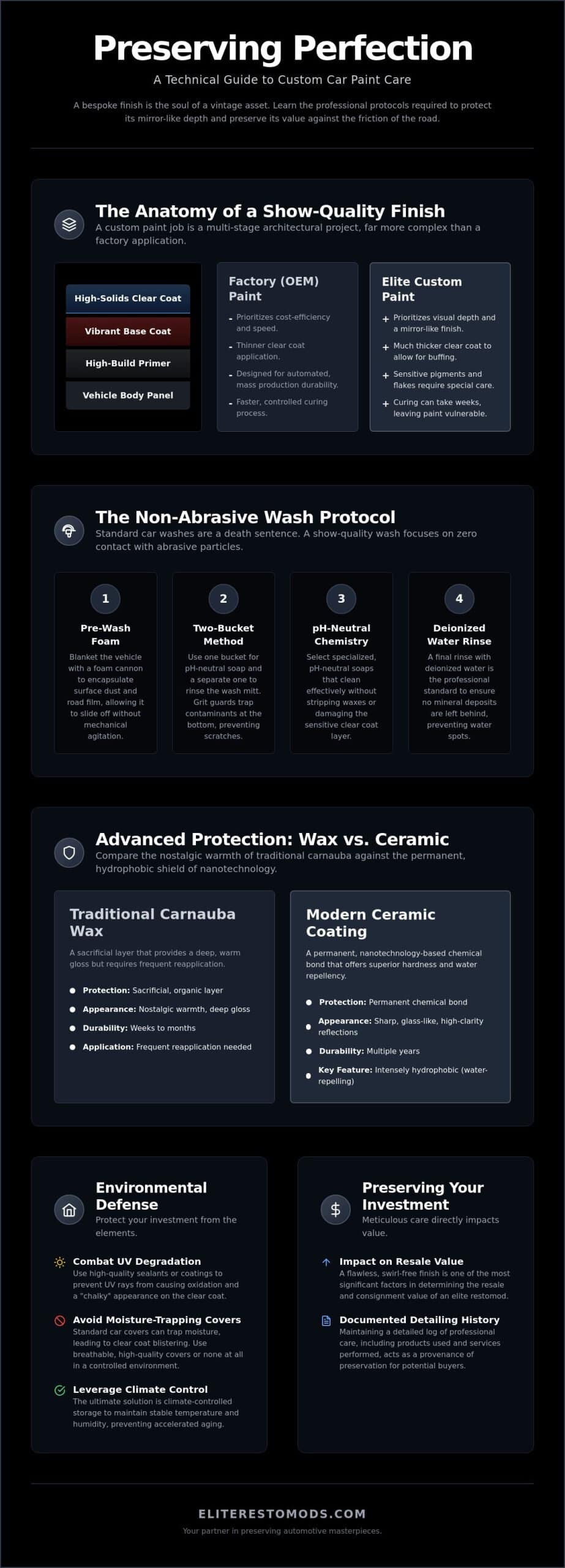
A show-quality finish isn’t just paint. It’s a multi-stage architectural project. While a factory car might receive a thin, automated application, an elite restomod undergoes a meticulous layering process. We begin with high-build primers, followed by vibrant base coats, and finally, multiple layers of high-solids clear coat. To understand the technical depth involved, one must look at The Anatomy of a Show-Quality Finish as a structural achievement. This complexity is exactly why knowing how to care for custom car paint requires a shift in mindset from basic maintenance to active preservation.
High-performance restomods introduce unique environmental stressors that standard vehicles never face. Massive powerplants generate intense heat soak under the hood. This thermal energy can accelerate clear coat gas-off or cause premature oxidation if the paint system isn’t managed correctly. Additionally, the proximity of custom plumbing means fluid leaks like caustic brake fluid or high-temp coolant are a constant threat to your artisanal finish. Our custom build services prioritize these chemical bonds to ensure the finish survives the heat of the street.
To visualize the precision required for maintaining this level of craftsmanship, watch this expert breakdown:
The Difference Between OEM and Custom Paint
Factory finishes are designed for the masses. They prioritize durability and cost-efficiency over visual depth. Custom paint flips this hierarchy. A bespoke finish often utilizes a much thicker clear coat, measured in mils, to allow for extensive color sanding and buffing. This creates the signature mirror-like reflection. However, these specialized pigments and metallic flakes are more sensitive to chemical etching. The curing process for a custom job can also take weeks to fully stabilize. During this window, the paint remains “open” and highly vulnerable to improper handling or harsh detergents.
Why Clear Coat Health is the Priority
Think of the clear coat as the sacrificial layer of your restomod. It’s the only thing standing between the environment and your expensive color coat. When this layer is healthy, light refracts perfectly off the surface. Micro-scratches and swirl marks act like tiny canyons that scatter light in every direction. This diffusion kills the visceral impact of the color, making even the most expensive paint look dull and aged. Early signs of failure include a “chalky” appearance or a loss of surface tension where water no longer beads. Catching these signs early is vital for anyone learning how to care for custom car paint effectively.
The Meticulous Wash: A Non-Abrasive Protocol
Standard car washes are a death sentence for bespoke finishes. A driver-quality wash focuses on speed. A show-quality protocol focuses on preservation. When you are learning how to care for custom car paint, the objective is zero physical contact with abrasive particles. This begins with the water itself. Standard tap water contains minerals like calcium and magnesium that leave etched rings on your clear coat. Using deionized water is the professional standard for a spot-free finish, ensuring that no mineral deposits interfere with the mirror-like clarity of your restomod.
The two-bucket method is your primary defense. One bucket holds your pH-neutral soap solution, while the other serves as a rinse station for your wash mitt. This ensures that grit removed from the car is trapped at the bottom of the rinse bucket, rather than being reintroduced to the paint. It’s a simple system. It’s an essential discipline. By using grit guards in both buckets, you create a sanctuary for your finish that prevents the circular swirl marks common in lesser detailing routines.
Pre-Wash and Contaminant Removal
Lubrication is everything. We utilize a foam cannon to blanket the vehicle in a thick layer of specialized soap. This encapsulates surface dust and road film, allowing it to slide off without mechanical agitation. Speed is essential when dealing with organic contaminants. Bird droppings and tree sap contain acidic compounds that can etch into a clear coat in hours. Because Environmental Defense and the Role of Climate Control involves understanding how VOC-compliant coatings react to their surroundings, we avoid harsh household detergents. These chemicals strip away protective waxes and can dull the visceral impact of an elite finish.
The Art of the Touchless Dry
Friction is the enemy. Traditional chamois cloths are detrimental because they trap microscopic particles and drag them across the surface. This creates the micro-marring that haunts show cars. The professional choice is filtered compressed air. By blowing water out of crevices, trim, and emblems, you eliminate the need for physical contact entirely. It’s efficient. It’s safe. If air drying isn’t an option, use a dedicated, ultra-plush microfiber towel with a high GSM count. Don’t wipe the paint. Instead, lay the towel flat and pat it to absorb moisture, maintaining the integrity of the surface.
Maintaining this level of perfection is a demanding journey. For those who want to ensure their vehicle remains a masterpiece, our custom build services provide the foundational engineering that makes long-term maintenance possible.
Advanced Protection: Ceramic Coatings vs. Traditional Wax
Choosing the right shield for your vehicle is a balance between aesthetic preference and operational reality. Carnauba wax offers a deep, organic luster that many collectors associate with the golden era of automotive design. Modern nanotechnology, however, provides a level of chemical resistance and surface hardness that traditional formulas simply cannot match. Understanding how to care for custom car paint in 2026 means navigating these two worlds with technical precision. While one offers a fleeting, nostalgic glow, the other provides a semi-permanent barrier against the elements.
The global car care market is projected to reach 12.1 billion dollars this year, driven largely by the shift toward these advanced chemical solutions. Beyond liquid coatings, Paint Protection Film (PPF) has become the gold standard for physical defense. It is a thick, self-healing urethane layer designed to absorb the impact of high-speed road debris. In 2026, the trend has shifted toward color PPF, with collectors opting for warm satin neutrals and muted metallics that provide both a bespoke look and a rugged physical shield. For the ultimate preservation strategy, we recommend a hybrid approach: PPF on high-impact lead surfaces and ceramic coatings over the remaining panels.
The Case for Carnauba on Classic Aesthetics
Many owners of elite certified restomods still prefer the “warm” glow of high-grade carnauba wax. It enhances the depth of solid colors and softens the sharp edges of light refraction in a way that synthetic sealants sometimes fail to replicate. It is a temporary bond. Because wax sits on top of the clear coat rather than bonding with it, it requires reapplication every few months to maintain its integrity. To avoid unsightly build-up in the tight tolerances of custom trim and emblems, always apply in thin, uniform layers using a dedicated applicator. This method respects the heritage of the build while providing a basic sacrificial layer.
Ceramic Coatings: The Modern Standard
Ceramic coatings represent a fundamental shift toward permanent protection. These liquid polymers bond chemically with the clear coat to create a hydrophobic surface with a 9H hardness rating. This hardness resists chemical etching from acid rain and industrial fallout. It also simplifies the maintenance routine. Dirt and contaminants simply cannot find a foothold on the slick, glass-like surface. Before application, professional paint correction is an absolute requirement. Any swirl mark or imperfection left behind will be permanently locked under the coating. Our custom build services often integrate these advanced coatings to ensure the vehicle leaves the shop with a finish that is as durable as it is beautiful.
Environmental Defense and the Role of Climate Control
The environment is a relentless adversary. It never sleeps. While we celebrate the brute force of a high-displacement restomod, the delicate skin that covers it requires a different kind of vigilance. UV radiation acts as a silent catalyst for pigment degradation, breaking down the chemical bonds of even the most advanced high-solids clear coats. In 2026, while modern coatings offer significant UV inhibitors, prolonged exposure still leads to a loss of depth and clarity. Understanding how to care for custom car paint means acknowledging that the sun is a slow-acting solvent that eventually robs a finish of its visceral impact.
Heat management is a unique challenge for the restomod community. High-performance engines generate massive thermal energy that radiates upward through the hood. If a vehicle is tucked away immediately after a spirited drive, this trapped heat can “cook” the paint from the underside, leading to clouding or premature delamination. It’s a risk standard vehicles rarely face. Similarly, the interplay between atmospheric moisture and thermal expansion creates a volatile environment. Humidity control is essential to prevent micro-blistering, a condition where moisture trapped between paint layers expands and creates tiny, irreparable bubbles in the finish.
The Risks of Improper Storage
Standard garages often provide a false sense of security. They shield the car from rain, but they don’t protect it from the corrosive effects of temperature swings and industrial fallout. In coastal regions, salt air can penetrate even closed structures, accelerating oxidation on any exposed surface. Outdoor car covers are often a detrimental choice for custom finishes. When the wind catches the fabric, it acts like sandpaper, dragging microscopic grit across the clear coat. For those serious about preservation, we offer climate controlled car storage to stabilize the environment and eliminate these variables entirely.
Daily Driving Precautions
The road is an unpredictable theater. Avoiding construction zones and sprinkler systems is a basic discipline for the show-car owner. Reclaimed water used in irrigation is often highly mineralized, leading to etched spots that require professional correction to remove. Chemical spills represent an immediate crisis. Fuel and brake fluid are aggressive solvents that can dissolve a custom clear coat in minutes. If a spill occurs, blot the area immediately with deionized water rather than wiping, which only spreads the damage. When moving your masterpiece to distant events, an enclosed transport strategy is the only way to ensure the finish arrives in concours condition.
Protecting your investment requires more than just a roof over its head. Explore our Climate-Controlled Storage solutions to give your restomod the sanctuary it deserves.
Preserving the Value of Your Elite Restomod
A restomod is more than a machine. It’s a high-performance asset that bridges the gap between nostalgic design and modern capability. In the world of elite automotive collecting, a flawless finish isn’t just an aesthetic choice; it’s a financial imperative. Precision pays dividends. Documented maintenance serves as the pedigree for your vehicle, proving that the finish has been curated with professional-grade discipline. When you maintain a meticulous log of how to care for custom car paint, you’re building a narrative of stewardship that resonates with future buyers. This transparency is what separates investment-grade vehicles from common projects.
The role of professional detailing becomes critical when preparing for a transition in ownership. A show-quality finish must be free of the micro-marring and oxidation that diminish its visceral impact. By integrating paint care into your broader management strategy, you ensure that the car is always ready for the spotlight. This level of aesthetic care reflects the mechanical integrity of the build. It suggests that if the owner was this meticulous with the clear coat, the engine and drivetrain likely received the same level of perfectionism. It’s about protecting the soul of the asset.
The Elite Restomods Quality Assurance
Our commitment to excellence begins long before the first wash. The internal process we follow ensures that every vehicle leaves our facility with a surface that exceeds factory standards. We understand that a custom finish is a bespoke piece of functional art. Starting with a professionally prepared surface is the only way to achieve the mirror-like depth our clients expect. For those who have maintained their vehicles to this standard, our consignment services provide an exclusive channel to connect with collectors who value artisanal craftsmanship and verified provenance.
Building a Long-Term Care Routine
Consistency is the hallmark of the master builder. Creating a seasonal schedule for deep cleaning and protection renewal is essential to combat the environmental stressors of the 2026 landscape. This routine should include a decontamination wash every six months to remove industrial fallout that standard soaps can’t touch. While daily upkeep is part of the owner’s journey, your mastery of how to care for custom car paint should include knowing when to seek professional paint correction. Surgical-grade polishing is a delicate operation that preserves the clear coat thickness for decades. Ready to find your next masterpiece? View our inventory of fully sorted restomods and experience the marriage of brute force and refined comfort.
Securing the Legacy of Your Masterpiece
The journey from a vintage relic to a high-performance restomod is one of transformation. Preserving that transformation requires a commitment to the meticulous protocols we have discussed. By embracing the non-abrasive two-bucket method and the advanced hydrophobic barriers provided by modern ceramic nanotechnology, you ensure the depth of your finish remains untarnished. Understanding how to care for custom car paint is the ultimate mark of a true curator. It is the bridge between a beautiful machine and a lasting investment that commands attention on any concours lawn.
Your obsession with excellence deserves a partner who shares your standards. Our Elite Certified quality assurance process guarantees that every build meets our rigorous benchmarks for craftsmanship. Whether you require specialized classic car financing partnerships to secure your next asset or nationwide enclosed vehicle transport to deliver it in pristine condition, we provide the infrastructure for elite ownership. The road is calling. Your finish is ready to meet it with confidence.
Explore our inventory of Elite Certified Restomods and find the bespoke art piece that defines your era.
Frequently Asked Questions
How often should I wash my custom-painted restomod?
Wash your vehicle based on its exposure to environmental contaminants rather than a set calendar date. If you’ve enjoyed a weekend drive, a wash is essential to remove road film and exhaust particulates. For a show-quality finish, we recommend a meticulous cleaning once a week. This frequency prevents the buildup of abrasive grit that leads to micro-marring. Regularity is the foundation of excellence.
Can I use a pressure washer on high-end custom paint?
You can utilize a pressure washer provided you maintain a safe distance and use a wide-angle nozzle. High-pressure streams can actually force water into tight seals or cause delamination if there is a chip in the clear coat. Keep the pressure below 1500 PSI to be safe. It’s an effective tool for the pre-wash foam stage. Just don’t get too aggressive with the wand.
Is ceramic coating better than traditional wax for classic cars?
Ceramic coatings provide superior chemical resistance and a permanent hydrophobic barrier that traditional wax cannot match. While carnauba wax offers a nostalgic, warm glow, it lacks the 9H hardness that protects against acid rain and UV damage. Most modern restomod owners choose ceramic for its durability. It simplifies the process of how to care for custom car paint by making the surface easier to clean.
What is the safest way to remove bird droppings without scratching the paint?
Neutralize the acidity immediately by soaking the area with a pH-neutral quick detailer or deionized water. Never rub the spot while it’s dry. Instead, lay a saturated microfiber towel over the dropping for several minutes to soften it. Once it’s fully encapsulated, gently lift it away from the surface. This technique prevents the uric acid from etching into your expensive clear coat.
Should I use a car cover when storing my car indoors?
Use a car cover only if the vehicle is perfectly clean and the cover is made of a breathable, high-quality fabric. A cover on a dusty car acts like sandpaper when movement causes friction. For indoor storage, a soft indoor-specific cover is a great choice. However, we believe climate-controlled environments are the best defense. They eliminate the need for physical barriers that might trap moisture.
What is the best way to dry my vehicle to avoid water spots?
Filtered compressed air is the gold standard for drying a bespoke finish without causing friction. By blowing water out of the crevices and off the panels, you eliminate the risk of towels dragging grit across the clear coat. If air isn’t available, use a dedicated drying aid and an ultra-plush microfiber towel. Pat the surface rather than wiping it. This preserves the mirror-like clarity of your build.
Does custom paint require a special type of microfiber towel?
Custom finishes require ultra-plush, edgeless microfiber towels with a high GSM count, typically 500 or higher. Standard retail towels often have rough polyester edges that create swirl marks. High-quality towels are designed to trap contaminants deep within the fibers, keeping them away from the paint surface. It’s a small investment that pays off in the longevity of your shine. Don’t compromise on your contact points.
How can I protect my hood paint from engine heat?
Protecting your hood requires a combination of high-quality heat shielding under the bonnet and a ceramic coating on the exterior. Ceramic coatings offer high thermal resistance that helps prevent the clear coat from clouding. Additionally, ensuring your high-performance engine has an efficient cooling system reduces the overall heat soak. Knowing how to care for custom car paint means managing the temperature variables as much as the chemical ones.