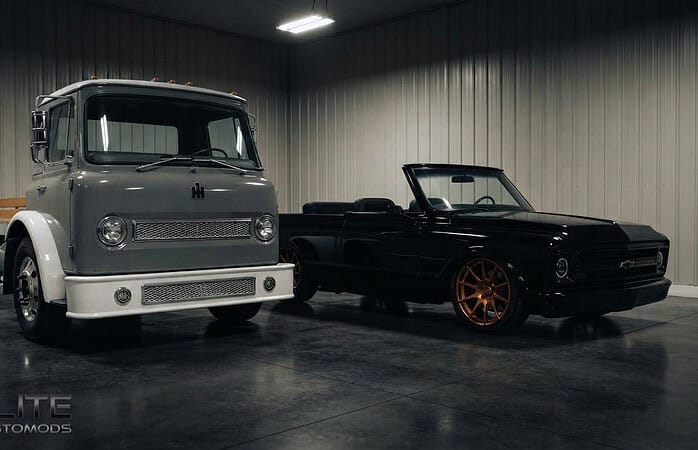

The judging criteria for a restomod class depend on the club and event, not on one universal points scale. Judges may consider condition, workmanship, cleanliness, fit and finish, function, craftsmanship, and creativity. A concours class, by contrast, may deduct points for departures from factory specifications. As one specific entry rule, a Mustang in the Space Coast Mustang Club Modified class must have at least five discernable modifications from original.
A polished finish matters, but it is only part of the picture. A restomod combines classic character with modern components, so judging may balance originality and modification differently from a restoration-focused class. This guide explains how authenticity and restoration quality shape an evaluation, why event policies vary, and how points-based systems work. It also covers practical preparation, from checking visible workmanship to understanding the rules for the class you enter. Knowing what judges assess helps you interpret a score and present the thinking behind a carefully executed build.
Key Takeaways
- Separate original features from modern upgrades, and keep records of the changes so judges can understand the build’s intent.
- Read the event’s class rules before preparing the car; judging standards and inspection procedures vary between clubs.
- Recognize that a points-based score reflects defined categories, while other classes may assess workmanship and condition without judging every area of the vehicle.
- Match the car’s presentation to its class, paying attention to the details judges will inspect and the modifications the rules require.
Authenticity and restoration quality
Authenticity describes how well a car retains its original design identity and historic character. A restomod typically keeps the classic appearance while updating mechanical components. Judges may value the period silhouette even when the drivetrain, suspension, or brakes have changed. For example, a vintage body paired with modern mechanicals can preserve recognizable styling without claiming factory originality.
A 100% restoration is one definition of a vehicle rebuilt using all original, authentic parts. A restomod follows a different brief, so assess each component against the build’s intended balance of heritage and modernization. Compare the exterior lines, trim, and cabin details with the model’s original character, then identify changes that affect function. A modern engine may fit the concept; careless bodywork or mismatched finishes can undermine it.
Restoration quality is the precision and consistency of the work, from panel alignment to mechanical installation. Check how the doors meet the body, whether paint transitions are even, and whether the interior materials look deliberately selected. In the engine bay, look for tidy routing and secure installations. Fit and finish show workmanship; function shows whether modified systems operate as intended. A polished surface cannot make up for a poorly executed detail.
Reversibility means a modification can be removed without permanently damaging original components or structure. Keeping removed parts and documenting changes can help preserve the car’s history and future options. For example, retaining the original wheels while using radial tires for driving keeps the upgrade separate from the vehicle’s permanent identity. The event’s judging policy still matters, but this approach makes the owner’s choices easier to explain.
Before entering a show, follow a simple inspection sequence: record original features, list each modification, and examine visible workmanship in consistent lighting. Check body gaps, paint edges, upholstery seams, and the fit of replacement components. Then consider whether the car presents as one coherent build rather than a collection of unrelated upgrades. Strong judging criteria for a restomod class distinguish thoughtful modernization from shortcuts while recognizing the craftsmanship that connects contemporary capability with classic character.
Judging policy and scoring factors
A judging policy defines class rules, the inspection method, and the factors that affect a vehicle’s result. Those rules determine how judges assess a restomod’s modifications.
Show and Competition Rules
Show and competition rules are event-specific standards for eligibility and judging. Events may use different class definitions, inspection steps, and scoring methods, so expectations at one show may not apply at another. Some clubs separate concours, touring, preservation, and restomod classes, each with its own standards.
How do restomod class rules differ between car shows and competitions? One show may assess a car in a dedicated restomod class, while another uses different judging standards or safety exceptions. The key is the event’s written class policy, not a universal rule for every modified classic.
Documentation and safety requirements are event-specific, as are judging standards and safety exceptions. Read the entry rules for required records and inspection conditions. A modification accepted at one show may not qualify elsewhere.
Build Quality and Craftsmanship
Build quality and craftsmanship describe the condition, execution, and finish of a vehicle’s restoration or modifications. Judges may assess these through visible workmanship and the car’s overall condition, but the scoring method depends on the class.
How are restomod cars scored for build quality and craftsmanship? In the Space Coast Mustang Club Modified class, judges assess condition, workmanship, and cleanliness; they do not judge the undercarriage. A concours class takes a different approach, generally comparing the car with its factory-delivered specification, with deviations potentially resulting in deductions.
Use the class policy to guide your preparation. For a Modified-class entry, inspect the areas judges evaluate: body finish, trim, cabin presentation, and visible workmanship. For concours judging, compare details with factory specifications before making changes, since a modern upgrade may count against originality. These differences explain why craftsmanship alone does not determine every result. Prepare a carefully finished restomod for its assigned class, rather than relying on assumptions from another event.
Points-based vehicle evaluation
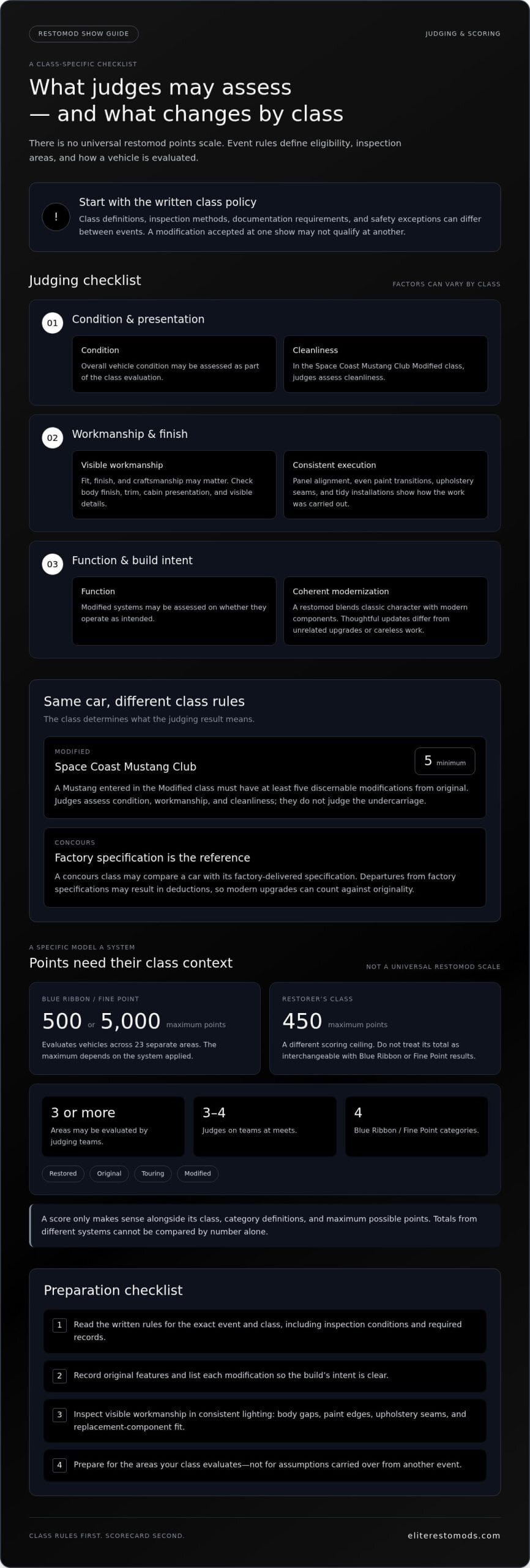
Points-based vehicle evaluation assigns scores across defined inspection areas, up to a stated maximum. Model A Blue Ribbon or Fine Point judging uses a maximum of 500 or 5000 points and evaluates vehicles across 23 separate areas. These figures describe a specific Model A system, not a universal restomod scorecard. The maximum tells you the system’s ceiling; the inspection categories show what judges assess.
Model A Restorer’s Class uses a different ceiling: 450 points. Blue Ribbon or Fine Point judging instead uses 500 or 5000 points, depending on the system applied. Don’t treat these totals as interchangeable. A score only has meaning alongside its class, category definitions, and maximum possible points. Two vehicles judged under different systems cannot be compared by their totals alone.
Model A judging teams often evaluate three or more areas of a vehicle. Teams at meets consist of three or four judges. Blue Ribbon or Fine Point judging also separates entries into four categories: Restored, Original, Touring, and Modified. These categories provide context for interpreting an assessment. For example, do not read a Modified entry as though it were entered in Original.
Use a class-first preparation process. First, identify the scoring system and its maximum. Next, list the inspection areas and match each one to a visible part or feature of the car. Then inspect those areas separately instead of relying on one overall impression. For a Model A, a clean exterior cannot tell you how the other 22 areas will be assessed. Organize photographs and build records by category, so details are easy to present during judging.
Before interpreting a restomod’s total, check what the event’s scorecard measures. A points-based score reflects the areas defined by that system; it does not establish a universal ranking for every modified classic. Consider the event, class, maximum score, and category together. This context makes the score a useful guide for focused preparation.
Resto-Mod judging criteria
Resto-Mod judging balances preserved character with purposeful upgrades, according to each event’s class rules. The Space Coast Mustang Club Modified class is one specific example.
Originality and Modern Upgrades
Originality describes the classic features a build retains, while upgrades are modern changes from its original specification. Judges assess both according to the class entered, not by applying one standard to every car.
How do judges evaluate originality versus modern upgrades in a restomod? They assess the car’s condition and workmanship under the class rules. Concours judging generally compares cars with their factory-delivered specification, and deviations can lead to deductions. A Modified class may instead require visible changes from original. Modern mechanical components may suit a Mustang entered in that class, while its finish still needs careful execution.
Local Show Classes and Rules
Local show rules define each event’s classes and inspection requirements. The Space Coast Mustang Club Modified class is one example, not a universal standard for all shows.
Which car shows have a restomod class, and what are their local judging rules? The Space Coast Mustang Club offers a Modified class for Mustangs with at least five discernable modifications from original. Judges assess condition, workmanship, and cleanliness, but do not judge the undercarriage. Entrants must open the hood and trunk, position the windows halfway open, and raise the convertible top.
Common Score-Lowering Mistakes
Score-lowering mistakes are preparation or workmanship problems that conflict with a class’s stated criteria. In the Space Coast Mustang Club Modified class, overlooking cleanliness or visible workmanship can weaken the areas judges assess.
Start by checking class eligibility: a Mustang with fewer than five discernable modifications does not meet the stated minimum for the Space Coast Mustang Club Modified class. Then prepare the car for inspection by following the requirements for the hood, trunk, windows, and convertible top. Do not spend time polishing an undercarriage the class does not judge. For a concours entry, check factory details carefully, since deviations from original specifications can result in deductions. Before the show, compare each visible change and inspection area with the rules for your chosen class.
Elite Restomods: Elite Certified Restomods
Elite Restomods offers Elite Certified Restomods for enthusiasts seeking a carefully evaluated classic with modern capability. Each vehicle in this offering undergoes a rigorous quality assurance process, giving buyers another way to assess build condition and execution beyond a show scorecard. Event judging measures a car against a specific class’s rules; this quality review offers a separate perspective.
If you are planning a distinctive build rather than choosing an existing restomod, Custom Build Services can help turn your vision into a finished vehicle. Owners preparing to sell can use the Consignment Program to present a completed car to prospective buyers. Choose the next step that fits your goals, whether you are buying, building, or selling a restomod.
Contact Elite Restomods to discuss your next step with a classic car.
Shape Your Next Build with Purpose
A judging result can offer perspective, but it does not have to define the car you want to create. Use the judging criteria for a restomod class as one reference point, then set priorities around the driving experience, character, and finish that matter to you. A strong build has a clear intention behind every choice.
Before planning your next step, write down how you want the car to feel on the road and which details should preserve its heritage. That vision can guide a custom project or help you evaluate a finished restomod. Keep the goal personal: a classic should be more than a scorecard entry. It should make you eager to turn the key and enjoy the drive.
When you’re ready to put that vision into motion, contact Elite Restomods to discuss your build. Your next chapter with a classic can start with a clear idea and a thoughtful conversation.
Frequently Asked Questions
What are the judging criteria for a restomod class at car shows?
Judges assess a restomod against the standards for its specific class and event. Common considerations include fit and finish, function, workmanship, cleanliness, and how well modern changes complement the car’s classic character. To prepare, separate visible finish details from functional upgrades, then compare both with the event’s class description. A strong result depends on meeting the right class standard, not simply having an impressive build.
Are there standard point sheets or scoring weights for restomod classes?
There is no single points sheet or scoring-weight system for every restomod class. Clubs and events set their own policies: some use defined points, while others assess condition and workmanship under class-specific rules. Before entering, find out whether the event publishes a scorecard, uses deductions, or judges by class criteria. This helps you focus preparation on what judges actually evaluate.
What modifications qualify a car for a restomod class?
Qualifying changes depend on the event’s definition of a restomod or modified class. For example, the Space Coast Mustang Club requires a Mustang in its Modified class to have at least five discernable modifications from original. Modernized mechanical components may distinguish a restomod from a purely original car, but assess modifications against the specific class rules rather than assuming every upgrade qualifies.