
What if the very space you built to protect your investment is actually accelerating its decay? It’s a sobering thought for any owner who treats their vehicle as a bespoke piece of functional art. While the collector car market holds steady with a Hagerty Market Rating of 59.01 as of March 2026, the difference between a high-performing asset and a depreciating relic often comes down to meeting specific collector car storage requirements.
You already know that ‘lot rot’ is a silent thief that steals performance during the off-season. It’s easy to feel overwhelmed by the gap between basic heated storage and true climate control, or the 2026 insurance policy updates requiring professional appraisals for vehicles valued over $50,000. We promise to give you total clarity on the environmental and mechanical standards required to preserve your car’s soul. We’ll explore the 50 to 70 degree temperature thresholds, the critical 40 percent to 60 percent humidity range, and a foolproof checklist to ensure your machine remains turn-key ready.
Key Takeaways
- Learn how to maintain the “Golden Ratio” of 70°F and 50% relative humidity to prevent condensation and oxidation in boxed frames.
- Master the essential collector car storage requirements for mechanical preservation, including high-end fluid management and fuel stabilization for both modern crate engines and vintage carburetors.
- Identify the “Maximum Permitted Value” traps in standard contracts and ensure your “Agreed Value” policy aligns with professional security protocols.
- Discover why active preservation, including weekly fluid checks and tire pressure monitoring, is the only way to ensure your vehicle remains turn-key ready.
- Navigate the 2026 landscape of professional appraisals and new storage regulations to safeguard your automotive investment’s market value.
Defining Professional Collector Car Storage Requirements
Preservation is an active pursuit. The “Golden Standard” of automotive housing isn’t just a roof over a chassis; it’s a meticulously managed ecosystem where climate, security, and maintenance converge. Most owners assume their home garage is sufficient. However, residential spaces often lack the vapor barriers and industrial-grade HVAC needed for long-term health. When Defining a Collector Car, we’re talking about a high-value asset that demands protection from the invisible threats of humidity and temperature swings.
Short-term seasonal parking is a passive event. Multi-year preservation is a strategic commitment. A true professional facility ensures your vehicle isn’t just sitting; it’s being curated. This “turn-key” philosophy means that whether you pull the car out in three months or three years, it should greet you with the immediate roar of a perfectly primed engine. It’s the difference between a machine that survives and a machine that thrives.
To better understand how professional facilities manage these high-end assets, watch this helpful video:
The Investment-Grade Preservation Mindset
Restomods, featuring modern LS3 crates or Coyote engines, require a more nuanced approach than unrestored survivors. These builds are bespoke pieces of functional art where every hand-stitched interior and flawless finish contributes to a six-figure valuation. With insurers now requiring formal appraisals for vehicles over $50,000 as of 2026, the financial impact of “lot rot” or mechanical degradation is more than just an inconvenience. It’s a direct hit to your net worth. Collector car storage is a proactive risk-mitigation strategy for high-performance machinery.
The Three Pillars of Professional Storage
Meeting modern collector car storage requirements involves balancing three distinct priorities. First is atmospheric stability. We target a range of 50 to 70 degrees Fahrenheit and 40 to 60 percent relative humidity to stop oxidation before it starts. Second is mechanical continuity. Stagnation is the enemy. Professional management prevents seals from drying and fluids from settling, ensuring the mechanical soul of the car remains vibrant. Finally, facility integrity provides the physical and digital security protocols necessary for high-value assets. This includes 24/7 surveillance and specialized fire suppression. For those seeking this level of care, the Elite Restomods services team provides the climate-controlled infrastructure required to protect your legacy.
Atmospheric Control: The Science of Humidity and Temperature
“Heated” is a marketing term. “Climate-controlled” is a technical standard. To meet professional collector car storage requirements, you need the “Golden Ratio”: 70°F and 50% relative humidity. Why? Basic physics. When temperatures fluctuate, air loses its ability to hold moisture. That moisture migrates to the coldest surfaces, like the inside of your boxed frame or the back of a chrome bumper. This hidden condensation is where rust begins, often long before it’s visible on the exterior panels.
Bespoke interiors are equally vulnerable. High-end leather and hand-stitched fabrics can swell or crack if the environment isn’t stable. State Farm identifies these common storage pitfalls and risks as primary drivers for insurance claims in non-specialized facilities. Proper climate controlled car storage does more than stop rust; it prevents the oxidation of modern aluminum components like Wilwood calipers or custom intake manifolds. It’s about maintaining the aesthetic purity of every component, from the Coyote engine’s valve covers to the hand-polished trim.
Humidity: The Silent Engine Killer
Corrosion is a chemical reaction fueled by water. When humidity climbs above 55 percent, oxidation accelerates on chrome and exposed steel. Conversely, if the air is too dry, specifically below 40 percent, you risk dry rot in rubber seals and gaskets. Industrial air filtration is a non-negotiable requirement. It removes corrosive particulates that can settle on a flawless finish and eat through the clear coat over time. Clean air is just as vital as stable air for preserving a high-performance machine.
Thermal Stability and Fluid Viscosity
Extreme cold is a mechanical stressor. It thickens synthetic fluids and causes classic gaskets to shrink, leading to leaks upon the first spring startup. Stable temperatures prevent the expansion and contraction cycles that micro-crack vintage paint finishes. Professional facilities also utilize vapor barriers in the flooring. This stops ground moisture from rising through the concrete, a common issue in residential garages. If you’re planning a build that deserves this level of protection, consider our meticulous build process which prioritizes longevity from the very first bolt.

Mechanical Preparation for Long-Term Preservation
Stagnation is a slow-motion mechanical failure. While atmospheric control protects the exterior, the internal components of a high-performance machine require a different level of vigilance. To meet the most stringent collector car storage requirements, you must adopt the “Elite Standard” for fluid management. This begins with fresh oil. Used motor oil contains combustion byproducts and acids that, when left to sit, can etch bearings and internal engine surfaces. Changing your oil immediately before storage ensures that only clean, pH-neutral lubricants touch your engine’s vitals.
Tire preservation is equally critical for maintaining a “turn-key” status. Modern performance rubber is susceptible to flat-spotting if left under the weight of a heavy muscle car for months. While some collectors prefer jack stands, this can stress suspension bushings by leaving them in an unloaded state for too long. We recommend inflating tires to 10 to 15 PSI above their normal operating pressure to maintain their roundness. For a comprehensive walkthrough of these steps, consult our ultimate preservation checklist before you lock the doors.
Battery Maintenance for Modern Electronics
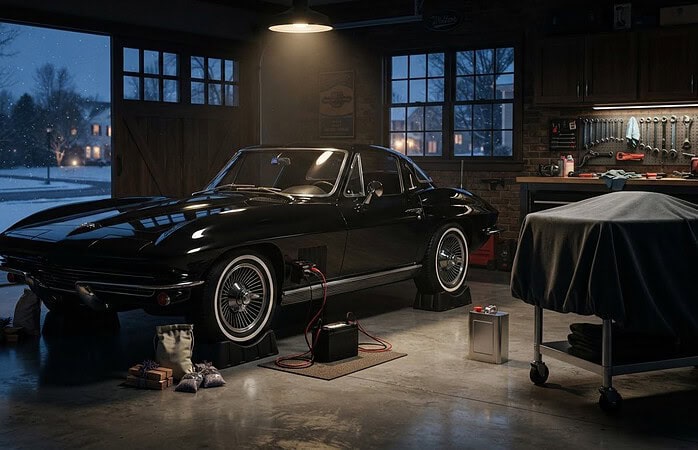
Classic style. Modern power. The very thing that makes a restomod incredible—its LS3 or Coyote heart—creates unique challenges during storage. These modern ECUs and electronic fuel injection systems have higher parasitic draws than a vintage points-style ignition. A standard trickle charger isn’t enough. You need a smart battery tender that monitors voltage and performs desulfation cycles to prevent internal plate damage. When connecting these units, remember that fiberglass-bodied vehicles require a dedicated ground path back to the frame or battery, as they lack the natural grounding of a steel chassis.
Fluid Stabilization and Seal Protection
Ethanol is the enemy of the automotive curator. It’s hygroscopic, meaning it actively pulls moisture from the air. In a fuel tank with a large air gap, this leads to rapid condensation and internal corrosion. Untreated ethanol fuel undergoes phase separation over a six-month period, creating a corrosive, water-heavy layer at the bottom of the tank that can devastate fuel pumps and injectors. Always top off the tank and add a high-grade stabilizer to minimize the air gap. Don’t forget your brakes. Brake fluid is also hygroscopic; a pre-storage flush prevents moisture from settling in your Wilwood calipers and causing internal pitting. These meticulous steps ensure that when the season changes, your beast is ready to roar without hesitation.
Security is more than a padlock and a perimeter fence. It is a legal fortress built on precise documentation. Many owners fall into the “Maximum Permitted Value” trap found in generic storage contracts. These clauses often limit the facility’s liability to a mere $5,000. For an Elite Certified Restomod valued in the six figures, this represents a catastrophic risk. Your collector car storage requirements must include a contract that explicitly acknowledges the full replacement value of the asset. Classic style. Legal protection.
Alignment is the key to total confidence. Your “Agreed Value” insurance policy—which, as of 2026, requires a professional appraisal for any vehicle over $50,000—should dictate the security standards of the facility. If your underwriter requires 24/7 active digital monitoring and motion sensors, the facility must provide documented proof of compliance. We also advocate for a strict “no-access” policy. High-value vehicles deserve privacy. No one should be near your machine without an authorized escort and a valid reason for being on the floor.
Fire Suppression and Environmental Alarms
Smoke detection is the bare minimum. In an environment filled with combustible fluids, you need heat and rate-of-rise sensors that trigger before a flame even erupts. Wet-pipe sprinkler systems are a gamble in regions where power failures could lead to frozen, bursting pipes. Dry-pipe systems or specialized gas suppression are the gold standard for automotive preservation. Remote monitoring is equally vital. The facility owner should receive instant alerts if the HVAC system drops below the 50-degree threshold or if power to the smart battery tenders is interrupted. This level of vigilance prevents the mechanical soul of your car from being compromised by environmental failure.
Contractual Due Diligence for High-Value Assets
The legal distinction between a “Bailment” and a “Lease” agreement is critical. In a bailment, the facility takes legal possession and assumes a higher duty of care for your vehicle. A simple lease often leaves the burden of risk entirely on the owner. Ensure the contract allows for periodic maintenance, such as engine warm-ups or tire pressure checks, without violating insurance terms. Finally, verify liability during the intake process. If you are utilizing enclosed vehicle transport, the transition from the carrier to the storage floor must be covered by a seamless hand-off of responsibility. To ensure your investment is handled with this level of meticulous care, explore our professional climate-controlled storage solutions today.
The Elite Approach: Professional Management vs. DIY Storage
A bespoke machine deserves more than a concrete slab and a polyester tarp. While the U.S. self-storage market is projected to reach $49.88 billion by 2029, most of those square feet are designed for household clutter, not high-performance engineering. Storing a six-figure investment in a generic unit ignores the fundamental collector car storage requirements that maintain mechanical integrity. A “fully sorted” vehicle requires active curation. Passive parking leads to stagnant fluids and brittle seals. At Elite Restomods, we treat storage as a critical phase of our comprehensive vehicle services strategy. This ensures your car remains as flawless as the day it left the assembly line.
Professional management is the bridge between a car that merely sits and a car that is ready to perform. Property managers at generic facilities worry about square footage and gate codes. Our master builders worry about fuel stabilization and the chemical health of your synthetic lubricants. We understand the duality of these machines. They are museum-quality art, but they were born to be driven. Integrating professional storage into your ownership plan is the only way to ensure that the vintage aesthetics you love aren’t compromised by modern mechanical neglect.
The Concierge Difference
Professional oversight is the heartbeat of preservation. Our curators implement “exercise programs” that go beyond simple idling. These programs involve moving the vehicle to lubricate seals and gaskets that would otherwise dry and shrink during the winter months. Detailing is the final, essential storage requirement. A professional wax or high-end ceramic coating application protects the clear coat from microscopic particulates that can settle over long months. When the frost breaks, our spring “wake-up” service ensures your vehicle transitions from the floor to the street with immediate, turn-key reliability. No flat spots on the tires. No dead cells in the battery. Just the visceral roar of a perfectly maintained engine.
Securing Your Legacy
View your storage plan as an extension of your investment-grade restomod ownership. With the high-end market for vehicles over $250,000 showing continued strength in early 2026, the cost of professional management is a strategic investment in asset protection. Monthly rates for premium, climate-controlled facilities currently range from $300 to over $700. This reflects the specialized infrastructure and technical expertise required for high-value machinery. You gain the peace of mind that comes from a facility designed by builders who know every bolt and wire in a custom chassis. We bridge the gap between your childhood dreams and a tangible, high-performance reality. Contact the curators at Elite Restomods today to discuss a bespoke storage and maintenance plan tailored to your collection.
Securing Your Automotive Legacy
Preserving a high-performance machine is about more than finding a spot to park. It’s an active commitment to modern engineering and vintage soul. We’ve detailed how atmospheric stability at the 70 degree and 50 percent humidity mark stops oxidation before it starts. We’ve also explored why fresh fluids and smart battery tenders are non-negotiable for modern LS3 and Coyote powerplants. Meeting these collector car storage requirements is what separates a depreciating asset from a timeless piece of functional art.
Don’t leave your investment to chance in a generic garage. Your vehicle deserves a sanctuary designed by master builders who understand every mechanical intricacy. Protect your investment with Elite Restomods professional storage services. Our facility provides secure, climate-controlled environments and concierge maintenance programs that keep your machine in peak condition. We handle the technical details so you can focus on the drive. Your childhood dream is safe with us. Let’s ensure your beast is ready to roar the moment the season changes.
Expert Guidance on Automotive Preservation
Can I store my collector car in a non-climate-controlled garage if I use a high-quality cover?
A high-quality cover cannot replace a climate-controlled environment. In a non-specialized space, a cover can actually trap moisture against the paint, leading to micro-blistering and surface oxidation. Professional collector car storage requirements demand an environment where the air is actively dehumidified. Without this, your cover becomes a sponge for the very condensation you are trying to avoid, risking the integrity of your flawless finish.
How much humidity is too much for a classic car with a custom leather interior?
Relative humidity levels exceeding 60 percent are dangerous for bespoke leather interiors. Excess moisture promotes mold growth and causes hand-stitched fabrics to swell, leading to permanent warping. Conversely, dropping below 40 percent leads to dry rot in natural hides. Maintaining the “Golden Ratio” of 50 percent relative humidity ensures the natural oils in your luxury upholstery remain stable and the leather stays supple for your next drive.
Is it better to start the car periodically during winter storage or let it sit?
It is better to let the car sit unless you can drive it for at least 20 minutes to reach full operating temperature. Short periods of idling create internal condensation in the exhaust system and engine oil. This moisture doesn’t evaporate during a five-minute run, leading to acid buildup and internal corrosion. If you can’t reach a consistent 180 degrees oil temperature, it’s best to keep the ignition off.
What happens if the storage facility has a maximum value limit below my car’s appraisal?
If a facility’s maximum value limit is below your car’s appraisal, you are essentially self-insuring the difference. Most generic storage contracts limit liability to $5,000 or less, which creates a massive gap for a restomod valued over $100,000. You must verify that the facility’s bailment agreement acknowledges the full “Agreed Value” of your vehicle to ensure your specialized insurance policy remains valid in the event of a total loss.
Do I need to change the oil before or after the storage period?
Always change your oil immediately before the storage period begins. Used motor oil contains acidic contaminants and combustion byproducts that can etch internal engine bearings while the vehicle sits stagnant. Fresh, clean oil provides a pH-neutral environment for your LS3 or Coyote engine. This simple step is a core component of investment-grade collector car storage requirements that protects the mechanical soul of your machine.
What is the best way to prevent rodents from damaging the wiring in my restomod?
The best defense against rodents is a professional, sealed facility with a strict no-food policy. Avoid using mothballs, which leave a permanent, unpleasant odor in hand-stitched interiors. Instead, utilize high-grade peppermint oil or specialized scent deterrents that don’t compromise the cabin’s aroma. Professional curators also ensure that all building entry points are reinforced with steel wool and industrial-grade seals to prevent pests from reaching your wiring harnesses.
Can I use a standard car battery charger for a long-term storage situation?
Never use a standard car battery charger for long-term storage. These units lack the intelligence to stop charging when the battery is full, which can boil the electrolyte and ruin the internal cells. You need a smart battery tender that utilizes a multi-stage charging cycle. This keeps the battery at a constant 12.6 to 12.8 volts and prevents the sulfation that often kills modern electronic control units and digital displays.
What specific tire pressure is required to prevent flat-spotting during six months of storage?
We recommend increasing tire pressure by 10 to 15 PSI above your normal operating level to prevent flat-spotting. For a typical high-performance tire, this usually means a storage pressure of 45 to 50 PSI. This extra volume helps maintain the roundness of the tire under the vehicle’s weight during months of inactivity. Always remember to bleed the pressure back to factory specifications before you take the car out for its first spring drive.