
With the Hagerty Market Index dropping to a four-year low of 171.04 in March 2026, the traditional rules of appreciation have been rewritten. You might feel the anxiety of conflicting data or the fear that your modern upgrades won’t translate into a higher classic car value. It’s a common frustration. You see a restored 1931 Ford Model A sell for just $8,000 at auction and wonder if the market has left your investment behind. We understand that a vehicle is more than a machine. It’s a bespoke piece of functional art.
You deserve a clear path to proving your vehicle’s worth without leaving money on the table. This 2026 Investor’s Guide will help you master the art of valuation and teach you the specific steps to elevate your car to investment-grade status. We’ll explore the Restomod Premium, provide a meticulous framework for assessing condition, and outline actionable steps to prepare your vehicle for a record-breaking sale. From the roar of a Coyote engine to the refined elegance of a hand-stitched interior, your car’s true value is waiting to be unlocked.
Key Takeaways
- Learn to evaluate your vehicle through the lens of the three critical pillars: provenance, preservation, and modern performance.
- Discover how to leverage Hagerty and NADA data to establish a rock-solid baseline for your classic car value in a fluctuating market.
- Unlock the secrets of the restomod premium by identifying which powertrain and suspension upgrades drive the highest return on investment.
- Master the “Fully Sorted” checklist to ensure every mechanical and aesthetic detail is flawless before you hit the auction block.
- Explore how professional consignment and Elite certification transform a vintage machine into a high-performance investment-grade asset.
Understanding the Foundations of Classic Car Value in 2026
True classic car value in 2026 isn’t a static number found in a dusty ledger. It’s the visceral intersection of rarity, condition, and modern-day usability. While traditionalists once focused solely on factory-correct markings, the modern investor looks for three distinct pillars: Provenance, Preservation, and Performance. Provenance tracks the history and ownership. Preservation measures how well the soul of the machine has survived. Performance, however, has become the new kingmaker in a market that demands more than just a pretty silhouette.
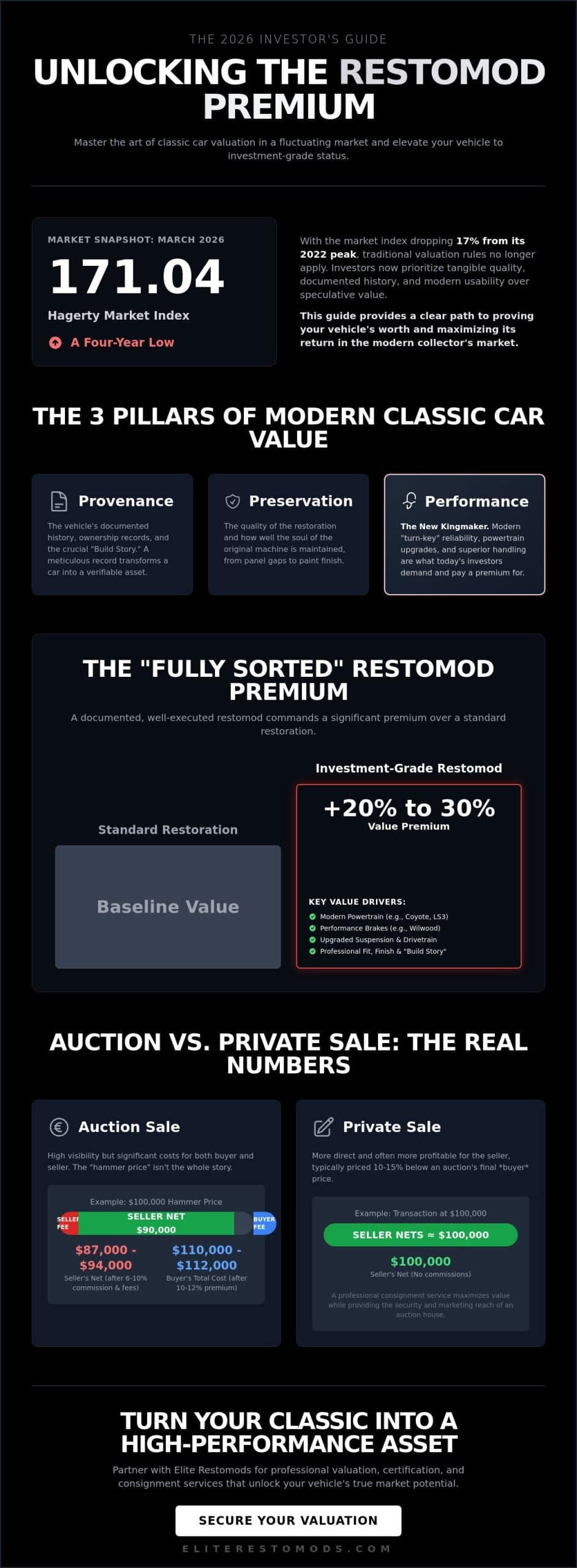
It’s vital to distinguish between “Book Value” and “Market Value.” NADA guides provide a necessary baseline for classic car financing and lending, but they often struggle to keep pace with the heat of a live auction. Real-world sales define the market. For instance, RM Sotheby’s retains a 10% seller’s commission in 2026, reflecting the premium nature of high-end transactions. Because market volatility exists, as seen in the Hagerty Market Index dropping 17% from its December 2022 peak to 171.04 in March 2026, savvy owners opt for “Agreed Value” insurance. This ensures your investment is protected based on its actual worth, not a depreciated estimate.
The Shift Toward Modern Performance
The 2026 market prizes “turn-key” reliability over museum-quality originality. Collectors want to drive. They want the iconic roar of a 1960s Mustang or the rugged charm of a K5 Blazer without the mechanical headaches of the past. This desire has fueled the rise of the “Investment-Grade Restomod” as a distinct asset class. These vehicles marry vintage aesthetics with modern engineering, creating a machine that is both a nostalgic masterpiece and a reliable performer. You can explore these high-performance blends in our current inventory.
Market Tiers: From Project Cars to Elite Certified
Understanding what is a classic car requires looking at the Hagerty Condition Scale, which ranges from Condition 4 (drivers) to Condition 1 (concours). In today’s landscape, a “fully sorted” vehicle often commands a 20% to 30% premium over a standard restoration. This premium is driven by the “Build Story.” A meticulous record of the build process, documenting everything from the installation of LS3 crates to the fitment of Wilwood brakes, establishes a pedigree. This transparency proves the vehicle’s quality, transforming a simple machine into a documented, investment-grade asset.
Leveraging Valuation Tools and Market Indices
Determining the true classic car value requires a multi-faceted approach that looks far beyond the chrome. Online tools like Hagerty Valuation provide a specific technical baseline for thousands of models by tracking auction results and private transactions. These numbers represent a broad average. To understand the ceiling of the 2026 market, you must look at real-time barometers like Bring a Trailer or Cars & Bids. These platforms showcase the current appetite for specific configurations; for example, a manual transmission swap or a modern fuel-injection system can spark a bidding war that defies traditional book values. Collectors demand precision. They want data that reflects the raw power under the hood and the meticulous craftsmanship of the finish.
While investing in classic cars offers significant potential for growth, it requires verifying data across multiple sources. NADA guides remain the standard for lenders and financial institutions. If you’re seeking classic car financing, your lender will likely lean on these figures to determine loan-to-value ratios. However, NADA often lags behind the visceral, fast-moving reality of the collector market. Relying on a single source is a mistake. You need a composite view to ensure you aren’t leaving money on the table or overpaying for a vehicle that lacks the necessary pedigree.
Interpreting Auction Results vs. Private Sales
Auction results are often the most visible data points, yet they’re frequently misleading. A “hammer price” is just the beginning of the story. In 2026, RM Sotheby’s retains a 10% seller’s commission on motor car lots. Mecum Auctions charges 6% for no-reserve lots and 10% for those with a reserve, plus entry fees up to $1,000. Buyers also pay premiums, often adding another 10% to 12% to the final cost. Private party sales usually happen at a 10% to 15% discount compared to these public spectacles because they lack the “stage effect” and competitive frenzy. You must also account for outliers. A single celebrity-owned vehicle selling for double the market rate shouldn’t dictate the value of every similar model in existence.
The Role of Professional Appraisals
Online tools have limits when a build is truly bespoke. When you’ve invested in a custom build with an LS3 crate engine and Wilwood brakes, you need a certified appraiser to document the mechanical intricacies that algorithms miss. They provide a detailed report that justifies a higher valuation to insurance companies and future buyers. A professional appraisal serves as a binding legal safeguard for high-value assets in a court of law or insurance dispute. This documentation is the bridge between a simple hobby car and a verified investment-grade asset that holds its worth through market shifts.
The Restomod Premium: How Upgrades Affect Classic Car Value
Old-school purists often claim that modifications destroy a vehicle’s worth. In 2026, this myth is dead. For the modern investor, classic car value often hinges on how well a machine handles today’s roads, not just how it looked on the showroom floor in 1969. While traditional guides might penalize a non-original engine, the private market tells a different story. A high-end build commands six figures precisely because it offers the raw, visceral excitement of American muscle paired with the confidence of modern engineering. It’s the marriage of brute force and refined comfort.
The “Big Three” value-add upgrades include the powertrain, suspension, and interior. Swapping a tired, carbureted block for an LS3 crate or a Coyote engine isn’t just a mechanical change; it’s a total transformation. The ROI on these swaps is substantial because buyers prioritize a “turn-key” experience. They want to hear the roar of a performance beast every time they turn the key, without the temperamental rituals of vintage hardware. Likewise, Wilwood brakes and coilover suspensions are no longer considered “extras.” At the investment-grade level, these components are expected. A car that can’t stop or corner like a modern sports car is often seen as a liability rather than a bespoke piece of functional art.
Pro-Touring vs. Traditional Restomod Value
Pro-Touring builds represent a performance-first investment strategy. These machines are designed to dominate both the track and the street. Integrating an Art Morrison chassis or similar track-ready components creates a rigid foundation that significantly bolsters resale appeal. This level of engineering ensures the car drives as well as it looks. You can see how these high-performance elements come together in our guide to Classic Car Restomods for Sale. This isn’t a simple restoration; it’s a meticulous re-engineering for the twenty-first century.
Bespoke Craftsmanship and Interior Upgrades
The final sale price often lives or dies in the details of the cabin and the finish. Hand-stitched leather and modern climate control systems turn a cramped, vintage cabin into a luxury cockpit. We focus on “invisible technology,” such as Bluetooth connectivity hidden within a period-correct radio and LED lighting that mimics a classic warm glow. These subtle touches preserve the nostalgia while providing modern convenience. A flawless, custom paint finish provides the essential curb appeal that triggers an emotional connection. A deep, mirror-like finish reflects the perfectionism of the entire build, often adding significant value during a competitive sale.
How to Maximize Your Classic Car Value Before a Sale
In a market that Hagerty described as “flat” in March 2026 with a rating of 59.01, the burden of proof lies with the seller. To achieve the highest possible classic car value, your vehicle must transition from a personal project to a turn-key investment. This requires a commitment to being “fully sorted.” It means every toggle switch clicks with purpose, every bulb illuminates the dash, and every bolt is torqued to spec. Buyers in this correction phase are discerning. They aren’t just buying a silhouette; they’re buying the peace of mind that comes with professional-grade execution.
Preparation begins with a meticulous “Build Book.” This is more than a folder of crumpled receipts. It’s a curated history of the transformation, documenting the installation of performance components like LS3 crates or Wilwood braking systems with high-resolution photos. This documentation serves as the vehicle’s pedigree, proving the quality of the craftsmanship hidden beneath the paint. When paired with professional paint correction and a ceramic coating, the visual impact becomes undeniable. A flawless finish reflects a car that has been treated as a bespoke piece of functional art, not just another machine in a garage.
The “First Turn” test is perhaps the most critical moment in any high-value transaction. When a prospective buyer or an auction scout turns the key, the engine must roar to life instantly without hesitation or smoke. Immediate reliability is worth thousands in the final negotiation. It establishes a psychological baseline of trust. If the car starts, idles, and sounds like a modern performance beast, the buyer’s anxiety about “leaving money on the table” evaporates. You’ve proven the car is ready for the open road.
Mechanical Sorting and Quality Assurance
Minor mechanical flaws are the primary killers of six-figure deals. Small leaks, persistent rattles, or suspension squeaks suggest a lack of attention to detail during the build process. Addressing these “small things” before listing the car is essential for maintaining your price floor. A pre-sale inspection from a world-class curator provides the credibility you need to justify a premium. We use our Elite Certified Restomods as the benchmark for what a truly sorted vehicle should be, ensuring every mechanical intricacy is perfected before it ever reaches a buyer.
Marketing Your Vehicle for a National Audience
Selling an investment-grade asset requires more than a smartphone photo in a driveway. You need high-resolution, professional automotive photography that captures the visceral excitement of the machine. Your listing should tell a compelling “Build Story” that highlights the marriage of vintage aesthetics and modern power. If you want to maximize your return without the stress of managing inquiries, consider our Premier Classic Car Consignment Services. We handle the presentation and negotiation, positioning your car in front of a global audience of serious collectors who value unrivaled craftsmanship. Before choosing this path, it’s worth understanding the myths and realities of selling a classic car privately in today’s market to make the most informed decision for your investment.
Ready to see how your build measures up? Contact our team for a professional valuation and take the first step toward a record-breaking sale.
Partnering with Elite Restomods for Valuation and Sales
Elite Restomods acts as the definitive bridge between your childhood dream and a tangible, high-performance reality. We specialize in transforming the narrative of your vehicle, moving it beyond the category of a simple vintage machine into a verified investment-grade asset. In a market currently navigating a correction phase, as evidenced by the Hagerty Market Index hitting a four-year low in March 2026, the expertise of a world-class curator is indispensable. We don’t just facilitate transactions. We build trust through transparency and technical authority. This approach ensures your classic car value is recognized by a national network of serious collectors who prioritize quality over a bargain.
Our professional consignment program is designed for those who refuse to leave money on the table. Selling a bespoke restomod privately often leads to “tire-kickers” and low-ball offers from buyers who don’t understand the cost of perfection. We eliminate this anxiety. By leveraging our reputation, your car gains the “Elite Certified” status, which serves as a beacon of reliability. Buyers pay more for our vehicles because they know the “Fully Sorted” guarantee isn’t just a marketing phrase. It’s a meticulous promise that every component, from the Coyote engine’s roar to the flawless ceramic finish, is ready for the open road. This professional positioning protects your equity and accelerates the sale process.
Beyond the Transaction: Storage and Sourcing
Preserving an asset is just as critical as building one. Environmental factors can silently erode the condition of your vehicle, which is why we offer Climate Controlled Car Storage. This service uses precision technology to maintain the science of preservation, ensuring that your investment remains in concours condition regardless of the season. For those looking to expand their collection, our Classic Car Sourcing Service identifies undervalued gems before they hit the mainstream market. Whether you’re planning a value-driven custom build from the ground up or seeking an iconic silhouette to add to your stable, our team provides the vision to secure your automotive future.
Take the Next Step in Your Automotive Journey
The 2026 market rewards those who treat their vehicles as functional art. While selling a classic car privately is fraught with risk and inconsistent data, professional representation offers a steady, purposeful path to a record-breaking result. We invite you to participate in a transformative journey that honors the soul of vintage muscle while embracing the confidence of modern engineering. Don’t let your investment sit idle or undervalued. View our current inventory of masterworks or contact us to discuss how we can maximize your classic car value through our unrivaled consignment platform.
Your masterpiece deserves a global stage. Speak with an Elite Restomods Expert Today to begin your consultation.
Securing Your Automotive Legacy
Vintage aesthetics. Modern power. The 2026 market rewards the meticulous owner who understands that documentation is as vital as the visceral roar of a Coyote engine. You’ve learned that a “fully sorted” machine, backed by a transparent and technical build book, creates the exclusivity that serious investors crave. Elevating your classic car value is a deliberate process of curation and precision that distinguishes a simple driver from a bespoke piece of functional art.
With over 100+ Elite Certified vehicles sold, we possess the professional authority needed to navigate the complexities of today’s market corrections. Our specialized classic car financing partnerships and secure, climate-controlled storage facilities offer a comprehensive ecosystem designed for the preservation of high-performance assets. We handle the intricacies of transport and negotiation so you don’t have to. It’s your turn to bridge the gap between a garage-bound icon and a record-breaking sale.
Maximize your vehicle’s potential with Elite Restomods Consignment. Your automotive masterpiece is ready for its next chapter. Let’s ensure its legacy is preserved with the unrivaled craftsmanship it deserves.
Frequently Asked Questions
How much does a restomod increase a classic car’s value?
A high-end restomod typically increases a vehicle’s worth by 20% to 30% over a standard restoration. This premium is driven by the demand for turn-key reliability and modern performance. In the 2026 market, buyers prioritize the seamless marriage of vintage aesthetics and modern power found in an Elite Certified build.
Does high mileage significantly decrease classic car value?
Mileage is less critical than mechanical condition and the depth of the build story. For a restomod, the miles on the original chassis matter less than the quality of the new powertrain and suspension. A documented history of meticulous maintenance and performance upgrades often offsets a high odometer reading.
Is a professional appraisal required for classic car financing?
Yes, most specialized lenders require a certified appraisal to establish a precise loan-to-value ratio. While online tools provide a technical baseline, a professional report documents bespoke craftsmanship and high-end components like Wilwood brakes. This documentation serves as a legal safeguard for your investment-grade asset.
What are the most valuable classic car brands in 2026?
Ford, Chevrolet, and Porsche remain the gold standard, though Japanese performance icons are surging. Hagerty’s 2026 Bull Market List highlights the 1995–1998 Nissan Skyline GT-R at an estimated $82,350 and the 2004–2007 Porsche Carrera GT at $1.55 million. Modern classics from the 1990s and 2000s are now major drivers of market growth.
How do I find the “Blue Book” value for a modified classic car?
Standard guides like NADA often fail to account for the “Restomod Premium,” so you must use a multi-source analysis. Compare your build against real-time auction results from platforms like Bring a Trailer or Mecum. These results reflect the current appetite for performance beasts equipped with Coyote engines or LS3 crates.
Can I sell my classic car for more through consignment than privately?
Professional consignment often yields a higher final price by accessing a national network of serious investors. While RM Sotheby’s retains a 10% seller’s commission in 2026, the reach of a professional curator eliminates the “private party” discount. It transforms your car from a local listing into a globally recognized piece of functional art.
What is the “Agreed Value” in classic car insurance?
Agreed Value is a guaranteed payout amount established between you and the insurer that does not depreciate over time. This protection is vital when the Hagerty Market Index fluctuates, as it did when it dropped 17% from its 2022 peak. It ensures your classic car value remains secure regardless of temporary market corrections.
How does a LS engine swap affect the resale value of a vintage truck?
An LS engine swap significantly bolsters the resale value of a vintage truck by providing unrivaled reliability and power. In 2026, collectors prioritize usability and the ability to drive their vehicles in modern traffic. A truck featuring a modern LS3 crate engine and updated cooling systems will consistently command a premium over stock, carbureted models.