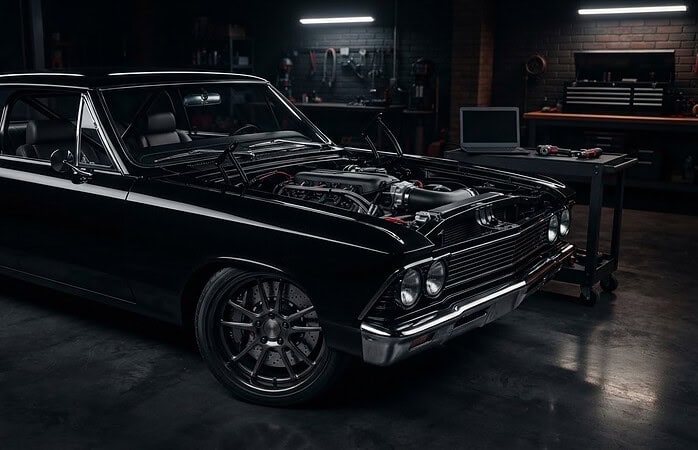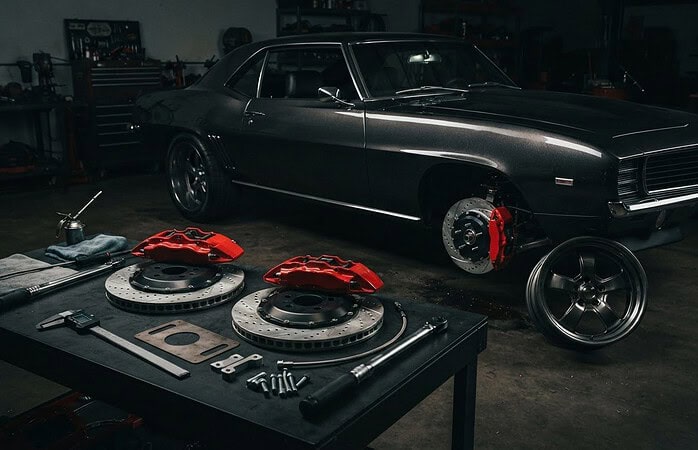

What if the most dangerous mile your investment-grade car ever travels isn’t on the track, but on the back of a trailer? A six-figure restomod is more than a machine; it’s a bespoke piece of functional art. You understand that the “fully sorted” status of your build is fragile. One rogue rock chip or a sudden hail storm can erase months of meticulous paint correction. Choosing enclosed vehicle transport isn’t just about moving a car. It’s about preserving a legacy.
We agree that your investment deserves better than the industry average. Most owners feel a justified anxiety when handing over their keys to generic haulers who treat a vintage beast like a used sedan. This guide explores why enclosed hauling has evolved into a mobile extension of climate-controlled storage. You’ll discover how to vet carriers using the 2026 FMCSA National Registry II standards and why elite transporters now carry cargo insurance limits up to $1,000,000. We’ll preview the technical features that ensure a damage-free delivery, from hydraulic liftgates to digital inspections. This is your roadmap to professional handling and transparent communication throughout the journey.
Key Takeaways
- Identify the technical superiority of hard-sided trailers and hydraulic liftgates in protecting low-clearance chassis and bespoke finishes.
- Evaluate the true ROI of enclosed vehicle transport by accounting for the detailing fees and mechanical risks inherent in open-air exposure.
- Implement a professional-grade preparation protocol, from high-resolution undercarriage documentation to critical fluid and battery tender checks.
- Protect the integrity of hand-stitched interiors and vintage seals by mitigating the environmental stress caused by long-haul weather exposure.
- Streamline your delivery experience by integrating expert logistics with climate-controlled storage solutions for a flawless, turn-key arrival.
Beyond the Road: Why Enclosed Vehicle Transport is Non-Negotiable for High-Value Assets
A bespoke restomod represents thousands of hours of craftsmanship. It’s a fusion of vintage soul and modern precision, often featuring six-figure price tags and paint finishes that belong in a gallery. For these investment-grade assets, shipping is never a commodity service. It’s a curated logistics event. While a standard car carrier trailer is the backbone of the general automotive industry, it lacks the structural defenses required for high-performance machinery. True enclosed vehicle transport utilizes hard-sided, weather-tight trailers that act as a mobile extension of your private garage. This approach prioritizes the “Investment-Grade” mindset, where even a single microscopic rock chip is viewed as a failure of the logistics chain.
The difference between open and enclosed shipping is the difference between exposure and exclusivity. Open carriers are designed for volume, moving mass-market vehicles from ports to dealerships. Enclosed transport is designed for protection, keeping your vehicle shielded from prying eyes and the chaotic variables of the interstate. It offers a level of privacy that ensures your asset remains anonymous until it reaches your driveway. This isn’t just about logistics; it’s about maintaining the integrity of a masterpiece.
To better understand this concept, watch this helpful video walkthrough of a professional transport setup:
The Vulnerability of the Open Road
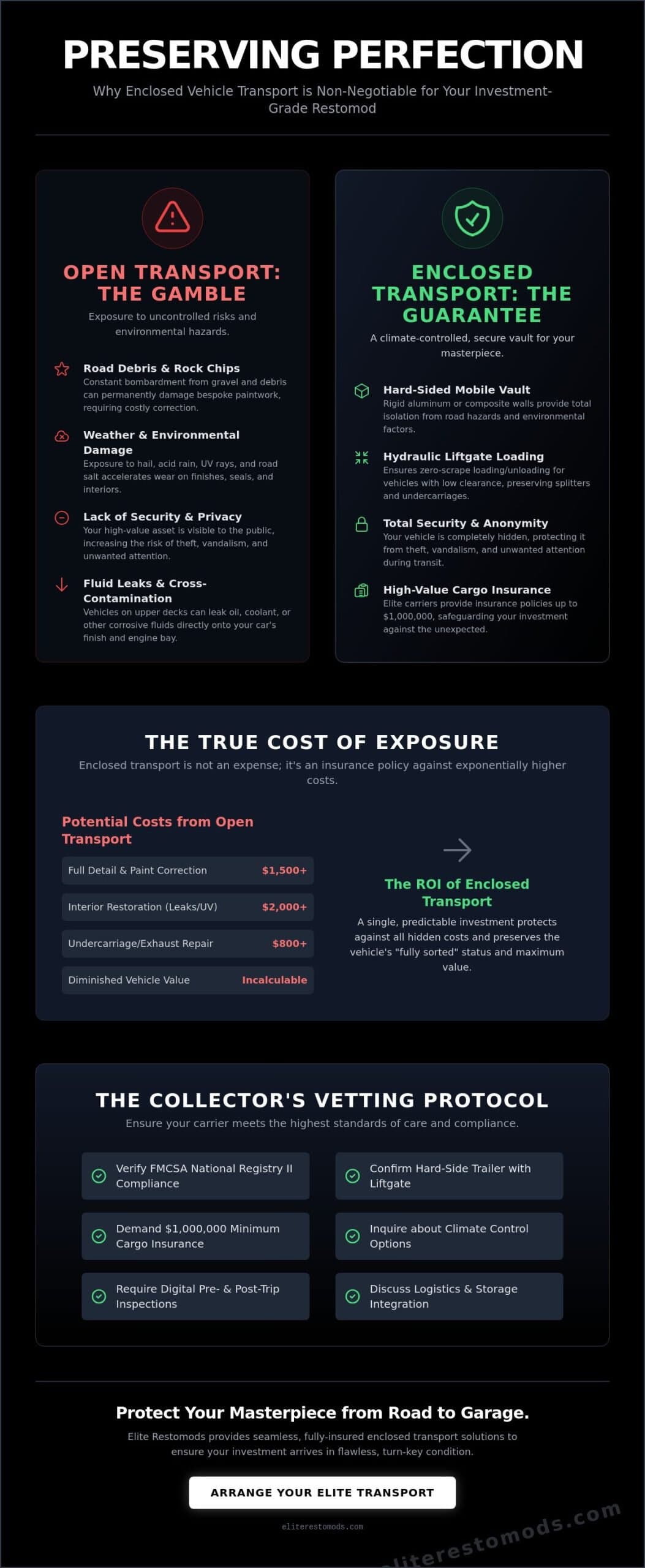
The open road is a hostile environment for a fresh build. Atmospheric pollutants, road salt, and corrosive UV rays act as silent enemies, dulling the luster of a “flawless” finish over a long-haul journey. Beyond the weather, mechanical risks are rampant on open decks. Fluid leaks from an aging sedan on an upper rack can drip directly onto your hand-stitched leather interior or bespoke Coyote engine bay. On an open carrier, your vehicle is a target; in an enclosed trailer, it is a guest. By eliminating these variables, you ensure the car arrives in the same “fully sorted” state it left the shop, ready for the pavement at our inventory showroom or your private collection.
Defining the Standard for 2026
As we move through 2026, the industry has shifted away from soft-side “curtain” trailers that offer only a thin layer of fabric against the elements. The modern standard is the hard-side trailer, constructed from rigid aluminum or composite panels. These units provide superior security against theft and total isolation from road debris. Many elite carriers now offer climate-controlled transit, a critical feature for vehicles equipped with sensitive modern electronics and high-end interiors that can warp or crack under extreme temperature fluctuations. This level of technical oversight is why enclosed vehicle transport remains the only acceptable choice for the world’s most iconic restomods.
The Mechanics of a Mobile Vault: Hard-Side Trailers and Hydraulic Liftgates
Classic aesthetics. Modern security. While our previous discussion established the necessity of isolation, the true value of enclosed vehicle transport lies in the mechanical precision of the equipment used. For investment-grade restomods, the industry standard has shifted decisively toward hard-side trailers. Unlike soft-side enclosures that utilize heavy-duty fabric curtains, hard-side trailers are rigid structures built from aluminum or composite panels. These walls provide a literal barrier against the dust and grit that can bypass a curtain seal at highway speeds. For a car with a bespoke, multi-stage paint job, this structural rigidity is essential. It’s not just about keeping the rain off; it’s about maintaining a static, dust-free environment for the duration of the journey.
Choosing the right carrier requires looking beyond the trailer walls. You must evaluate the technology used to bridge the gap between the pavement and the deck. According to the FMCSA consumer advisory, vetting the specific equipment of a transporter is a key step in protecting your asset. High-performance builds often feature aggressive stances and low-clearance components that make traditional ramps a liability. This is where the engineering of the transport vehicle must match the engineering of the car itself.
The Hydraulic Advantage for Low-Clearance Builds
Traditional ramps create a dangerous apex at the top of the incline. For a pro-touring build with a carbon fiber splitter or low-hanging Wilwood brake lines, this angle is a recipe for disaster. Scraping the undercarriage isn’t just a cosmetic issue; it can compromise the structural integrity of the headers or the steering rack. Hydraulic liftgates solve this through physics. The platform remains perfectly level as it rises from the ground to the trailer deck. This horizontal loading process ensures that your car never encounters a steep incline, preserving the flawless finish of your front-end aero and the clearance of your LS3 oil pan. It’s a sophisticated solution for a sophisticated machine.
Advanced Securing Techniques
Once inside the vault, the method of securement is just as vital as the loading process. Traditional axle chains are a relic of the past. They apply immense, concentrated stress to vintage suspension components and can mar powder-coated frames. Modern elite transporters utilize soft-tie over-the-tire straps. These straps wrap around the rubber, using the vehicle’s own weight and tire friction to hold it in place. There is zero metal-on-metal contact. Combined with floor-mounted E-track systems, this allows for precision positioning. Your car stays exactly where it was placed, regardless of the terrain outside. This level of care is a standard part of our meticulous build process, ensuring your vehicle arrives ready for the roar of the engine.
Enclosed vs. Open Transport: Calculating the Real Cost of Exposure
The sticker price of a transport quote often hides the true cost of the journey. While open transport might save you $400 to $1,200 on a cross-country trip, the environmental tax on your vehicle can be far higher. For an investment-grade restomod, exposure is a liability. Road salt, industrial fallout, and even hydraulic fluid from vehicles on the upper deck can compromise a build that took months to perfect. Choosing enclosed vehicle transport isn’t an expense; it’s a defensive strategy to protect the mechanical integrity of your asset.
Maintaining the “Elite Certified” status of your car requires a commitment to preservation. When you’ve invested in a flawless, multi-stage paint job or a custom-trimmed interior, the risk of a single rock chip devaluing the asset is simply too high. Forbes highlights the necessity of transporting classic cars in a protected environment to avoid the “hidden costs” of paint correction and deep detailing that open carriers often necessitate. It’s about ensuring the car arrives in the same “fully sorted” state it left the shop.
Weather-induced stress is another silent enemy. High-performance machinery isn’t just about the engine; it’s about the preservation of hand-stitched leather and vintage rubber seals. Intense UV exposure and rapid temperature swings during a 2,000-mile transit can cause materials to contract and expand, leading to premature wear or cracking. Our specialized transport services focus on mitigating these variables, ensuring the car remains in a protected, static environment from door to door. Understanding the collector car storage requirements that govern temperature thresholds and humidity control is equally essential to maintaining your asset’s condition between transports.
The ROI of Protection
Contrast a $500 shipping “saving” with a $5,000 paint repair bill for a custom finish. For a collector, “investment-grade” means the car must arrive in the exact state it left the showroom. If a vehicle requires three days of paint correction upon arrival, the initial savings evaporate instantly. Enclosed trailers typically carry only 2 to 6 vehicles at a time. This significantly reduces the handling risks found on open carriers that pack 7 to 10 units into a single load.
Insurance and Liability: What Collectors Must Know
The insurance gap is where many owners get caught off guard. While the FMCSA minimum for cargo insurance is $100,000, enclosed carriers typically offer limits ranging from $250,000 to $1,000,000. This aligns with the “Agreed Value” coverage of high-end builds. Before booking, verify the carrier’s Certificate of Insurance (COI) using this checklist:
- Confirm the cargo limit matches or exceeds your vehicle’s appraised value.
- Ensure the policy is active and specifically covers enclosed hauling.
- Verify the deductible responsibilities in the event of a transit claim.
The Collector’s Protocol: Vetting Carriers and Preparing Your Vehicle
Handing over the keys to a custom build is a high-stakes moment. You aren’t just shipping a vehicle; you’re trusting a third party with a piece of functional art. While generic haulers follow a basic checklist, the collector’s protocol for enclosed vehicle transport requires a technical deep dive. It begins with meticulous documentation. Capture high-resolution imagery of the undercarriage, the engine bay, and the hand-stitched interior. These photos serve as your baseline. They prove the “fully sorted” status of the car before it ever enters the trailer vault.
Next, address the vitals. If your build features modern EFI systems like a Coyote or LS3 crate engine, ensure the battery is at full charge. Check all fluid levels. A small leak might be a nuisance in your garage, but on a multi-day transit, it can become a liability for other vehicles in the trailer. Measure the exact ground clearance at the lowest point, usually the front splitter or the headers. Providing this specific number to the driver allows them to adjust the hydraulic liftgate with surgical precision. Don’t assume the driver knows your car’s soul. Provide a written briefing on the start-up procedure. Custom builds often have unique quirks, from specific fuel pump primes to hidden kill-switch locations.
The Bill of Lading is your most important legal document. As of the February 19, 2026, FMCSA mandate, many professional carriers have transitioned to electronic Driver Vehicle Inspection Reports (eDVIRs). Ensure every existing blemish, no matter how microscopic, is noted on this digital record before the ramp closes. This transparency protects both you and the carrier, creating a clear “then and now” comparison for the delivery day.
Vetting the Driver, Not Just the Company
Experience with restomods is fundamentally different from experience with factory luxury cars. A driver who spends their day hauling new SUVs may not understand the nuances of a pro-touring machine with aggressive offset wheels and Wilwood brakes. Ask direct questions: “How many cars with custom engine swaps have you loaded this month?” You want a professional who respects the raw power and the delicate finish of a bespoke build. Reliability is built on this specific mechanical empathy.
The Digital Paper Trail
In 2026, transparency is a standard feature of elite logistics. High-value enclosed vehicle transport now utilizes real-time GPS tracking and instant digital communication. This allows you to monitor the journey from the workshop to your driveway with total confidence. Combined with your high-resolution “before” photos, this digital paper trail creates a comprehensive safety net for your investment. If you are ready to move your next masterpiece, explore our professional logistics services to ensure a flawless, turn-key delivery.
Seamless Logistics: How Elite Restomods Bridges the Gap Between Purchase and Pavement
Elite Restomods doesn’t just build world-class machines; we curate the entire ownership experience. Most transport companies operate as third-party brokers who never touch the vehicle. We bridge that gap by managing the entire logistics chain for our Elite Certified Restomods. This integrated approach ensures that the same level of perfectionism applied to your LS3 installation or bespoke interior is applied to the loading and transit phase. Our “Turn-Key” promise means your car arrives ready for the road, not a car wash. It’s a professional standard that distinguishes a curator from a simple dealer.
The synergy between our climate-controlled car storage and our enclosed vehicle transport network creates a seamless environment of preservation. Your vehicle moves from a stable, temperature-regulated facility directly into a hard-side trailer vault. It never sits on a dusty lot or suffers the risks of open-air shipping. We invite you to view the Elite Restomods process to see how our quality assurance protocols extend far beyond the workshop floor. Every detail matters. Every mile counts.
From Our Gallery to Your Garage
Before any vehicle is loaded for national delivery, it undergoes a final, rigorous 50-point inspection. We verify every seal, fluid level, and electrical connection to ensure the car’s performance matches its visual impact. During this logistics phase, we also coordinate with specialized lenders for classic car financing to ensure all paperwork is synchronized with the delivery schedule. This eliminates the administrative friction often found in high-value acquisitions, allowing you to focus on the excitement of the arrival.
The Final Hand-Off
The journey ends with a professional handover. We select drivers who understand that a restomod is a unique beast. They don’t just drop a ramp and leave; they provide a briefing on the vehicle’s modern features. They ensure you’re comfortable with the cockpit and the start-up sequence before they depart. This level of service is why enclosed vehicle transport remains the only logical choice for the discerning collector. For a classic icon, the journey to your garage is as important as the destination itself. It is the final chapter of the build story, and we ensure it is written with absolute precision.
The Final Mile of Your Masterpiece
Your restomod is the culmination of a vision. Protecting that vision requires more than just a trailer; it requires a specialized logistics strategy. We’ve explored how hard-side enclosures and hydraulic liftgates eliminate the physical risks of the road. You now understand that the premium for enclosed vehicle transport is actually a reinvestment in your car’s flawless finish and mechanical integrity. By following a rigorous preparation protocol and vetting drivers for technical empathy, you ensure that your asset’s “fully sorted” status remains intact from the workshop to the pavement.
At Elite Restomods, we treat every delivery as a high-stakes hand-off. Our national network of vetted carriers operates under the Elite Certified Quality Assurance standard, offering expert handling for your LS or Coyote-swapped icons. We manage the intricacies so you can focus on the roar of the engine. Secure Your Investment: Explore Our Enclosed Transport & Sourcing Services today. Your dream was built to the highest standards. It’s time to bring it home with that same level of perfectionism. Once your vehicle arrives, meeting the proper collector car storage requirements ensures the preservation work that began in transit continues in your facility.
Common Questions Regarding Enclosed Vehicle Transport
How much more does enclosed vehicle transport cost compared to open shipping?
Enclosed vehicle transport typically costs 30% to 60% more than standard open shipping. For a cross-country haul in 2026, this translates to a premium between $400 and $1,200. While the average car shipment is approximately $1,200, investment-grade assets require the $1,400 to $2,800 range for total isolation. This investment protects bespoke paint from the road debris that devalues high-performance machinery.
Will my low-clearance restomod scrape during the loading process?
Your low-clearance restomod will not scrape if the carrier utilizes a hydraulic liftgate. These systems maintain a perfectly level plane during the loading process, eliminating the steep incline of traditional ramps. We recommend providing the driver with the exact ground clearance measurement of your front splitter. Professional handlers use this data to ensure your undercarriage and Wilwood brake lines remain untouched.
Is my vehicle insured for its full replacement value during transit?
Most elite enclosed carriers provide cargo insurance limits ranging from $250,000 to $1,000,000 to cover high-value inventory. While the FMCSA minimum for cargo is $100,000, we prioritize carriers with higher thresholds that align with Agreed Value appraisals. Always verify the Certificate of Insurance to ensure the policy covers the full replacement value of your bespoke build before the journey begins.
What is the difference between hard-side and soft-side enclosed trailers?
Hard-side trailers utilize rigid aluminum or composite panels to create a weather-tight vault; soft-side trailers use heavy-duty vinyl curtains. Hard-side units offer superior protection against road salt, moisture, and theft. In 2026, the hard-side configuration is the only acceptable standard for enclosed vehicle transport involving investment-grade assets. It prevents the wind-driven silt that can bypass curtain seals and mar a flawless finish.
Can I ship personal items inside the car during enclosed transport?
Shipping personal items inside the vehicle is generally prohibited by FMCSA regulations and carrier insurance policies. Most transporters allow up to 100 pounds of goods if they are secured in the trunk or below the window line; however, these items are not insured against loss or damage. To ensure a fully sorted delivery, it is best to remove all loose equipment and personal belongings before the driver arrives.
How long does nationwide enclosed vehicle transport typically take in 2026?
Nationwide transport typically takes 7 to 10 days for cross-country routes in 2026. Shorter regional hauls of 1,000 miles generally arrive within 3 to 5 days. These timelines allow for meticulous loading and the mandatory rest periods required by FMCSA electronic logging devices. Booking 1 to 2 weeks in advance ensures your vehicle secures a spot on a specialized carrier during peak seasons.
Do I need to be present for the pickup and delivery of my vehicle?
You or a designated representative must be present at both pickup and delivery to sign the Bill of Lading. This document is a legal record of the vehicle’s condition. Since professional carriers now use eDVIR digital inspections, you will need to review and approve high-resolution photos on-site. This transparency ensures that any pre-existing quirks or new concerns are documented with absolute precision before the ramp closes.
What happens if my car is damaged during enclosed transit?
If damage occurs, you must note it immediately on the Bill of Lading before the driver leaves the delivery site. Take clear, high-resolution photos of the affected area and compare them to the pickup documentation. Enclosed vehicle transport claims are handled through the carrier’s cargo insurance. Contact the transport broker or the Elite Restomods logistics team within 24 hours to initiate the formal claims process and ensure a swift resolution.