
Is your standard storage unit actually a slow-motion disaster for your vehicle’s chassis? While a simple lock-and-key unit at a basic facility seems like a safe harbor, it often lacks the specialized care required for true investment grade car storage. You understand that your vehicle is more than just a machine. It’s a bespoke piece of functional art. It deserves better than a cold concrete floor and a fluctuating thermostat. You’ve spent years curating this asset, and the thought of corrosive road treatments, harsh environmental elements, or invasive pests compromising that legacy is enough to keep any enthusiast awake at night.
This guide, brought to you by Elite Restomods, reveals how to transform your winter off-season into a period of active preservation. You’ll discover the meticulous strategies needed to protect your high-value classic or restomod from the brutal elements of the 2026 winter season. We will explore the critical differences between mere parking and professional preservation, ensuring your engine fires with visceral excitement the moment the snow melts. By prioritizing climate-controlled environments and battery tending, you can achieve complete peace of mind while securing the long-term resale value of your automotive investment.
Key Takeaways
- Understand how Northern Michigan’s humidity and road salt aggressively degrade vintage steel if left in unheated or standard storage environments.
- Learn the technical requirements for investment grade car storage, including why a consistent 55-65 degree climate is essential for preserving high-performance components.
- Follow a systematic winterization approach that includes professional detailing to protect aesthetic finishes before the vehicle cover is applied for the season.
- Identify the specific security and maintenance standards necessary to safeguard vehicles valued at six figures or more during the long winter months.
- Discover the advantages of a professional preservation ecosystem that provides recurring maintenance checks and battery tending to ensure your vehicle is road-ready by spring.
The Northern Michigan Winter Challenge for Classic Vehicles
Northern Michigan winters are a beautiful nightmare for the automotive purist. While the snow-covered streets of Boyne City offer a picturesque backdrop, the chemical reality for vintage steel is unforgiving. Standard unheated garages often act as incubators for decay rather than sanctuaries. They provide a false sense of security while allowing ambient moisture to settle into every crevice of your vehicle’s chassis. For owners of high-value assets, the decision to utilize professional investment grade car storage is a commitment to the long-term integrity of the machine. It’s about moving beyond simple parking to embrace rigorous vehicle preservation principles.
To better understand the logistical and technical demands of high-end vehicle housing, watch this helpful video:
Corrosion and Humidity in the Lake Charlevoix Region
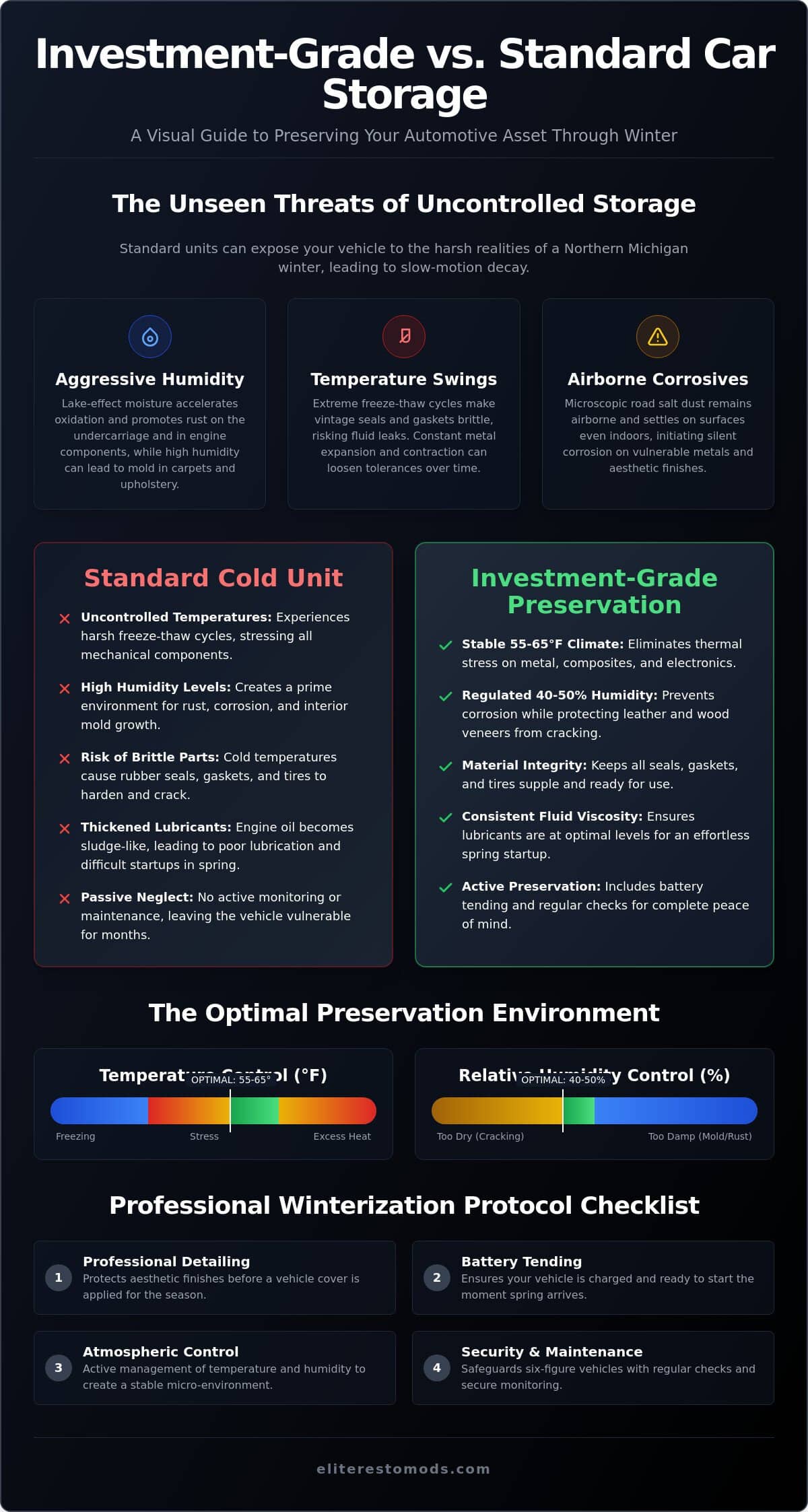
Lake Charlevoix is a stunning neighbor, but its lake-effect moisture is a constant threat to automotive longevity. This localized humidity accelerates oxidation on exposed undercarriages with startling speed. When temperatures shift, condensation forms inside unsealed engine components, creating a micro-environment where rust can take hold unseen. Even if your car never touches a salted road, microscopic salt dust remains airborne in Northern Michigan. It finds its way into indoor environments, clinging to aesthetic finishes and initiating silent corrosion on vulnerable metal surfaces.
Mechanical Risks of Extreme Temperature Swings
The Boyne City freeze-thaw cycle is particularly treacherous for mechanical components. Sub-zero temperatures cause vintage seals and gaskets to become brittle, leading to catastrophic fluid leaks when the spring thaw arrives. Fluctuating heat cycles trigger constant expansion and contraction of metal components, which can loosen tolerances over time. For those who own modern classic car restomods for sale, thermal shock is a genuine concern for sensitive electronics and custom wiring harnesses. Professional investment grade car storage mitigates these risks by maintaining a stable, controlled environment that protects both heritage metal and modern upgrades.
Beyond the technical benefits, there is a profound psychological peace of mind. Knowing your bespoke piece of functional art is shielded from the elements allows you to enjoy the winter season without anxiety. You aren’t just storing a car. You’re preserving a legacy that deserves to be driven when the roads finally clear.
Climate-Controlled Storage vs. Standard Cold Units
Most owners mistake a heated garage for a safe haven. It’s a common error. A simple heater prevents freezing but does nothing to stabilize the atmospheric chemistry surrounding a high-value machine. True investment grade car storage functions as a laboratory for preservation. By maintaining a constant 55-65 degree environment, we eliminate the thermal fluctuations that stress vintage gaskets and modern composites alike. This precise window ensures that lubricants remain at a consistent viscosity. It prevents the sluggish startup issues often found in vehicles kept in standard cold units where oil can thicken to a sludge-like consistency.
The Role of Humidity Regulation
Humidity is the silent predator of the automotive world. While temperature affects the metal, moisture dictates the lifespan of your interior. Professional facilities target a relative humidity level between 40% and 50%. This balance is critical. If the air is too dry, Connolly leather and artisanal wood veneers will shrink and crack. If it’s too damp, mold spores find a home in deep-pile carpets. Stable air also prevents micro-condensation on circuit boards. This is vital for modern restomods equipped with complex EFI systems and digital displays. Following expert classic car storage tips involves more than just a cover; it requires atmospheric mastery.
Long-Term Mechanical Preservation
Mechanical integrity depends on stability. In a climate-controlled ecosystem, high-performance fluids are less prone to separation or chemical breakdown. This is especially important for bespoke builds featuring specialized cooling systems or high-compression powerplants. Custom paint finishes also benefit from a steady environment, as the lack of expansion and contraction prevents microscopic clear-coat checking. Understanding the science of car storage reveals that every degree matters. It’s the difference between a car that survives the winter and one that thrives. Professional storage is a deliberate choice for the discerning collector.
DIY home solutions often fall short when the Northern Michigan power grid faces a blizzard. A professional facility offers redundant systems and expert oversight that a residential garage simply cannot match. If you are seeking a sanctuary for your vehicle, exploring our climate-controlled storage services provides the ultimate insurance policy for your asset. You’ve invested in excellence; don’t settle for a cold concrete floor when the snow begins to fall in Boyne City.
Essential Winterization Steps Before Long-Term Storage
Preparing a vehicle for the Boyne City off-season is a ritual of respect. It’s a systematic transition from the open road to a state of suspended excellence. For owners of bespoke restomods, this process requires a deep understanding of both heritage materials and contemporary mechanical systems. Professional investment grade car storage is only as effective as the meticulous preparation that precedes the final storage cycle. This isn’t merely about parking; it’s about ensuring that every component remains in a state of peak readiness.
Cleaning and Surface Protection
Before the vehicle cover is even considered, every trace of Northern Michigan road salt must be eradicated from the chassis. This isn’t a standard wash. It’s a surgical decontamination. Even microscopic salt particles trapped in wheel wells or frame rails can trigger oxidation in a humid environment. Once decontaminated, applying a high-quality carnauba wax or a modern ceramic coating provides a sacrificial barrier against the elements. Inside the cabin, bespoke upholstery requires conditioning to withstand the dry winter air. This ensures that artisanal leather or custom Alcantara remains supple, preventing the shrinkage and cracking that can occur over several months of inactivity.
Mechanical and Electrical Preparation
Modern restomods demand a specialized approach to fluid management. LS-swapped engines and sophisticated fuel-injected systems are particularly sensitive to ethanol-blended gasoline. This fuel can gum up high-performance injectors if left untreated for months. Utilizing a high-grade fuel stabilizer is essential to prevent phase separation and internal corrosion. Tire integrity is another critical factor for high-performance builds. Increasing tire pressure slightly above standard street levels helps prevent flat-spotting on soft performance rubber during extended periods of rest on concrete floors.
Electrical systems in high-end builds require constant oversight. Unlike vintage cars where you might simply disconnect the terminals, modern builds rely on ECU memory and sensitive digital components. Removing the battery can reset critical mapping data or security codes. Instead, utilize a smart tender to maintain battery health. These devices provide a controlled trickle charge that keeps the system active without the risk of overcharging. This ensures a seamless spring awakening, where the engine fires with the same visceral authority it possessed on the final drive of autumn.
A final inspection serves as the closing chapter of the winterization narrative. Check for fluid leaks that may have developed during the final weeks of the season. Verify that all seals are seated correctly and that the fuel tank is filled to minimize air space where condensation could form. This systematic approach transforms the off-season from a period of risk into a period of professional preservation. It is the hallmark of true investment grade car storage.
Evaluating Storage Facilities in the Boyne City Region
Selecting a facility in the Boyne City region requires a shift in perspective. You aren’t merely renting square footage. You are choosing a guardian for a bespoke piece of functional art. While many local options emphasize 24-hour access or freshly paved driveways, these features cater to general household goods rather than the specific needs of a high-value machine. True investment grade car storage demands a facility that understands the chemical and mechanical vulnerability of your asset. It’s about moving beyond the convenience of a nearby unit to find a sanctuary that prioritizes preservation over simple parking.
Security and Surveillance Standards
When a vehicle is valued at six figures or more, a standard padlock is insufficient. Multi-layered security is the baseline. This begins with perimeter control but must extend to individual monitoring and facility-wide fire suppression technology. Unmanned units with constant public access might offer convenience, but they also introduce unnecessary variables to your security profile. A professional environment limits exposure. It ensures that only qualified personnel are in proximity to your vehicle. Specialized insurance and liability coverage also distinguish a premium facility. This provides a legal and financial safety net that generic self-storage contracts often exclude or limit through fine-print clauses.
Facility Management and Maintenance
Cleanliness is a primary indicator of professional oversight. A facility that allows dust to accumulate or ignores minor spills is not equipped to manage a restomod. Proactive pest control is another non-negotiable factor. In the rural landscape of Charlevoix County, field mice are a persistent threat to artisanal wiring and bespoke interiors. A sealed, managed environment is the only way to mitigate this risk. You should also evaluate the level of active care provided. Ask if the staff performs recurring maintenance checks. A facility managed by automotive professionals will offer battery tending and tire pressure monitoring as part of a comprehensive preservation ecosystem.
The difference between a generic unit and a professional facility is the presence of expertise. An unmanned kiosk cannot tell you if a seal has begun to weep or if a battery tender has failed. By choosing a partner who understands the soul of a vintage asset, you ensure that your vehicle remains in peak condition throughout the off-season. If you are ready to secure a space that matches the quality of your build, you can explore our elite storage services to see how we maintain the highest standards in Northern Michigan. Your investment deserves more than a cold floor; it deserves a curator who values excellence as much as you do.
Elite Professional Storage for High-Value Restomods
At Elite Restomods, we reject the notion that winter is a period of stagnation. For the discerning collector, investment grade car storage is not merely a logistical necessity but a strategic phase in the vehicle’s life cycle. We provide a comprehensive preservation ecosystem designed to maintain the soul of your machine while enhancing its modern capabilities. This isn’t a passive parking solution. It’s an active commitment to excellence where every vehicle is treated as a bespoke piece of functional art, sheltered from the Northern Michigan elements within our state-of-the-art facility. Our climate-controlled environment provides the ultimate sanctuary, ensuring that the marriage of brute force and refined comfort remains uncompromised by the passage of time.
The Elite Certified Storage Experience
Our approach to preservation is rooted in meticulous detail. Every vehicle under our care undergoes regular battery health monitoring and precise tire pressure checks to ensure the integrity of high-performance components. We understand that your asset represents a significant investment of both capital and passion. Our facility is managed by automotive professionals who possess the vision to maintain vintage assets in peak operational condition. Beyond simple housing, our clients enjoy direct access to master builders for winter upgrades. This allows you to utilize the off-season for performance tuning or interior refinements by exploring our custom build and storage services. It’s a proactive way to ensure your vehicle returns to the road in the spring with even greater authority than when it arrived.
Seamless Ownership Transition
The journey from the final autumn drive to the first spring awakening should be effortless. We simplify the entire process for Boyne City clients by offering enclosed vehicle transport, providing a secure bridge between your garage and our facility. This eliminates exposure to salt-treated roads during the transition. For those considering a change in their collection, the winter months represent an ideal window to leverage our premier classic car consignment program. Storing your vehicle with us provides the unique advantage of having it professionally maintained and ready for showing to potential buyers at a moment’s notice. Whether you are preserving a legacy or preparing for a sale, our integrated services provide the reliability and perfectionism that investment grade car storage demands. We don’t just store machines; we curate the future of automotive history.
Securing Your Automotive Legacy for the Spring Awakening
The transition from the final autumn drive to winter dormancy shouldn’t be a source of anxiety. It’s a strategic pause in the life of a high-performance machine. You’ve learned that Northern Michigan’s climate demands more than a simple roof and a locked door. True preservation requires a climate-controlled environment that stabilizes humidity and temperature to protect both vintage steel and modern electronics. By choosing investment grade car storage, you ensure that your vehicle remains in a state of peak readiness, shielded from the corrosive reach of lake-effect moisture and extreme thermal shifts.
Our facility is designed for those who view their vehicles as bespoke pieces of functional art. We provide a sanctuary where battery tending and recurring maintenance checks are standard, not optional extras. Don’t leave your restomod’s integrity to chance when the snow begins to fall in Boyne City. Secure your winter storage spot at Elite Restomods today and experience the peace of mind that comes with professional curation. The first drive of spring is closer than it appears, and your vehicle will be ready to meet it with visceral authority.
Frequently Asked Questions
Is climate-controlled storage really necessary for a car in Michigan?
Yes, climate control is essential for any vehicle that you consider an heirloom or a high-value asset. Michigan’s lake-effect moisture and rapid temperature shifts create a breeding ground for condensation inside engine blocks and chassis crevices. Without a stabilized environment, you risk the structural integrity of your investment grade car storage choice. Maintaining a constant temperature prevents the expansion and contraction that leads to brittle gaskets and cracked finishes.
Should I start my car periodically while it is in winter storage?
No, you should not start your vehicle unless you intend to drive it for at least thirty minutes. Short idling sessions fail to reach the temperatures necessary to evaporate moisture from the oil and exhaust system. This actually promotes internal corrosion and creates acidic buildup in the crankcase. In a professional preservation environment, it’s better to let the machine rest in a stabilized state until the spring thaw allows for a complete heat cycle.
Do I need to change the oil before or after winter storage?
You must change the oil immediately before the vehicle enters its winter sanctuary. Used motor oil contains combustion byproducts, moisture, and acids that can etch bearing surfaces and internal components if left to sit for months. Fresh lubricants provide a clean, alkaline environment that actively protects the engine’s internals. While some owners change it again in the spring, the pre-storage oil change is the most critical step for long-term mechanical health.
How do I prevent mice and pests from entering my car in storage?
Prevention begins with choosing a managed, professional facility that prioritizes proactive pest control. Mice are attracted to the artisanal materials found in high-end interiors, such as wool carpets and leather. We recommend using high-quality steel wool to plug exhaust tips and air intakes while utilizing scent-based deterrents inside the cabin. Avoid using food-based baits nearby, as these can actually attract rodents to the vicinity of your vehicle’s sensitive wiring harnesses.
Is it better to store a car with a full or empty gas tank?
You should always store your vehicle with a full tank of fuel treated with a premium stabilizer. A full tank minimizes the air volume inside the reservoir, which significantly reduces the risk of moisture condensation. This is particularly vital for modern restomods with sensitive fuel injection systems. Using non-ethanol fuel whenever possible will further prevent the phase separation and gumming that can occur when ethanol-blended gasoline sits for extended periods.
Will my standard auto insurance cover my car while it is in storage?
You should contact your provider to confirm, but most owners transition to a comprehensive-only or storage policy during the winter. This covers theft, fire, and environmental damage while significantly reducing your premium. However, for vehicles of this caliber, an agreed-value policy is often more appropriate. This ensures that the true market value of your investment grade car storage asset is protected, rather than just its depreciated book value in the event of a loss.
Can I store my car with a car cover in a climate-controlled unit?
Yes, a breathable indoor cover is an excellent secondary layer of protection against settling dust. It’s critical that the vehicle is professionally detailed before the cover is applied, as any trapped grit can act as an abrasive against the paint. Avoid plastic or waterproof covers that can trap moisture against the finish. In a climate-controlled environment, the cover’s primary role is to maintain the pristine aesthetic finish you’ve worked hard to achieve.
What is the difference between a battery charger and a battery tender?
A battery tender is a sophisticated management system that only provides a charge when the battery’s voltage drops below a specific threshold. Unlike a traditional charger, which can boil the battery’s electrolytes through constant power delivery, a tender enters a float mode once full capacity is reached. This is essential for modern builds with complex electronics, as it maintains the battery’s chemical health without the risk of overcharging or damaging sensitive onboard computers.