
A generic classified listing can quietly erase tens of thousands of dollars in value from an exceptional vintage build. Treating a hand-crafted machine like an ordinary commuter invites lowball offers and endless tire-kickers who don’t understand the artistry beneath the sheet metal. Knowing how to market a classic car for sale requires a fundamental shift from casual advertising to bespoke presentation.
You already know the frustration of pouring relentless craftsmanship into a vehicle, only to face unqualified buyers who can’t grasp the worth of custom engineering, or feeling torn between unpredictable public auctions and specialized consignment. You shouldn’t have to defend the integrity of your investment to people who aren’t serious about buying it.
This guide shows you how to position, document, and market your vintage automobile to captivate discerning collectors and maximize your net return. From building bulletproof provenance to selecting the right platform for a swift, secure transaction, here’s your playbook for selling at the top of the market.
Key Takeaways
- Establish realistic pricing power by evaluating recent verified auction transactions and building an unbroken chronological ownership record.
- Capture serious collectors by investing in studio-grade visuals that highlight both exterior paint depth and mechanical undercarriage detailing.
- Learn how to market a classic car for sale through technical copywriting that balances visceral performance with exact component specifications.
- Weigh the immediate urgency of digital auctions against private sales to protect your reserve and avoid tire-kickers.
- Leverage dedicated consignment programs to secure professional representation, qualified buyer financing, and seamless enclosed logistics.
Laying the Groundwork: Asset Valuation and Market Positioning
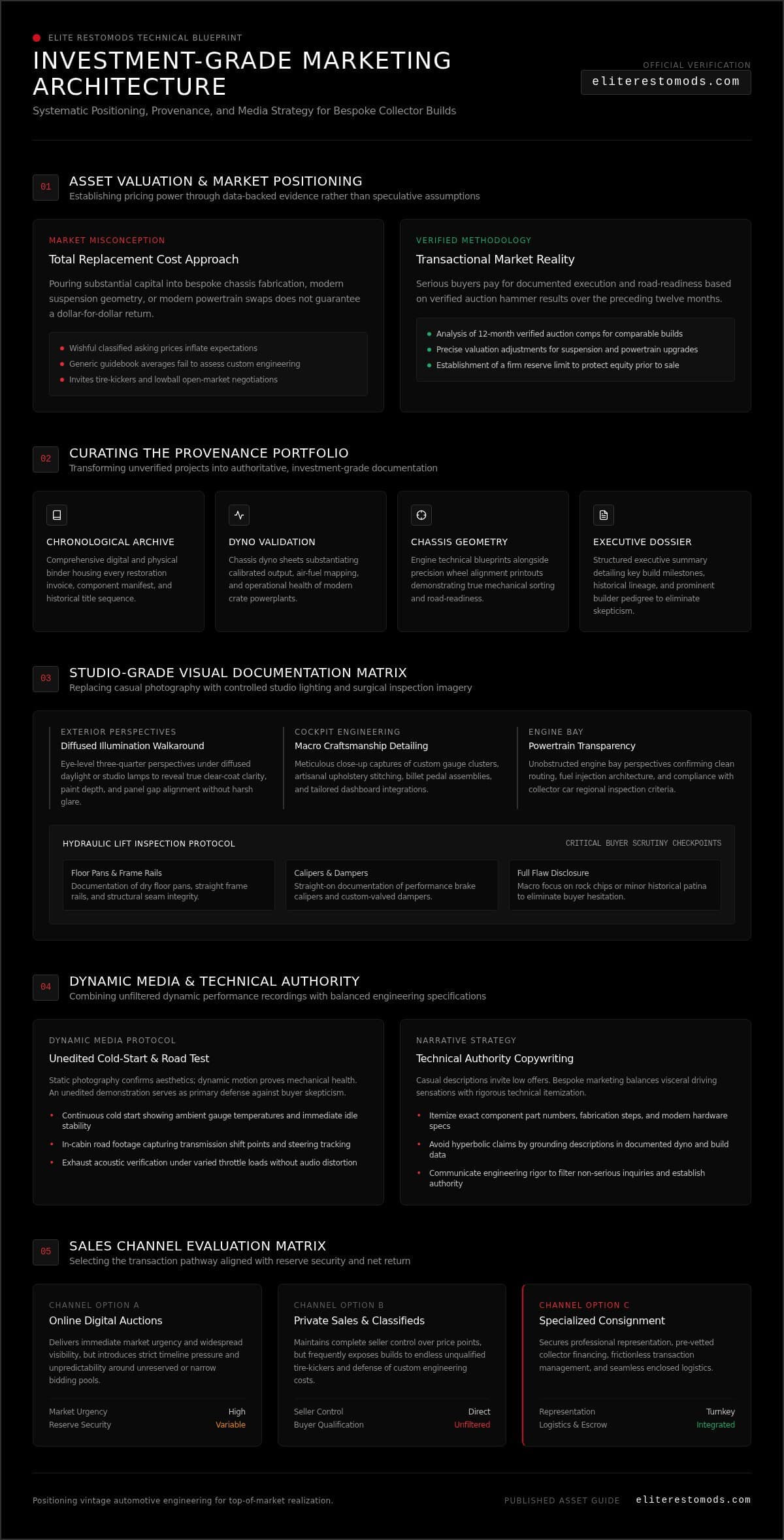
Every exceptional vintage build requires a valuation that withstands intense collector scrutiny. Real transaction value isn’t dictated by wishful classified asking prices or generic guidebook averages. While understanding what defines a classic car provides a legal and historical baseline, serious buyers pay for execution, documentation, and mechanical road-readiness. Understanding how to market a classic car for sale begins with rigorous asset positioning based on recent verified transactions, not internet speculation.
To better understand the current sales environment and protect your investment, watch this helpful overview:
Establishing an Evidence-Based Market Value
Sellers often confuse total replacement cost with true transactional market value. Pouring substantial capital into bespoke chassis fabrication, modern suspension geometry, or an electronic fuel-injected crate engine doesn’t guarantee an automatic dollar-for-dollar return. You must analyze verified auction hammer results over the past twelve months for comparable builds. Factor in modern powertrain swaps, suspension upgrades, and overall craftsmanship. From there, establish a firm reserve limit to protect your equity before entering open market negotiations.
Curating Provenance and Mechanical Documentation
Serious collectors buy confidence. A vintage automobile accompanied by a loose stack of receipts looks like an unverified project; the same car backed by an organized, chronological portfolio commands immediate authority. Highlighting a deliberate, professional process proves the vehicle was thoroughly sorted rather than merely assembled.
- Compile all restoration receipts, component manifests, and historical titles into a chronological digital and physical binder.
- Include technical validation data such as chassis dyno sheets, engine blueprints, and precision wheel alignment printouts to substantiate build quality.
- Draft an executive summary that outlines vehicle milestones, historical significance, and prominent builder involvement.
When you present clear mechanical verification, you immediately eliminate buyer hesitation. This systematic approach forms the bedrock of how to market a classic car for sale to discerning enthusiasts who value exceptional craftsmanship.
Producing Studio-Grade Visual Assets and Dynamic Media
Casual smartphone snapshots in an asphalt parking lot instantly undermine an investment-grade vehicle. Discerning collectors expect visual documentation that reflects the exact caliber of the engineering beneath the hood. Knowing how to market a classic car for sale demands studio-grade media that converts passive observers into active, confident bidders. Every panel gap, custom weld, and bespoke trim piece must speak with absolute clarity.
Executing the Complete Photographic Walkaround
Controlled illumination makes all the difference. Diffused studio lighting or soft ambient daylight eliminates harsh glare, revealing true paint depth, clear-coat clarity, and panel uniformity. Start with eye-level three-quarter exterior perspectives before moving inward. Document the cabin with meticulous macro shots of gauge clusters, artisanal upholstery stitching, and billet pedal assemblies. Remote buyers also scrutinize whether a build adheres to regional standards or state-level legal requirements for collector cars, making transparent under-hood documentation vital.
Critical visual checkpoints must include:
- Elevating the chassis on a hydraulic lift to document dry floor pans, frame rails, and suspension hardware.
- Clear, straight-on views of high-performance brake calipers and custom-valved dampers to verify component condition.
- Transparent close-up photographs of minor rock chips or historical patina to eliminate surprises and cultivate buyer confidence.
Producing Cold-Start and Driving Demonstrations
Static imagery proves aesthetic appeal; dynamic video verifies mechanical health. An unedited cold-start video serves as your primary defense against skepticism. Point an infrared thermometer at the exhaust runners to verify ambient temperatures before turning the key. Capture immediate oil pressure stabilization and crisp throttle response without background music or artificial audio enhancements.
Complement the startup sequence with high-resolution interior point-of-view footage. Show crisp clutch engagement, precise transmission shifts, and rock-solid tracking down highway lanes. Finally, capture outdoor drive-by acceleration passes that allow buyers to hear the distinct acoustic profile of the performance exhaust system. When private owners lack the facility or equipment to execute this level of production, turning to dedicated consignment representation services ensures every mechanical asset is staged to capture peak market value.
Drafting Technical Copywriting That Commands Authority
Casual phrases like “runs great” or “real head-turner” belong in ordinary classifieds, not on investment-grade machinery. Discerning collectors want to feel the raw energy of an aggressive cam profile, but they also demand the exact engineering specifications behind the valvetrain. Mastering how to market a classic car for sale requires transforming an extensive parts list into an authoritative developmental narrative that commands respect and justifies top-tier valuation.
Structuring the Comprehensive Build Specification
Serious enthusiasts read listings like engineering blueprints. Vague descriptions invite skepticism, while granular technical precision establishes immediate confidence. Lead with headline performance figures, displacement, and chassis dynamics before detailing individual sub-assemblies.
- Powertrain and Drivetrain: Document exact cubic-inch displacement, compression ratios, fuel delivery mapping, transmission torque ratings, and rear axle gear ratios.
- Chassis and Footwork: Outline suspension geometry, tubular control arms, coilover valving, and multi-piston brake rotor dimensions.
- Electrical and Thermal Systems: Highlight modern wiring harnesses, dual-pass aluminum radiators, and high-output alternator setups.
- Interior Craftsmanship: Specify acoustic sound-deadening layers, custom instrumentation calibration, and genuine leather hide treatments.
Presenting this data with structured clarity reflects the standard of professional automotive curation, matching the meticulous methodology detailed across high-level vehicle representation services.
Balancing Vintage Heritage with Modern Usability
Effective copywriting celebrates the marriage of brute mechanical force and refined touring comfort. Classic body lines evoke timeless nostalgia, but modern engineering guarantees turn-key reliability. Explain how an electronic fuel injection setup delivers crisp throttle response without vapor lock, or how modern rack-and-pinion steering tracks dead center without vintage play.
Describe road manners using precise sensory terminology. Detail the mechanical bite of the clutch, the flat cornering attitude through sweeping turns, and the civil cabin noise at highway cruising speeds. Addressing drivability and proactive maintenance up front disarms buyer hesitation. This measured approach mirrors the caliber of presentation found across curated collector inventory, assuring prospective buyers that your machine is engineered to be driven, not merely parked.
Evaluating Sales Channels: Online Auctions vs. Classifieds vs. Private Networks
Selecting the wrong venue can quickly derail an otherwise pristine vehicle representation. High-profile digital auctions, legacy print classifieds, and private collector networks attract entirely distinct buyer mindsets. Each comes with its own fee obligations, privacy tradeoffs, and vulnerability to market volatility. Knowing how to market a classic car for sale requires aligning your build’s specific strengths with the platform that best protects your time and equity.
Navigating Curated Digital Auction Platforms
Digital auctions generate intense bidding urgency, but they demand complete emotional detachment. Enthusiasts monitor auction comments relentlessly. A single critical remark regarding a mismatched casting number or an unseen fluid seep can suppress momentum across a seven-day listing. If you list without a reserve, you risk letting a master-level build sell below its foundational build cost. If you set a reserve and miss it, the car becomes publicly branded as unsold inventory, softening its market desirability for months.
Succeeding in this arena requires daily hands-on management. Sellers must respond to technical inquiries within minutes, host walkaround inspections, and upload supplementary media on demand.
Mitigating Security and Payment Hazards in Private Sales
Classified listings grant you absolute control over pricing, yet they expose you to unqualified inquiries and genuine security liabilities. High-net-worth transactions require rigorous protocols:
- Require verifiable proof of funds before scheduling in-person showings or permitting dynamic test drives.
- Conduct all physical inspections at neutral, secure automotive facilities rather than your personal residence.
- Use licensed automotive escrow solutions rather than accepting unverified cashier checks or direct peer-to-peer bank transfers.
- Ensure prospective buyers understand structured funding pathways by consulting our resources on collector financing and acquisition protocols through our blog.
Managing high-tier transactions independently introduces substantial friction. If you prefer to bypass the endless back-and-forth of public listings while safeguarding your personal security, explore our turnkey representation through our tailored consignment services to ensure your build commands top-tier value without unnecessary exposure.
The Consignment Solution: Professional Representation Without Friction
Selling an investment-grade restomod yourself often turns into an exhausting second job. Vetting prospective buyers, coordinating test drives, and defending technical modifications require hours of delicate negotiation. While common advice treats dealerships as mere wholesale liquidation lots, specialized collector representation is completely different. Understanding how to market a classic car for sale at the pinnacle of the market often means partnering with dedicated curators who command established buyer networks.
Unlocking Qualified National Collector Networks
High-tier collectors rarely spend their weekends scanning generic classified listings. Instead, they acquire vehicles through trusted institutional channels with proven vetting standards. Professional consignment bridges this gap by presenting your vehicle directly to an established roster of qualified enthusiasts seeking turnkey assets.
Specialized representation also removes the largest transaction barriers for private sellers:
- Providing verified buyer financing solutions directly through established classic lending partners.
- Facilitating high-value trade-ins, allowing qualified collectors to reallocate portfolio equity seamlessly.
- Arranging secure transactions with verified funds and legitimate title processing.
To see how full-service representation removes friction from start to finish, explore dedicated classic car consignment services tailored for bespoke builds.
Achieving Effortless Premium Execution with Elite Restomods
Elite Restomods redefines vehicle representation by merging world-class marketing infrastructure with end-to-end operational execution. Every consigned vehicle undergoes in-house technical sorting and detailing to verify mechanical readiness before cameras ever click. This rigorous standard separates exceptional builds from questionable backyard projects, establishing immediate credibility across national marketing channels.
Our comprehensive white-glove consignment program manages every logistical hurdle:
- Coordinating fully insured, enclosed vehicle transport directly from your garage to our climate-controlled facility.
- Deploying multi-channel national digital marketing campaigns across premier collector networks.
- Conducting rigorous multi-point mechanical inspections and technical documentation under our established evaluation process.
This hands-off model transforms how to market a classic car for sale, ensuring your bespoke machine captures true top-market value while you maintain complete privacy. Discover more collector market analyses and transaction strategies by visiting the Elite Restomods blog.
Commanding Top Market Value for Your Vintage Build
Transforming a high-performance vintage machine into maximum realized equity requires more than casual advertising. It demands rigorous valuation, studio-grade visual transparency, and technical documentation that substantiates every mechanical enhancement. Understanding how to market a classic car for sale ensures your asset commands the respect and financial return its craftsmanship deserves, sparing you from endless tire-kickers and lowball offers.
You don’t have to carry the burden of private negotiations or unpredictable public auctions alone. By leveraging specialized national marketing, in-house technical sorting, pristine showroom staging, and complete buyer solutions including classic car financing and enclosed transport, you protect both your time and your equity. Discover how Elite Restomods consignment maximizes your vehicle value and transition your functional work of art to its next custodian with absolute confidence.
Frequently Asked Questions
What is the most effective way to market a classic car for sale in 2026?
The most effective approach combines studio-grade visual documentation, transparent mechanical provenance, and targeted syndication across dedicated collector networks. Learning how to market a classic car for sale at the top of the market means treating the vehicle as a bespoke asset rather than an ordinary used vehicle. Professional presentation, verified build manifests, and transparent cold-start video demonstrations build the trust high-tier buyers require before committing substantial capital.
How many photos should be included in a high-end classic car listing?
A high-end listing should feature between 80 and 150 comprehensive, high-resolution photographs. Discerning remote collectors need an exhaustive visual audit before submitting offers. You should capture full three-quarter exterior profiles, detailed interior craftsmanship, close-ups of specific switchgear, engine bay components, and transparent views of minor cosmetic flaws. Leaving gaps in visual coverage invites speculation and depresses competitive bidding.
Is it better to sell a vintage automobile privately or through professional consignment?
Professional consignment is typically better for investment-grade assets where owner privacy, security, and maximum net value matter most. Private sales demand substantial personal time vetting inquiries, defending build choices, and absorbing financial transaction risks. A dedicated consignment program delivers specialized showroom presentation, national marketing exposure, and institutional financing options that private sellers cannot easily arrange independently.
Why is undercarriage photography critical when selling a collector vehicle online?
Undercarriage photography on a lift proves structural integrity, chassis craftsmanship, and leak-free reliability to remote collectors who cannot inspect the car in person. Serious buyers scrutinize floor pans, frame rails, suspension geometry, and fluid fittings to separate sorted builds from superficial cosmetic refreshes. Clear chassis documentation provides the mechanical proof needed to command premium market pricing with total transparency.
How do dyno sheets and mechanical build receipts impact final sale prices?
Documented build records and dyno validation sheets substantiate mechanical claims, often dramatically increasing final hammer prices. When asking how to market a classic car for sale to skeptical collectors, organized receipts and component manifests prove the caliber of internal hardware. Dyno printouts verify engine health and tuning precision, eliminating the risk of hidden assembly shortcuts and justifying top-of-market valuation.
What precautions should be taken to prevent payment scams when selling a vintage car?
Always use a bonded automotive escrow service or direct attorney-supervised wire transfers before releasing titles or vehicle possession. Cashier checks, third-party payment apps, and overpayment drafts carry severe fraud risks in private collector transactions. Never schedule personal garage visits without pre-qualifying buyer identity and verifiable proof of funds, and conduct in-person inspections only at secure, neutral commercial automotive facilities.
Can offering buyer financing options accelerate the sale of a restomod?
Yes, offering buyer financing options significantly accelerates transactions by expanding the potential buyer pool beyond all-cash purchasers. Many affluent collectors prefer retaining liquidity or leveraging low-rate classic financing rather than reallocating capital from other investments. Providing access to specialized classic lending solutions makes six-figure restomods instantly accessible to qualified enthusiasts, driving faster closings and firmer price retention.